Best AI Search Monitoring Tools in 2026: 9 Tools Compared

How we put this together: we compare official feature and pricing pages, app store listings, privacy policies and public user reviews. Prices change, so check the provider's site before you pay.
Key takeaways
- Most buyers should start with prompt coverage, not a headline price, because entry tiers often track fewer answer engines than the marketing page suggests.
- Otterly.AI gives the cheapest clear entry point in this list, while Peec AI gives a cleaner mid-market balance of prompts, projects and reporting.
- Profound suits larger teams that need deeper analytics and enterprise controls, but its brand pricing after a trial is custom, so budget approval takes longer.
- Tools built on a traditional SEO suite, such as Semrush and Ahrefs, make sense if you already pay for that suite and want AI visibility in the same place.
- AI answers change often, so a tool that runs prompts daily and keeps a history is more useful than a one-off audit.
Quick comparison
| Name | Who it suits | Starting price | Free option | |
|---|---|---|---|---|
 Profound | Large brands and enterprise teams | See website | Free trial | Visit |
 Peec AI | Mid-market teams and agencies | €85 per month | Free trial | Visit |
 Otterly.AI | First-time buyers on a budget | $29 per month | Free trial | Visit |
 Scrunch AI | Teams that also want an AI-facing site layer | $250 per month | Free trial | Visit |
 AthenaHQ | Teams that want actions tied to citations | $295 per month | Yes | Visit |
 Semrush AI Visibility Toolkit | Existing Semrush users | $99 per month | Free trial | Visit |
 Ahrefs Brand Radar | Finding prompts you did not know about | $199 per month | No | Visit |
 Goodie AI | Linking AI visibility to revenue work | See website | Free trial | Visit |
 Rankscale AI | Simple prompt tracking over time | $20 per month | Free trial | Visit |
The best ai search monitoring tools
AI search monitoring shows how your brand appears inside answers from ChatGPT, Gemini, Perplexity, Google AI Overviews and similar systems. It is not the same as a classic ranking report, because the answer itself, the sources cited and the competitors named all matter. We compared official feature pages, pricing pages, public reviews and documentation to sort tools by coverage, prompt limits, reporting and price.
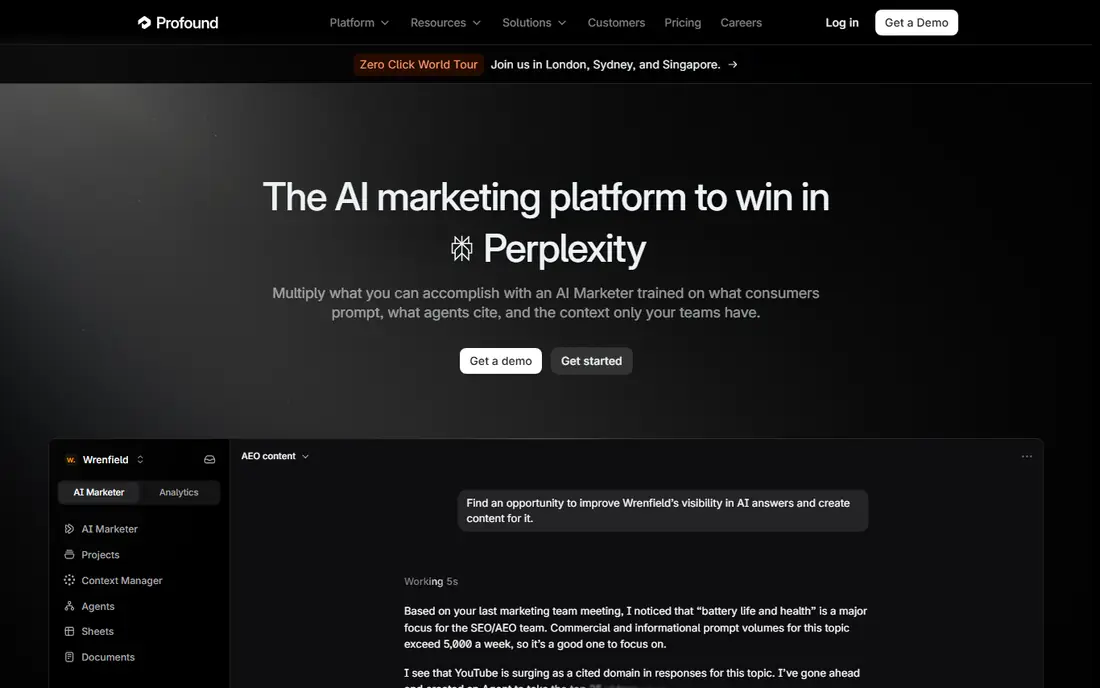
Profound is the name that comes up most often in enterprise conversations, and for a clear reason. Its tracking covers the major answer engines, and its reports focus on share of voice, citations and sentiment rather than a single visibility score. For a team that must explain AI performance to senior leaders, that depth helps, because a change in citations can be traced back to specific prompts and sources.
The catch is cost and setup. The free trial is limited, and the full brand plan is priced through sales, which makes it hard to compare at a glance with self-serve tools. Small teams may find the entry experience thin, since the widest engine coverage sits on higher tiers. Profound fits best when AI visibility is a regular board-level topic and the team has time to act on the findings.
- Wide answer-engine coverage on enterprise plans
- Strong citation and competitor analysis
- Enterprise controls such as SSO and SOC 2 compliance
- Brand pricing after the trial is custom
- Entry options track fewer engines than the top tier
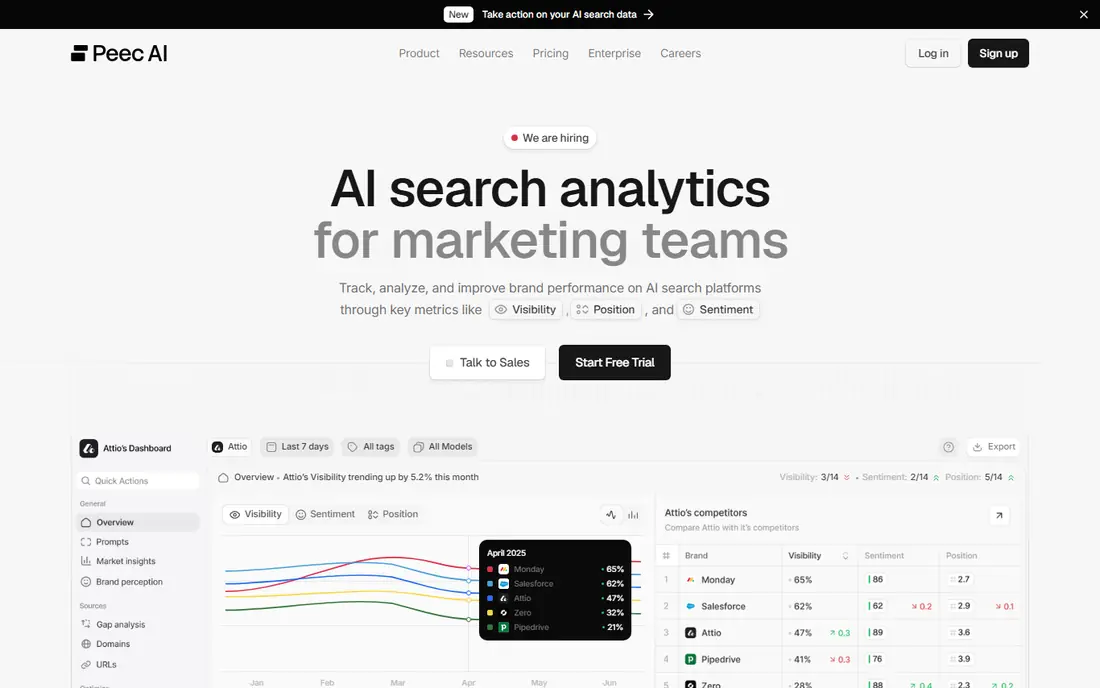
Peec AI takes a tidy approach to a messy problem. You choose prompts, pick models, and get daily tracking of mentions, citations, sentiment and competitor share of voice. The dashboard is easy to read, which matters when the person checking it is not the person who set it up. Suggested prompts also help teams that know their customers but have not yet turned customer questions into a prompt list.
Pricing is published in euros, with a starter tier that suits one project and one country. Larger teams will need a higher tier for more projects and countries, and for Looker Studio reporting. Peec AI is a strong middle choice for teams that want a predictable bill and do not need every engine on day one.
- Clear self-serve pricing
- Unlimited users on self-serve plans
- Citation gap analysis shows which sources matter in a category
- Entry tier lets you pick only three of its models
- Some advanced engines sit on the custom enterprise tier
Otterly.AI is the easiest way to test whether AI search monitoring is worth paying for at all. The entry tier covers core engines such as ChatGPT, Google AI Overviews, Perplexity and Microsoft Copilot, with daily tracking and citation source URLs.
The trade-off appears when you add engines. Add-ons can push the real monthly cost well above the headline price, so check the total before you commit. Prompt limits also mean you need to choose your most important questions first. Used with discipline, Otterly.AI gives a useful first picture without a large contract.
- Lowest entry price in this list
- Daily tracking and unlimited team members
- Simple setup for a first AI visibility project
- Some engines, including Claude and Gemini, are paid add-ons
- Prompt limits are tight on the entry tier
Scrunch AI does two jobs at once. It tracks how AI systems present your brand, and it can serve an AI-optimised version of your site to AI crawlers. That second part is the reason to consider it over a monitoring-only tool, especially if your own site is hard for crawlers to read or if key facts are buried in complex pages. The monitoring side covers prompts, competitors and responses across major engines.
Scrunch AI fits marketing teams that already plan content work around AI answers and want monitoring and delivery in one place.
- Monitoring plus a parallel AI-optimised site experience
- Competitor tracking and prompt uploads on paid plans
- Agency options for multi-brand work
- Higher entry price than budget tools
- The site layer adds setup work beyond simple monitoring
AthenaHQ stands out because it tries to turn a citation report into a task list. Its citation engine flags where your brand is cited, where it is missing, and where an answer attributes a fact to the wrong source. It also tracks visibility across several engines, so a win on one system is not mistaken for a win everywhere.
The free tier is useful for a first check, but serious tracking needs the paid plan, which is priced for teams rather than individuals. If your main need is a simple daily mention count, AthenaHQ may feel heavier than necessary. It fits best when someone on the team owns the follow-up work and can act on citation gaps each week.
- Free tier for a first look
- Citation engine flags citations and misattribution
- Covers several engines on paid plans
- Paid entry is high for small teams
- Full coverage and features require the higher tiers
Semrush AI Visibility Toolkit
Who it suits: Existing Semrush users
Semrush is a practical choice for teams that already live in Semrush. The AI Visibility Toolkit adds tracking for AI surfaces to the keyword and site data those teams already use, which keeps reporting in one place. You can compare AI mentions with the search data you already trust, rather than reconciling two different systems.
The weakness is that it is an add-on, not a standalone product, so the total cost depends on your Semrush plan and the number of domains. Dedicated tools may also cover more engines or give deeper citation detail. Choose Semrush here when consolidation matters more than having the deepest AI-only feature set.
- Sits inside a familiar SEO platform
- Combines AI visibility with keyword, traffic and content data
- Useful for teams that already report from Semrush
- Priced as an add-on per domain
- AI coverage is narrower than dedicated tools on some tiers
Ahrefs Brand Radar appeals to SEO teams because it can surface prompts they would not have written themselves. Instead of only tracking the questions you already know, it helps you find the questions AI systems are actually answering in your category. That discovery step is valuable, because a prompt list built only from internal guesses often misses the comparisons buyers really make.
The price is the main barrier. Brand Radar is an addition to Ahrefs plans, and the starting point is aimed at teams rather than solo users. It also works best when someone can follow up with content and link work, since a new prompt list alone does not change an answer. For Ahrefs users, it is a natural extension. For others, a dedicated AI monitoring tool may be cheaper.
- Strong prompt discovery from a large SEO data set
- Useful brand and competitor tracking
- Sits inside the wider Ahrefs platform
- Higher starting price
- Full value depends on already using Ahrefs for SEO work
Goodie AI positions itself as more than a tracker. It measures visibility, suggests optimisations, and tries to connect AI visibility to traffic and revenue through attribution. For a growth team, that chain is attractive, because a visibility report that never leads to a decision is hard to defend in a budget review. Agent and crawler analytics also help technical teams see how AI systems read a site.
Goodie AI fits teams that already have a content and SEO workflow and want AI visibility tied into it, rather than teams looking for a quick monthly report.
- Closed-loop workflow from measurement to optimisation
- Agent and crawler analytics
- Attribution features for teams that must show return
- Pricing is not simple to compare at a glance
- Full value needs a team that acts on recommendations
Rankscale AI keeps things simple, and that is its main strength. It tracks AI search rankings for prompts over time, so you can see whether a brand is gaining or losing ground in answers. For a freelancer, a small agency or a startup, that history is often enough to spot a problem early and check whether a content change helped. The low price also makes it easy to keep running through a quiet quarter.
Rankscale AI is best as a focused tracker, not as a full AI visibility platform. Pair it with your normal SEO tools if you need deeper analysis.
- Low entry price
- Historical prompt tracking
- Straightforward setup for small prompt sets
- Fewer advanced features than enterprise tools
- Reporting depth is limited compared with larger platforms
How we picked these
We compared official feature pages, pricing pages, app and platform documentation, and public reviews for each tool, and we checked that each product is a real, current AI search monitoring product in October 2026. We favoured tools that track prompts across more than one answer engine, show citation sources, keep a history, and publish clear pricing or trial terms. We also weighed fit for different team sizes, because a tool that suits an enterprise team can be poor value for a solo marketer.
We did not claim hands-on testing for every product. Where pricing had changed across sources, we used the most recent published figure we found and marked custom pricing as See website, so you can confirm the current figure before buying.
What to check before you pay
Start with your prompt list, because it decides almost everything else. Write down the questions customers ask before they buy, the comparisons they make between you and named competitors, and the questions where your brand should appear but does not. A tool with 50 well-chosen prompts will teach you more than a tool with 500 generic prompts that no buyer asks.
Count engines at your tier
Check which engines are included in the plan you would buy, and which are paid add-ons. ChatGPT, Gemini, Perplexity, Claude, Google AI Overviews and Google AI Mode do not always appear together on entry tiers. If your customers use one engine heavily, coverage of that engine matters more than a long list of engines you will never check.
Check prompts, countries and seats together
Prompt limits, country coverage and seat limits interact. A plan that looks cheap for one brand in one country can become expensive for an agency with several clients, or for a brand that sells in several markets. Unlimited seats help, but only if prompt and project limits still fit your workload.
Ask what happens after the report
A good tool should help you decide what to change. Look for citation sources you can open, competitor comparisons you can explain, and exports or reports you can share. If no one owns the follow-up, even a good report will sit unread, and a cheaper tracker may serve you just as well.
Frequently asked questions
What is the best AI search monitoring tool?
There is no single best tool for every team, because the right choice depends on budget, prompt count and engine coverage. Otterly.AI suits a first, low-cost check, Peec AI suits mid-market teams that want clear pricing, and Profound suits larger teams with enterprise needs. Start with your prompt list and the engines your customers use, then shortlist two tools and compare them at the tier you would buy.
What is the best AI brand monitoring tool for agencies?
Peec AI and Scrunch AI both offer agency-friendly structures, with client projects and reporting that keep clients separate. Profound also offers agency workspaces, but its pricing is custom for brands, so agencies should confirm per-client costs before quoting. The best AI brand monitoring tool for an agency is usually the one whose project and prompt limits match the number of clients on the books.
Which AI search monitoring platform is cheapest to start with?
Rankscale AI and Otterly.AI have the lowest entry prices in this list, at $20 and $29 per month in the figures we found. Both are useful for a first project, but check add-on costs and prompt limits, because a cheap headline price can rise once you add engines. A free trial or free tier, where offered, is a good way to test prompt setup before paying.
What is the best AI search monitoring software for small businesses?
Small businesses often do best with a tool that is easy to set up and easy to read, such as Otterly.AI or Peec AI at starter level. The key is a small, focused prompt list and a weekly check, not a large dashboard that no one opens. If you already use Semrush or Ahrefs, their AI tools may be better value because you avoid a second subscription.
Do these tools replace traditional SEO tools?
No, they complement them. Traditional SEO tools track rankings, links, traffic and site health in classic search, while AI search monitoring tools track how brands appear inside AI answers. Many teams need both, because a brand can rank well in classic search and still be missing from AI answers, or the reverse. Use AI monitoring to find citation gaps, then use SEO and content work to close them.
How often should AI prompts be checked?
Daily tracking is the norm for paid tools in this list, and it makes sense because AI answers can change with model updates and new content. A weekly review of trends is usually enough for most teams, with a closer look when a competitor gains ground or a key prompt changes sharply.
Sources we checked (9)

Online Jobs is an independent blog about careers, online work, learning new skills and the tools that help people earn. More about us.
Keep reading
All posts
Best White Label SEO Companies
We compare the best white label SEO companies and tools in 2026 for agencies, from fulfilment services to branded reporting platforms, margins and prices.
Best Webinar Software
We compared the best webinar software for 2026 on price, attendee limits, automation and ease of use, to help you host better live sessions with confidence.
Best Web Scraping Tools
Compare the best web scraping tools in 2026, from no-code Octoparse and Browse AI to Apify, Firecrawl, Bright Data, Zyte, ScraperAPI and free Scrapy, with prices.