Best AI Search Analytics Platforms in 2026: 8 Platforms Compared

How we put this together: we compare official feature and pricing pages, app store listings, privacy policies and public user reviews. Prices change, so check the provider's site before you pay.
Key takeaways
- Profound is our pick for large enterprises that need broad engine coverage and security review readiness.
- Peec AI is the best pick for mid market teams and agencies that want a clean daily visibility number.
- AthenaHQ is the best pick for teams that want optimisation tools, dashboards and a free starting plan.
- Prompt counts, engine counts and credit models differ sharply, so price the workload you will run in six months.
- AI answers change daily, so track the same prompts over time, not just a single snapshot, before you change content.
Quick comparison
| Name | Who it suits | Starting price | Free option | |
|---|---|---|---|---|
 Profound | Large enterprises | See website | No | Visit |
 Peec AI | Mid market and agencies | $95 per month | No | Visit |
 AthenaHQ | Teams wanting optimisation tools | $295 per month | Yes | Visit |
 Scrunch AI | Mid market and enterprise | $250 per month | No | Visit |
 Otterly.AI | Small teams on a budget | $29 per month | No | Visit |
 Goodie | Brands wanting agents and attribution | $295 per month | No | Visit |
 Semrush AI Visibility Toolkit | Teams already on Semrush | $99 per month | No | Visit |
 Ahrefs Brand Radar | SEO teams finding new prompts | See website | No | Visit |
The best ai search analytics platforms
AI search analytics, also called AI visibility or generative engine optimisation tools, track how your brand appears in answers from ChatGPT, Perplexity, Google AI Overviews, Gemini and other AI surfaces. They differ on prompt volume, engine coverage, citation analysis and price, so pick by the workload you will actually run, not by the longest engine list.
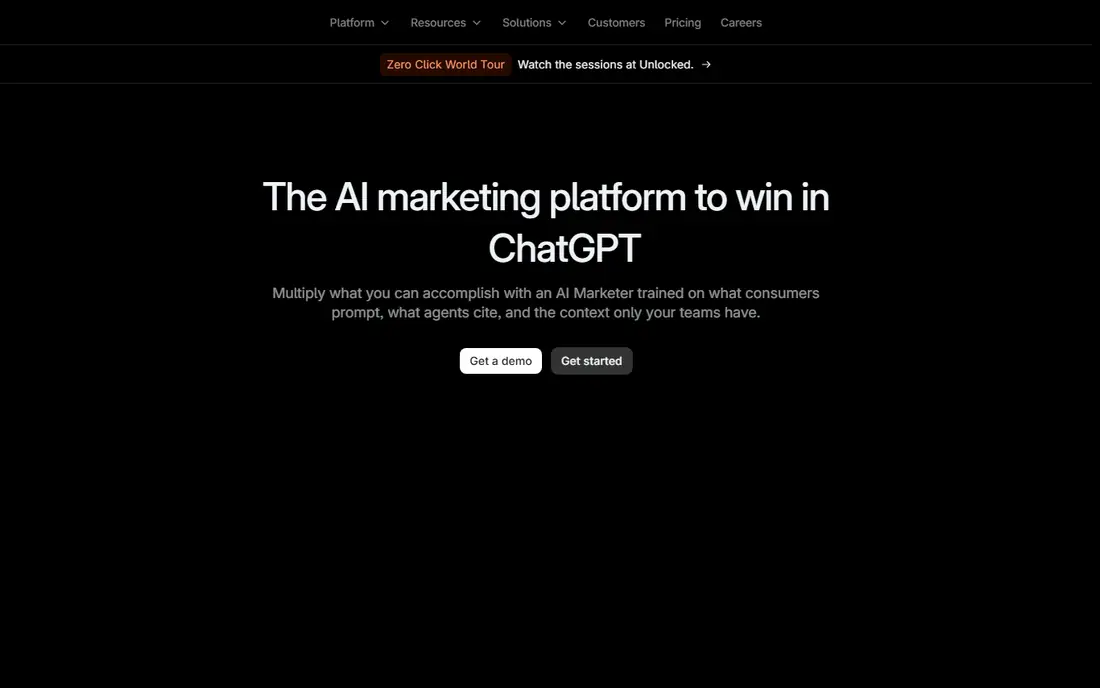
Profound is our pick for large enterprises because its ceiling is higher than most tools in this list. On Enterprise, it tracks up to 9 answer engines, including ChatGPT, Perplexity, Google AI Overviews, Google AI Mode, Gemini, Claude, Copilot, Grok and DeepSeek, and it connects AI crawler activity to analytics tools through integrations with Cloudflare, Akamai, AWS, Fastly, Vercel, Netlify and Google Analytics.
The catch is price and access. Profound does not publish a standard monthly price, with Enterprise pricing custom and a free 7-day trial in some listings. That makes it hard to budget without a sales conversation, and it puts Profound out of reach for a small team that wants a self serve start. If your purchase must pass a security review, or if you need 9 engines and crawler attribution, Profound is worth that conversation. If you need a published price today, Peec AI or Otterly.AI will be faster to test.
- Broad engine coverage up to 9 engines on Enterprise
- Crawler analytics
- Content agents
- Enterprise pricing is custom
- Entry trial is limited to 7 days in some listings
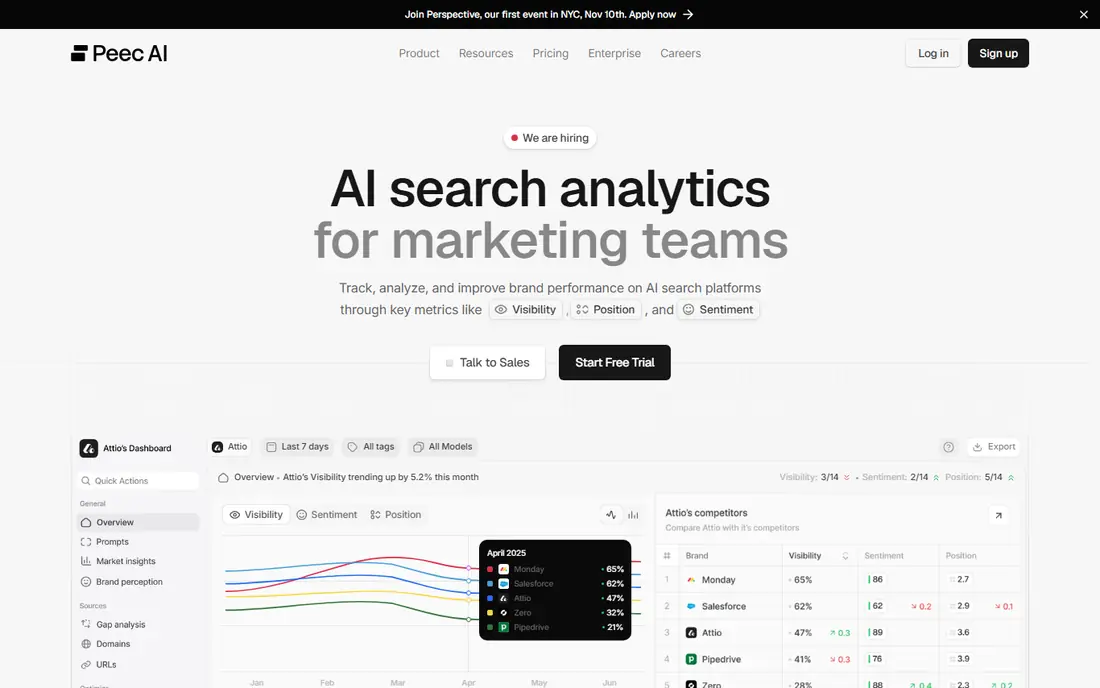
Peec AI is the best pick for mid market teams and agencies that want one clean daily number for AI visibility. Entry pricing is listed at $95 per month, or $80 per month when billed annually, with 50 prompts and 3 models on the entry plan, and a choice of 3 engines, with more as add-ons. Higher plans are listed at $245 per month for 150 prompts and $495 per month for 350 prompts in enterprise comparisons, with unlimited users and multi market tracking on agency plans.
The trade-off is prompt and engine limits on the entry plan. Fifty prompts is enough for a single brand pilot, but an agency with several clients or a brand with many product lines will outgrow it quickly. Price the plan for the prompts you will run in six months, not just for a trial, and check which engines are included versus add-ons. For a mid market team that wants a simple, reportable visibility score, Peec AI is a strong pick.
- Clean daily visibility number
- Unlimited users on some plans
- Multi market tracking
- Entry plan covers 50 prompts and 3 models
- More engines are add-ons
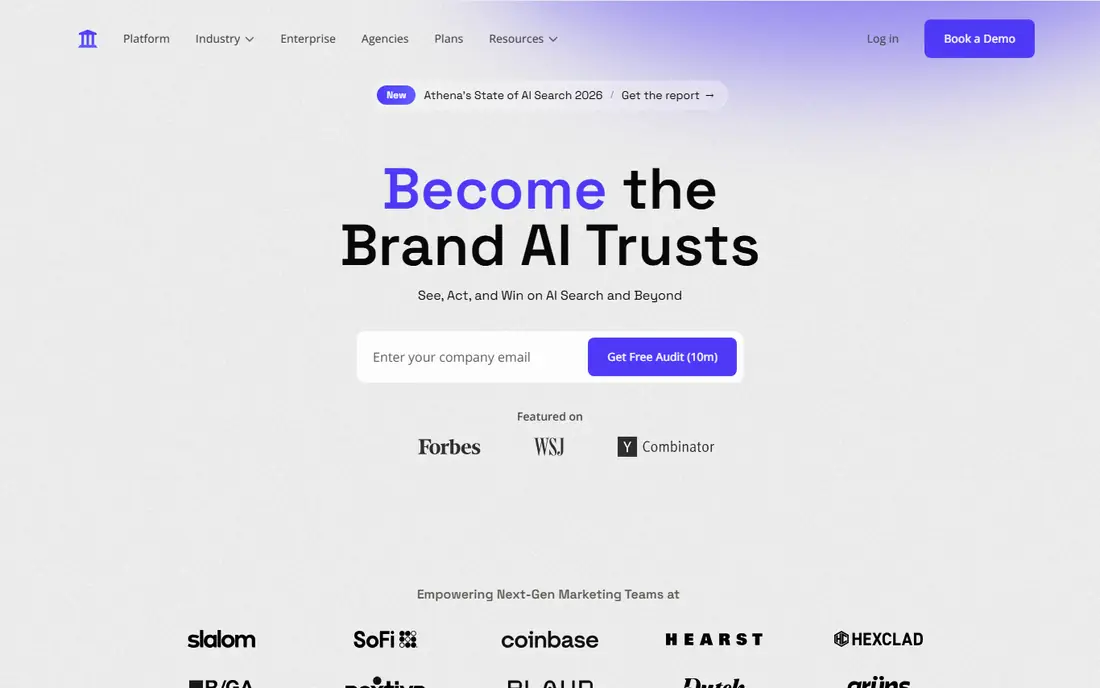
AthenaHQ suits teams that want analytics plus optimisation work, not just tracking. It offers a free plan, with 5 engines on free and 11 on Starter, and Starter is listed at $295 per month, with 3,600 credits, where 1 credit equals 1 answer. That credit model gives you a clear unit to budget, and AthenaHQ pairs tracking with dashboards, audit logs and drafted follow up work, plus an automated content pipeline that finds gaps and drafts optimised articles.
The catch is price for a small team. At $295 per month, Starter is a serious commitment, and credit use can rise fast if you track many prompts across many engines daily. Test the free plan first, with a small prompt set, and check how credits are spent in a week. If the dashboards and optimisation tools save your team time, the price can be justified. If you only need a weekly visibility check, a cheaper tool such as Otterly.AI may be enough.
- Free plan to start
- Starter with 3,600 credits
- Dashboards and drafted follow up work
- Starter price is high for a small team
- Credit model needs care for large prompt sets
Scrunch AI is a good pick for technical teams that care about AI crawler analytics as well as answer tracking. Core is listed at $250 per month when billed annually, or $300 per month monthly, with 350 custom prompts, 3 users and 7 engines. Scrunch's focus on crawler behaviour helps a team understand which AI crawlers visit and how that relates to citations. For a mid market team with a technical SEO lead, that depth matters.
The trade-off is price. At $250 per month, Scrunch is not a trial tool for a solo marketer, and it is best justified when you will use the prompt volume and crawler data weekly. Check whether your team will act on crawler data, or whether answer tracking alone would be enough. If crawler analytics will change your technical work, Scrunch earns its price. If you only need brand mention tracking, a cheaper plan from Peec AI or Otterly.AI may fit better.
- Published entry price
- 350 custom prompts on Core
- 7 engines
- Crawler analytics focus
- Entry price is $250 per month
- Not a budget tool for a solo marketer
Otterly.AI is our pick for a small team on a budget that wants to start AI tracking without a large monthly commitment. Entry pricing is listed at $29 per month, with 15 prompts and 4 engines, including ChatGPT, Google AI Overviews, Perplexity and Microsoft Copilot, with Gemini, AI Mode and Claude as extras on some plans. Higher plans are listed at $189 per month for 100 prompts and $489 per month for 400 prompts in enterprise comparisons, with unlimited workspaces.
The limits are prompt volume and depth. Fifteen prompts is enough for a brand pilot, but not for a full product catalogue, and optimisation tools are thinner than AthenaHQ or Profound. Start with your 15 most important prompts, such as brand, product and comparison queries, and track them daily for a month. If AI visibility becomes a core channel for you, upgrade or move to a larger tool. If it stays a side check, Otterly.AI's low price is a good fit.
- Lowest entry price in this list
- Unlimited workspaces
- Simple monitoring
- Entry plan covers only 15 prompts
- Claude is an extra on some plans
- Fewer optimisation tools
Goodie suits larger marketing teams that want AI agents and attribution, not just a visibility score. Entry pricing is listed at $295 per month, with 110 prompts, 1 brand and 5 engines, and Goodie positions its agents as a way to act on visibility data, with attribution linking AI citations to outcomes.
The catch is entry scope. At $295 per month for 1 brand and 110 prompts, Goodie is priced for a brand team, not for a solo marketer or a small agency with many clients. Check how many brands and prompts your team needs, and whether attribution data will actually change budget decisions. If attribution is a must for your reporting, Goodie is worth a trial. If you only need tracking, Peec AI or Scrunch offer more prompts per dollar at lower entry prices.
- Agents and attribution focus
- 110 prompts on entry
- 5 engines
- Brand level reporting
- Entry price is $295 per month
- Entry covers only 1 brand in some listings
Semrush AI Visibility Toolkit
Who it suits: Teams already on Semrush
Semrush AI Visibility Toolkit is the best pick if your team already pays for Semrush and wants AI tracking inside the same workflow. It is listed at $99 per month per domain in recent comparisons, as an add-on to a Semrush plan, with coverage of 4 to 5 AI surfaces. That view helps an SEO team compare AI visibility with organic rankings in one dashboard.
The trade-off is total cost and coverage. The $99 per month is per domain and on top of your Semrush subscription, so a team with several domains will pay more, and engine coverage is narrower than Profound's 9 engines. Check whether your Semrush plan already includes a few AI prompts, and whether the add-on covers the engines your customers actually use. For a Semrush team, the workflow saving can justify the add-on. For a team without Semrush, a standalone tool will usually be cheaper.
- Works inside Semrush
- Familiar SEO workflow
- AI visibility per domain
- Add-on price on top of Semrush
- Engine coverage is 4 to 5 surfaces in comparisons
Ahrefs Brand Radar suits SEO teams that want to discover new AI prompts, not just track a list they already wrote. It is listed with 7 engines in recent comparisons, including Claude, and it helps teams find prompts, questions and brand mentions they had not thought to track. Inside Ahrefs, Brand Radar sits alongside backlink, keyword and site audit data.
The catch is pricing clarity. Brand Radar is an add-on to Ahrefs plans, with an AI Visibility Index price cited at $199 per month in some listings, and a few prompts included on paid Ahrefs plans. Check the current Ahrefs pricing page for your plan, because add-on terms change. For an Ahrefs team that wants prompt discovery, Brand Radar is a natural add-on. For a team without Ahrefs, a standalone AI tool with a published entry price will be simpler to trial.
- Finds prompts you did not know about
- Works inside Ahrefs
- 7 engines in comparisons
- Pricing is add-on based
- AI Visibility Index price cited at $199 per month in some listings
How we picked these
We compared official pricing pages, docs and recent enterprise comparisons, and we weighted prompt volume, engine coverage, credit model, citation analysis and reporting. We looked for tools that track the same prompts daily, show sources and citations, and let you compare your brand with competitors. We did not claim hands-on testing for every platform, and prices change often in this fast moving category, so check the vendor pricing page before you buy. A tool with a low entry price can cost more once you add prompts, engines and brands.
How to run AI search analytics that actually help
Start with a prompt list that mirrors real customer questions, not just your brand name. Include brand queries, product queries, comparison queries and problem queries, such as how to choose a product in your category. Track those prompts daily for at least a month before you change content, because AI answers vary day to day. A single snapshot can mislead you, while a trend shows whether a change actually moved visibility.
Compare prompts, engines and citations together
Do not judge a tool by engine count alone. Check whether it covers the engines your customers use, whether it shows citations and sources for each answer, and whether it lets you compare your brand with competitors on the same prompts. Citation data is often more useful than a visibility score, because it tells you which pages AI answers cite, and which pages you need to improve. Use that citation list to prioritise content fixes, rather than chasing a score in isolation.
Price for prompts, engines, brands and users
Price a tool for the workload you will have in six months, not for a pilot. Count prompts, engines, brands, markets and users, and check whether each is included or an add-on. Credit based tools, such as AthenaHQ, need a weekly credit check, while prompt based tools, such as Peec AI, need a prompt count check. Set a monthly review of usage, and drop prompts that no longer matter. A tool that fits a pilot but not a full programme will cost more in migration than a slightly higher entry price today.
Frequently asked questions
What is the best AI search analytics platform?
Profound is our pick for large enterprises, Peec AI is the best pick for mid market teams and agencies, and AthenaHQ is the best pick for teams that want optimisation tools. Otterly.AI is the best budget pick, and Semrush and Ahrefs add-ons suit teams already on those platforms. The best platform depends on your prompt volume, engine needs and budget.
Which tool is best for AI search analytics on a small budget?
Otterly.AI is the best budget pick, starting at $29 per month for 15 prompts. Peec AI starts at $95 per month for 50 prompts, which is the next step up. Start with your most important prompts, track them for a month, and upgrade only when you need more prompts or engines. A small, tracked prompt set beats a large, untracked list.
How many prompts should I track?
Start with 15 to 50 prompts that mirror real customer questions, including brand, product, comparison and problem queries. A small team can learn a lot from 15 well chosen prompts tracked daily. A larger brand or agency may need 150 to 350 prompts to cover products, markets and competitors. Add prompts only when you will act on the data they produce.
What engines should AI search analytics track?
At minimum, track ChatGPT, Google AI Overviews and Perplexity, because those surfaces drive most AI answers for many businesses. Add Gemini, Claude, Copilot and Google AI Mode if your customers use them. Engine count alone is not a quality signal, so check whether the tool shows citations, sources and competitor comparisons for each engine you care about.
Can AI search analytics replace traditional SEO tools?
No, not yet. AI analytics track how AI answers cite and mention your brand, while traditional SEO tools track rankings, backlinks, keywords and site health. The two views complement each other, because AI answers often cite pages that rank well in traditional search. Use both: SEO tools for site and ranking work, AI tools for answer visibility and citation work.
How often should I check AI visibility?
Check daily for tracking, but review trends weekly and monthly, not daily spikes. AI answers change often, so a single day can mislead you. A weekly trend shows whether visibility is rising, falling or flat, and a monthly review is the right time to change content. Keep the same prompt list over time, so trends are comparable.
Sources we checked (8)

Online Jobs is an independent blog about careers, online work, learning new skills and the tools that help people earn. More about us.
Keep reading
All posts
n8n Alternatives
n8n alternatives compared for 2026, with Zapier, Make, Activepieces, and more, covering visual builders, code steps, self-hosting, and pricing models.

ZoomInfo Alternatives
The best ZoomInfo alternatives in 2026, compared on price, free plans, data coverage, and which tool fits small teams or large sales teams best in detail.

Workday Alternatives
We compared the best workday alternatives for HR, payroll, and global hiring, from BambooHR and Gusto to Rippling, Deel, and HiBob for growing teams in 2026.