Best AI Search Analysis Tools in 2026: 8 Tools Compared

How we put this together: we compare official feature and pricing pages, app store listings, privacy policies and public user reviews. Prices change, so check the provider's site before you pay.
Key takeaways
- Profound is the deepest enterprise option, while Peec AI is the cleaner mid-market pick for teams that want clear visibility scores fast.
- Otterly.AI is the lowest-cost entry point on this list, and ZipTie offers a free tier for very small teams getting started.
- AthenaHQ and Scrunch AI add action guidance on top of tracking, which matters if your team needs next steps, not only charts.
- Semrush and Ahrefs suit teams that already pay for SEO suites, since AI tracking sits inside a tool they already use.
- Price these tools by prompts, engines and users at your real workload, not by the entry tier, since prompt allowances drive cost quickly.
Quick comparison
| Name | Who it suits | Starting price | Free option | |
|---|---|---|---|---|
 Profound | Enterprise AI visibility depth | See website | Free trial | Visit |
 Peec AI | Clean mid-market tracking | See website | No | Visit |
 Otterly.AI | Low-cost entry monitoring | $29.00 per month | No | Visit |
 AthenaHQ | Tracking plus action guidance | $295.00 per month | Yes | Visit |
 Scrunch AI | Enterprise brand experience | $250.00 per month | Free trial | Visit |
 Semrush AI Toolkit | SEO suite with AI tracking | See website | Free trial | Visit |
 Ahrefs Brand Radar | Broad AI platform coverage | See website | No | Visit |
 ZipTie | Free tier for small teams | Free | Yes | Visit |
The best AI search analysis tools
AI search analysis tools track how a brand, product or topic appears in AI answers from engines such as ChatGPT, Perplexity, Google AI Overviews and Gemini. They report visibility, position, sentiment and citations, so a marketing team can see whether AI answers mention, recommend or ignore them. The eight below cover enterprise depth, mid-market clarity and budget entry points.
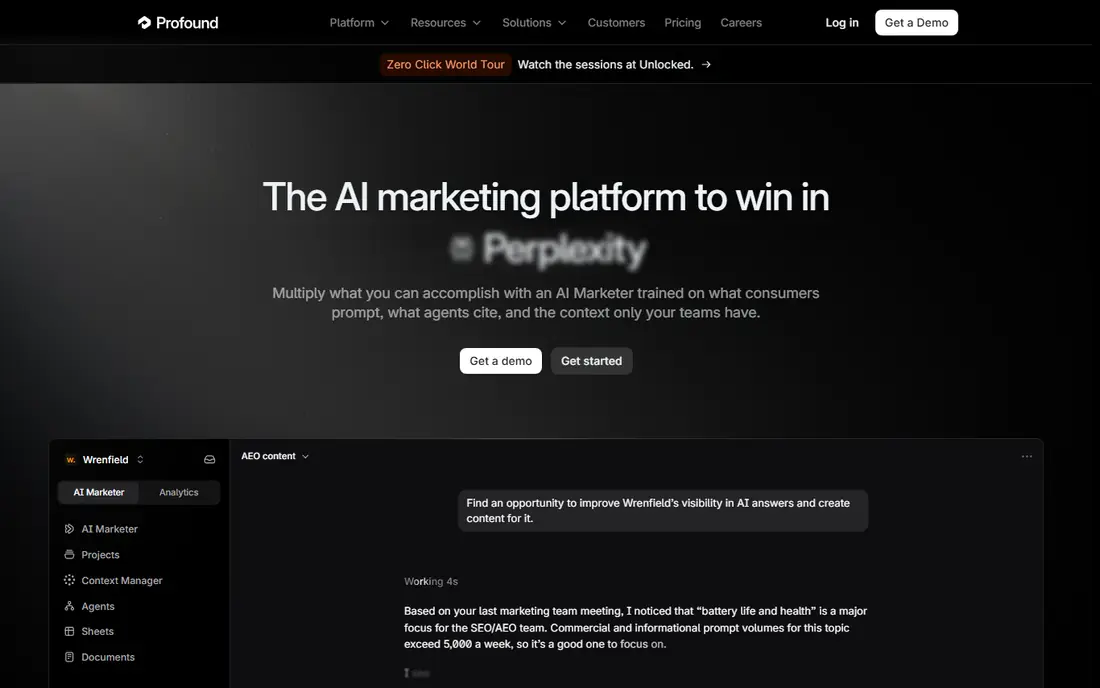
Profound is the enterprise standard in this category. It tracks prompts across many answer engines, shows which pages AI crawlers visit and cite, and adds an action layer that can draft pages for prompts where your brand is missing. For large brands and agencies with many clients, that depth and reporting range matter more than a low entry price.
The cost and sales process are the barriers. Brand plans are custom priced, with only agency tiers publishing a starting figure in recent coverage, and a free trial runs for a limited period with a daily prompt limit. Profound suits teams that need enterprise security, reporting and depth, and that can justify a custom contract. Smaller teams should start with Otterly.AI, ZipTie or Peec AI.
- Broad engine coverage on enterprise plans
- Agent Analytics for AI crawler visits
- Action tools that draft content to fill gaps
- Brand pricing is custom and not published
- Full engine coverage is enterprise only
- Trial data does not carry over in some cases
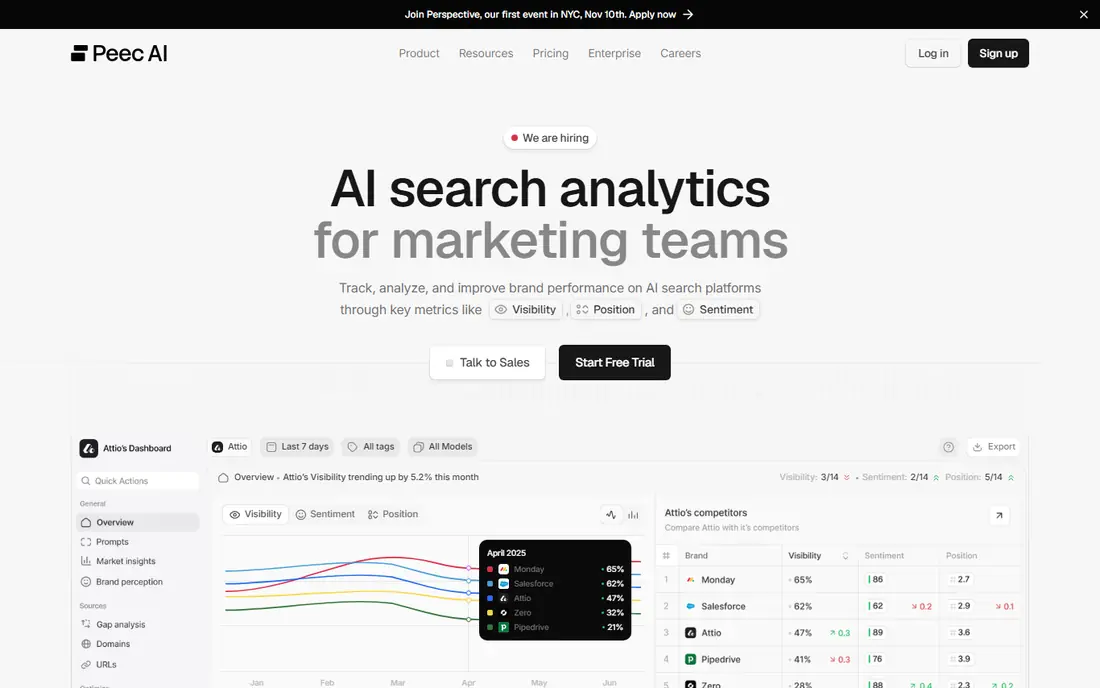
Peec AI focuses on numbers a team can act on quickly: visibility, position, sentiment and share of voice for each prompt, across engines such as ChatGPT, Perplexity, Gemini and Google AI Overviews. Unlimited seats on plans means a whole marketing team can use the same dashboard without per-seat pricing, which helps mid-market teams.
Pricing needs checking on the vendor site, since recent coverage shows prices in euros and dollars on different pages, with Starter, Pro and Advanced tiers based on prompt counts. Peec AI suits in-house teams that want a clean dashboard and fast setup, without an enterprise procurement cycle. Agencies should check agency plans and prompt allowances for multi-client work.
- Clear visibility, position and sentiment scores
- Unlimited seats on plans as described by the vendor
- Multi-engine tracking
- Prices vary between pages and currencies in recent coverage
- Brand plans cover a limited number of models
- API access is enterprise only
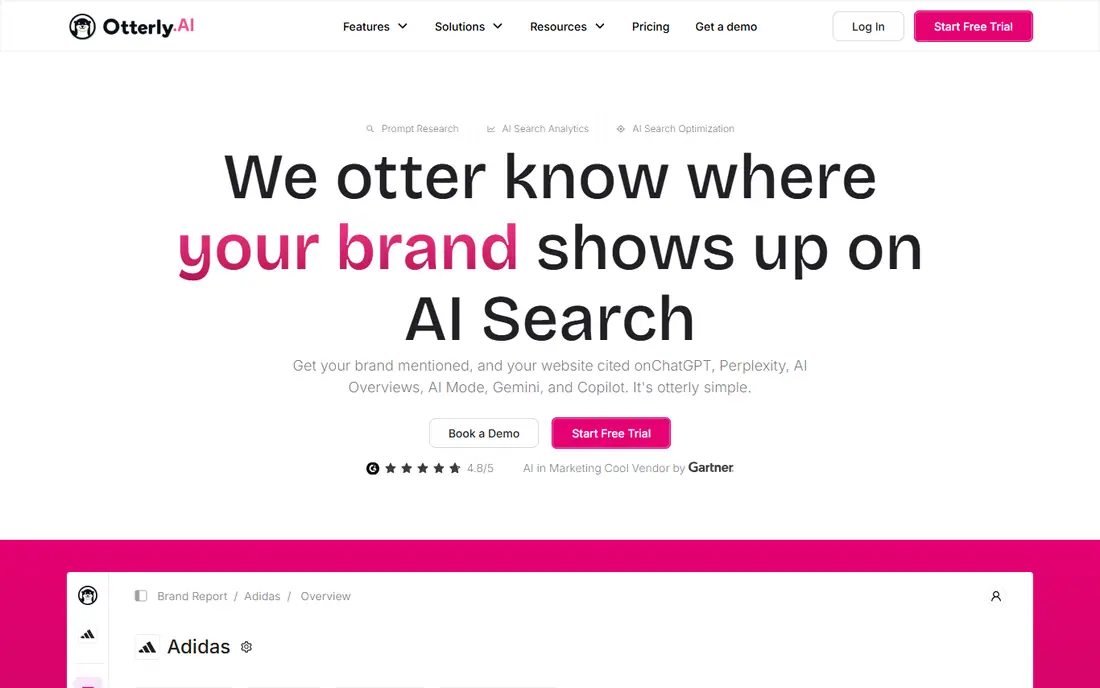
Otterly.AI is the budget entry point for AI visibility tracking. Its Lite tier covers a small prompt set across core engines with daily tracking, which is enough for a freelancer or small team to learn whether AI answers mention them at all. The interface is simpler than enterprise tools, and setup is faster.
Scale is the limit. As prompt counts grow, Otterly.AI tiers rise in price, and some engines are paid add-ons. For a small brand tracking a focused prompt set, Otterly.AI is good value. For a large brand tracking hundreds of prompts across many engines, Peec AI or Profound may be cheaper per prompt at scale.
- Lowest published entry price on this list
- Daily tracking
- Unlimited workspaces as described by the vendor
- Entry tier covers fewer prompts and engines
- Higher tiers rise sharply in price
- Add-ons needed for some engines
AthenaHQ pairs AI visibility tracking with guidance on what to fix. Instead of only showing a visibility score, it points to content, citation and optimisation steps, which helps teams that know they are invisible but do not know what to change first. Dashboards and reporting suit teams that need to share results with clients or leadership.
Price sits in the mid-market range, with a free tier for very small use and a Starter tier above Otterly.AI entry pricing. Check how credits or prompt allowances work on your plan, since that decides whether the Starter tier covers your real prompt list. AthenaHQ suits teams that want tracking plus next steps in one tool.
- Free tier as described in recent coverage
- Optimisation guidance alongside tracking
- Dashboards suited to reporting
- Entry paid price is higher than Otterly.AI or Peec AI Starter
- Enterprise features are custom priced
- Credit-based limits need checking
Scrunch AI focuses on how AI crawlers experience a brand site, including readability and citation readiness, alongside prompt tracking. Its Core tier publishes a prompt allowance and engine set, which makes pricing clearer than custom-only enterprise tools. A free trial lets teams test the dashboard before committing.
For enterprise brands, Scrunch AI offers agency and enterprise tiers with broader coverage and support. For small teams, the entry price is higher than Otterly.AI, so it suits brands that already know AI visibility matters and want a published, mid-range starting point with a focus on site readiness, not only prompt scores.
- Published entry price with prompt allowance
- AI crawler and readability focus
- Agency and enterprise tiers
- Entry tier covers a limited prompt set
- Full features are enterprise only
- Response limits need checking for large prompt lists
Semrush AI Toolkit is the practical pick for teams that already pay for Semrush. Instead of adding a separate AI tool, you get AI visibility tracking alongside keyword research, site audits, backlink data and content tools. That single login can save time and reduce tool sprawl, especially for SEO teams that report on classic search and AI search together.
If you do not already use Semrush, the total cost is harder to justify for AI tracking alone, since you pay for a full suite. Check whether AI Toolkit is included in your Semrush plan or sold as an add-on, and how many prompts it covers. For existing Semrush users, it is often the fastest way to add AI tracking without a new vendor review.
- AI tracking inside a full SEO suite
- Keyword, backlink and content tools in one login
- Daily rank data alongside AI data
- AI Toolkit is an add-on or higher-tier feature in many plans
- Total cost is higher if you do not already use Semrush
- Prompt limits vary by plan
Ahrefs Brand Radar tracks brand mentions across AI platforms and sits inside Ahrefs, a tool many SEO teams already use for backlinks and keyword research. That combination helps teams compare AI mentions with classic search visibility, links and content performance in one place. Coverage across many AI platforms is a stated strength in recent coverage.
Cost is the barrier for small teams. Brand Radar is an add-on, so you pay for a base Ahrefs plan plus the add-on, which quickly exceeds a standalone budget tool. For agencies and brands already on Ahrefs, Brand Radar is a logical add-on. For teams that only need AI tracking, Otterly.AI or ZipTie will be cheaper.
- Broad AI platform tracking as described by the vendor
- Strong backlink and keyword data alongside brand tracking
- Familiar Ahrefs reporting
- Sold as an add-on to Ahrefs plans
- Entry add-on price is high for small teams
- Total cost depends on your base Ahrefs plan
ZipTie is the best starting point for a very small team or freelancer who wants to test AI tracking without paying. The free tier covers a small prompt set, and paid tiers in recent coverage start at a low monthly price. That makes it easy to learn what AI answers say about a brand before committing to a mid-market tool.
Depth is limited compared with Profound, Peec AI or AthenaHQ. Reporting, sentiment detail and engine coverage are thinner, and large prompt lists will outgrow the free and low tiers quickly. Use ZipTie to prove the need for AI tracking, then move to Otterly.AI or Peec AI when prompt counts and reporting needs grow.
- Free tier available
- Simple prompt tracking for small sets
- Low-cost paid tier in recent coverage
- Free tier covers a small prompt set
- Depth and reporting are thinner than enterprise tools
- Check engine coverage before you rely on it
How we picked these
We compared official vendor pages, pricing pages and documentation, plus public comparisons that checked prices against vendor sites in October 2026. We looked at prompt allowances, engine coverage, free tiers and trials, reporting features and whether AI tracking was standalone or an add-on to a larger suite. We also noted where pricing was custom, since that changes the buying process.
We did not claim hands-on testing that did not happen, and we did not invent prompt counts, engine lists or prices where vendors did not publish them. Prices in this category change often, and some vendors show different prices in different currencies, so we used See website where a single clear price could not be stated safely. Check the vendor pricing page before you buy.
How to choose the best AI search analysis tool for you
Start with your prompt list, not with a vendor ranking. Write down the questions buyers actually ask AI tools about your product, brand and competitors, then count them. That count, times the number of engines you want to track, is your real workload, and it decides which tier you need. A tool that looks cheap for 50 prompts can become costly for 300.
Engines, metrics and actions
Check which engines matter for your buyers: ChatGPT, Perplexity, Google AI Overviews, Google AI Mode, Gemini and Copilot cover most cases, but not every tool tracks all of them on every tier. Look for prompt-level detail, citation sources and sentiment, not only a single visibility score. If your team needs next steps, prefer AthenaHQ, Profound or Scrunch AI, which add guidance or content actions. If you only need monitoring, a simpler tracker saves money.
Trials, seats and reporting
Use a free tier or trial with your real prompts, not demo prompts, and check whether results update daily and whether you can export reports. Check seat limits, since Peec AI offers unlimited seats while other tools charge per user. For agencies, check workspaces, client reporting and whether trial data carries into a paid plan, since losing early data can waste the trial period.
Frequently asked questions
What is the best AI search analysis tool?
Profound is best for enterprise depth, Peec AI is best for clean mid-market tracking, and Otterly.AI is best for low-cost entry monitoring. Semrush AI Toolkit and Ahrefs Brand Radar are best if you already use those SEO suites. The best AI search analysis software for you depends on prompt count, engine coverage and whether you need action guidance or only monitoring.
How much do AI search analysis tools cost?
Entry prices range from free on ZipTie and a free tier on AthenaHQ, through about $29 per month on Otterly.AI, to $250 to $295 per month on Scrunch AI and AthenaHQ Starter, with Profound and Ahrefs Brand Radar priced custom or as add-ons. Total cost depends on prompts, engines, users and billing period, so price your real prompt list before you compare entry prices.
What is AI visibility tracking?
AI visibility tracking measures how often, where and how a brand appears in answers from AI search and chat tools, rather than in classic search result pages. Tools track prompts, report visibility and position, show citations and sentiment, and compare you with competitors. That data helps teams see whether AI answers recommend them, ignore them or cite competitors instead.
Do I need an AI search tool if I already use SEO tools?
Classic SEO tools show rankings, links and traffic, but they do not show what AI answers say about your brand. If buyers use ChatGPT or Perplexity to research suppliers, AI tracking adds a view that classic rank tracking misses. If you already use Semrush or Ahrefs, their AI add-ons may cover that need without a separate tool.
Which AI engines should I track first?
Start with ChatGPT, Perplexity and Google AI Overviews, since those cover many buyer research journeys, then add Gemini, Copilot and Google AI Mode if your buyers use them. Check which engines each tool covers on your tier, since some tools limit engines on entry plans. Track competitor prompts too, not only your own brand name, since buyers ask comparison questions.
Can a small business use AI search analysis tools?
Yes. ZipTie offers a free tier, Otterly.AI starts at a low monthly price, and AthenaHQ offers a free tier in recent coverage. Start with a small prompt list, such as 20 to 50 buyer questions, and upgrade only when prompt counts or reporting needs grow. A small, focused prompt list gives more useful data than a large, unfocused list on a costly tier.
Sources we checked (8)

Online Jobs is an independent blog about careers, online work, learning new skills and the tools that help people earn. More about us.
Keep reading
All posts
ZoomInfo Alternatives
The best ZoomInfo alternatives in 2026, compared on price, free plans, data coverage, and which tool fits small teams or large sales teams best in detail.

Workday Alternatives
We compared the best workday alternatives for HR, payroll, and global hiring, from BambooHR and Gusto to Rippling, Deel, and HiBob for growing teams in 2026.
Which SaaS Tools Have the Best Customer Support
Which SaaS tools have the best customer support? Compare eight popular tools on help centres, live help, response options and overall support quality.