Best AI Recruiting Tools in 2026: 8 Tools Compared

How we put this together: we compare official feature and pricing pages, app store listings, privacy policies and public user reviews. Prices change, so check the provider's site before you pay.
Key takeaways
- Workable is the best all-round pick for teams that want an applicant tracking system with AI sourcing and screening built in.
- Manatal and Truffle offer the lowest entry prices for small teams, while Paradox and HireVue suit high-volume and enterprise hiring.
- AI should screen and schedule, not decide alone: keep a human in every hiring decision and check scores for bias before relying on them.
- Pricing models differ sharply, from per-user seats to headcount bands and credit pools, so compare the cost at your actual team size.
- Start with one bottleneck, such as resume screening or interview scheduling, and measure time-to-hire before expanding AI across the whole process.
Quick comparison
| Name | Who it suits | Starting price | Free option | |
|---|---|---|---|---|
 Workable | All-round AI applicant tracking | $299 per month | Free trial (15 days) | Visit |
 Manatal | Budget AI recruiting for small teams | $15 per user per month | Free trial (14 days) | Visit |
 Paradox | High-volume hourly and frontline hiring | See website | No | Visit |
 HireVue | Enterprise video interviews and assessments | See website | No | Visit |
 Juicebox | AI sourcing across large profile pools | $99 per user per month | Free trial | Visit |
 Greenhouse | Structured hiring at scale | See website | No | Visit |
 Fetcher | Automated outbound sourcing for small teams | $115 per month | Free trial | Visit |
 Truffle | Low-cost AI screening for lean teams | $49 per month | Free trial (7 days) | Visit |
The best AI recruiting tools
AI recruiting tools now cover sourcing, resume screening, chat-based screening, scheduling, and video interviews, but they do not all do the same job. We compared official pricing and feature pages, plus public reviews, for tools that are actively sold in 2026, and we kept tools that explain what their AI actually decides. Where a vendor does not publish a price, we wrote "See website" rather than repeating a third-party estimate as fact.
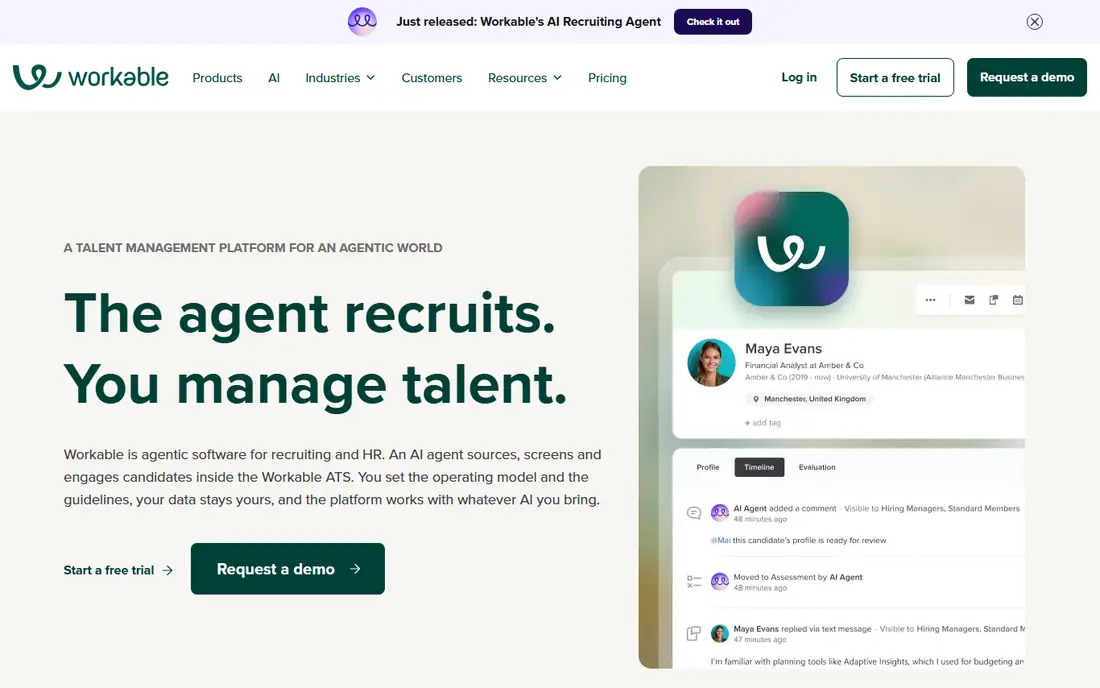
Workable is the safest all-round pick for a team that wants one system for job posts, applications, screening, and hiring workflow. Its AI agent helps with job intake, sourcing from a large profile database, screening, and writing job ads, while the core applicant tracking system keeps pipelines, scorecards, and interview stages in one place. That breadth matters, because a screening-only tool still leaves you managing the rest of hiring elsewhere.
The catch is price structure. The entry tier starts at 299 dollars per month for small teams, billed annually, and costs rise as headcount grows, so a fast-growing company should model the next band before signing. Use the 15-day trial on a live role, and check whether the AI features you need are included in the tier you priced, not just in a demo.
- Full applicant tracking system with AI sourcing, screening, and job ad writing
- Large candidate profile database
- Scales from small teams upward
- Price rises with headcount band
- AI agent features may need higher plans or credits
- Annual commitment is typical
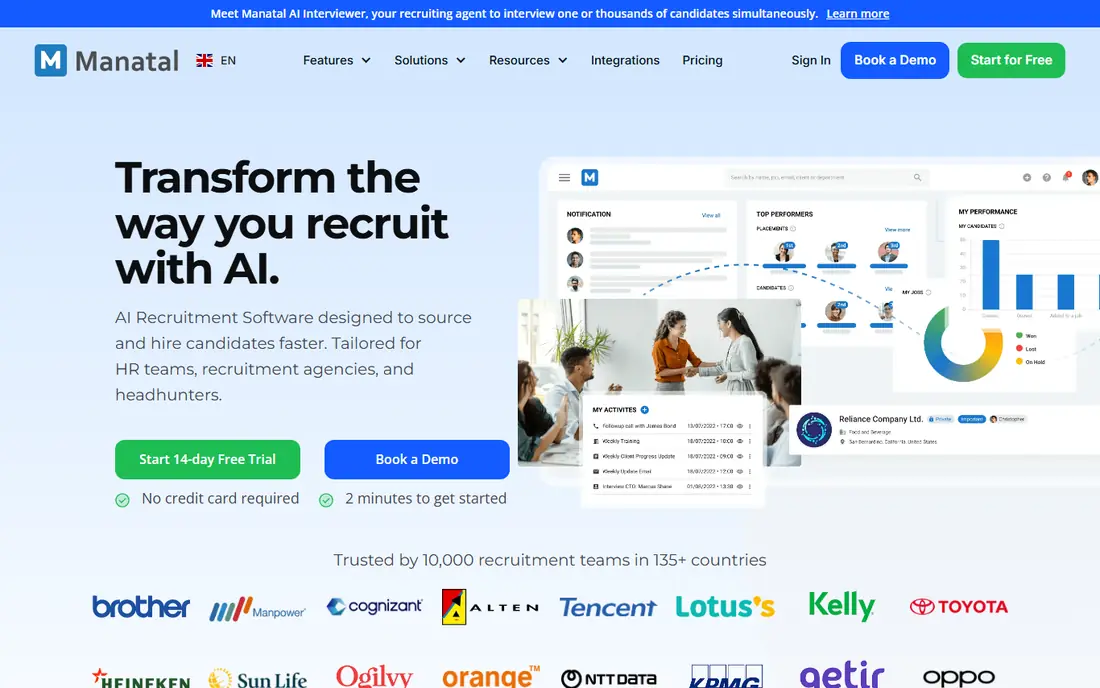
Manatal is the budget pick that still feels like a real recruiting system. At around 15 dollars per user per month billed annually, it offers AI matching against roles, candidate recommendations from your database and job boards, and social profile enrichment that fills out thin applications. Small agencies and in-house teams on a tight budget get a usable pipeline without an enterprise contract.
Its limits are depth and add-ons. Advanced AI interviewing is sold separately, and larger companies may miss the reporting, permissions, and structured hiring controls of Greenhouse or Workable. For a team hiring a handful of roles at a time, though, that simplicity is a strength, not a weakness.
- Low per-user price
- AI candidate matching and social profile enrichment
- Suits agencies and small in-house teams
- AI interview features are an add-on
- Less enterprise depth than Greenhouse or HireVue
- Interface is simpler, with fewer advanced controls
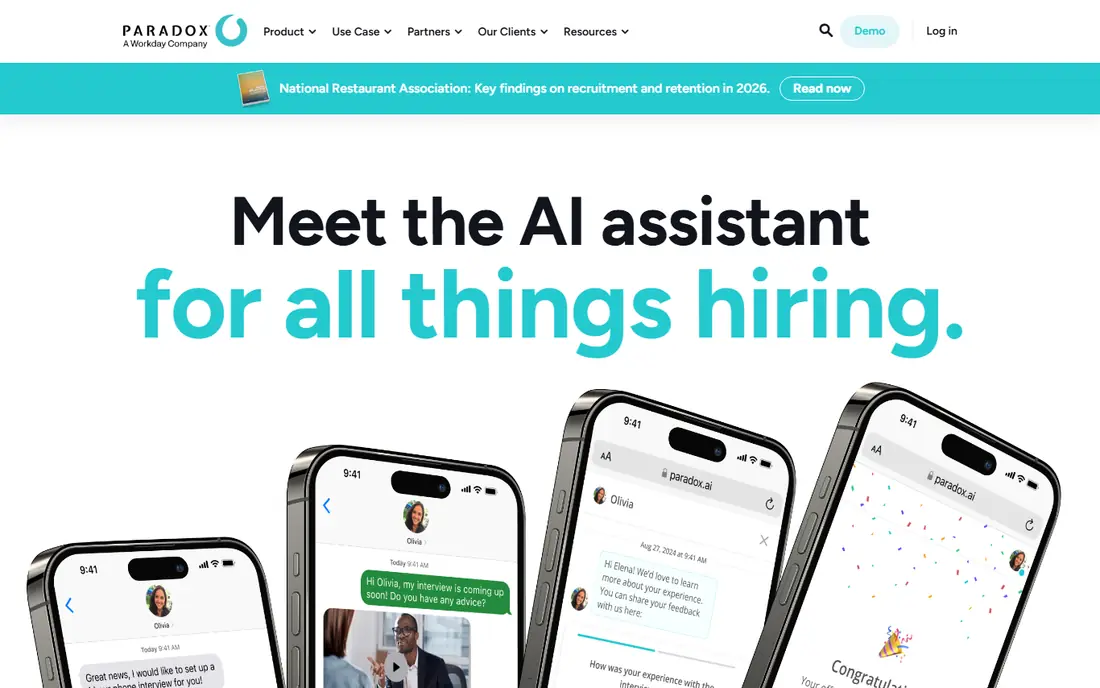
Paradox, built around its Olivia assistant, is designed for hiring at volume: hundreds of hourly applicants, many locations, and managers who cannot spend their days scheduling. Candidates can be screened, asked questions, and booked into interviews by text message at any hour, which cuts the days-long back-and-forth that kills frontline hiring. It also integrates with major HR platforms, including Workday, which matters for large employers.
The catch is access and cost. Paradox publishes no price and offers demos rather than a self-serve trial, so small teams cannot easily test it or budget for it. It is best judged by enterprises and franchise groups with steady high-volume hiring, where the scheduling saving alone can justify a custom contract.
- Conversational AI screens and schedules by text around the clock
- Strong for retail, hospitality, and healthcare volume hiring
- Integrates with major HR systems
- No published price, so budgeting needs a sales conversation
- Enterprise focus makes it heavy for small teams
- No self-serve free trial
HireVue suits employers that interview thousands of candidates and need every applicant to face the same structured questions. Its asynchronous video interviews let candidates record answers on their own schedule, while AI scoring and game-based assessments add a consistent first screen before human interviewers spend time. For graduate programs and large hiring campaigns, that consistency is the main selling point.
Cost and governance are the trade-offs. HireVue uses custom contracts, so there is no simple starting price to compare, and AI scoring in hiring carries fairness and legal duties that vary by location. Any team using it should document how scores are used, keep humans in final decisions, and check local rules on AI hiring tools before launch.
- Structured video interviews with AI scoring
- Game-based assessments
- Built for screening thousands of applicants consistently
- Custom enterprise pricing only
- Heavier than small teams need
- AI scoring needs governance and human review
Juicebox solves a different problem from Workable: finding people who have not applied. Recruiters type a plain-language description of the ideal candidate, and its search covers hundreds of millions of profiles, with AI agents that can run sourcing workflows on your behalf. For hard-to-fill technical or specialist roles, where the right person is not in your inbox, that approach beats keyword searching.
The catch is scope. Juicebox is a sourcing tool, not a full hiring system, so you still need an applicant tracking system to manage applications and interviews, and agent features may cost extra. Buy it when sourcing is your bottleneck, and pair it with a system like Workable or Greenhouse for the rest of the pipeline.
- Plain-language search across a very large profile pool
- AI sourcing agents for passive candidates
- No Boolean strings needed
- Sourcing only, so you still need an applicant tracking system
- Per-seat price plus agent costs can add up
- Best for outbound hiring, not inbound screening
Greenhouse is the pick for companies that want hiring to be consistent and measurable as they grow. Structured interview plans, scorecards, and approval workflows keep every candidate on the same process, while reporting shows where pipelines stall and which sources produce hires. AI matching and report helpers on higher plans add speed without replacing the structured process.
The trade-off is price and setup. Greenhouse does not publish a starting price, contracts are annual and based on headcount, and getting the most from it takes proper setup of jobs, stages, and scorecards. It suits mid-size companies that already feel the pain of inconsistent hiring, rather than a startup filling its first few roles.
- Strong structured hiring, scorecards, and reporting
- AI matching and report tools on higher plans
- Trusted by mid-size and large companies
- Custom pricing only
- Implementation takes planning
- AI features are tier-dependent
Fetcher is built for small teams that need passive candidates but cannot hire a sourcer. It automates candidate discovery and email outreach, sending a steady flow of profiles and responses while your team focuses on interviews. At around 115 dollars per month, it is one of the more accessible ways to add outbound recruiting without an enterprise tool.
Its limits are control and scope. Automated outreach still needs good targeting and honest, human-written messages, or response rates will disappoint, and Fetcher does not replace an applicant tracking system. Use it when you have a clear ideal candidate profile and a recruiter who can follow up quickly on replies.
- Automated sourcing and email outreach without a full-time sourcer
- Accessible monthly price
- Suits small teams with steady hiring
- Outreach quality depends on targeting and message copy
- Sourcing only, not a full hiring system
- Lead volume limits apply by plan
Truffle is the cheapest way to add AI screening to a lean hiring process. Its starter plan starts at 49 dollars per month, covers unlimited users, and uses credits for screening work: the AI reads resumes, one-way interviews, and assessments against criteria you set, then ranks candidates with reasons shown. That transparency matters, because a recruiter can check the reasoning instead of trusting a bare score.
The catch is maturity and scope. Truffle is newer and smaller than the established systems here, and credit-based pricing needs watching if application volume spikes. It also covers screening, not the full hiring workflow, so pair it with a simple applicant tracking system or a spreadsheet process for interviews and offers.
- Low starting price with unlimited users
- AI reads resumes and interviews against your criteria and shows reasons
- Credit-based plans suit variable volume
- Newer and smaller than Workable or Greenhouse
- Credit pools need monitoring
- Screening only, so you still need a hiring system for later stages
How we picked these
We compared official pricing and feature pages, plus public reviews and pricing roundups checked in October 2026, for AI recruiting tools that are actively sold and that describe their AI functions clearly. We kept a mix of full applicant tracking systems, sourcing tools, and screening tools, because buyers often confuse those categories. Where a vendor publishes no price, we wrote "See website" and noted the contract model, rather than presenting a third-party estimate as a vendor price.
Buying AI recruiting tools without regret
Fix one bottleneck first
Pick the step that costs the most time today: sourcing, resume screening, scheduling, or first-round interviews. Buy a tool that solves that step well, measure time-to-shortlist before and after, and only then expand. A tool bought for every step at once often gets used for none of them properly.
Check what the AI decides and what it only suggests
Ask vendors which outputs are decisions, which are rankings, and which are drafts a human must approve. Keep humans in final hiring decisions, log overrides, and review AI scores for patterns by group before relying on them. If a vendor cannot explain its scoring, that is a reason to pause, not a detail to skip.
Compare total cost at your real size
Per-user, per-agent, headcount-band, and credit pricing behave very differently as you grow. Model the cost at your current team size and at double that size, and include add-ons such as AI agents, interviews, or resolutions. A low headline price can become an expensive contract once add-ons are counted.
Run a paid pilot on a real role
Use a real vacancy, a real shortlist, and a real hiring manager, and compare time-to-hire, candidate response rates, and quality of hire against your previous process. A demo with sample data tells you little about how the tool handles your applicants, your job descriptions, and your interviewers.
Frequently asked questions
What is the best AI recruiting tool for startups?
Workable suits startups that want a full hiring system, while Manatal suits the tightest budgets and Truffle suits lean teams that mainly need screening. Start with the bottleneck: if sourcing is the problem, add Juicebox or Fetcher; if screening volume is the problem, add Truffle.
Can AI replace recruiters?
No, and vendors that suggest otherwise should be treated with caution. AI handles repetitive work such as sourcing, screening, and scheduling well, but final judgments about fit, motivation, and potential need human interviewers. The best setups use AI to shorten the funnel and humans to make the decisions.
Is AI recruiting legal?
AI hiring tools are regulated in some places, such as New York City's rules on automated employment decision tools, and employment law in the European Union treats hiring AI as high-risk in many cases. Check the rules where you hire, document how scores are used, and keep a human in final decisions.
How much do AI recruiting tools cost?
Entry prices here range from 15 dollars per user per month for Manatal and 49 dollars per month for Truffle to 299 dollars per month for Workable, with enterprise tools like Paradox, HireVue, and Greenhouse priced by custom quote. Always model add-ons and growth bands before signing.
What is the difference between an AI ATS and an AI sourcing tool?
An AI applicant tracking system manages the whole hiring pipeline, from job posts to offers, with AI features inside it. A sourcing tool finds passive candidates who have not applied, but does not manage interviews or offers. Many teams need both, or a full system plus a sourcing add-on.
How do you measure whether an AI recruiting tool works?
Track time-to-hire, time-to-shortlist, candidate response rates, and quality of hire over at least one hiring cycle. Compare those figures with your previous process for the same type of role, and survey candidates about their experience, since a fast tool that puts candidates off is a poor trade.
Sources we checked (8)

Online Jobs is an independent blog about careers, online work, learning new skills and the tools that help people earn. More about us.
Keep reading
All posts
Best White Label SEO Companies
We compare the best white label SEO companies and tools in 2026 for agencies, from fulfilment services to branded reporting platforms, margins and prices.
Best Webinar Software
We compared the best webinar software for 2026 on price, attendee limits, automation and ease of use, to help you host better live sessions with confidence.
Best Web Scraping Tools
Compare the best web scraping tools in 2026, from no-code Octoparse and Browse AI to Apify, Firecrawl, Bright Data, Zyte, ScraperAPI and free Scrapy, with prices.