Best AI Customer Support Platforms in 2026: 8 Platforms Compared

How we put this together: we compare official feature and pricing pages, app store listings, privacy policies and public user reviews. Prices change, so check the provider's site before you pay.
Key takeaways
- Intercom Fin is our pick for teams that want clear per outcome AI pricing and fast chat deployment.
- Zendesk AI suits teams already on Zendesk, but per resolution costs need careful forecasting.
- Freshdesk Freddy and Tidio Lyro offer lower cost entry points for smaller teams.
- AI pricing models differ a lot, so compare cost per resolved conversation, not just seat price.
- A good AI agent still needs a clean help centre, clear escalation rules, and human review.
Quick comparison
| Name | Who it suits | Starting price | Free option | |
|---|---|---|---|---|
 Intercom | Chat first AI support | $29 per seat per month | Free trial (see website) | Visit |
 Zendesk AI | Existing Zendesk teams | $55 per agent per month | Free trial (see website) | Visit |
 Freshdesk | Budget helpdesk with AI | $15 per user per month | Free trial (see website) | Visit |
 Tidio | Small business chat AI | See website | Yes | Visit |
 Gorgias | Shopify support teams | $10 per month | Free trial (see website) | Visit |
 HubSpot Customer Agent | HubSpot CRM users | See website | Free trial (see website) | Visit |
 Ada | Enterprise AI agents | See website | No | Visit |
 Help Scout | Email focused teams | $30 per user per month | Free trial (see website) | Visit |
The best ai customer support platforms
We compared platforms for AI agent quality, channels, helpdesk features, integrations, and pricing transparency. The eight below cover chat first teams, email teams, ecommerce brands, and enterprises, but AI billing is the biggest difference between them.
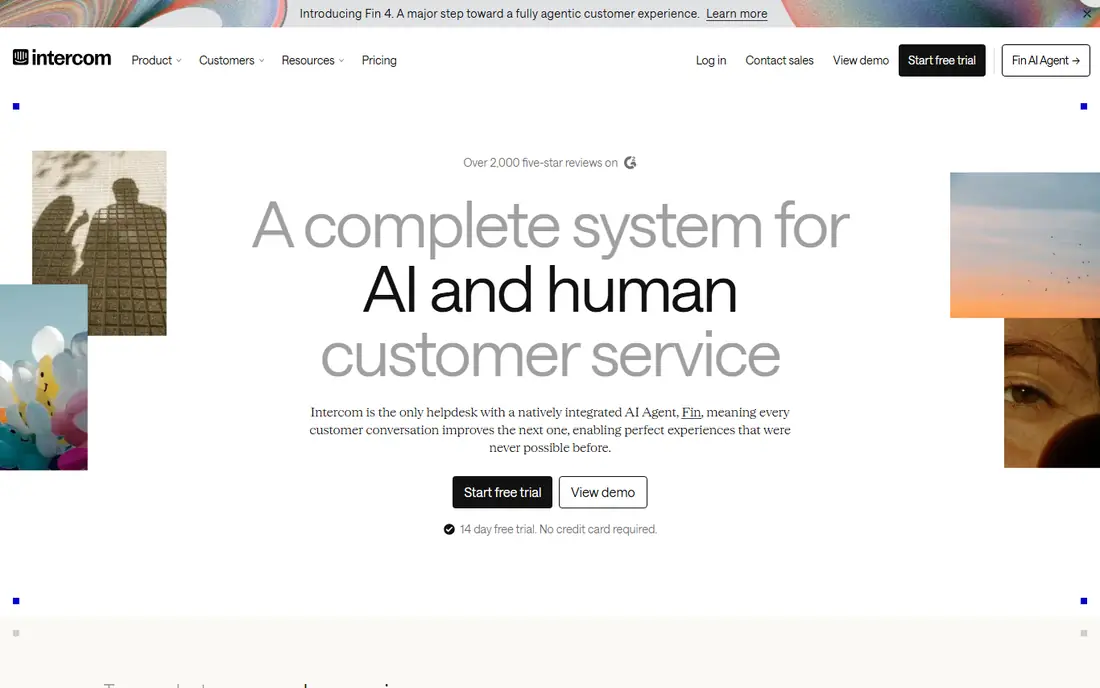
Intercom is built around messaging, and Fin is its AI agent for answering customer questions from help centre content. Fin can resolve common questions, hand over to a human with context, and work across chat and email. The published per outcome price makes it easier to forecast than some rivals, since you pay for resolutions rather than every AI reply.
The catch is volume. Seat fees plus outcome fees add up when traffic grows, so model a month of real conversations before you commit. For chat heavy SaaS and ecommerce teams, Intercom remains a strong default because deployment is fast and the agent is easy to test.
- Fin AI agent with clear per outcome pricing
- Strong chat and help centre tools
- Fast deployment for digital teams
- AI outcomes are billed on top of seat fees
- Costs can rise quickly at high chat volume
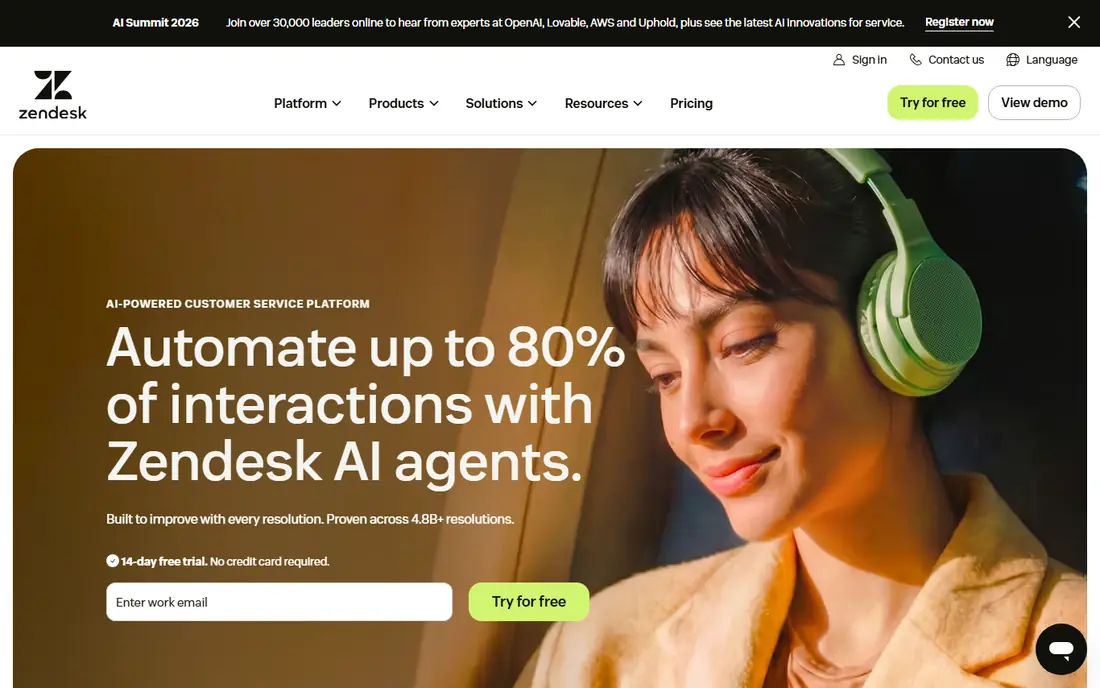
Zendesk AI makes most sense if you already run Zendesk. Its AI agents can answer from help centre articles, triage tickets, draft replies, and summarise conversations for agents. Copilot features help human agents work faster, which matters when tickets are complex or sensitive.
Pricing needs care, since suite fees, copilot seats, and per resolution charges stack. Teams that switch to Zendesk only for AI should compare total cost with a standalone agent that plugs into their current helpdesk. For large, complex support operations, the workflow depth is hard to match.
- Deep ticketing and workflow tools
- AI agents, triage, and copilot features
- Very large integration library
- AI resolutions are billed separately
- Setup and admin effort is higher than for simpler tools
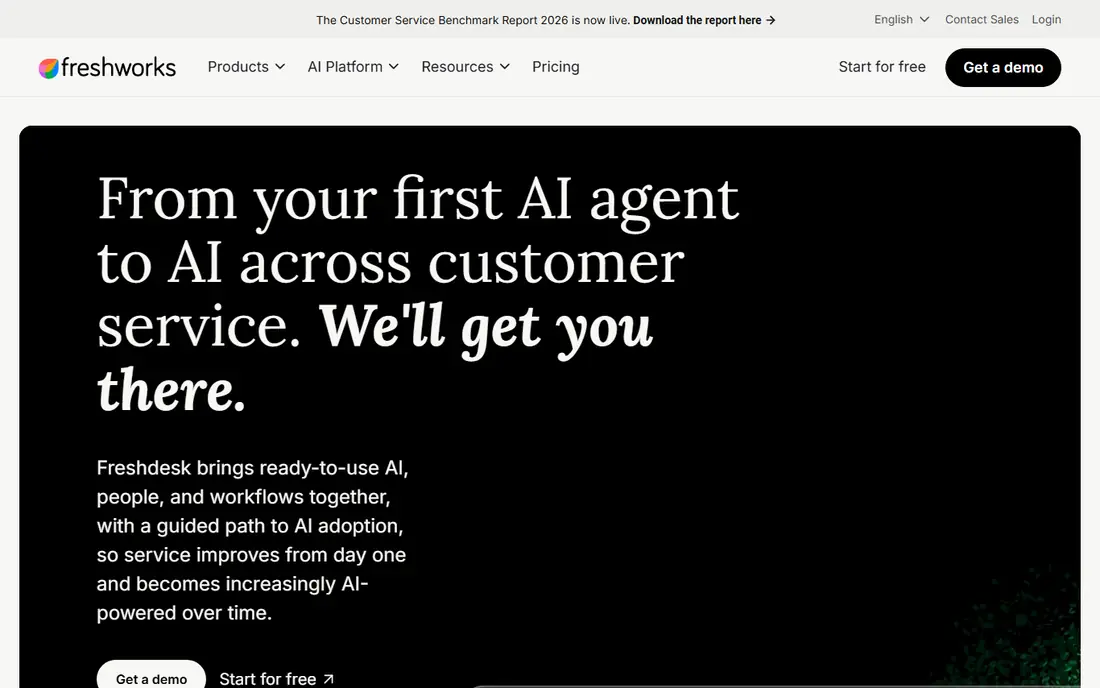
Freshdesk, part of Freshworks, offers a practical balance for small and mid sized teams. Freddy AI can summarise tickets, draft replies, detect sentiment, and help route work. The helpdesk itself covers email, chat, social, and phone integrations, so teams do not need a separate tool for each channel.
It is not as deep as Zendesk for very complex workflows, and some AI features need higher plans. For teams that want a full helpdesk with useful AI, rather than an AI only agent, Freshdesk is a sensible value choice.
- Lower entry price than enterprise suites
- Freddy AI for summaries, drafting, and triage
- Omnichannel tickets
- AI depth varies by plan
- Advanced automation sits on higher tiers
Tidio is the easiest starting point for a small business that mainly needs chat. Its free plan covers basic live chat, and Lyro, its AI agent, can answer FAQs from your content and hand over to a human when needed. Setup is quick, which suits teams without a dedicated support ops role.
Larger teams with complex routing, SLAs, and reporting will outgrow it. For a small store or service business, though, Tidio lets you test AI support at low cost. Check Lyro pricing and conversation limits before you rely on it for high traffic.
- Free plan for small teams
- Lyro AI chatbot for FAQs
- Simple setup for websites
- Limited workflow depth for large teams
- Lyro is an add on on some plans
Gorgias is designed for ecommerce support, with deep Shopify links for orders, returns, and customer data. Its AI agent can handle order status, shipping, and return questions inside the ticket, which covers a large share of store support volume. That context reduces back and forth for agents.
Non ecommerce teams will find less value in its Shopify focus. For Shopify brands, compare its per interaction AI price with Intercom and Zendesk on your actual ticket mix, since order questions are cheaper to automate than complex product support.
- Built for Shopify and ecommerce
- AI agent included on plans
- Ticket pricing without seat fees on some plans
- Best fit is ecommerce, less so for general SaaS
- AI costs are per automated interaction
HubSpot Customer Agent, also called Breeze Customer Agent, answers from your HubSpot knowledge base and can use CRM context. For teams already on HubSpot, that fit matters: tickets, contacts, and help content already live in one system, so setup is faster than with a standalone agent.
Teams outside HubSpot should not adopt a CRM just for this agent. Pricing is credit based and public details are limited, so ask HubSpot for a cost estimate based on your monthly resolved conversations. Inside HubSpot, it is a natural shortlist item.
- Uses HubSpot knowledge base and CRM data
- Fits Service Hub workflows
- Credit based AI pricing
- Pricing and credit details are less clear on public pages
- Best value only inside HubSpot
Ada suits enterprises that need AI agents across many channels with strict controls. Its agents can follow playbooks for complex tasks, use safety guardrails, and handle voice as well as chat and email. That breadth helps large brands with high volume and compliance needs.
It is not a small team tool. Pricing is quote only, and implementation takes planning. For mid market and enterprise teams with multilingual or regulated support, Ada is worth a detailed demo against Intercom and Zendesk.
- Omnichannel AI agents for chat, voice, email, and messaging
- Strong safety guardrails
- Playbook based automation
- Quote only pricing
- Enterprise setup effort and contract size
Help Scout is best for teams where email is still the main channel. Its shared inbox is clear, its AI tools help draft and summarise replies, and pricing is simple to understand. Small and growing teams often prefer its calm interface to a complex enterprise suite.
If you need a full AI agent that resolves chat without a human, Help Scout is lighter than rivals here. For email heavy teams that want AI help for agents rather than full automation, it is a strong, low friction choice.
- Simple, clear shared inbox
- AI writing and summarising tools
- Transparent per user pricing
- Less AI agent depth than Intercom or Ada
- Chat and phone features are lighter than full suites
How we picked these
We reviewed official feature pages, pricing pages, and app store listings, along with privacy policies and public reviews for AI pricing, channel coverage, and integration fit. We compared AI agent models, helpdesk depth, escalation controls, and total cost, including seat fees plus per resolution or per interaction charges. Where pricing was quote only or credit based without clear public rates, we wrote See website.
We did not run live AI agents for every platform, so treat this as a research based shortlist. Pilot any agent on real tickets, measure resolution rate and customer satisfaction, and check how often it escalates correctly before you expand it.
What to check before you choose
Model the total AI bill
Seat price alone misleads. Add per outcome, per resolution, or per interaction charges for your monthly volume, and include any included allowances. A platform with a higher seat price can be cheaper overall if its AI unit price is lower for your ticket mix.
Fix the help centre first
AI agents answer from your content. If articles are out of date, thin, or contradictory, the agent will repeat those flaws at scale. Audit your top twenty help articles, remove duplicates, and add clear escalation paths before you launch.
Set escalation and review rules
Decide which topics must always go to a human, such as refunds above a threshold, account security, and complaints. Review a sample of AI resolutions weekly at first, and track deflection, resolution rate, and satisfaction together, not deflection alone.
Frequently asked questions
What is the best AI customer support software for small teams?
Tidio and Freshdesk are the strongest small team starting points. Tidio is cheapest for chat only support, while Freshdesk gives a fuller helpdesk with Freddy AI. Choose Tidio if chat dominates, and Freshdesk if email, chat, and tickets all matter.
What is the best AI customer support platform for chat?
Intercom leads for chat first support, thanks to Fin and its messaging tools. Ada is close for enterprises that also need voice and email at scale. Test Fin on your top chat questions, since chat quality depends on help centre content as much as on the model.
What are the best AI tools for customer support on Shopify?
Gorgias is the best fit for Shopify brands, since it links orders and returns directly into tickets. Intercom also works well for Shopify stores with heavy chat volume. Compare per interaction AI costs on order status and return tickets, which dominate most store queues.
Which AI tool is best for customer support email?
Help Scout is a strong email first choice, with AI drafting and summaries for agents. Zendesk AI and Freshdesk also handle email well, with deeper automation. Pick Help Scout for simplicity, and Zendesk or Freshdesk when email needs complex routing and SLAs.
How much does AI customer support cost?
Costs vary by model. Some platforms charge per seat plus a per outcome fee near $0.99 to $2.00, while others charge per interaction or per credit. Always model seat fees plus AI fees for your real monthly volume, and ask about included allowances, minimums, and overage rates.
Can an AI agent replace human support?
No, not fully. AI agents handle repeated questions well, but complex, sensitive, and high value cases still need people. The best setup uses AI for common work, clear escalation for the rest, and human review for edge cases. Measure satisfaction and resolution quality, not just how many tickets AI touches.
Sources we checked (8)

Online Jobs is an independent blog about careers, online work, learning new skills and the tools that help people earn. More about us.
Keep reading
All posts
ZoomInfo Alternatives
The best ZoomInfo alternatives in 2026, compared on price, free plans, data coverage, and which tool fits small teams or large sales teams best in detail.

Workday Alternatives
We compared the best workday alternatives for HR, payroll, and global hiring, from BambooHR and Gusto to Rippling, Deel, and HiBob for growing teams in 2026.
Which SaaS Tools Have the Best Customer Support
Which SaaS tools have the best customer support? Compare eight popular tools on help centres, live help, response options and overall support quality.