Best Account-Based Marketing Tools in 2026: 9 Platforms Compared

How we put this together: we compare official feature and pricing pages, app store listings, privacy policies and public user reviews. Prices change, so check the provider's site before you pay.
Key takeaways
- 6sense and Demandbase suit large B2B teams that need intent data, scoring and ads in one place, but both are priced on quote.
- RollWorks and HubSpot are the more practical starting points for mid-market teams that already use a CRM.
- Bombora is a data layer rather than a full campaign tool, so it works best paired with ads or a CRM.
- Mutiny and Influ2 solve narrower jobs, web personalisation and person-level ads, and can sit beside a larger platform.
- No tool on this list replaces a clear target account list, agreed sales handoffs and content that speaks to a real buying group.
Quick comparison
| Name | Who it suits | Starting price | Free option | |
|---|---|---|---|---|
 6sense | Enterprise predictive ABM | See website | No | Visit |
 Demandbase | Large enterprise ABM suites | See website | No | Visit |
 RollWorks | Mid-market account ads | See website | No | Visit |
 HubSpot | CRM users adding ABM | See website | Yes | Visit |
 Terminus | Multi-channel ABM campaigns | See website | No | Visit |
 Bombora | Intent data | See website | No | Visit |
 Mutiny | Website personalisation | See website | No | Visit |
 ZoomInfo Marketing | Data-led account targeting | See website | No | Visit |
 Madison Logic | Content-led account engagement | See website | No | Visit |
The best account-based marketing tools
Account-based marketing works when sales and marketing agree on the same accounts and then treat those accounts as a market of one. The tools below differ in how much of that job they cover, from data and scoring through to ads, web changes and measurement.
6sense starts with a simple question for a B2B team: which accounts are showing signs of buying, and which ones should sales call first. It pulls together first-party signals from a website and CRM with third-party intent data, then scores accounts so teams can focus on a shorter list. That focus is the main reason large teams choose it, because a list of thousands of accounts is not a plan on its own.
The platform also supports ads, web personalisation and sales alerts, which helps a team act on the same account view rather than passing spreadsheets between departments. The trade-off is cost and complexity. A small team with a short target list may find the depth more than it needs, and pricing is agreed with sales rather than published as a simple monthly rate.
- Broad intent and predictive scoring
- Strong Salesforce and HubSpot links
- Ads and orchestration in one platform
- Quote-only pricing
- Setup can take time for smaller teams
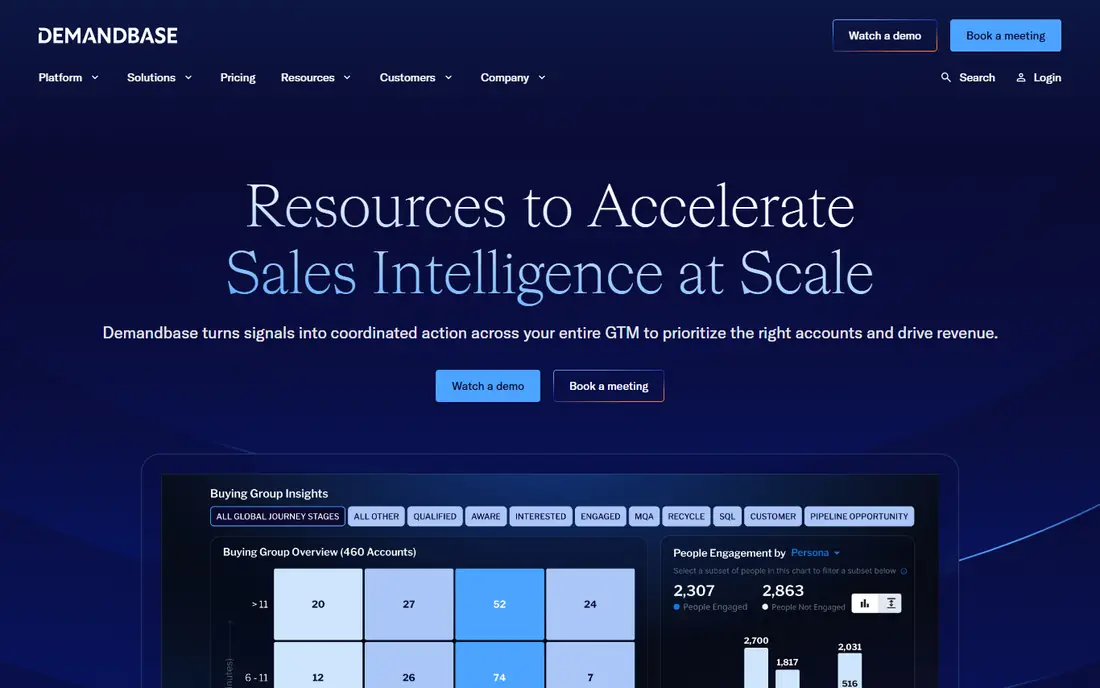
Demandbase is built for organisations that want ads, intent, web personalisation, sales insight and attribution under one roof. Its account identification work helps teams see which companies visit a site even when no form is filled in, and that view feeds advertising and sales prioritisation. For a large team with many stakeholders, having one shared account record can cut down on conflicting reports.
That breadth comes with enterprise weight. Contracts are quoted, implementation is a project rather than a quick signup, and teams need clear ownership to get value from every module. It fits best where ABM is a core go-to-market motion, not a side experiment with a handful of accounts.
- Wide ABM suite in one place
- Account identification and intent
- Native advertising and measurement
- Enterprise pricing
- Onboarding needs dedicated time
RollWorks is often the first dedicated ABM platform a growing B2B team tries, because its core job is easy to explain: show ads to people at chosen accounts and measure what those accounts do next. It connects to common CRMs so marketing can build account lists from CRM data and sales can see account engagement without learning a new system from scratch. That practical fit matters more than a long feature list for many mid-market teams.
The platform has grown beyond ads into intent, website personalisation and measurement, but advertising remains its centre. Teams that need deep predictive modelling or complex enterprise governance may still look at 6sense or Demandbase first. Teams that need to launch account campaigns quickly and learn from real account behaviour will find RollWorks easier to start with.
- Clearer entry point for growing teams
- Account ads across display and social
- CRM links for Salesforce and HubSpot
- Quote-based pricing
- Reporting depth varies by plan
HubSpot appeals to teams that already run marketing and sales in HubSpot and do not want another system to keep in sync. Its ABM tools let a team mark companies as target accounts, track engagement at company level and build workflows and reports around those accounts. Because contacts, deals and web activity already live in the same place, the setup burden is lower than with a standalone platform.
The limit is depth. HubSpot does not match the intent data or predictive breadth of a dedicated ABM suite, and the more useful ABM reporting and automation sit on paid tiers. It is still a strong choice for a team whose ABM programme is really about focus and follow-up inside a CRM, rather than large-scale paid account advertising.
- ABM tools sit inside a familiar CRM
- Target account lists and company scoring
- Free CRM tier to start
- ABM depth is narrower than dedicated platforms
- Advanced features sit on higher tiers
Terminus, now part of DemandScience, is aimed at teams that want to reach target accounts through ads, email, chat and web experiences without stitching together a separate tool for each channel. The idea is coordination: the same account list drives each touch, and engagement data flows back to sales in one view. That can help a team avoid the common problem where ads, email and sales outreach all tell a slightly different story.
Buyers should confirm the current plan names and what is included before signing, because the product has changed hands and packaging has shifted over time. For a mid-market or enterprise team that values one campaign hub and strong sales alignment, it remains a credible option to compare against RollWorks and Demandbase.
- Multi-channel campaigns from one hub
- Account engagement and sales signals
- Chat and email signature options in its suite
- Pricing is quoted
- Product history includes a change of ownership, so check current packaging
Bombora answers one question well: which companies are researching topics linked to a product or service. Its Company Surge data tracks research activity across a network of business content sites and surfaces topics that are rising for a given account. Sales teams can use that signal to time outreach, and marketing teams can use it to build or refresh target lists.
The catch is that Bombora does not run the campaign. A team still needs ads, email, a CRM or an ABM platform to act on the signal. That makes it a good buy for teams that already have activation tools and want better prioritisation, and a poor first purchase for a team that expects a single tool to do everything.
- Widely used intent data
- Topic-level buying signals
- Integrations with CRMs, ad platforms and ABM suites
- Data only, not a campaign tool on its own
- Needs activation elsewhere
Mutiny focuses on the moment an account actually arrives on a website. Instead of showing every visitor the same homepage, a team can change headlines, proof points, calls to action or page sections for a target account or segment. That is a useful lever because paid ABM traffic is wasted when it lands on a generic page that does not speak to the visitor's company or role.
Mutiny is not a full ABM suite, and it does not replace intent data or ad buying. Its value shows up when a team already drives account traffic and wants more of that traffic to convert. Teams with low traffic or no clear account segments will get less from it, because personalisation needs enough visits to test and learn from.
- Personalised web experiences by account or segment
- No-code style editing for marketers
- Measurement tied to site conversion
- Focused on the website, not full ABM orchestration
- Pricing is quoted
ZoomInfo Marketing builds on a contact and company database that many sales teams already know. A marketing team can build account lists from firmographic and technographic filters, enrich records, layer intent signals and run account advertising from the same vendor. That data-first route suits teams whose main ABM problem is list quality rather than campaign tooling.
The trade-off is that ZoomInfo is first a data company, so its ABM workflow may feel less complete than a dedicated suite for teams that need deep orchestration. Data accuracy and coverage also vary by market and company size, so a team should test its own target accounts during evaluation rather than trusting a database size claim alone.
- Large business contact and company database
- Account and intent signals
- Advertising and enrichment links
- ABM features sit beside a data product
- Pricing is quoted and tiered
Madison Logic suits B2B teams that win business through content, white papers, webinars and research rather than short display ads alone. It helps a team put content in front of people at target accounts, capture engagement signals and pass account-level activity back for sales follow-up. That content route can work well for complex purchases where buyers need education before a sales conversation makes sense.
Costs need care, because media spend is separate from any platform fee and can grow quickly with a large account list. It is a strong fit for teams with a content engine and a clear definition of a qualified account, and a weaker fit for teams that only need simple account ads.
- Content syndication to target accounts
- Multi-channel account advertising
- Account-level measurement
- Media costs sit on top of platform fees
- Best for content-heavy programmes
How we picked these
We compared official product pages, pricing pages where pricing is published, integration lists and public documentation for each vendor, and we checked that each product is still sold as an ABM or ABM-related platform in October 2026. We favoured tools with a clear ABM job, live CRM links and a track record with B2B teams, and we mixed large suites with narrower tools so a reader can match the list to team size and budget. Where a vendor does not publish a price, we wrote See website rather than repeating a third-party estimate as if it were a list price. We did not claim hands-on trials that did not take place, and we treated review-site claims as background only.
What to check before you buy
Start with the account list, not the platform
A platform cannot fix a vague list. Agree the target accounts, the buying roles inside each account and the signal that moves an account from marketing to sales. Then check that the tool can hold that list, update it from the CRM and report on it without manual exports every week.
Match intent data to your sales cycle
Intent data helps most when sales cycles are long and buying groups are large, because it shows research before a form fill. If deals close in days and buyers contact sales directly, simpler CRM-based ABM in HubSpot or RollWorks may give faster value than a predictive suite.
Count the full cost
Quote-only pricing means the subscription is only part of the bill. Ask about onboarding, ad spend, media spend, data credits and the seats needed for marketing, sales and operations. A cheaper platform with high media costs can cost more in year one than a larger suite with bundled advertising.
Test the sales handoff
Ask for a live demo using a small set of real target accounts. Check what a salesperson sees, how fast an alert arrives and how an account moves back to marketing when it goes quiet. A tool that marketing loves but sales ignores will not produce pipeline, however good its dashboards look.
Frequently asked questions
What is the best account-based marketing software for a small team?
HubSpot or RollWorks are the usual starting points, because both connect to a CRM and do not require an enterprise implementation. A small team should start with a short account list, one or two channels and clear sales follow-up, then add intent data only when the basic motion works.
What tools are best for account-based marketing ads?
RollWorks, Demandbase, Terminus and ZoomInfo Marketing all support account advertising, with different strengths in channels and reporting. The right choice depends on where target buyers spend time and how much of the budget should go to display, social or content-led placements.
Do I need intent data to do ABM?
No, but it helps with prioritisation. A team can run ABM from CRM data, website visits and sales knowledge alone, especially with a small list. Intent data from Bombora, 6sense or Demandbase becomes more valuable as the list grows and sales need help choosing which accounts to work first.
How much does account-based marketing software cost?
Prices vary widely, from CRM tiers that include basic ABM to enterprise suites priced on quote with annual contracts. Always ask for onboarding, media and seat costs in writing, and compare the first-year total rather than the headline subscription alone.
What is the difference between 6sense and Demandbase?
Both are enterprise ABM suites with intent, scoring, ads and measurement, but they differ in data sources, workflow emphasis and packaging. A team should run the same target accounts through both in a trial or guided demo and judge signal quality, sales usability and total cost rather than choosing on a feature table alone.
Can HubSpot replace a dedicated ABM platform?
It can for teams whose ABM work lives mainly in the CRM, with focused lists, workflows and company-level reporting. It is less suited to teams that need deep third-party intent, large-scale account advertising or complex predictive scoring across thousands of accounts.
Sources we checked (9)

Online Jobs is an independent blog about careers, online work, learning new skills and the tools that help people earn. More about us.
Keep reading
All posts
Best Tool for Lead Generation
Find the best tool for lead generation in 2026, from prospecting databases and outreach tools to landing pages, with prices and honest trade-offs for buyers.
Best Omnichannel Marketing Platform
Compare the best omnichannel marketing platform in 2026. We review Klaviyo, HubSpot, Braze, Salesforce and more, with pricing, free plans and channel coverage.
Best Landing Page Tools
Compare the best landing page tools for 2026, from Unbounce and Instapage to Carrd and Framer, with pricing, free plans, testing and publishing compared.