Best 360 Feedback Tools in 2026: 8 Platforms Compared


Research-backed surveys and benchmarks · Starting price: See website
How we put this together: we compare official feature and pricing pages, app store listings, privacy policies and public user reviews. Prices change, so check the provider's site before you pay.
Key takeaways
- Dedicated 360 tools suit coaches and small teams that want a focused, anonymous survey.
- Full performance suites suit larger companies that want 360 feedback inside reviews, goals and engagement.
- Anonymity rules matter more than question libraries: check minimum response thresholds before you buy.
- Culture Amp and Lattice do not publish simple list prices, so budget on a quote, not a web page.
- A 360 survey only helps when results lead to a clear development plan and follow-up.
Quick comparison
| Name | Who it suits | Starting price | Free option | |
|---|---|---|---|---|
| Culture Amp | Research-backed surveys and benchmarks | See website | No | Visit |
 Lattice | Performance and 360 in one suite | $10 per person per month | No | Visit |
 15Five | Manager-led feedback and check-ins | $4 per user per month | No | Visit |
 Leapsome | Modular European HR teams | See website | No | Visit |
 Qualtrics | Complex survey design at scale | See website | No | Visit |
 Spidergap | Coaches and consultants | $989 per year | No | Visit |
 SurveySparrow | Engagement plus 360 surveys | See website | Free trial | Visit |
 Primalogik | Simple 360 for smaller teams | See website | Free trial | Visit |
The best 360 feedback tools
A 360 feedback tool collects views from a manager, peers, direct reports and the person being reviewed, then turns them into a readable report. The best choice depends on team size, anonymity needs and whether 360 feedback sits inside a wider performance system.
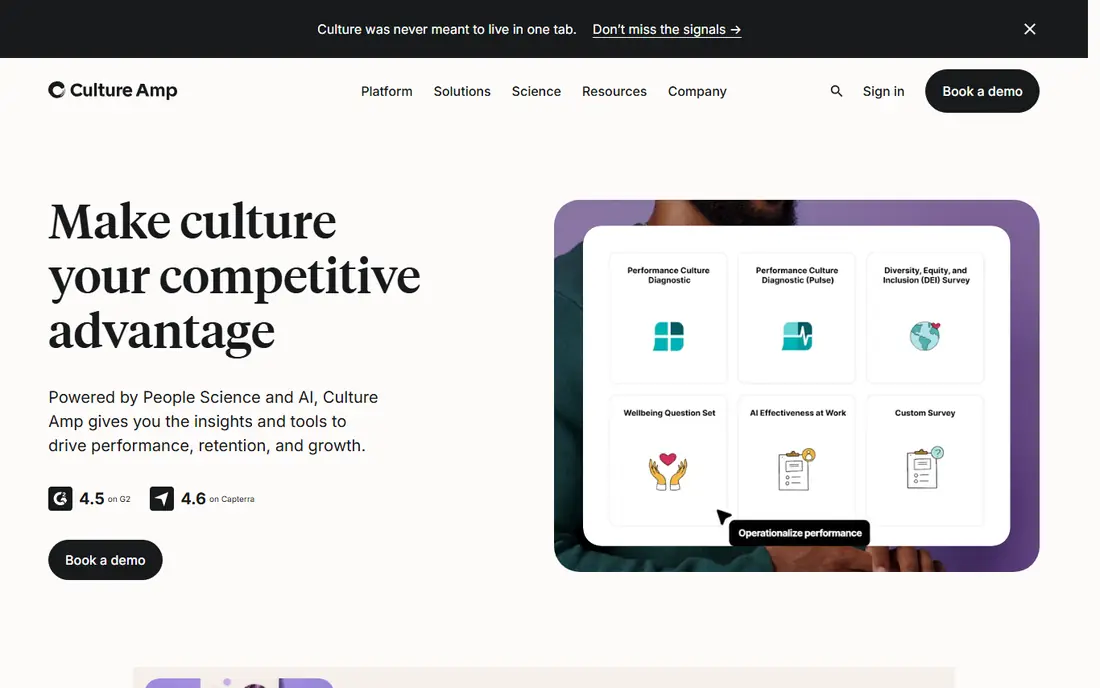
Culture Amp built its name on survey quality. Its 360 and effectiveness surveys sit inside Engage and Perform modules, with question sets grounded in people science and benchmarks that let a company compare results with similar organizations. For HR teams that want credible data rather than a simple form, that research base is the main draw.
The trade-off is opacity and effort. Pricing is not published as a simple per-person list, and contracts are typically annual and sized by headcount and modules. Smaller teams may find the setup heavier than they need. For mid-size and larger companies that will run surveys repeatedly, Culture Amp is a strong, serious choice.
- Strong survey science
- Benchmarking against other companies
- Engagement plus performance modules
- Pricing is quote only
- Implementation takes time for larger teams
Lattice combines performance reviews, goals, engagement surveys and 360-style feedback in one platform. That matters because 360 results are more useful when they feed directly into review conversations and development goals, rather than living in a separate report. Published module pricing includes Performance from $10 per person per month, with Engagement and other modules priced separately.
The catch is total cost. Buying several modules can double the bill, and Lattice sets a minimum annual commitment in recent listings. Teams that only need occasional 360 surveys may be better served by a dedicated tool. Teams that want one performance home will find Lattice coherent and well designed.
- Reviews, goals and engagement in one place
- Clear module pricing
- Useful manager tools
- Modules add up quickly
- No free trial for a full test
15Five focuses on the habits around feedback, not just the annual survey. Weekly check-ins, praise, goals and review cycles help managers act on feedback throughout the year, and its Engage entry pricing starts from $4 per user per month in recent listings, with Perform higher. That makes it approachable for small and mid-size teams.
For a deep, standalone 360 program with complex rater groups and coaching reports, 15Five is less specialized than Spidergap or Qualtrics. Its strength is making feedback regular and manager-owned. If your main problem is that feedback happens once a year and then fades, 15Five addresses that directly.
- Weekly check-ins and feedback habits
- Simpler than enterprise suites
- Clear entry pricing
- 360 depth is less than dedicated tools
- Higher tiers needed for full performance features
Leapsome lets teams buy the modules they need, including reviews with 360 feedback, goals, engagement surveys and learning. That modular approach suits companies that want a full people platform without paying for every module at once. It is widely used by European mid-market teams and supports multiple languages and compliance needs.
Pricing is less transparent than Lattice, with effective rates often set by quote, so buyers should request a written total for their chosen modules and headcount. Setup still needs HR ownership, especially for review cycles and rater rules. For a growing European team that wants one platform, Leapsome is a balanced option.
- Modular reviews, goals and surveys
- Strong in European mid-market teams
- Clear workflows
- Effective price is often quote based
- Setup still needs HR time
Qualtrics is a survey platform first, and that shows in its depth. Teams can design complex 360 questionnaires, control rater groups, apply logic and analyze results in detail. Large organizations with many locations, languages and reporting needs will find few limits.
For a small team running one 360 cycle, Qualtrics is too much tool. Pricing is quoted, implementation can be heavy, and building a good 360 survey still requires survey design skill. Choose Qualtrics when survey complexity, scale or analytics justify the effort, not when a simple 360 report would do.
- Deep survey logic and reporting
- Enterprise scale
- Strong analytics
- Quote only pricing
- Overkill and complex for a simple 360 cycle
Spidergap is one of the few tools built mainly for 360 feedback, and it shows. Coaches, consultants and HR teams can set up a 360 survey in about half an hour in recent guides, invite raters by link, and produce a report designed for development conversations. Pricing starts from $989 per year for up to 30 assessments in recent listings.
The limit is scope. Spidergap does not replace a performance suite, so teams that want goals, engagement and reviews in one place will need another system. For a coach running leadership 360s, or an HR team running a focused leadership program, that focus is a benefit, not a gap.
- Built for 360 specifically
- Fast setup
- Clear coaching reports
- Annual price is high for a single leader
- Not a full HR suite
SurveySparrow makes surveys feel conversational, which can help response rates, and it supports employee engagement surveys alongside 360-style feedback. That combination suits small and mid-size teams that want one survey tool for several people programs without buying a full HR suite.
Pricing for 360 use is custom in recent listings, so the headline survey price may not reflect the full cost. Reporting depth also lags behind dedicated 360 tools. For teams that value ease of use and a trial before buying, SurveySparrow is worth testing, provided the 360 report format is checked with a real example first.
- Conversational surveys
- Engagement and 360 in one tool
- Trial available
- Custom pricing for 360 use
- Less depth than dedicated 360 tools
Primalogik offers 360 surveys plus performance reviews in a simpler package than enterprise suites. Small teams can run a 360 cycle without a long implementation project, and the trial lets HR test the survey and report before committing. That simplicity is the point.
The trade-off is ecosystem size. Integrations and advanced analytics are fewer than in Culture Amp, Lattice or Qualtrics, and pricing is not published. For a small team that wants a clean 360 process and a readable report, Primalogik is a practical shortlist entry. Larger teams with complex reporting needs should look higher up this list.
- Straightforward 360 surveys
- Performance reviews included
- Trial available
- Smaller vendor with fewer integrations
- Pricing not published
How we picked these
We compared vendor feature pages, pricing pages and independent comparisons, and kept only tools that are live in October 2026 and truly support 360 feedback. We mixed dedicated 360 tools with full performance suites, because buyers search for both. Where a vendor does not publish a price, we wrote See website rather than presenting a third-party estimate as a list price.
How to run a 360 survey well
Start with purpose. Tell participants whether the survey is for development or for a formal review, since that choice changes honesty and use. Set a minimum number of responses before any group result is shown, so no single rater can be identified from a small group. Choose raters who actually work with the person, not just people who like them.
Keep the questionnaire short and focused on behaviors that can change. A 20-minute survey with clear questions beats a long survey that people rush. Finally, plan the follow-up before launch: who discusses the report, what development goal follows, and when progress will be reviewed. Without that step, even a good survey becomes a report that sits unread.
Frequently asked questions
What is the best 360 feedback software?
For larger companies, Culture Amp and Lattice are strong choices because 360 feedback sits inside wider performance and engagement systems. For a focused leadership program, Spidergap is a strong dedicated choice. The best tool depends on team size, anonymity rules and whether you need a full HR suite.
What is the best 360 degree feedback software for small teams?
Smaller teams often do best with a simpler tool such as 15Five, SurveySparrow or Primalogik, or a dedicated tool like Spidergap for a single program. Check the trial, the report format and the minimum response rules before buying, since those details matter more than a long feature list.
How do 360 feedback tools protect anonymity?
Good tools group responses so individual raters cannot be identified, and they hold back results until a minimum number of responses arrive. Ask the vendor for its exact threshold, how manager and peer groups are shown, and whether free-text comments can identify a writer. Do not promise anonymity you cannot enforce.
How often should a company run 360 feedback?
Once a year is common for a full program, with lighter check-ins in between. Running 360 surveys too often can tire raters and reduce honest answers. For development, an annual cycle plus a follow-up review of progress is a sensible rhythm for most teams.
Are free 360 feedback tools worth using?
A free survey form can collect ratings, but it usually lacks anonymity thresholds, rater management and readable reports. For a single informal exercise, that may be enough. For a formal program, a dedicated tool or suite is safer, because anonymity and reporting quality protect trust in the process.
Sources we checked (8)

Online Jobs is an independent blog about careers, online work, learning new skills and the tools that help people earn. More about us.
Keep reading
All posts
n8n Alternatives
n8n alternatives compared for 2026, with Zapier, Make, Activepieces, and more, covering visual builders, code steps, self-hosting, and pricing models.

ZoomInfo Alternatives
The best ZoomInfo alternatives in 2026, compared on price, free plans, data coverage, and which tool fits small teams or large sales teams best in detail.
Zoom Alternatives for Webinars
Compare Zoom alternatives for webinars in 2026, from browser-based rooms to enterprise events, with prices, attendee limits, features and honest trade-offs.