Best Apollo Alternatives in 2026: 8 Tools Compared

How we put this together: we compare official feature and pricing pages, app store listings, privacy policies and public user reviews. Prices change, so check the provider's site before you pay.
Key takeaways
- ZoomInfo suits large sales teams that need deep company data, intent signals, and phone numbers at enterprise scale.
- Lusha and RocketReach suit individual reps who want fast contact reveals from LinkedIn and the web.
- Clay suits teams that want to combine many data sources into custom enrichment workflows, rather than relying on one database.
- Hunter and Snov.io suit budget-conscious teams that mainly need email finding, verification, and simple outreach.
- Compare cost per usable contact, not just monthly price, because credit systems and bounce rates change the real cost quickly.
Quick comparison
| Name | Who it suits | Starting price | Free option | |
|---|---|---|---|---|
 ZoomInfo | Enterprise sales intelligence | See website | No | Visit |
 Lusha | Fast LinkedIn contact reveals | $29 per month | Yes | Visit |
 RocketReach | Email and profile lookup | See website | Yes | Visit |
 Seamless.AI | Real-time contact search | See website | Yes | Visit |
 Snov.io | Budget email finding and outreach | $30 per month | Yes | Visit |
 LeadIQ | LinkedIn to CRM capture | $20 per month | Yes | Visit |
 Hunter | Email finding and verification | $49 per month | Yes | Visit |
 Clay | Data orchestration workflows | $134 per month | Yes | Visit |
The best Apollo alternatives
Apollo.io combines a contact database with sequences, a dialer, and CRM sync, which makes it a strong all-in-one for small sales teams. Teams leave Apollo when they need better phone data, better accuracy in a specific region, a different credit model, or a workflow that combines several data sources. Here are the alternatives that cover those reasons.
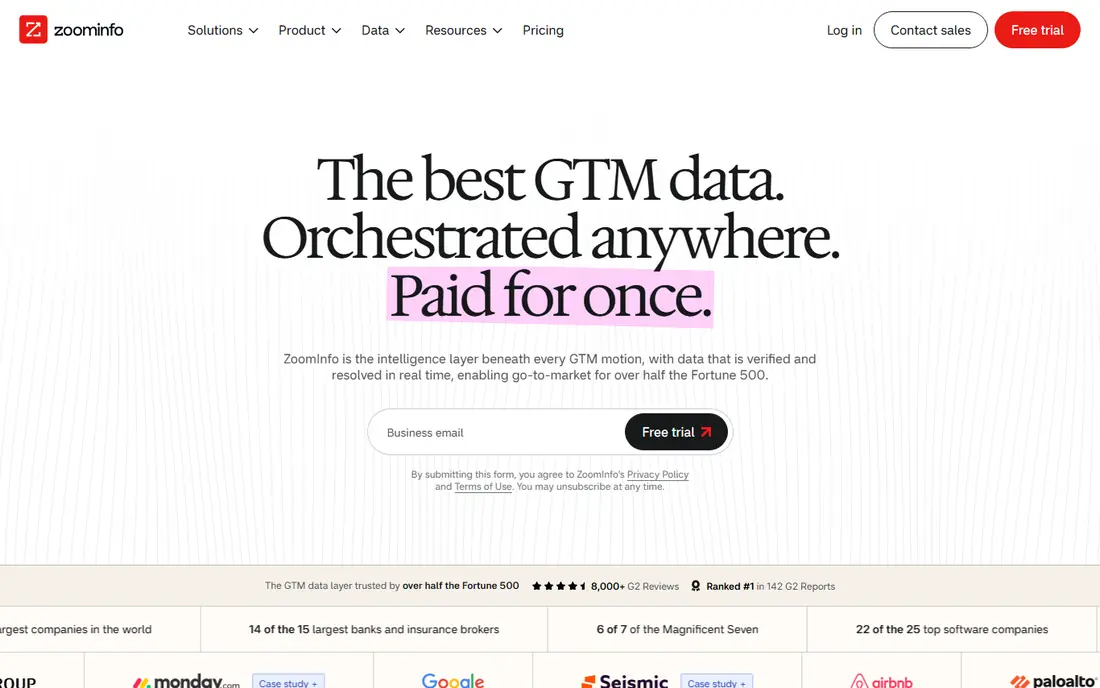
ZoomInfo is the enterprise standard many Apollo alternatives are measured against. It offers a large B2B database, company intelligence, intent data, org charts, technographics, and phone numbers, with integrations into major CRMs. Large sales organisations use it to build target account lists, find buying committees, and prioritise accounts showing intent signals.
The cost is the main barrier. ZoomInfo pricing is quote-based, usually annual, and add-ons for intent, global data, and extra users can raise the total well beyond the starting contract. Small teams will usually find it out of reach, but for a large team that lives in its CRM and needs reliable phone data, ZoomInfo remains the most complete single database option.
- Deep company and contact data
- Intent signals
- Org charts and technographics
- Enterprise pricing
- Annual contracts
- Add-ons raise the total cost
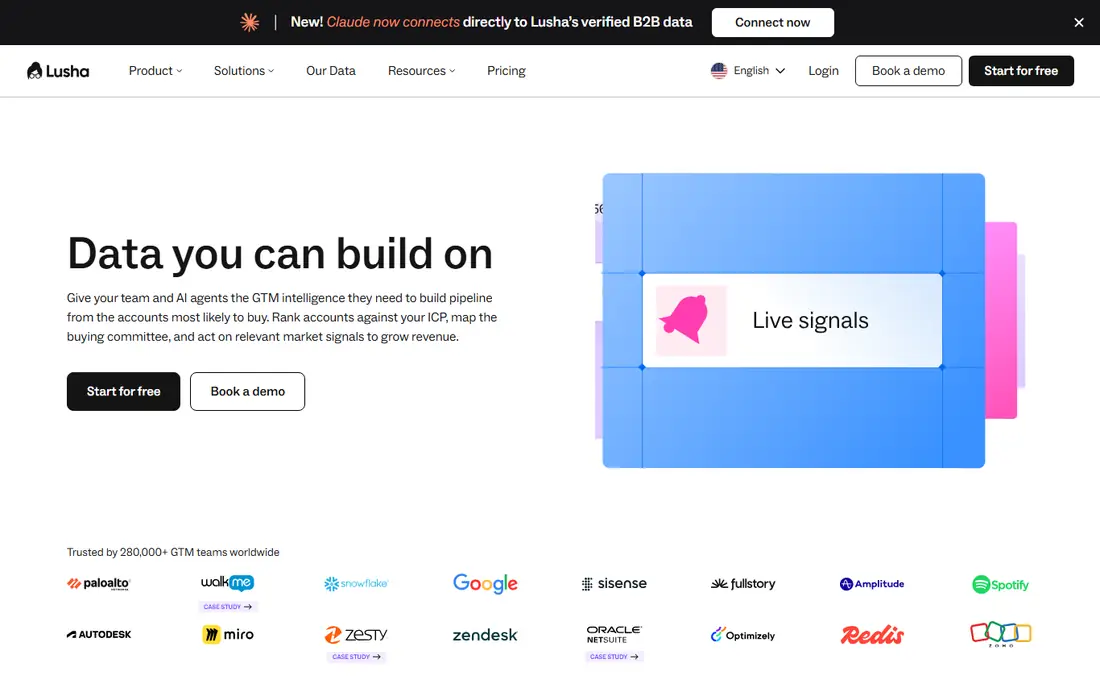
Lusha is built for speed. Its browser extension lets a rep reveal an email or phone number directly from a LinkedIn profile or company website, without exporting a list first. That workflow suits prospecting reps who work profile by profile and want to move fast between research and outreach.
A free plan with a small credit allowance lets you test accuracy for your market before paying. Phone numbers cost more credits than emails, so teams that need many direct dials should check the credit math for their monthly volume. Lusha is less suited to bulk list building than ZoomInfo, but for daily LinkedIn prospecting, it is one of the easiest tools to adopt.
- Simple Chrome extension
- Fast reveals on LinkedIn
- Free credits to test
- Credits burn quickly on phones
- Accuracy varies by region
- Bulk lists need higher tiers
RocketReach helps you find emails and profiles for people and companies, with search by name, company, title, and location. It suits recruiters, sales reps, and founders who need to find a decision maker at a specific company and verify an email before outreach. A free tier with a small monthly lookup allowance lets you test it on real targets.
Phone numbers are available on higher tiers, so email-focused teams will get better value than phone-heavy teams at the entry level. As with all databases, accuracy varies by industry and region, so verify important contacts before a large campaign. For email lookup at scale, RocketReach is a solid Apollo alternative.
- Large profile database
- Email lookup by name and company
- Bulk search options
- Phone data needs higher tiers
- Pricing varies by plan
- Accuracy varies by industry
Seamless.AI presents itself as a real-time search engine for contacts, rather than a static database that is only updated on a schedule. It searches for emails, phone numbers, and company details when you run a query, and it includes built-in tools for email, dialling, and task management on paid plans. That model appeals to teams that want fresh results for fast-moving markets.
A free plan with a small credit allowance lets you test search quality for your niche. Paid pricing is quote-based for higher tiers, so small teams should confirm the monthly cost and credit limits before committing. If Apollo's database misses contacts in your market, Seamless.AI is worth testing as a second source.
- Real-time search engine model
- Large contact index
- Built-in outreach tools
- Paid pricing is quote-based
- Credit model needs care
- Data quality varies
Snov.io combines an email finder, a verifier, and a simple outreach platform, which makes it a good budget alternative for teams that want finding and sending in one place. You can find emails by domain or by name, verify them before sending, and run email sequences with tracking, without buying three separate tools.
The database is smaller than the largest enterprise databases, so match rates may be lower for niche industries or regions outside North America and Europe. Deliverability also depends on your domain setup, sending volume, and list quality, not just on the tool. For startups and small sales teams on a budget, Snov.io offers a lot of function for its starting price.
- Email finder, verifier, and outreach in one tool
- Affordable starter plan
- Free tier
- Database is smaller than ZoomInfo
- Deliverability needs care
- Some features need higher tiers
LeadIQ is built around a simple workflow. While browsing LinkedIn or Sales Navigator, a rep clicks to capture a prospect, enrich the contact, and push it to a CRM such as Salesforce or HubSpot. That one-click flow saves the copy-and-paste work that slows down many prospecting routines, and it keeps CRM records cleaner.
Champion tracking alerts you when a past customer or champion changes jobs, which can open a warm introduction at a new company. Credit limits and phone costs matter on lower tiers, so check how many captures and phone reveals your team needs each month. For teams that prospect mainly on LinkedIn, LeadIQ is a focused, practical Apollo alternative.
- One-click capture from LinkedIn and Sales Navigator
- CRM sync
- Champion tracking
- Credit limits on lower tiers
- Phone data costs extra credits
- Best for LinkedIn-heavy teams
Hunter does one job well. It finds email addresses associated with a domain, verifies whether an address is deliverable, and helps you find the right pattern for a company. That simplicity suits marketers, founders, and sales reps who mainly need email outreach and do not need a full sales engagement platform.
Hunter does not offer a phone database or a full company intelligence suite, so teams that need direct dials will need a second tool. It also does not include sequences or a dialer, so you will pair it with your CRM or email tool for sending. For email-first prospecting, its accuracy, verification, and clear pricing make it easy to justify.
- Domain search and email verifier
- Simple interface
- Credits roll over on paid plans
- Email only, no phone database
- Smaller company data
- Outreach needs another tool
Clay is different from the other tools on this list. Instead of giving you one database, it lets you build tables that pull data from many providers, enrich contacts with AI, score leads, and push results to your CRM. If one provider misses a phone number, Clay can try another provider in the same workflow, which improves match rates for hard-to-find contacts.
That flexibility comes with a learning curve and a higher starting price. Clay suits RevOps teams and advanced prospecting teams that want to design their own enrichment logic, not reps who want a single search box. If Apollo's single database leaves too many gaps, Clay offers a way to fill those gaps systematically, provided someone on the team owns the workflows.
- Combines many data providers
- AI enrichment workflows
- Flexible table-based building
- Higher starting price
- Learning curve
- Credit costs vary by provider
How we picked these
We reviewed official feature pages, pricing pages, documentation, and public reviews for tools that find B2B contacts, enrich company data, or support sales prospecting as a core function. We looked at database coverage, email and phone accuracy, credit models, CRM integrations, and whether a free plan lets you test real contacts. We did not claim hands-on testing for every tool, and we treated accuracy figures as vendor or third-party claims that vary by market.
We also kept Apollo itself out of the list, because the keyword asks for alternatives. Each pick solves a different reason teams leave Apollo, from phone data and regional accuracy to budget, workflow, and data orchestration.
Choosing the right Apollo alternative
Start with how your team actually prospects. If reps work mainly on LinkedIn, Lusha or LeadIQ may fit better than a bulk database. If you build large lists for campaigns, ZoomInfo, RocketReach, or Clay may fit better. If email is your main channel, Hunter or Snov.io may be enough, at a lower cost.
Compare cost per usable contact
Divide the monthly price by the number of contacts you can actually email or call after verification, not by the headline credit count. A cheap tool with high bounce rates can cost more in lost deliverability and wasted sending time than a pricier tool with cleaner data. Test a sample list from each shortlisted tool before committing to an annual contract.
Check compliance and data sources
B2B contact data is regulated differently by region, especially in Europe under GDPR. Ask how a vendor sources data, how it handles opt-outs, and whether it offers data processing terms for your region. A tool that works well in the US may need extra care for European prospecting, so confirm compliance before a large rollout.
Test with your real target list
Vendor demos use clean, well-known companies. Your test should use your real target accounts, including smaller firms and niche titles. Measure match rate for emails and phones, check how many contacts are current, and see how easily results flow into your CRM. That test tells you more than a database size claim.
Frequently asked questions
What is the best alternative to Apollo.io?
For large teams, ZoomInfo is the most complete alternative. For individual reps, Lusha and LeadIQ are strong for LinkedIn prospecting. For budget teams, Snov.io and Hunter cover email finding well, while Clay suits teams that want to combine many data sources.
Is there a free Apollo alternative?
Hunter, Snov.io, Lusha, LeadIQ, RocketReach, Seamless.AI, and Clay all offer free plans or free credits, but free tiers are limited and usually lack phone data or bulk features. For serious prospecting volume, a paid plan is normally needed.
Why do teams switch from Apollo?
Common reasons include phone data gaps, accuracy issues in a specific region, credit limits, deliverability concerns, and a need for a different workflow, such as LinkedIn capture or multi-provider enrichment. The best alternative depends on which of those reasons matters most to your team.
Is ZoomInfo better than Apollo?
ZoomInfo generally offers deeper company data, intent signals, and phone coverage, but at a much higher enterprise price. Apollo offers a stronger all-in-one package for small teams, with sequences and a dialer included. For large teams with budget, ZoomInfo often wins on data depth alone.
Do these tools work with Salesforce and HubSpot?
Yes, most tools on this list integrate with Salesforce, HubSpot, or both, either natively or through their browser extensions and APIs. Check the specific integration for your CRM plan, because some sync features require a higher tier.
How accurate is B2B contact data?
Accuracy varies by provider, industry, region, and how recently a person changed jobs. No database is perfect, so verify important contacts, use email verification before large sends, and expect to supplement any single source with a second source for hard-to-find roles.
Sources we checked (8)

Online Jobs is an independent blog about careers, online work, learning new skills and the tools that help people earn. More about us.
Keep reading
All posts
ZoomInfo Alternatives
The best ZoomInfo alternatives in 2026, compared on price, free plans, data coverage, and which tool fits small teams or large sales teams best in detail.

Workday Alternatives
We compared the best workday alternatives for HR, payroll, and global hiring, from BambooHR and Gusto to Rippling, Deel, and HiBob for growing teams in 2026.
Which SaaS Tools Have the Best Customer Support
Which SaaS tools have the best customer support? Compare eight popular tools on help centres, live help, response options and overall support quality.