Best Amplitude Alternatives in 2026: 9 Tools Compared

How we put this together: we compare official feature and pricing pages, app store listings, privacy policies and public user reviews. Prices change, so check the provider's site before you pay.
Key takeaways
- Mixpanel is the closest like-for-like Amplitude alternative, with event-based funnels, retention and cohorts in a self-serve interface.
- PostHog suits engineering-led teams that want analytics, session replay, feature flags and surveys in one open-source platform.
- Heap suits teams that want retroactive analysis without upfront tagging, while Pendo suits SaaS teams that also need in-app guides and feedback.
- Google Analytics 4 and Matomo suit teams that need free or privacy-first web analytics, but neither replaces Amplitude's product analytics depth on its own.
Quick comparison
| Name | Who it suits | Starting price | Free option | |
|---|---|---|---|---|
 Mixpanel | Event-based product analytics | See website | Yes | Visit |
 PostHog | All-in-one open-source platform | See website | Yes | Visit |
 Heap | Autocapture without manual tagging | See website | Yes | Visit |
 Pendo | Analytics plus in-app guidance | See website | Yes | Visit |
 Google Analytics 4 | Free web and app measurement | Free | Yes | Visit |
 Matomo | Privacy-first self-hosted analytics | Free | Yes | Visit |
 FullStory | Session replay and experience insight | See website | Free trial | Visit |
 Hotjar | Heatmaps, recordings and surveys | $32 per month | Yes | Visit |
 Countly | Self-hosted product analytics | See website | Yes | Visit |
The best Amplitude alternatives
Amplitude is strong on behavioural cohorts, journeys and experimentation, so a good alternative needs to match the job your team actually uses it for. Some teams need deep event analysis, others need replay and qualitative insight, and others need a cheaper or more private option. The nine tools below cover those different jobs, and the right pick starts from your team's main question, not from a feature checklist.
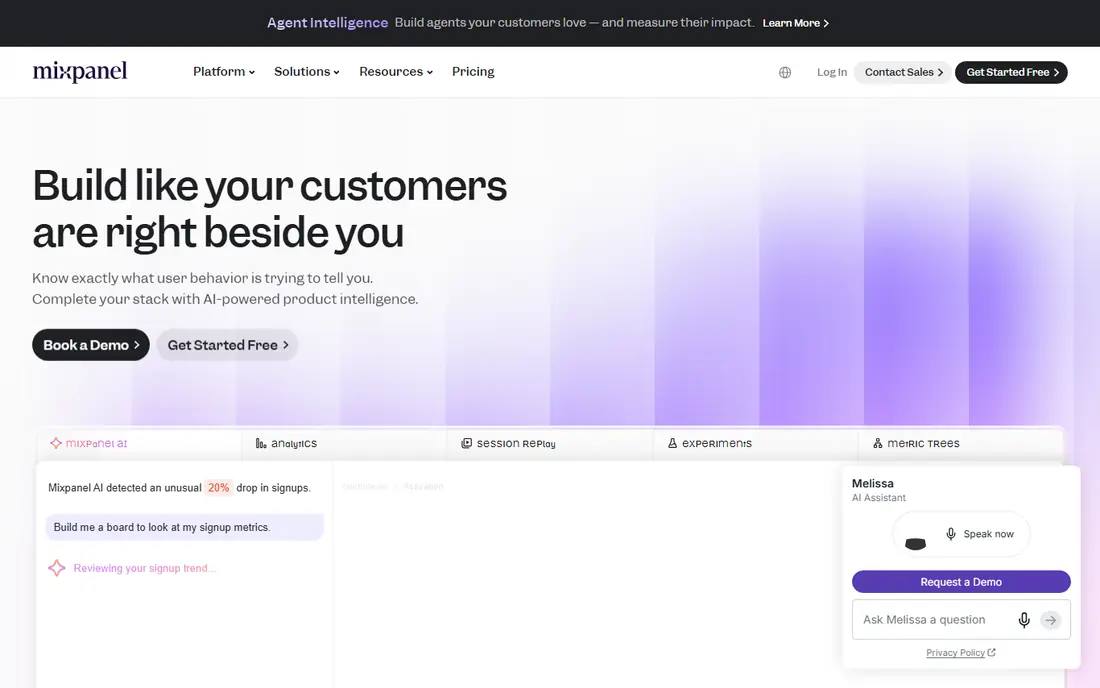
Mixpanel is the most direct Amplitude alternative for product teams. Event-based funnels, retention curves, cohorts and flows answer the same questions Amplitude answers, through a self-serve interface that non-technical product managers can use without waiting on an analyst. A free tier covering up to one million events a month lets small teams start properly before paying.
The pricing model is the watch point. Paid plans are usage-based, so event volume drives the bill, and teams that track everything will pay more than teams that track key events well. Session replay is also limited next to dedicated replay tools. For a product team that wants Amplitude-style analysis with a faster learning curve, Mixpanel is the first alternative to test.
- Fast self-serve funnels, retention and cohorts
- Strong for product-led growth
- Generous free event tier
- Costs rise with event volume
- Session replay is limited compared with FullStory
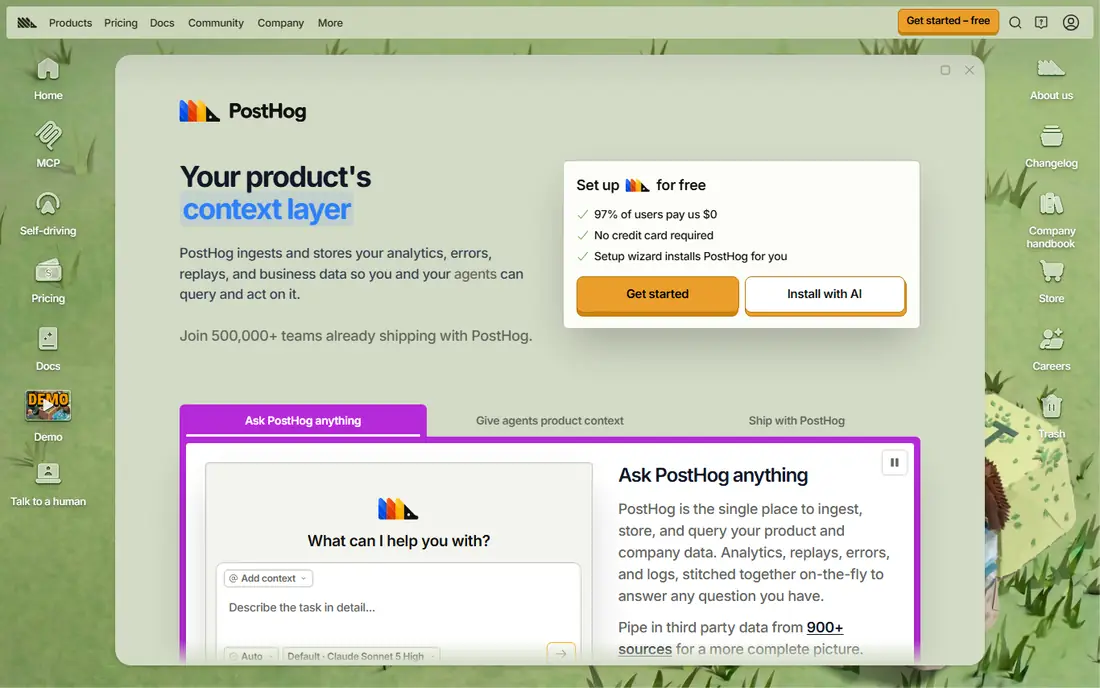
PostHog is the best alternative for engineering-led teams that want one platform instead of four subscriptions. Product analytics sits alongside session replay, feature flags, surveys, experiments and error tracking, and the open-source code can be self-hosted for teams with privacy or data control requirements. A free tier covers one million events and thousands of recordings a month.
Breadth is also the challenge. PostHog packs many products into one interface, and teams that only need analytics may find it busier than Mixpanel. Self-hosting adds maintenance work. For a technical team that wants analytics plus the surrounding product tools, PostHog offers the most for the least subscription sprawl.
- Analytics, replay, feature flags and surveys in one platform
- Open source with self-hosting
- Generous free tier
- Needs technical setup for full value
- Interface packs many products
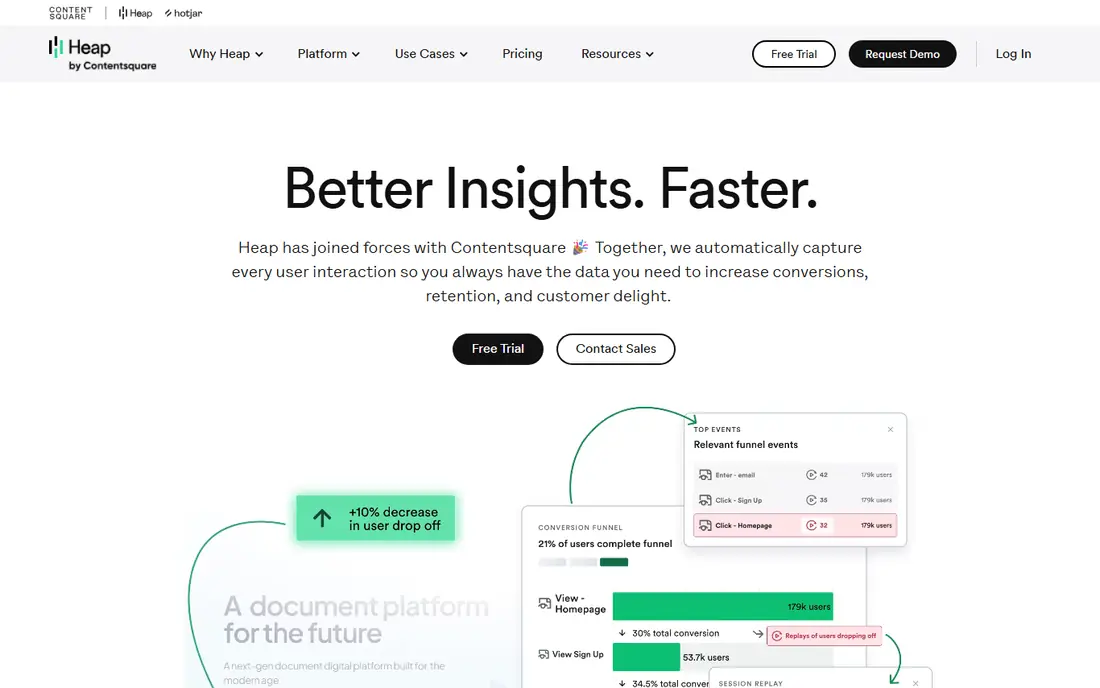
Heap solves the tagging problem that slows many analytics projects. Instead of planning and tagging every event in advance, Heap autocaptures page views, clicks, taps and form interactions, so a team can define and analyse events retroactively when a question arises. That flexibility suits teams that move fast and cannot predict every question they will ask next quarter.
Paid pricing is quote-based, and session replay costs extra, so budget from a sales conversation rather than a public price list. At high volumes, Heap can also become expensive. For a team that has been burned by missing events in a manually tagged setup, Heap's autocapture is a genuine advantage worth paying for.
- Autocapture records interactions without upfront tagging
- Retroactive analysis
- Free tier available
- Paid pricing is quote-based
- Session replay is an add-on
- Costs rise at scale
Pendo suits SaaS teams that need analytics plus the tools to act on it inside the product. Usage analytics show where users struggle, and in-app guides, onboarding flows and feedback surveys help fix those spots without a release. A free tier covers up to 500 monthly active users, which suits early-stage SaaS products testing product-market fit.
Analytics depth is lighter than Amplitude or Mixpanel for advanced cohort and journey work, and paid pricing is quote-based. Pendo wins when the job is adoption and guidance as much as measurement: a team that wants to guide users through a product, not just watch them, will get more from Pendo than from a pure analytics tool.
- Product analytics with in-app guides, onboarding and feedback
- Free tier to 500 monthly active users
- Strong for SaaS
- Paid pricing is quote-based
- Analytics depth is lighter than Amplitude for some teams
Google Analytics 4, or GA4, is the free baseline every team should consider, especially for marketing measurement. The standard plan is free, it covers websites and apps, and BigQuery export supports deeper analysis for teams with data skills. For traffic, acquisition and basic conversion questions, GA4 answers them at no cost.
It is not a like-for-like Amplitude replacement. Funnel, cohort and retention analysis are less flexible, event modelling works differently, and privacy settings need attention for regulated audiences. Use GA4 alongside a product analytics tool, or on its own if your questions are mainly about acquisition and site performance rather than in-product behaviour.
- Free standard plan
- Broad web and app measurement
- BigQuery export available
- Product analytics depth is limited
- Event modelling differs from Amplitude
- Privacy controls need care
Matomo is the privacy-first alternative. The self-hosted edition is free and open source, data stays on your own servers, and no third party shares in your visitor data by default. That ownership appeals to European teams, public sector organisations and any company with strict data rules. A cloud plan from around 29 euros a month suits teams that prefer hosted service.
Product analytics depth is partial compared with Amplitude: funnels and cohorts exist, but the product is rooted in web analytics rather than in-product behaviour analysis. Self-hosting also needs maintenance. For a team whose first requirement is data ownership, Matomo is the right alternative. For deep product analysis, pair it with PostHog or Mixpanel.
- Self-hosted free edition
- Full data ownership
- Privacy-focused design
- Product analytics features are partial
- Cloud pricing is per-hit
- Self-hosting needs maintenance
FullStory answers a different question from Amplitude: not how many users converted, but why a specific user struggled. Session replay, frustration signals and journey views show rage clicks, dead clicks and error paths that numbers alone hide. Product and engineering teams use it to debug onboarding, checkout and key flows with evidence rather than guesses.
It is a complement, not a replacement. Quantitative analytics breadth is narrower than Amplitude, and pricing is quote-based, aimed at mid-market and enterprise teams. Pair FullStory with Mixpanel or PostHog for numbers plus replay, or use it alone if your main problem is understanding friction in a few critical flows.
- Excellent session replay
- Frustration signals and journey insight
- Strong for debugging experience problems
- Pricing is quote-based
- Analytics breadth is narrower than Amplitude
- Best as a complement
Hotjar is the affordable qualitative tool in this list. Heatmaps show where users click and scroll, recordings show how they move through a page, and surveys capture feedback in context. Paid plans start at $32 per month, with a free plan for small sites, and setup is a single script tag. For UX teams and small product teams, Hotjar delivers insight fast.
The scope is page-level, not product-wide. Hotjar will not replace Amplitude's funnels, cohorts and retention analysis across a whole app. Use it to understand friction on key pages, and pair it with GA4 or Mixpanel for the numbers. For a small team that needs to see what users actually do, Hotjar is the best-value starting point.
- Heatmaps and recordings at a low price
- Surveys and feedback built in
- Easy to set up
- Page-level insight, not full product analytics
- Session limits on lower plans
Countly is a self-hosted product analytics platform with event tracking, funnels, retention, cohorts and crash reporting, aimed at teams that want Amplitude-style analysis with full data control. A community edition supports self-hosting, and enterprise plans add support and advanced features. Mobile analytics are a particular strength, with SDKs for major platforms.
The ecosystem is smaller than Mixpanel or PostHog, so integrations and community resources are thinner, and self-hosting needs technical attention. Countly suits a technical team, especially a mobile team, that wants product analytics on its own servers without Amplitude's pricing or data terms. For a non-technical team, a hosted tool will be easier to run.
- Self-hosted product analytics
- Event, funnel and retention analysis
- Data ownership
- Smaller ecosystem than rivals
- Self-hosting needs technical care
- Pricing varies
How we picked these
We compared official feature and pricing pages for product and web analytics tools that teams commonly evaluate against Amplitude, and we kept only tools actively sold and supported in 2026. We covered event analytics, autocapture, replay, guidance, free web analytics and self-hosted options, because Amplitude buyers leave for different reasons: price, privacy, replay needs or guidance features. Where pricing is quote-based or usage-based, we say so rather than publishing a figure that would not match a reader's bill.
Switching without losing history
Map your key events before you migrate
List the ten events and five funnels your team actually checks weekly, and rebuild those first in the new tool. Migrating every historical event at once wastes weeks, while a focused set of key metrics lets the team judge the new tool on real decisions within days.
Run both tools for a month
Overlap Amplitude and its replacement for at least one reporting cycle, so numbers can be compared and tagging gaps found before Amplitude is cancelled. Expect small differences from different session and event definitions, and document them, so a later reader does not mistake a definition change for a product change.
Decide what history matters
Full historical event data rarely transfers cleanly between tools. Export key reports and cohort summaries before cancelling, and accept that raw event history may stay in Amplitude's export rather than living in the new tool. Teams that need long history should plan the export early, not in the final week of a contract.
Frequently asked questions
What is the best alternative to Amplitude?
Mixpanel is the closest like-for-like alternative for event-based product analytics, while PostHog is the best all-in-one alternative for technical teams. Heap suits teams that want autocapture, Pendo suits SaaS teams that need in-app guidance, and GA4 suits teams that mainly need free web measurement. Pick by the job Amplitude does for your team today.
Is Mixpanel better than Amplitude?
Mixpanel is easier to learn and faster for self-serve funnel and retention analysis, while Amplitude is stronger for deep behavioural cohorts, journeys and experimentation at enterprise scale. Small and mid-size product teams often find Mixpanel quicker to adopt, while large teams with complex analysis needs may stay with Amplitude. Test both on your own key events before switching.
What is a free alternative to Amplitude?
Google Analytics 4 is free for standard web and app measurement, Matomo's self-hosted edition is free, and PostHog, Mixpanel, Heap and Pendo all offer free tiers with event or user limits. Free tiers suit small products and testing, but growing products will hit limits and need a paid plan or a self-hosted option.
What is the best privacy-focused Amplitude alternative?
Matomo and PostHog lead on privacy, thanks to self-hosting options and data ownership, while Countly offers self-hosted product analytics for mobile and web teams. Self-hosting gives the most control but needs maintenance, while PostHog's cloud free tier suits teams that want privacy features without running servers.
Why do teams switch from Amplitude?
Teams usually switch for price, simpler self-serve analysis, autocapture, session replay, in-app guidance or data ownership. Mixpanel and PostHog address price and simplicity, Heap addresses tagging effort, FullStory and Hotjar address replay and qualitative insight, and Matomo and Countly address privacy. Naming your reason first makes the shortlist much shorter.
Sources we checked (9)

Online Jobs is an independent blog about careers, online work, learning new skills and the tools that help people earn. More about us.
Keep reading
All posts
ZoomInfo Alternatives
The best ZoomInfo alternatives in 2026, compared on price, free plans, data coverage, and which tool fits small teams or large sales teams best in detail.

Workday Alternatives
We compared the best workday alternatives for HR, payroll, and global hiring, from BambooHR and Gusto to Rippling, Deel, and HiBob for growing teams in 2026.
Which SaaS Tools Have the Best Customer Support
Which SaaS tools have the best customer support? Compare eight popular tools on help centres, live help, response options and overall support quality.