Alternatives to Consul in 2026: 8 Tools Compared

How we put this together: we compare official feature and pricing pages, app store listings, privacy policies and public user reviews. Prices change, so check the provider's site before you pay.
Key takeaways
- Consul combines service discovery, configuration, health checking, and service mesh, so most alternatives replace only part of that set.
- etcd is the best key-value alternative for configuration and coordination, especially in Kubernetes environments.
- ZooKeeper suits teams with existing Java and Hadoop-style systems, while Eureka suits Spring-based Java services.
- Nacos combines discovery and configuration for cloud-native Java and microservice teams.
- Kubernetes built-in discovery may remove the need for a separate tool if all your services already run on Kubernetes.
Quick comparison
| Name | Who it suits | Starting price | Free option | |
|---|---|---|---|---|
 etcd | Key-value coordination and config | Free | Yes | Visit |
 Apache ZooKeeper | Coordination for distributed systems | Free | Yes | Visit |
 Netflix Eureka | Service discovery for Spring services | Free | Yes | Visit |
 Alibaba Nacos | Discovery and config for microservices | Free | Yes | Visit |
 CoreDNS | DNS-based service discovery | Free | Yes | Visit |
 Kubernetes Service Discovery | Discovery inside Kubernetes | Free | Yes | Visit |
 Traefik | Discovery with routing and load balancing | Free | Yes | Visit |
 HashiCorp Nomad Service Discovery | Discovery for Nomad workloads | Free | Yes | Visit |
The best alternatives to Consul
Consul does several jobs at once: services register themselves, clients discover them, health checks remove sick instances, configuration is shared, and a service mesh can secure traffic. No single open-source tool replaces all of that in one package. We compared official project pages to sort alternatives by the job they do best, so you can pick one tool or a small combination that covers your needs.
etcd is a distributed key-value store built for consistency and coordination, and it powers Kubernetes control planes. Teams use it to store configuration, coordinate leaders, and share state that must stay consistent across machines. Its Raft consensus model gives strong guarantees, which matters for systems where a wrong value causes real damage.
etcd alone is not a Consul replacement. It does not provide service health checking, DNS discovery, or a service mesh out of the box, so teams pair it with a discovery layer or a platform such as Kubernetes. Choose etcd when consistent configuration and coordination are the core need, and add discovery separately if your services need it.
- Free and open source
- Strong consistency
- Core to Kubernetes control planes
- Key-value store only, not full service discovery
- Needs a client or wrapper for health checks
- Operations need care at scale
ZooKeeper has coordinated distributed systems for years, managing configuration, naming, leader election, and synchronization for tools such as Kafka, Hadoop, and Solr. Its watch mechanism lets services react to changes, which is useful for configuration updates and coordination tasks. Teams with existing ZooKeeper deployments often keep it because it works and their tools already speak to it.
New projects rarely start with ZooKeeper today. Operations are heavier than etcd, the design is older, and it does not offer Consul's health-checked discovery or mesh features. Choose ZooKeeper when you already run systems that depend on it. For a new build, etcd or Kubernetes discovery will usually be simpler.
- Free and open source
- Proven coordination for distributed systems
- Wide integration with Java and big data tools
- Older design and operations model
- Needs Java expertise
- Not a modern service mesh
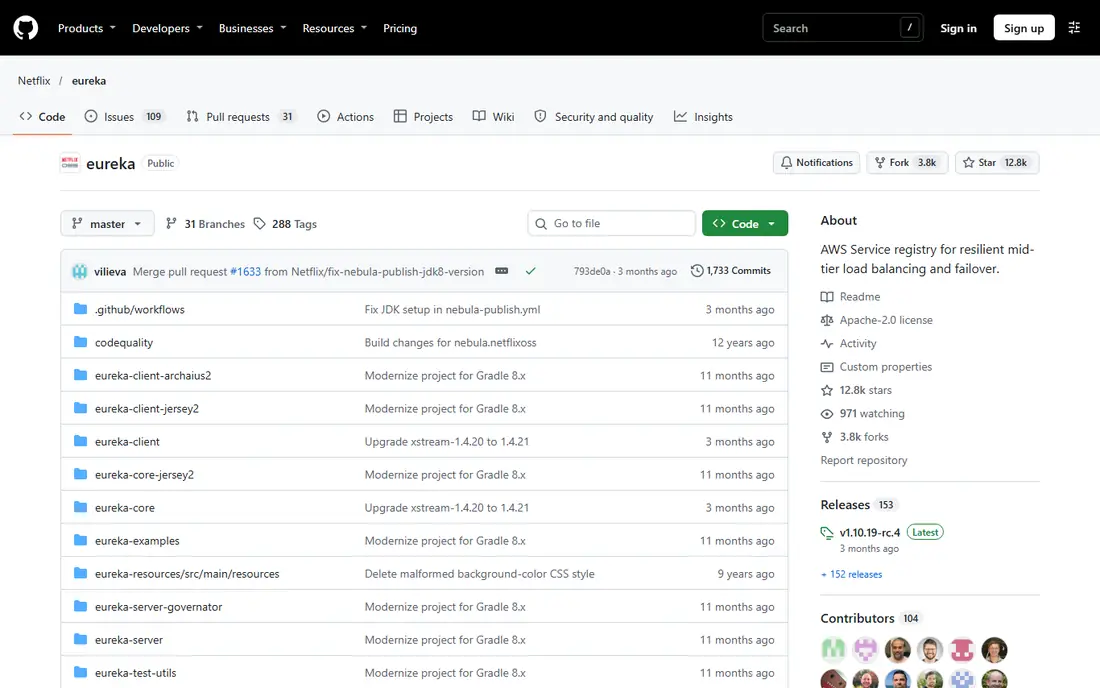
Eureka is a service registry from Netflix, widely used with Spring Cloud. Services register themselves, clients fetch the registry and choose an instance, and unhealthy instances age out. For a Java team already on Spring Boot and Spring Cloud, Eureka feels natural and adds little new complexity.
Outside Spring, the value drops. Eureka does not store general configuration, run a service mesh, or provide the DNS and health features Consul offers. Teams often pair Eureka with Spring Cloud Config for configuration. Choose Eureka when your stack is Spring-based and discovery is the main gap. Choose a broader tool when you need configuration and mesh as well.
- Free and open source
- Simple service registry for Spring Cloud
- Client-side load balancing support
- Java and Spring focus
- Needs Spring Cloud for full value
- No built-in configuration or mesh features
Nacos combines service discovery and dynamic configuration in one open-source platform, which covers two of Consul's main jobs without a second tool. Services register, clients discover them, and configuration can change at runtime without redeploying. That combination suits microservice teams, especially those building cloud-native systems in Java.
English documentation and community support are thinner than for etcd or Kubernetes, so teams should test setup and troubleshooting before committing. Nacos also leans toward Java ecosystems, though clients exist for other languages. If you want discovery plus configuration in one free tool, Nacos is one of the closest Consul matches here.
- Free and open source
- Combines discovery and configuration
- Strong for cloud-native microservices
- Documentation and community are thinner in English
- Java-centric ecosystem
- Operations need planning at scale
CoreDNS is a DNS server that can answer service discovery queries from a backend such as etcd or Kubernetes. Since almost every program can resolve DNS, CoreDNS gives discovery without a special client library, which is useful for legacy services and mixed-language systems. It is also the default DNS server in Kubernetes, so many teams already run it.
DNS discovery has limits. Caching can delay updates, health information is coarse, and CoreDNS does not manage configuration or secure service-to-service traffic. Use CoreDNS as the discovery front end, with etcd or Kubernetes as the source of truth behind it. That pair covers discovery cleanly for many systems.
- Free and open source
- DNS-based discovery works with many clients
- Default DNS in Kubernetes
- DNS only, so no rich health or config features
- Caching can delay updates
- Needs another store for state
Kubernetes Service Discovery
Who it suits: Discovery inside Kubernetes
If all your services run on Kubernetes, you may not need a separate discovery tool at all. Kubernetes Services give each service a stable address, CoreDNS resolves service names, and readiness probes remove unhealthy pods from the load-balanced set. That covers the core discovery and health jobs Consul provides for container workloads.
The limit is scope. Services outside Kubernetes, such as virtual machines, databases, or legacy apps, do not get this discovery for free, and cross-cluster discovery needs extra tooling. Configuration still needs ConfigMaps, Secrets, or a store such as etcd. Choose Kubernetes discovery when your platform is already Kubernetes, and add another tool only for services outside the cluster.
- Built into Kubernetes
- Services and DNS handle discovery
- Health checks remove sick pods
- Only helps inside Kubernetes
- Cross-cluster and non-Kubernetes services need another tool
- No general config store
Traefik is a reverse proxy and load balancer that discovers services from providers such as Docker, Kubernetes, and file configuration, then routes traffic to healthy instances. For teams that mainly need discovery plus routing, Traefik can replace part of a Consul setup with less moving machinery. Automatic TLS and middleware for headers and auth add practical value.
Traefik is not a general service registry or configuration store. Services must be visible through one of its providers, and rich health and mesh policies need other tools. Choose Traefik when routing is the main job and discovery can ride along with it. Choose etcd or Nacos when you need a registry that other systems query directly.
- Free and open source
- Discovers services from many providers
- Routing, load balancing, and TLS in one proxy
- Proxy and router, not a general registry
- Configuration is provider-based
- Mesh features are limited
HashiCorp Nomad Service Discovery
Who it suits: Discovery for Nomad workloads
Nomad, also from HashiCorp, includes built-in service discovery for jobs it schedules. Services registered by Nomad can be discovered by other Nomad jobs, with health checks tied to task status. For teams already running Nomad instead of Kubernetes, this built-in discovery avoids adding a separate registry for most workloads.
The tie to Nomad is the limit. If you do not run Nomad, this option does not apply, and its ecosystem is smaller than Kubernetes discovery. Nomad discovery also does not replace Consul's mesh or full configuration features. Choose it when Nomad is your scheduler and you want discovery without another system to operate.
- Free and open source
- Built-in discovery for Nomad jobs
- Pairs well with existing HashiCorp tooling
- Tied to Nomad
- Not a standalone discovery product
- Smaller ecosystem than Kubernetes discovery
How we picked these
We compared official project pages for tools that cover at least one core Consul job: service registration and discovery, health checking, configuration, or routing. We kept free, open-source, and actively maintained projects, and we left out paid-only service meshes and single-language libraries that cannot serve as a registry. Where a tool needs a companion for full Consul parity, we said so rather than overstating its scope.
Replacing Consul without losing features
List the Consul features you actually use before picking a replacement. If you use only discovery, Kubernetes discovery, Eureka, or Nacos may suffice. If you use discovery plus configuration, Nacos or etcd with a discovery front end fits better. If you use the service mesh, you will need a mesh tool such as Istio or Linkerd alongside your registry, since none of the tools above is a full mesh. Mapping features first prevents a replacement that looks simpler but drops a job your system depends on.
Migration checklist
Run the new registry alongside Consul, migrate one service at a time, and keep health checks in both systems during the cutover. Test failure cases, such as a dead instance and a registry outage, before removing Consul. Update client libraries and DNS settings in stages, and keep a rollback plan for the first few services. A careful staged migration beats a fast switch that breaks discovery at peak traffic.
Frequently asked questions
What are the best Consul alternatives?
etcd is the best key-value and coordination alternative, Nacos is the closest free combination of discovery and configuration, and Kubernetes discovery is the best option inside Kubernetes. Eureka suits Spring teams, while CoreDNS suits DNS-based discovery. The best pick depends on which Consul features you use.
Is etcd a good alternative to Consul?
etcd is a good alternative for consistent configuration and coordination, but not a full Consul replacement on its own. It lacks built-in health-checked service discovery and a service mesh, so pair it with Kubernetes, CoreDNS, or another discovery layer if your services need those features.
What is the best open-source alternative to Consul?
For discovery plus configuration, Nacos is the strongest free open-source match. For coordination, etcd leads. For Kubernetes workloads, built-in Kubernetes discovery plus CoreDNS is often enough. All three are free, so trial them on a non-critical service before migrating production traffic.
Can Kubernetes replace Consul?
Yes, for services inside Kubernetes, since Services, DNS, and readiness probes cover discovery and health checking. Kubernetes does not cover services outside the cluster, cross-cluster discovery, or a full service mesh on its own. Teams with mixed infrastructure usually keep a registry or mesh alongside Kubernetes.
What is the difference between Consul and Eureka?
Consul is a multi-feature platform covering discovery, health checks, configuration, and mesh across languages, while Eureka is a simpler service registry focused on Spring Cloud Java services. Eureka is easier for a Spring team that needs discovery only. Consul fits mixed-language systems that need more than a registry.
Should I replace Consul at all?
Not always. If you use discovery, configuration, health checks, and mesh together, Consul's combined package may be simpler than assembling several tools. Replace it when one job dominates your use, when your platform already provides discovery, or when operating Consul costs more than the value of its extra features.
Sources we checked (8)

Online Jobs is an independent blog about careers, online work, learning new skills and the tools that help people earn. More about us.
Keep reading
All posts
n8n Alternatives
n8n alternatives compared for 2026, with Zapier, Make, Activepieces, and more, covering visual builders, code steps, self-hosting, and pricing models.

ZoomInfo Alternatives
The best ZoomInfo alternatives in 2026, compared on price, free plans, data coverage, and which tool fits small teams or large sales teams best in detail.

Zoom Alternatives for Webinars
Compare Zoom alternatives for webinars in 2026, from browser-based rooms to enterprise events, with prices, attendee limits, features and honest trade-offs.