Best Alternatives to CockroachDB in 2026: 8 Databases Compared

How we put this together: we compare official feature and pricing pages, app store listings, privacy policies and public user reviews. Prices change, so check the provider's site before you pay.
Key takeaways
- YugabyteDB and TiDB are the closest distributed SQL replacements, with Postgres and MySQL compatibility respectively.
- Neon and Supabase suit most smaller apps that do not need multi-region writes, and both offer a free plan.
- Google Cloud Spanner and Amazon Aurora DSQL are strong managed options, but they tie you closely to one cloud provider.
- PostgreSQL and MySQL remain sound choices when a single well-run database can handle the load.
- Check compatibility, backup, and pricing on the vendor site before you migrate, because distributed SQL adds real operational work.
Quick comparison
| Name | Who it suits | Starting price | Free option | |
|---|---|---|---|---|
 YugabyteDB | Distributed Postgres workloads | See website | Yes | Visit |
 TiDB | MySQL workloads with analytics | See website | Yes | Visit |
 Google Cloud Spanner | Global managed SQL on Google Cloud | See website | Free trial | Visit |
 Amazon Aurora DSQL | Serverless SQL on AWS | See website | Free trial | Visit |
 PostgreSQL | Open source relational database | Free | Yes | Visit |
 MySQL | Open source web and app database | Free | Yes | Visit |
 Neon | Serverless Postgres for apps | Free | Yes | Visit |
 Supabase | Postgres plus auth and storage | Free | Yes | Visit |
The best alternatives to CockroachDB
CockroachDB set a high bar for distributed SQL, with strong consistency and multi-region operation. The tools below cover the same ground in different ways, from true distributed systems to simpler Postgres and MySQL options that may fit your workload better.
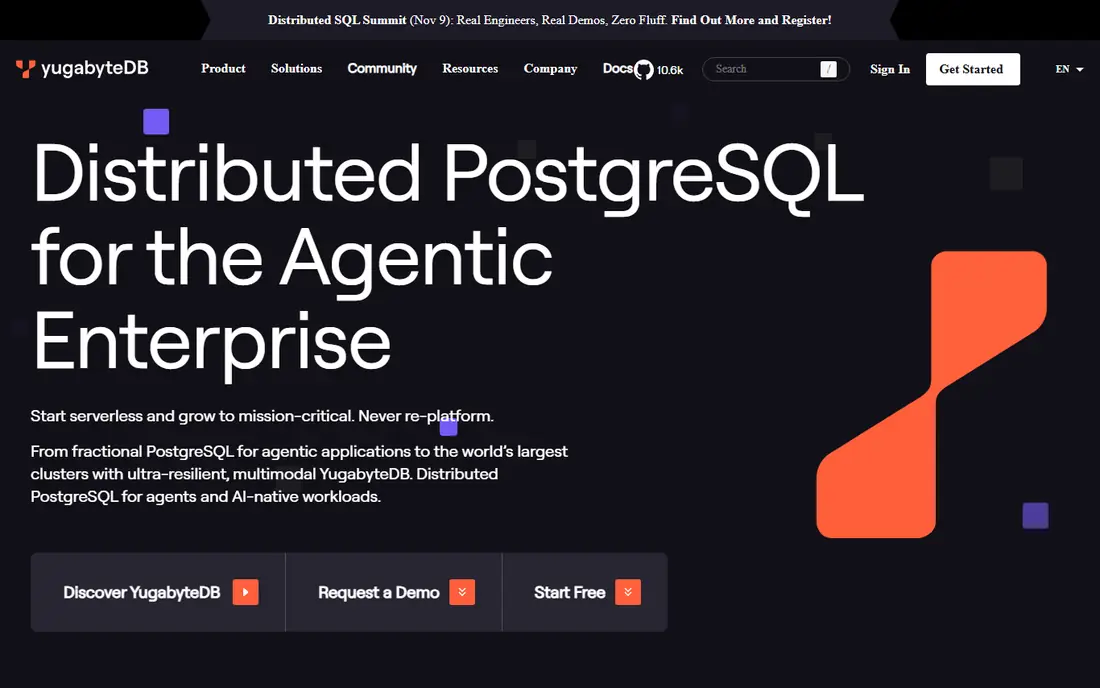
YugabyteDB is the first place we look when a team wants to keep Postgres habits and gain horizontal scale. It speaks the Postgres wire protocol, so many existing drivers and tools keep working, and it supports distributed transactions that hold up across nodes. That combination matters for apps that outgrow one server but do not want to rewrite every query. The catch is operational weight. A distributed cluster is not a drop-in replacement for a single database, even when the SQL looks familiar. You need to plan node placement, replication, and backup testing, and you should test failover before you depend on it. For teams with that capacity, YugabyteDB offers a credible path from Postgres to a system that can grow by adding nodes.
- Strong Postgres compatibility
- Distributed transactions across regions
- Open source core you can self-host
- Distributed setup needs planning
- Fewer managed regions than the largest clouds
TiDB comes from PingCAP and targets teams that already live in the MySQL world. It uses the MySQL protocol, so many MySQL clients and migration tools can connect with little change. It also separates compute from storage, which lets you scale the part that is under pressure rather than scaling the whole cluster at once. TiDB also offers a columnar engine for analytics on the same data, which helps teams that run reports next to live transactions. The trade-off is complexity in a self-hosted setup, where several services work together. Managed TiDB Cloud removes much of that burden, but you should still check its pricing model and region list against your traffic pattern before you commit.
- MySQL protocol compatibility
- Scales compute and storage separately
- Built-in analytics engine option
- More components to run self-hosted
- MySQL teams need time to learn its architecture
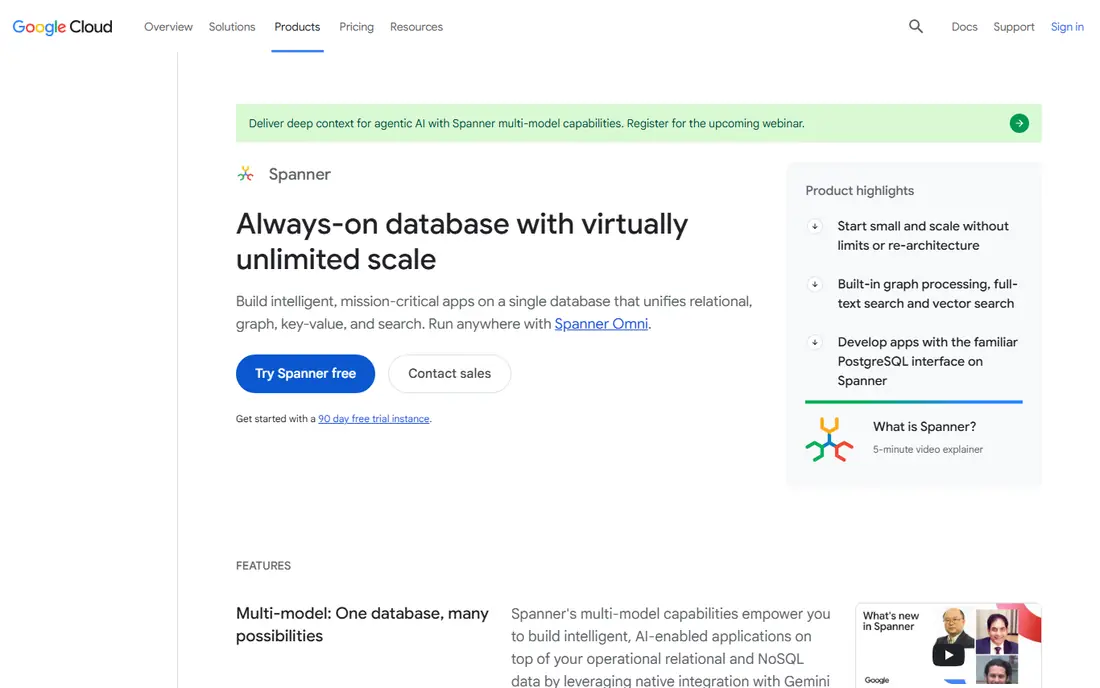
Google Cloud Spanner is a fully managed relational database built for global apps that need strong consistency. Google runs the infrastructure, replication, and much of the day-to-day care, which appeals to teams that do not want to run a distributed cluster themselves. It fits banks, marketplaces, and other systems where a transaction must be correct across regions. The limits are clear. Spanner lives inside Google Cloud, so teams committed to another cloud face extra work and data transfer costs. Pricing also depends on nodes, storage, and throughput, so a small test can look cheap while a busy production workload costs far more. Use the free trial to model a realistic workload, not just a few test rows.
- Fully managed global SQL
- Strong consistency at scale
- Deep Google Cloud integration
- Google Cloud only
- Costs need careful review at scale
Amazon Aurora DSQL is AWS answer to serverless distributed SQL. It scales with demand, so variable workloads do not need a fixed cluster size chosen in advance. That model suits apps with spiky traffic, seasonal peaks, or new products where demand is still uncertain. Because DSQL is an AWS service, it works best for teams already building on AWS. Networking, identity, and monitoring all sit inside that ecosystem, which speeds setup for AWS teams and adds friction for others. Region coverage also matters, so check that DSQL is available where your users live before you plan a multi-region design around it.
- Serverless scaling on AWS
- Strong consistency for distributed apps
- No servers to size in advance
- AWS only
- Region availability is more limited than older AWS databases
PostgreSQL is the plain, dependable answer for many teams that think they need distributed SQL but do not yet. It handles complex queries, JSON, full-text search, and a wide range of extensions, and almost every framework, host, and tool supports it. A well-tuned single instance, with read replicas for reporting, covers a large share of real apps. The honest limit is scale. When write load or data size passes what one primary can handle, you need replicas, partitioning, or an external sharding layer, and that work is yours to design. PostgreSQL also does not provide automatic multi-region active writes out of the box. If your app truly needs that, one of the distributed options above is a better fit.
- Mature and widely supported
- Rich SQL, types, and extensions
- No licence fee for the core database
- Single-node scaling needs read replicas or sharding
- High availability needs extra setup
MySQL remains a strong choice for web apps, content sites, and services with clear, high-volume read and write patterns. Hosting is available almost everywhere, managed versions exist on every major cloud, and hiring people who know MySQL is straightforward. For teams migrating from a MySQL-compatible system, it also keeps migration risk low. MySQL does not, on its own, give you the automatic global distribution that CockroachDB promises. Replication, clustering, and sharding tools exist, but they add design choices and failure modes you must test. Choose MySQL when your workload is well understood and your scale plan is based on replicas and careful schema design, not on automatic multi-region writes.
- Very widely supported
- Fast for common web workloads
- Large hosting and tool ecosystem
- Distributed features need extra layers
- Feature set differs from Postgres in places
Neon gives you Postgres without a server to babysit. It separates compute and storage, offers database branching for testing and preview environments, and lets idle projects scale down. That setup is a good match for side projects, early software as a service products, and teams that want Postgres with less operational work. Neon is not a like-for-like replacement for CockroachDB multi-region writes. It is a managed Postgres service, and its strengths are developer speed and simple scaling, not global active-active operation. If your main reason for choosing CockroachDB was Postgres compatibility and a low starting cost, Neon is worth testing first, because it may meet the need with far less complexity.
- Serverless Postgres with branching
- Fast setup for new projects
- Scales to zero on idle projects
- Not a multi-region distributed database
- Branching and limits vary by plan
Supabase bundles managed Postgres with authentication, file storage, and auto-generated APIs. That bundle speeds up app building, because a team can ship login, data, and file handling from one project instead of wiring several services together. Its free plan is useful for prototypes and small apps that need to prove an idea before paying. If you only need a database, the extra services may feel like overhead, and you should check whether you want that coupling in the long term. Supabase also runs as managed Postgres, not as a distributed multi-region database, so it does not replace CockroachDB for global write workloads. For product teams that value speed and a single dashboard, it is still one of the most practical alternatives on this list.
- Managed Postgres in one dashboard
- Built-in auth, storage, and APIs
- Free plan for starting projects
- Extra features add learning time if you only need a database
- Managed limits apply on lower plans
How we picked these
We started from official product pages, pricing pages, and documentation for each database, and we checked app and cloud listings where a managed plan was involved. We looked for Postgres or MySQL compatibility, distributed or serverless operation, managed and self-hosted options, backup and high availability features, and clear pricing or a free starting point. Public reviews helped us spot common setup pain points, but we did not treat review scores as proof of performance, and we did not claim hands-on load testing that we did not run. We kept the list to tools that a CockroachDB user could realistically evaluate, either as a direct distributed replacement or as a simpler database that removes the need for distribution. Where pricing depends on usage, nodes, or regions, we wrote See website rather than quoting a figure that would be wrong for most readers. Prices and free trials change, so confirm the current plan on the vendor site before you migrate.
Choosing the right replacement for your workload
Start with the question that decides the whole list: do you need writes from several regions at once, or do you need Postgres that scales and stays available? If the answer is multi-region writes, shortlist YugabyteDB, TiDB, Spanner, and Aurora DSQL, and test them with your actual queries. If the answer is reliable Postgres for one region with replicas, PostgreSQL, Neon, and Supabase will be simpler and cheaper to run.
Check compatibility before you migrate
Run your schema, migrations, and hardest queries against a test instance early. Postgres compatibility is close in several tools, but it is not identical, and features such as extensions, procedural code, and specific index types can differ. MySQL teams should do the same check for TiDB and MySQL, with attention to transactions and locking behaviour under load.
Plan for failure, backup, and cost
Test a node failure, a restore from backup, and a region outage in staging, not after launch. Distributed systems still need backups, and a restore test is the only way to know your recovery time. Model cost with realistic traffic, storage growth, and read and write ratios, because serverless and per-node pricing can both surprise teams that only test with small data.
Frequently asked questions
What are the best cockroachdb alternatives for Postgres users?
YugabyteDB is the closest distributed option for Postgres users, while Neon and Supabase offer managed Postgres with less operational work. PostgreSQL itself is the right choice when a single instance plus replicas can handle the load. Test your schema and extensions on each candidate before you choose.
Are there free cockroachdb alternatives?
Yes. PostgreSQL and MySQL are free open source databases, and YugabyteDB and TiDB have open source editions you can self-host. Neon and Supabase offer free plans for starting projects, while Spanner and Aurora DSQL use trial or usage-based models. Free plans always carry limits, so check storage, compute, and region rules.
Is YugabyteDB a direct replacement for CockroachDB?
It is close for many Postgres workloads, because it offers distributed SQL with Postgres compatibility and strong consistency. It is not identical in features, tooling, or managed regions, so migration still needs testing. Teams should compare backup, monitoring, and support options alongside SQL compatibility.
Should small apps use a distributed database?
Most small apps should not. A managed Postgres service or a single PostgreSQL or MySQL instance is simpler, cheaper, and easier to back up and debug. Move to a distributed database when measured load, availability needs, or multi-region writes prove that a single database cannot meet the requirement.
What is the difference between TiDB and YugabyteDB?
TiDB is built around MySQL compatibility and separates compute from storage, with an analytics engine option for reporting. YugabyteDB is built around Postgres compatibility and distributed transactions across nodes. Your existing database, drivers, and team skills should guide the choice more than marketing claims.
How hard is it to migrate away from CockroachDB?
Difficulty depends on how much you rely on CockroachDB specific features, extensions, and multi-region behaviour. A simple schema with standard SQL migrates more easily than a system built around specific distributed features. Plan a staged migration, run both systems in parallel for a test period, and keep a rollback plan until the new system proves itself in production.
Sources we checked (8)

Online Jobs is an independent blog about careers, online work, learning new skills and the tools that help people earn. More about us.
Keep reading
All posts
n8n Alternatives
n8n alternatives compared for 2026, with Zapier, Make, Activepieces, and more, covering visual builders, code steps, self-hosting, and pricing models.

ZoomInfo Alternatives
The best ZoomInfo alternatives in 2026, compared on price, free plans, data coverage, and which tool fits small teams or large sales teams best in detail.

Workday Alternatives
We compared the best workday alternatives for HR, payroll, and global hiring, from BambooHR and Gusto to Rippling, Deel, and HiBob for growing teams in 2026.