Tilt Skaffold Alternatives Low Footprint in 2026: 8 Tools Compared

How we put this together: we compare official feature and pricing pages, app store listings, privacy policies and public user reviews. Prices change, so check the provider's site before you pay.
Key takeaways
- DevSpace is our pick for most teams, since it pairs file sync, pipelines, and debugging in a single lightweight CLI.
- Telepresence suits developers who want to run one service locally against a remote cluster without copying the whole stack.
- Garden fits complex microservice projects that need dependency graphs and testing in the same workflow.
- Mirrord is the lightest option for debugging a remote service from local code with minimal cluster changes.
- Okteto works well for teams that want managed development environments, though it carries more platform weight than a pure CLI.
Quick comparison
| Name | Who it suits | Starting price | Free option | |
|---|---|---|---|---|
 DevSpace | Lightweight local dev | Free | Yes | Visit |
 Telepresence | Local against remote | Free | Yes | Visit |
 Garden | Complex microservices | See website | Yes | Visit |
 Mirrord | Remote debugging | Free | Yes | Visit |
 Okteto | Managed dev environments | See website | No | Visit |
 Draft | Simple app scaffolding | Free | Yes | Visit |
 Nocalhost | IDE-based dev | Free | Yes | Visit |
 Gefyra | Local with remote cluster | Free | Yes | Visit |
The best tilt skaffold alternatives low footprint
Tilt and Skaffold both automate the build, deploy, and live-reload loop for Kubernetes development, but they can feel heavy on a laptop or in a large team. The tools below aim for a smaller footprint, whether that means a single CLI, less cluster overhead, or running most work locally. We compared official docs, feature pages, and workflow models for each tool.
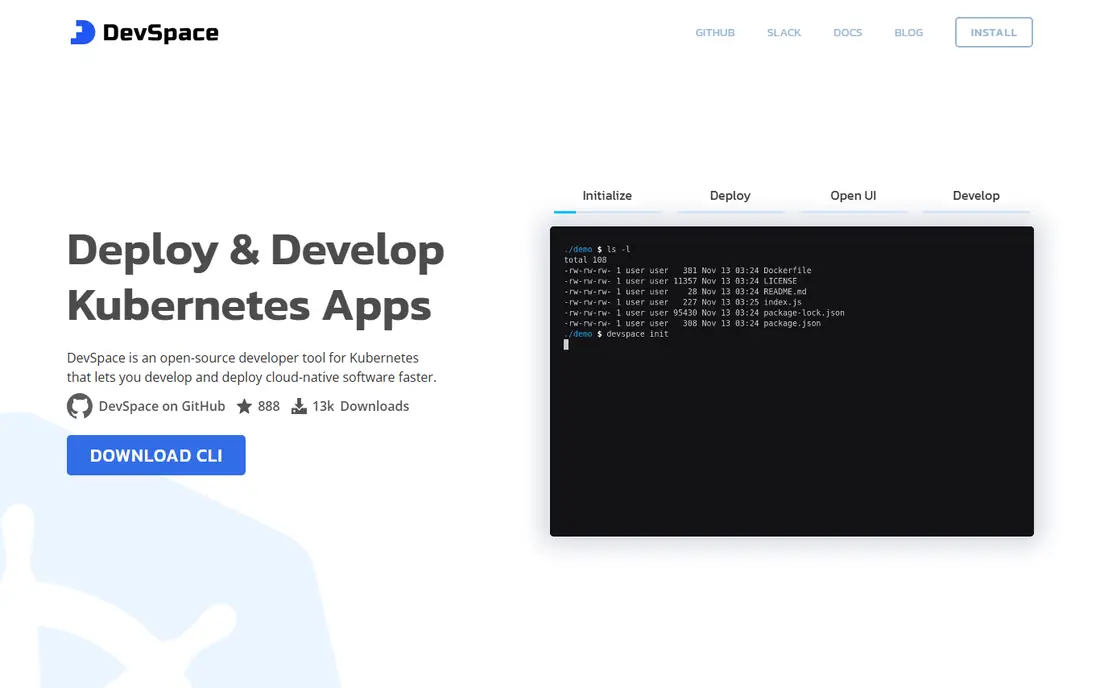
DevSpace is the closest low-footprint replacement for Tilt and Skaffold for everyday development. One CLI handles development containers, file sync, port forwarding, pipelines, and debugging, so you can iterate on code without rebuilding images for every change. It works with your existing deployment tools, which makes adoption gradual rather than a rewrite.
The configuration file needs care on larger projects, and teams that want shared preview environments will need another tool alongside DevSpace. For a developer who wants fast inner-loop work on a laptop, with minimal extra services running in the cluster, DevSpace is the best starting point.
- Single CLI for dev, sync, pipelines, and debugging
- File sync and hot reload without a heavy UI
- Works with kubectl, Helm, and Kustomize
- Configuration takes learning for complex projects
- No built-in team environment platform
- Enterprise features sit outside the open-source CLI
Telepresence solves a different problem from Tilt: instead of running the whole stack locally, you run one service on your laptop and connect it to the remote cluster as if it were inside. Traffic to that service routes to your local code, and your local code can reach cluster services, so you debug with real dependencies without copying everything. That keeps laptop resource use very low.
You need permission to install Telepresence components in the cluster, and network policies can complicate setup. It also does not replace a build pipeline, so you still need a way to build and deploy images. For debugging a single service in a large system, Telepresence is the lightest practical tool.
- Two-way proxy between local code and a remote cluster
- Run one service locally while the rest stays remote
- Open-source and CNCF-affiliated
- Needs cluster permissions to install traffic components
- Network setup can be tricky on restricted clusters
- Not a full build and deploy pipeline

Garden suits teams where services depend on each other in complex ways. Its dependency graph understands which services, tests, and builds relate to each other, so a change triggers only the work that matters. That structure helps large microservice projects stay consistent, and testing can run as part of the same workflow.
The learning curve is steeper than DevSpace or Telepresence, and the full cloud platform is heavier than the open-source CLI alone. Small projects with one or two services may not need Garden graph features. For a team juggling many interdependent services, Garden gives order to a workflow that otherwise sprawls.
- Graph-based dependency management for services
- Testing, building, and deploying in one workflow
- Supports Kubernetes, Helm, and Terraform
- Heavier to learn than a simple sync tool
- Cloud features add platform weight
- Configuration grows with project size
Mirrord is the most minimal tool in this list for a specific job: run your local process as if it were in the cluster, borrowing environment variables, files, and network access from a remote pod. That lets you debug with real config and data, without deploying your code or copying the whole environment locally. Resource use stays low because the heavy services remain remote.
It is not a build and deploy tool, so you will still need a pipeline for shipping code. The community is also smaller than Telepresence, which matters if you need extensive examples. For quick, low-impact debugging of a remote service, Mirrord is an excellent lightweight choice.
- Runs local code with remote cluster context, with minimal cluster changes
- Low overhead for debugging
- Works with your existing local tools
- Focused on debugging rather than full pipelines
- Team features need a paid tier in some cases
- Newer tool with a smaller community than Telepresence
Okteto is included as a heavier, but still practical, alternative for teams that want environments managed for them. Developers get a remote development environment with live reload, so laptop specs matter less, and teams can share consistent environments rather than each developer building a local stack. That consistency helps onboarding and reduces works-on-my-machine problems.
The trade-off is platform overhead. Okteto is more than a single CLI, and pricing depends on your deployment model, so solo developers seeking the lowest footprint should prefer DevSpace or Telepresence. For a team that values managed environments over minimal tooling, Okteto is a strong option.
- Managed development environments with hot reload
- Good team collaboration features
- Works with existing Kubernetes manifests
- Platform weight is higher than a pure CLI
- Pricing requires checking the site
- Managed model suits teams more than solo developers
Draft, originally from Azure, helps developers get a simple application running on Kubernetes with minimal setup. It scaffolds deployment files, builds images, and supports a local development loop for straightforward apps. That simplicity keeps the footprint small and the learning curve short for teams new to Kubernetes.
Draft does not match Tilt or DevSpace on pipeline depth, multi-service orchestration, or team features. It is best for simple apps, prototypes, and learning, rather than a large microservice system. If your app is small and you want the lightest path to a working Kubernetes deployment, Draft is worth trying.
- Open-source tool from Microsoft for scaffolding Kubernetes apps
- Simple local development workflow
- Low resource use
- Narrower scope than Tilt or Skaffold
- Community activity varies
- Not a full team environment platform
Nocalhost lets you develop inside your IDE while your code runs against a cluster, with file sync and debugging wired into the editor. That IDE-first flow suits developers who prefer to stay in one tool rather than switching between a terminal, a dashboard, and an editor. Cluster overhead stays low, since you are not running a full local stack.
The community is smaller than DevSpace or Telepresence, and plugin experience can vary by IDE. You also need cluster access, which some locked-down environments restrict. For IDE-centred developers who want a light, direct way to work against a cluster, Nocalhost is a useful, focused tool.
- Develop directly in your IDE against a cluster service
- File sync and port forwarding built in
- Open-source with low cluster overhead
- Smaller community than larger tools
- IDE plugin quality varies
- Setup needs cluster access and permissions
Gefyra bridges local Docker containers and a remote Kubernetes cluster, letting you run a service locally while it talks to cluster services as if it were inside. That model keeps laptop use low, since only the service you are changing runs locally, while the rest of the system stays remote. Setup is designed to be lighter than running a full local cluster.
It is a bridging tool, not a complete build, test, and deploy platform, so you will pair it with your existing pipeline. Documentation and community support are thinner than for DevSpace or Telepresence. For a developer who wants a simple local-remote bridge with minimal moving parts, Gefyra is a promising lightweight option.
- Connects local containers to a remote cluster with minimal setup
- Low overhead for local development
- Open-source and focused on the dev loop
- Smaller community and documentation than larger tools
- Focused on local-remote bridging, not full pipelines
- Setup varies by cluster networking
How we picked these
We compared official documentation, feature pages, and workflow models, and we favoured tools that reduce laptop or cluster load compared with a full local stack, whether through file sync, local-remote bridging, or managed environments. We included CLI tools, bridging tools, and one managed platform, so teams can match the tool to their constraint. We did not claim hands-on testing, and cluster permissions, networking, and pricing vary, so test each tool against your own cluster before adopting it.
How to choose a low-footprint Kubernetes dev tool
Start with the constraint that actually hurts. If your laptop struggles, pick a bridging tool such as Telepresence, Mirrord, or Gefyra, so only one service runs locally. If rebuild times hurt, pick a sync-focused CLI such as DevSpace, so code changes reach the cluster without a full image rebuild. If team consistency hurts, consider a managed option such as Okteto, even though it adds platform weight.
Next, check cluster permissions early. Bridging tools need traffic components or network access that some production-adjacent clusters will not allow. Test on a development cluster first, and confirm with your platform team what is permitted, before you build a workflow around a tool you cannot run in your real environment.
Finally, keep the pipeline separate from the dev loop in your mind. A great inner-loop tool does not have to be your CI and deployment system, and forcing one tool to do both often adds weight. Pick the lightest tool that fixes your daily loop, and let your existing CI handle building, testing, and shipping.
Frequently asked questions
What is the best low-footprint alternative to Tilt?
DevSpace is our pick for most teams, since it offers file sync, pipelines, and debugging in a single lightweight CLI. Telepresence is better if you want to run only one service locally against a remote cluster. The best choice depends on whether rebuild speed or laptop resource use is your main pain.
What is the best low-footprint alternative to Skaffold?
DevSpace and Garden both cover the Skaffold workflow of building, deploying, and live-reloading, with DevSpace being lighter for solo developers and Garden being stronger for complex dependencies. Draft suits very simple apps. Test file sync speed and configuration effort on your own project before you switch.
Is Telepresence better than Mirrord?
Telepresence has a larger community and a longer track record, while Mirrord is lighter and needs fewer cluster changes for debugging. Telepresence suits teams that want a proven two-way proxy, while Mirrord suits developers who want the fastest path to debugging a remote service locally. Both solve similar problems, so try each on a development cluster.
Can I use these tools without a local Kubernetes cluster?
Yes, Telepresence, Mirrord, Gefyra, and Nocalhost are designed to work against a remote cluster without running a full local cluster. DevSpace and Garden can also work against remote clusters, though many developers run them locally too. That remote-first model is the main way these tools keep laptop footprint low.
Do low-footprint tools work for large microservice projects?
Yes, but the right tool changes with scale. Garden handles complex dependencies best, DevSpace handles everyday multi-service work well, and bridging tools handle debugging one service inside a large system. Large teams often combine tools, using one for the daily loop and another for debugging, rather than forcing a single tool to do everything.
Sources we checked (8)

Online Jobs is an independent blog about careers, online work, learning new skills and the tools that help people earn. More about us.
Keep reading
All posts
n8n Alternatives
n8n alternatives compared for 2026, with Zapier, Make, Activepieces, and more, covering visual builders, code steps, self-hosting, and pricing models.

ZoomInfo Alternatives
The best ZoomInfo alternatives in 2026, compared on price, free plans, data coverage, and which tool fits small teams or large sales teams best in detail.

Workday Alternatives
We compared the best workday alternatives for HR, payroll, and global hiring, from BambooHR and Gusto to Rippling, Deel, and HiBob for growing teams in 2026.