Best NordVPN Alternatives in 2026: 9 VPNs Compared

How we put this together: we compare official feature and pricing pages, app store listings, privacy policies and public user reviews. Prices change, so check the provider's site before you pay.
Key takeaways
- Surfshark is our pick for most households because it covers unlimited devices at a low long term deal price.
- Proton VPN offers the best free tier on this list, with unlimited data on the free plan and a strong privacy record.
- Mullvad is the pick for buyers who want flat pricing, no email signup and no renewal price jump.
- Renewal prices matter more than first term deals, so set a reminder before a long plan renews at a higher standard rate.
- A VPN protects your connection from local snooping, but it does not make you anonymous on its own, and it does not replace good passwords or updates.
Quick comparison
| Name | Who it suits | Starting price | Free option | |
|---|---|---|---|---|
 Surfshark | Households with many devices | $2.49 per month | No | Visit |
 ExpressVPN | Simple premium VPN | $2.99 per month | No | Visit |
 Proton VPN | Privacy with a real free tier | Free | Yes | Visit |
 Mullvad | Flat pricing and anonymity | €5 per month | No | Visit |
 Private Internet Access | Power users and customisation | $2.03 per month | No | Visit |
 CyberGhost | Streaming and beginners | $2.03 per month | No | Visit |
 Windscribe | Flexible free and paid plans | Free | Yes | Visit |
 IPVanish | Unlimited devices and TV apps | $2.19 per month | No | Visit |
 TunnelBear | Simplest app for beginners | Free | Yes | Visit |
The best NordVPN alternatives
NordVPN is a strong VPN, but many buyers switch for lower prices, a real free tier, flat pricing, or a different privacy approach. We compared official feature pages, pricing pages, privacy policies and public reviews, and we kept only VPNs that still operate in 2026 with apps for major platforms. Our pick for most households is Surfshark, with Proton VPN for free use and Mullvad for flat, private pricing.
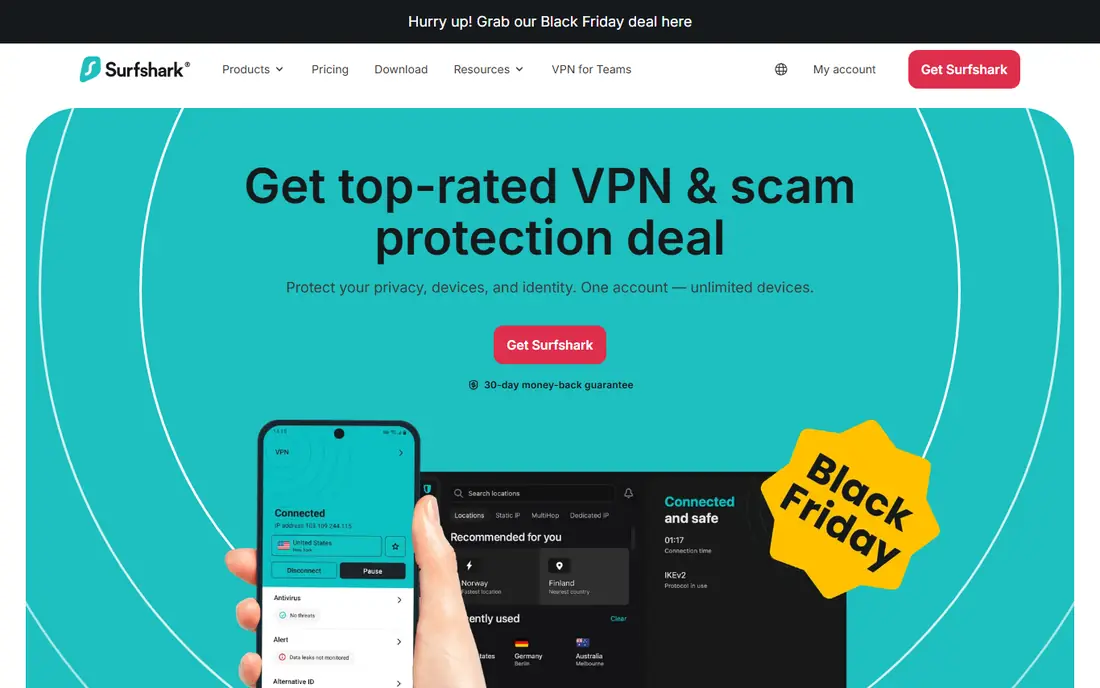
Surfshark is the value leader for households. One subscription covers every phone, laptop, tablet and TV in the house, with no device limit to manage. The app is polished, speeds are strong on major protocols, and the server network covers many countries for travel and streaming. Extra bundles add ad blocking, antivirus and identity alerts for buyers who want one security app.
The $2.49 per month figure is a long term deal price, not the standard renewal rate, so the second term will cost more unless you renegotiate or switch. That renewal jump is common across VPN deals, and it should be in your calendar before you buy. If you have many devices and want one simple subscription, Surfshark is still the easiest alternative to justify.
- Unlimited simultaneous devices
- Large server network
- Ad blocker and breach alerts in higher bundles
- Lowest price needs a long term deal
- Renewal price is higher than the deal price
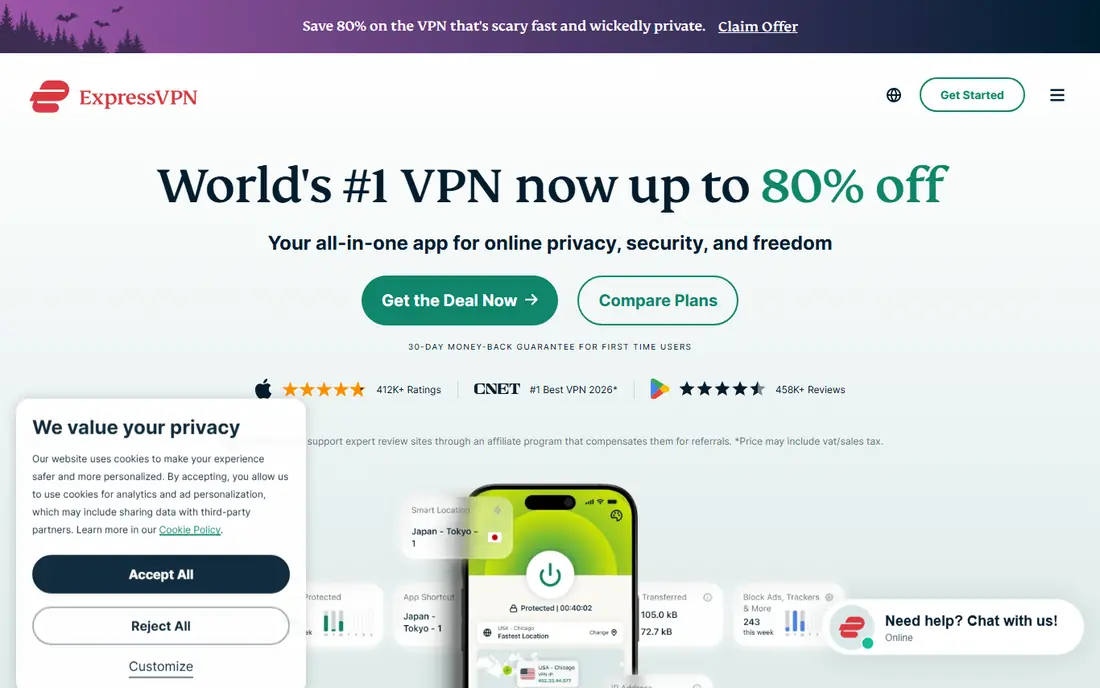
ExpressVPN is the premium simplicity pick. Apps are clean, connecting takes one tap, and support is available around the clock if a server or app issue appears. That simplicity matters for travellers, families and less technical users who do not want to tweak protocols, ports or split tunnelling. Streaming and travel performance are consistently strong in public reviews.
You pay for that polish. The $2.99 per month deal price renews at a higher standard rate, and power users may miss the deep settings found in Private Internet Access. If you want a VPN that just works, with help on hand, ExpressVPN is worth the premium over the cheapest deals, provided you note the renewal date.
- Very simple apps for non technical users
- Strong streaming and travel performance
- 24/7 live support
- Deal price renews higher
- Fewer advanced customisation options than Private Internet Access
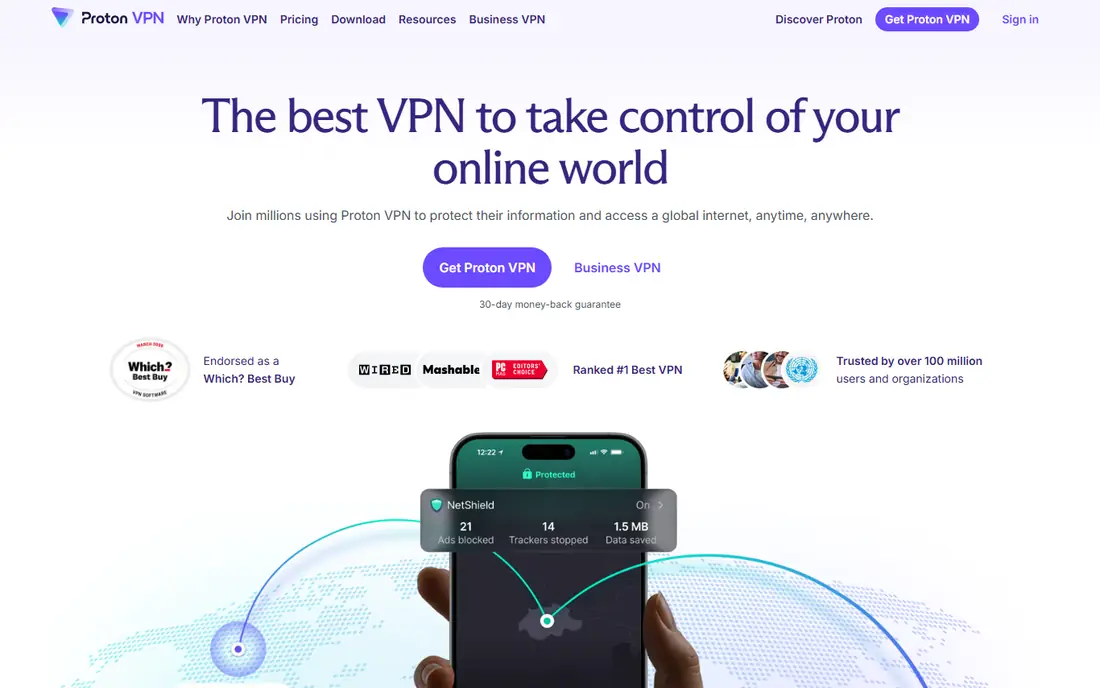
Proton VPN is the best free VPN on this list by a clear margin. The free plan offers unlimited data, which is rare, with servers in a small set of countries and one device at a time. That makes it genuinely useful for everyday privacy on public Wi-Fi, not only a short trial. Paid Plus adds faster servers, more countries, streaming support and ten devices.
Proton is based in Switzerland, publishes open source apps, and has undergone audits of its no logs claims in public reports. Those factors matter for buyers who care about jurisdiction and transparency, not only price. Start free, and upgrade to Plus only if you need speed, more locations or more devices.
- Free plan with unlimited data
- Swiss jurisdiction and open source apps
- Audited no logs policy
- Plus adds faster servers and streaming
- Free plan is limited to one device and slower servers
- Plus deal price renews higher
Mullvad is the honesty pick. The price is €5 per month, every month, with no deal, no renewal jump and no long term lock in. Signup needs no email, just an account number, and you can pay by cash, card or cryptocurrency. That approach, plus a long audit history and open source apps, appeals to privacy focused buyers who distrust deal pricing.
The trade off is polish and streaming. The network is smaller than the largest rivals, and the app is functional rather than feature rich. If streaming catalogues are your main goal, Surfshark or ExpressVPN may suit you better. If you want predictable pricing and minimal personal data at signup, Mullvad is hard to beat.
- Flat €5 per month with no renewal jump
- No email needed for signup
- Cash payment accepted
- Strong audit history
- Smaller server network than Surfshark or ExpressVPN
- Fewer streaming focused features
- App is functional rather than polished
Private Internet Access, often called PIA, is built for users who like control. You can adjust protocols, encryption, kill switch behaviour, split tunnelling and port forwarding in detail, and the apps are open source. Unlimited devices make it a good household deal, and the long term price is among the lowest on this list. Court tested no logs claims and audits are cited in public reviews as reasons to trust its privacy stance.
US jurisdiction is a concern for some buyers, even with audits and open source apps, because US law differs from Swiss or Swedish privacy law. Beginners may also find the settings overwhelming at first. PIA fits power users, torrent users who need port forwarding, and households that want unlimited devices at a low long term price.
- Unlimited devices
- Deep customisation for protocols and settings
- Open source apps and audited no logs claims
- US jurisdiction may concern some privacy buyers
- Interface can feel technical for beginners
CyberGhost makes choosing a server easy. Servers are labelled for streaming services, torrenting and gaming, so beginners do not need to guess which location works for a given task. Apps are simple, the network is large, and the long term deal price is low. That combination suits families and casual users who mainly want privacy plus streaming access.
Advanced users may miss PIA level customisation, and the renewal price jump applies here too. CyberGhost also sits in Romania, which some buyers view as a privacy benefit compared with US based rivals. If you want a low cost, beginner friendly VPN with clear server labels, CyberGhost is a strong NordVPN alternative.
- Servers labelled by streaming service and activity
- Simple apps for beginners
- Large server network
- Low long term deal price
- Deal price renews higher
- Fewer advanced features than PIA for power users
Windscribe is the flexible option. The free plan gives a monthly data allowance that suits light use, while paid Pro adds unlimited data, more locations and unlimited devices. A build a plan option lets you pay for only the locations you need, which can be cheaper than a full subscription for travellers who only use one or two countries.
Proton free beats Windscribe free on data, because Proton free has no data cap, while Windscribe free is capped. Paid speeds and features are solid for everyday use, but Windscribe is less of a streaming specialist than ExpressVPN or CyberGhost. Choose Windscribe if you want a free tier with a good app, plus flexible paid options that match your actual locations.
- Free plan with a monthly data allowance
- Unlimited devices on paid plans
- Flexible build a plan options for single locations
- Free data limit is lower than Proton free unlimited data
- Speeds and server choice vary by plan
IPVanish suits households with many TVs and streaming devices. Native apps for Android TV and Firestick, plus unlimited devices, make it easy to protect a living room setup without counting connections. The apps are straightforward, speeds are solid for streaming, and public audits support its no logs claims.
US jurisdiction is a drawback for privacy purists, and the deal price renews higher, as with most rivals. IPVanish does not offer a free tier, so trial it through the money back period if you want to test speeds at home. For TV heavy households that want unlimited devices, IPVanish is a practical alternative to NordVPN.
- Unlimited devices
- Strong TV and Firestick apps
- Audited no logs policy
- Simple apps for households
- US based provider
- Deal price renews higher
- Fewer privacy extras than Proton or Mullvad
TunnelBear is the friendliest VPN on this list. The app uses clear visuals, simple toggles and plain language, which helps first time VPN users who feel lost in technical settings. The free plan covers light use, such as occasional public Wi-Fi protection, and paid Unlimited adds more data and devices. Audits and clear privacy policies add trust for beginners.
The free data limit is small, so heavy users will need a paid plan quickly, and the server network and feature set are smaller than Surfshark or PIA. TunnelBear fits buyers who want the simplest possible VPN and are willing to pay a bit more for that simplicity, or who only need occasional protection on a free plan.
- Very simple, friendly app design
- Free plan for light use
- Audited privacy practices and clear policies
- Free plan data is limited
- Fewer servers and advanced features than larger rivals
- Paid price is higher than budget deals
How we picked these
We compared official feature pages, pricing pages, privacy policies and public reviews, focusing on price and renewal terms, device limits, server coverage, audits, jurisdiction, app quality and free plans. We kept only VPNs that still operate in 2026 with apps for Windows, macOS, iOS and Android, plus TV apps where relevant. We did not claim hands on speed testing that did not happen, and we treated vendor speed claims as claims to test during a money back period.
Renewal pricing was a key check. Many VPN deals look cheap for two years, then renew at double or triple the deal rate. Always read the renewal price at checkout, not only the monthly deal figure.
What to check before you switch
Read the renewal price, not only the deal
Note the standard annual price that applies after the first term. Set a calendar reminder a week before renewal, and check for a new deal before you let it renew automatically.
Check audits and jurisdiction, not only server counts
Server counts tell you little about privacy. Look for independent audits, open source apps, a clear no logs policy, and a jurisdiction you are comfortable with for your threat model.
Test on your devices during the refund window
Most paid VPNs offer a 30 day money back period. Test speeds, streaming, TV apps and kill switch behaviour on your real devices before the window closes.
Frequently asked questions
What is the best NordVPN alternative?
Surfshark is our pick for most households because it covers unlimited devices at a low deal price. Proton VPN is better if you want a real free tier, and Mullvad is better if you want flat pricing with no renewal jump.
Is there a free alternative to NordVPN?
Yes. Proton VPN free offers unlimited data with limited servers and one device, while Windscribe free and TunnelBear free offer limited data allowances. Free VPNs are best for light use, not for heavy streaming or many devices.
Is Surfshark better than NordVPN?
Surfshark is cheaper for households with many devices and offers unlimited connections, while NordVPN offers a larger feature set in some bundles. The better choice depends on device count, renewal price and which extra features you actually use.
Does a VPN make me anonymous online?
No, not fully. A VPN hides your traffic from your local network and internet provider, and masks your IP from sites you visit, but accounts, cookies, browser fingerprinting and your own logins can still identify you. Use a VPN as one layer, with strong passwords, updates and careful account habits.
How many devices can I use with a VPN?
It varies. Surfshark, Private Internet Access and IPVanish offer unlimited devices, Proton Plus and ExpressVPN offer ten, and Mullvad offers five. Free plans usually limit you to one device.
Should I choose a long term VPN deal?
A long term deal lowers the monthly price, but it locks you in and usually renews higher. Choose a long term deal only if you have tested the VPN during the refund window and noted the renewal price and date.
Sources we checked (9)

Online Jobs is an independent blog about careers, online work, learning new skills and the tools that help people earn. More about us.
Keep reading
All posts
Surfshark Alternatives
Looking for Surfshark alternatives? We compare 8 VPN services on price, privacy, streaming, and device limits to help you find a VPN that fits your needs.
NordPass Alternatives
We compared NordPass alternatives for families, solo users and teams, checking pricing, free plans, passkeys and sharing, so you can switch safely today.
Best background check app
We compared the best background check app options in 2026 for employers, landlords and individuals, with published prices, coverage and compliance notes.