Best Identity Guard Alternatives in 2026: 9 Services Compared

How we put this together: we compare official feature and pricing pages, app store listings, privacy policies and public user reviews. Prices change, so check the provider's site before you pay.
Key takeaways
- Aura suits most households that want three bureau credit monitoring, dark web alerts, and device protection in one subscription.
- LifeLock suits users who want Norton security integration and higher identity theft insurance on upper tiers.
- IDShield suits users who value legal assistance and dedicated restoration support alongside monitoring.
- Identity protection can alert you to misuse and help with recovery, but it cannot prevent all identity theft, stop every fraud attempt, or guarantee that your data will not appear in a breach.
Quick comparison
| Name | Who it suits | Starting price | Free option | |
|---|---|---|---|---|
 Aura | All in one family protection | See website | Free trial | Visit |
 LifeLock | Norton bundle and insurance | See website | Free trial | Visit |
 IDShield | Legal help and restoration | See website | Free trial | Visit |
 IdentityIQ | Credit focused monitoring | See website | Free trial | Visit |
 Experian IdentityWorks | Direct bureau monitoring | See website | Free trial | Visit |
 McAfee Identity Protection | Device plus identity bundle | See website | Free trial | Visit |
 IdentityForce | Dark web monitoring depth | See website | Free trial | Visit |
 PrivacyGuard | Simple credit monitoring | See website | Free trial | Visit |
 DeleteMe | Data broker removal | See website | Free trial | Visit |
The best Identity Guard alternatives
Identity Guard is known for affordable monitoring and restoration help, but many users look for three bureau monitoring on every plan, a family plan, a security bundle, or stronger legal support. The services below cover those gaps in different ways, so the right alternative depends on what Identity Guard lacked for you.
Aura is the most complete alternative for most households. Every plan includes three bureau credit monitoring, which many rivals reserve for premium tiers, plus dark web monitoring, financial account alerts, and device protection with VPN, antivirus, and a password manager. The family plan covers several adults and children, which suits households that want one subscription for everyone.
The catch is tiering for extras. Home title monitoring and some advanced features sit on higher plans, so read the plan details rather than assuming every feature is on the cheapest tier. For a single bundle that covers credit, dark web, and devices, Aura is a strong first alternative to check.
- Three bureau monitoring on all plans
- Dark web and home title monitoring
- VPN, antivirus, and password manager included
- Some advanced features need higher plans
- Family plan price rises with adults covered

LifeLock, now part of Norton, suits users who already use Norton security products or want a large bundle. It combines identity monitoring with Norton antivirus and VPN on higher plans, plus dark web monitoring and identity theft insurance. Restoration support helps users work through fraud cases, which matters when recovery takes weeks rather than days.
The limit is tiering. Three bureau monitoring and the highest insurance limits sit on upper plans, so the cheapest plan is thinner than Aura on credit coverage. Renewal pricing also rises after the first year. If you value the Norton bundle and strong insurance, LifeLock is a credible alternative. If three bureau monitoring on the base plan matters most, Aura may fit better.
- Norton security integration
- Dark web monitoring
- Identity theft insurance up to higher limits on upper tiers
- Three bureau monitoring only on higher tiers
- Renewal pricing needs checking
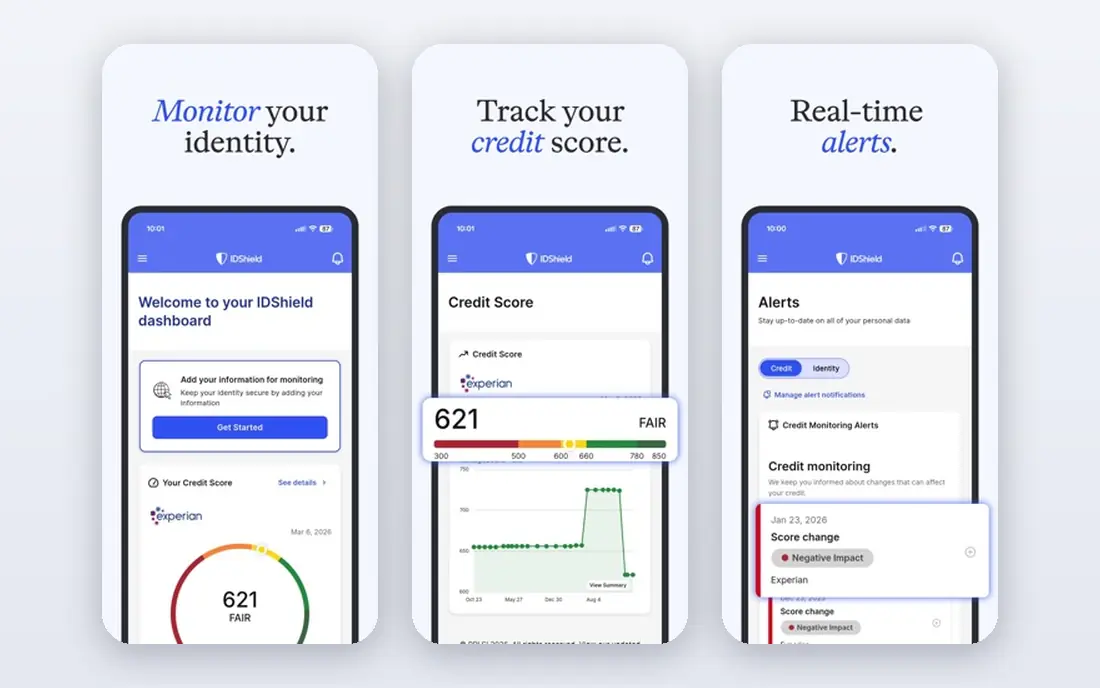
IDShield stands out for restoration and legal help. It pairs credit and dark web monitoring with support from licensed investigators and, on suitable plans, access to legal assistance for identity related issues. That combination appeals to users who worry less about alerts and more about who will help if fraud actually happens.
The interface is less polished than Aura, and three bureau monitoring depends on the plan you choose, so check that detail before buying. IDShield is best for users who want human help and legal backing alongside monitoring, rather than only a dashboard of alerts.
- Licensed investigator support
- Legal assistance options
- Credit and dark web monitoring
- Interface can feel dated
- Three bureau monitoring varies by plan
IdentityIQ suits users whose main worry is credit fraud. It offers three bureau credit monitoring on all plans, with credit reports, scores, and alerts for new accounts, inquiries, and changes. Identity theft insurance and restoration support are included, which helps when a credit account is opened in your name.
Device protection is thinner here than in Aura or LifeLock bundles, so users who also want VPN and antivirus will need a separate tool. If credit is the priority, and you already have device security elsewhere, IdentityIQ is a focused and clear alternative.
- Three bureau monitoring on all plans
- Credit reports and scores
- Identity theft insurance
- Less device protection than Aura or LifeLock
- Interface is credit first
Experian IdentityWorks appeals to users who want monitoring from a credit bureau itself. Experian data is direct rather than resold, and credit lock features help stop new accounts being opened with your Experian file. Paid plans add dark web monitoring, identity theft insurance, and restoration support.
The free tier is limited, and full three bureau monitoring needs a higher plan, so the cheapest option is thinner than Aura or IdentityIQ on bureau breadth. If you trust bureau direct data and want a credit lock, Experian IdentityWorks is a logical alternative. If you want three bureau cover on the base plan, look at Aura or IdentityIQ first.
- Direct Experian bureau data
- Credit lock options
- Dark web monitoring on paid plans
- Full three bureau cover needs higher plans
- Free tier is limited
McAfee Identity Protection
Who it suits: Device plus identity bundle
McAfee Identity Protection suits users who already use McAfee for device security and want identity monitoring in the same subscription. It combines antivirus and VPN style device protection with credit monitoring, dark web alerts, and restoration help, which reduces the number of security subscriptions in a household.
The identity features vary by plan, so a basic device plan may not include the full identity package. Users who do not use McAfee for devices may also find the bundle less compelling than a dedicated identity service. For a McAfee household, though, it is a convenient and coherent alternative.
- Combines device security with identity monitoring
- Credit monitoring
- Restoration support
- Identity features vary by plan and region
- Bundle may duplicate tools you already own
IdentityForce, part of TransUnion, suits users who want deep monitoring of dark web, public records, and court data, not only credit alerts. Its monitoring breadth helps catch misuse that does not immediately appear as a credit inquiry, and restoration support helps when a case needs sustained work.
Three bureau monitoring sits on higher tiers, and pricing is above budget options such as Identity Guard value plans. If deep monitoring matters more than a low price, IdentityForce is a strong alternative. If budget is the main driver, Aura or IdentityIQ may give more bureau cover for less.
- Deep dark web and public records monitoring
- Credit monitoring
- Restoration support
- Three bureau monitoring only on higher tiers
- Price is higher than budget options
PrivacyGuard suits users who want simple credit monitoring without a large bundle. It offers credit reports, scores, and alerts, plus identity theft insurance and restoration support, in plans that are easy to understand. That simplicity helps users who find larger suites confusing or overpriced for their needs.
The trade off is breadth. PrivacyGuard offers less dark web depth and device protection than Aura or LifeLock, so it is not the best all in one pick. For a user who mainly wants credit monitoring and a clear plan, it is a practical and lower complexity alternative.
- Simple credit monitoring and scores
- Identity theft insurance
- Straightforward plans
- Less device protection
- Fewer advanced monitoring features than Aura
DeleteMe does a different job from the other services here, and that is why it belongs on the list. Instead of monitoring for misuse, it removes your personal data from data broker sites that sell names, addresses, and phone numbers. Over time, that reduces the exposure that makes identity theft and scams easier, and regular reports show what was removed.
DeleteMe is not a replacement for credit monitoring, because it offers no credit alerts or identity theft insurance. It works best alongside a monitoring service, not instead of one. If your main concern is how much personal data is publicly sold, DeleteMe addresses the source in a way monitoring alone cannot.
- Removes personal data from data brokers
- Regular removal reports
- Reduces exposure over time
- No credit monitoring or identity theft insurance
- Removal is ongoing, not instant
How we picked these
We compared official feature pages, pricing pages, and current 2026 guides for identity protection services that monitor credit, dark web, or public records and offer restoration support. We mixed all in one bundles, credit focused services, bureau direct options, and a data removal service, because Identity Guard users leave for different reasons. We used See website for pricing, since plan structures, bureau coverage, and first year offers vary and change often, and a single price would mislead readers.
What identity protection can and cannot do
Identity protection can alert you when a new account, inquiry, or dark web listing matches your details, and it can help with the paperwork and calls needed to restore your identity. That help is valuable, because recovery can take weeks and involve many organisations. A service with dedicated restoration support can save real time and stress.
It cannot prevent all identity theft. No service can stop a thief from using stolen details, block every fraudulent application, or remove your data from every breach. Credit monitoring also only sees what reaches a bureau, so misuse that does not touch credit may not trigger an alert. Use protection alongside basic habits: freeze credit when you do not need new credit, use strong unique passwords, enable two factor authentication, and check bank and credit statements regularly. Protection is a safety net and a helper, not a shield that makes fraud impossible.
Frequently asked questions
What is the best Identity Guard alternative?
Aura is the best all round alternative for most households, because it includes three bureau monitoring on all plans plus device protection. LifeLock suits Norton users, IDShield suits users who want legal help, and IdentityIQ suits credit focused users. The best pick depends on whether you need family cover, a bundle, or legal support.
What is the best identity protection service?
There is no single winner for every household. Aura leads for all in one family cover, LifeLock leads for Norton bundle users, and IDShield leads for legal and restoration support. Compare bureau coverage, insurance, restoration help, and family pricing, rather than choosing on headline price alone.
What is the best identity theft protection company for families?
Aura suits families best, because its family plan covers several adults and children under one subscription with three bureau monitoring. LifeLock and IDShield also offer family plans, but check adult limits, child cover, and insurance per person, since family plans differ in who is actually covered.
Does identity protection prevent identity theft?
No, it cannot prevent all identity theft. It monitors for signs of misuse, alerts you faster than you might notice alone, and helps with restoration. Prevention still depends on habits such as credit freezes, strong passwords, two factor authentication, and careful sharing of personal data. Treat any service that promises total prevention with scepticism.
What is a fraud alert service?
A fraud alert service, or a fraud alert placed with a credit bureau, warns lenders to take extra steps to verify identity before opening new credit in your name. Some protection services help set and manage alerts, while others focus on monitoring and restoration. A fraud alert is a useful free step alongside a paid service, and you can place one directly with a bureau.
Sources we checked (9)

Online Jobs is an independent blog about careers, online work, learning new skills and the tools that help people earn. More about us.
Keep reading
All posts
Surfshark Alternatives
Looking for Surfshark alternatives? We compare 8 VPN services on price, privacy, streaming, and device limits to help you find a VPN that fits your needs.
NordPass Alternatives
We compared NordPass alternatives for families, solo users and teams, checking pricing, free plans, passkeys and sharing, so you can switch safely today.
Best background check app
We compared the best background check app options in 2026 for employers, landlords and individuals, with published prices, coverage and compliance notes.