Freshdesk Alternatives in 2026: 8 Help Desks Compared


Growing to enterprise teams · Starting price: $19 per agent per month
How we put this together: we compare official feature and pricing pages, app store listings, privacy policies and public user reviews. Prices change, so check the provider's site before you pay.
Key takeaways
- Zendesk and Zoho Desk cover the widest ground, from a free or low cost start to full enterprise controls, but Zendesk costs more at every comparable tier.
- Help Scout and LiveAgent are the friendliest picks for small teams, with free plans that let a team run real support before paying anything.
- Intercom and Kayako are built around AI resolution first, so their bills depend on conversation volume and resolved tickets, not just seat count.
- HubSpot Service Hub makes the most sense for teams already using HubSpot CRM, while Freshservice fits teams that also handle internal IT requests.
Quick comparison
| Name | Who it suits | Starting price | Free option | |
|---|---|---|---|---|
| Zendesk | Growing to enterprise teams | $19 per agent per month | Free trial | Visit |
 Help Scout | Small email-first teams | $25 per user per month | Yes | Visit |
 Zoho Desk | Budget-conscious teams | $7 per agent per month | Yes | Visit |
 Intercom | Chat and AI-led support | $29 per seat per month | Free trial | Visit |
 HubSpot Service Hub | Teams already on HubSpot CRM | $15 per seat per month | Yes | Visit |
 Freshservice | IT and employee service teams | $19 per agent per month | Free trial | Visit |
 LiveAgent | Small teams on a tight budget | $15 per agent per month | Yes | Visit |
 Kayako | AI-led support at low volume | See website | No | Visit |
The best Freshdesk alternatives in 2026
Freshdesk is a solid help desk, and its free plan keeps many small teams in place. Teams usually start looking elsewhere when they need deeper automation, a stronger knowledge base, built in voice, or a pricing model that fits how they actually work. The eight options below all handle email ticketing at a minimum, and each one earns its place for a different kind of team.
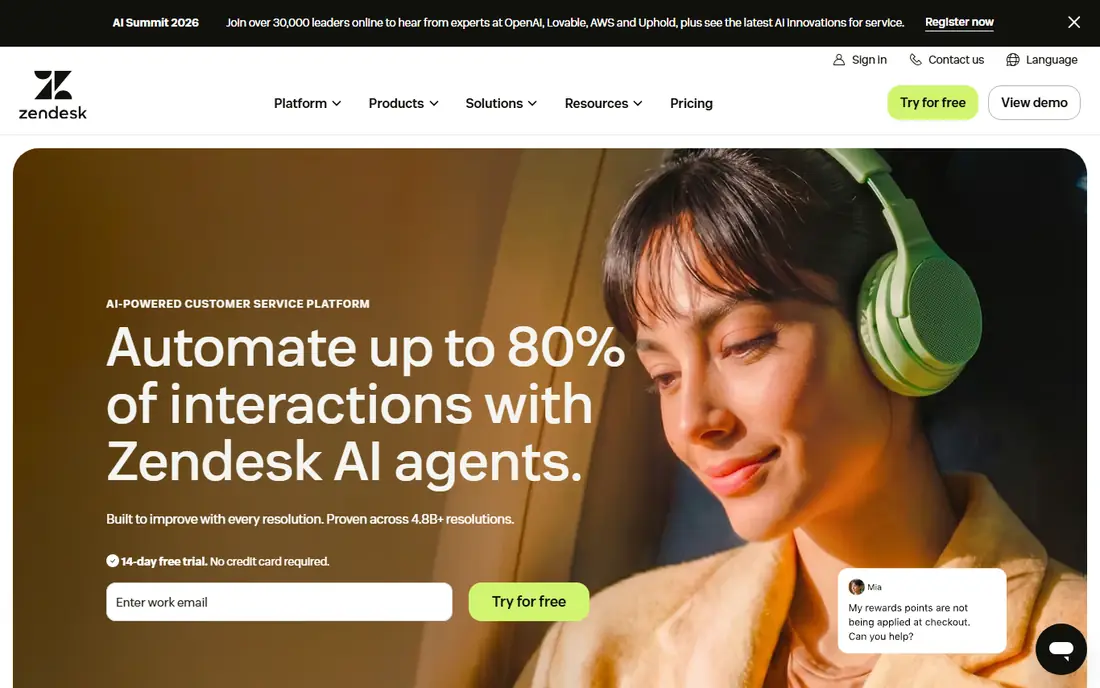
Zendesk is the most common move for teams that have outgrown Freshdesk and want a platform they will not outgrow again. The entry Support Team plan covers email ticketing, routing, macros and automations, while the Suite plans add messaging, live chat, a help center and voice. That split matters for budgeting, because the $19 per agent per month Support Team price does not include chat or a help center, and the cheapest plan with both is Suite Team at $55 per agent per month on annual billing.
The trade-off is setup time. Zendesk has more settings than Freshdesk, and a small team can spend days deciding which ones matter. For larger teams that cost is worth paying, because the automation depth, reporting and marketplace integrations are hard to match. AI agents are billed per automated resolution on top of seat prices, with a small monthly allowance included per agent, so check that line before signing.
- Very large integration marketplace
- Strong automation, triggers and macros
- Scales from one agent to large contact centers
- No free plan, only a 14-day trial
- Costs rise fast once chat, voice and AI add-ons are included
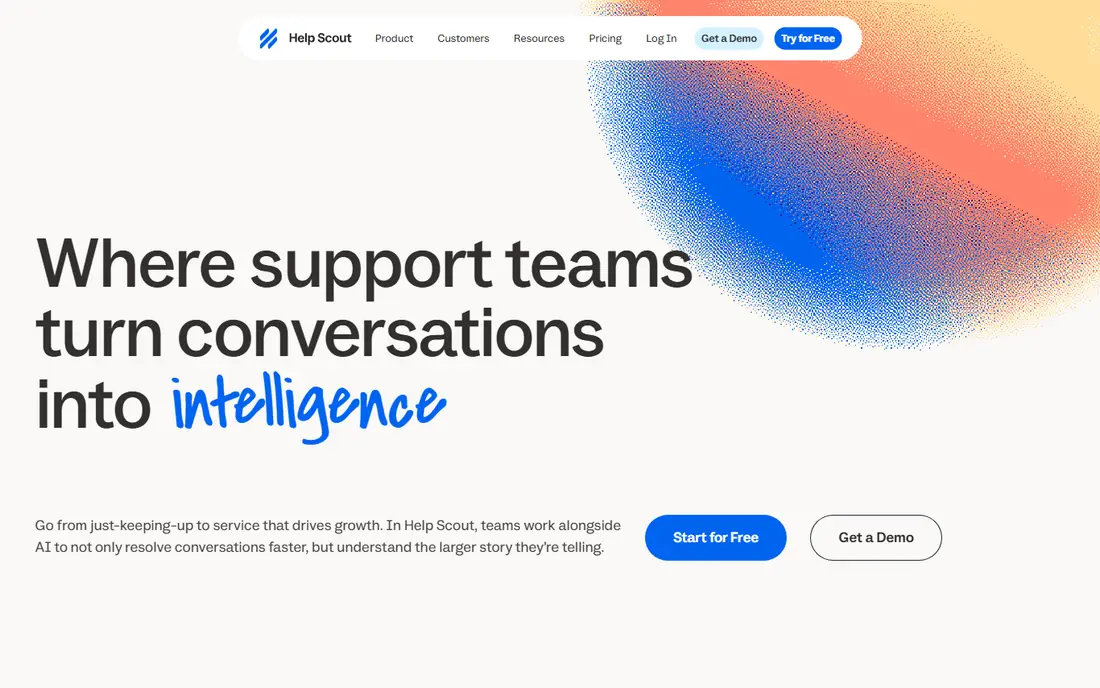
Help Scout suits teams that like Freshdesk but want support to feel more personal and less like a ticket queue. Conversations arrive in a shared inbox that looks like email, with collision detection so two agents never answer the same message, plus saved replies and assignments. The Docs knowledge base and Beacon help widget are built in, so customers can find answers without opening a ticket.
The free plan covers 5 users, one inbox and one Docs site, with a cap of 100 contacts per month, which is enough for a very small team to run real support. Standard at $25 per user per month adds multiple inboxes, live chat, SMS and social channels, plus basic workflows and one basic service level agreement policy. The main weakness is price growth, since every new hire adds a full seat, and the deeper workflow and security features sit on the $45 and $75 per user plans.
- Inbox feels like email, so new agents learn it fast
- Built in knowledge base and help widget
- Free plan covers up to 5 users
- Per-user pricing grows with every hire
- Fewer deep ticketing controls than Zendesk
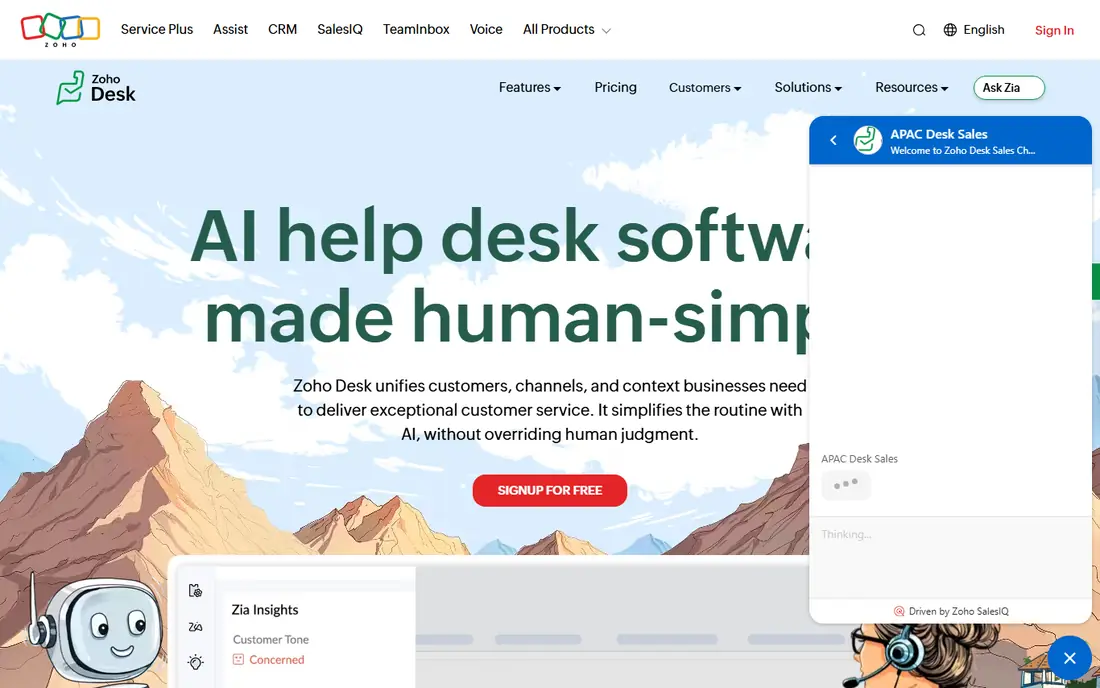
Zoho Desk is the pick for teams that want Freshdesk-style ticketing at a lower price. The free plan covers up to 3 agents with email ticketing, and Express at $7 per agent per month adds social channels, web forms and workflows for teams of up to 5 agents. Standard at $14 per agent per month removes the agent cap and adds a knowledge base, community forum and an answer bot, which is where most growing teams land.
The catch is that AI is split across tiers. Express can run generative AI only with your own model key, the answer bot arrives on Standard, and the full built in Zia AI suite needs Professional at $23 per agent per month. Teams already using Zoho CRM, Books or other Zoho apps get the most from Desk, because customer data flows between the apps without extra integration work. Teams outside that ecosystem should still compare it on price alone, since it undercuts most rivals at the entry level.
- Free plan for up to 3 agents
- Lowest paid starting price in this list
- Strong value if you already use other Zoho apps
- Agent caps on the free and Express plans
- AI features are spread across several tiers
Intercom is the alternative for teams whose support happens mostly in chat rather than email. The Messenger widget, shared inbox and help center are designed around live conversation, and the Fin AI agent answers from the same knowledge base your agents use, with handoffs that carry full context. Essential at $29 per seat per month on annual billing covers the inbox, ticketing and a public help center, while Advanced at $85 and Expert at $132 add workflows, round robin assignment and security features such as single sign-on.
Budgeting needs care, because Fin is billed at $0.99 per resolved conversation on top of seat prices. For a team with heavy chat volume, that usage line can grow larger than the seat bill, so model it from your last few months of conversation counts before committing. Intercom is also the pick most likely to appeal to SaaS and product teams, since its in-app messaging and product tours sit close to where customers already are.
- Messenger and shared inbox are polished and fast
- Fin AI agent is built in, not bolted on
- Strong fit for product-led and SaaS teams
- No free plan, only a 14-day trial
- AI outcome charges can match or pass the seat bill
HubSpot Service Hub is the natural Freshdesk alternative for any team already running HubSpot CRM, because tickets, contacts, deals and conversations live in one record. The free tools cover up to 2 users with a shared inbox, live chat and basic ticketing, which is enough to test whether the setup fits. Starter at $15 per seat per month on annual billing adds multiple ticket pipelines, conversation routing, simple automation and calling minutes.
The step up to Professional is steep, at $90 per seat per month on annual billing plus a one-time $1,500 onboarding fee, and that is the tier where service level agreement tracking, knowledge base features and customer feedback surveys appear. For teams already paying for HubSpot marketing or sales tools, the shared data and single login often justify the price on their own.
- Free tools cover up to 2 users
- Support tickets sit next to CRM records
- Starter removes HubSpot branding and adds routing
- Service level agreements and knowledge base need Professional
- Professional carries a one-time onboarding fee
Freshservice comes from the same company as Freshdesk, but it solves a different problem. Where Freshdesk serves external customers, Freshservice serves employees and IT operations, with incident, problem, change and asset management built around IT service practices. Starter at $19 per agent per month covers incident and knowledge management plus a service portal, while Growth at $49 adds a service catalog, service level management and asset tracking.
That makes it a good pick for a team that outgrew Freshdesk because internal requests, hardware assets and change approvals started piling up alongside customer tickets. It is a weaker pick for a pure customer support team, since several features that matter for external support, such as advanced analytics and some chat integrations, are gated behind higher tiers. Teams that only need customer ticketing will find better value elsewhere in this list.
- Built for IT service management, not just customer tickets
- Asset and service catalog features on higher tiers
- Same vendor family as Freshdesk, so migration is familiar
- No free plan, only a 14-day trial
- Advanced analytics and some integrations sit on higher tiers
LiveAgent is the budget pick that still covers a lot of ground. The free plan includes a knowledge base, customer portal and live chat button, though ticket history is limited to 7 days. Small at $15 per agent per month on annual billing adds more capacity, and Medium at $29 adds a call center, interactive voice response and service level agreement levels.
Channel coverage is the other strength, with email, live chat, phone, Facebook, Instagram, WhatsApp, Viber and Telegram tickets landing in one inbox. The interface is less polished than Help Scout or Intercom, but for a team that needs voice and social channels at the lowest price here, LiveAgent is hard to beat. A 30-day free trial with no card required makes it easy to test before paying.
- Free plan plus low paid starting price
- Built in call center on the Medium plan
- Wide channel coverage including social and WhatsApp
- Free plan keeps only 7 days of ticket history
- Interface feels dated next to newer rivals
Kayako changed its model in 2026, and it is now the most unusual option here. Instead of charging per agent seat, Kayako One charges $1 per ticket its Kay AI agent resolves, with no seat or setup fees listed. That makes it cheap for a small team with low volume, since a month with 100 AI resolutions bills around $100, but it grows without a ceiling as automation volume rises, so high-volume teams should model the cost carefully.
Kayako also works as an AI layer on top of a help desk you already use, including Zendesk, Freshdesk and Intercom, which means a team can add AI resolution without migrating tickets at all. The shared inbox, SingleView customer timeline and knowledge base with semantic search cover the basics, but teams that want a large integration marketplace or native voice will find Kayako thinner than Zendesk. It fits best where the goal is clearing a backlog with AI rather than rebuilding a support operation.
- AI agent resolves tickets without per-seat fees
- Unified customer timeline on every ticket
- Can sit on top of Zendesk, Freshdesk or Intercom
- No free plan and no public seat pricing
- Pricing scales directly with AI resolution volume
How we picked these
We compared the official pricing pages, feature pages and app store listings for each product, and checked that every homepage loads and belongs to the product named. Prices quoted here are the entry paid plan list prices in US dollars, with annual billing where the vendor discounts it, and free plan details are taken from the same vendor pages. We left out tools that only cover one channel, such as a standalone live chat widget, and tools that no longer publish a working product in October 2026.
We also weighed how each option handles a move away from Freshdesk. A good alternative should import tickets and contacts without a long project, keep the channels customers already use, and make its real monthly cost clear before checkout.
How to switch from Freshdesk without losing tickets
Export before you cancel anything
Export tickets, contacts, canned responses and knowledge base articles from Freshdesk first, and keep that export until the new tool has run for at least a month. An export you hold yourself is the safety net if an import misses attachments or ticket history.
Run both tools for two weeks
Point one channel, such as live chat or a single email address, at the new tool while the rest still runs on Freshdesk. That trial shows whether routing, macros and reply templates work the way your team expects, and it gives agents time to learn the new inbox before every ticket depends on it.
Match the plan to your real volume
Count seats, monthly conversations and tickets that need a human before choosing a tier. Per-seat tools such as Zendesk and Help Scout reward small teams, per-resolution tools such as Intercom and Kayako reward teams with high deflection, and free plans from Help Scout, Zoho Desk, HubSpot and LiveAgent let a team prove the fit before paying. If most tickets arrive inside a mobile app, also look at tools built for in-app support, since a web-first help desk can feel clumsy inside an app.
Frequently asked questions
Can I migrate tickets from Freshdesk to these alternatives?
Yes, in most cases. Zendesk, HubSpot, Zoho Desk and Help Scout all offer import tools or guided migration, and third-party migration services cover the rest. Test the import with a small batch before moving everything, so missing attachments or merged contacts show up early.
Which Freshdesk alternative has a free plan?
Help Scout, Zoho Desk, HubSpot Service Hub and LiveAgent all offer free plans, though each one caps users, history or features. Help Scout covers up to 5 users, Zoho Desk up to 3 agents, HubSpot up to 2 users and LiveAgent keeps only 7 days of ticket history. Zendesk, Intercom and Freshservice offer free trials instead, and Kayako has no free plan.
What is the cheapest Freshdesk alternative?
Zoho Desk has the lowest paid starting price in this list at $7 per agent per month for Express, followed by HubSpot Starter and LiveAgent Small at $15. The cheapest overall bill depends on your team, since a free plan may cover a tiny team entirely, while a per-resolution tool such as Kayako can be cheaper than any seat plan at very low volume.
Is Zendesk better than Freshdesk?
Zendesk offers deeper automation, a larger integration marketplace and stronger enterprise controls, but it costs more and takes longer to set up. Freshdesk is simpler and cheaper for small teams, so Zendesk is better mainly for teams that need scale, voice, advanced reporting or a help center that Freshdesk cannot match.
Do these alternatives work for small businesses?
Yes. Help Scout, Zoho Desk and LiveAgent are built with small teams in mind, with free plans and low entry prices, and HubSpot free tools suit a team of one or two. Larger platforms such as Zendesk and Intercom also work for small teams, but their value shows once volume, channels or automation needs grow past what a simple inbox can handle.
What about Helpshift as a Freshdesk alternative?
Helpshift is a fair option to check if most of your support happens inside a mobile app, since it is built around in-app messaging and support for app users. For email, chat and web support, the tools in this list cover more ground, so treat Helpshift as a specialist pick for app-first teams rather than a general replacement.
Sources we checked (8)

Online Jobs is an independent blog about careers, online work, learning new skills and the tools that help people earn. More about us.
Keep reading
All posts
Zoom Alternatives
Zoom alternatives compared for 2026: Google Meet, Microsoft Teams, Webex, Jitsi and more for free calls, large meetings and webinars for teams and classrooms.

Workday Alternatives
We compared the best workday alternatives for HR, payroll, and global hiring, from BambooHR and Gusto to Rippling, Deel, and HiBob for growing teams in 2026.
WordPress Alternatives
WordPress alternatives guide: we compare 8 platforms for builders, designers, stores, and publishers to leave WordPress without losing your full site content.