BrandVerity Alternatives in 2026: 8 Tools Compared


Paid search and affiliate compliance · Starting price: See website
How we put this together: we compare official feature and pricing pages, app store listings, privacy policies and public user reviews. Prices change, so check the provider's site before you pay.
Key takeaways
- The Search Monitor is the closest direct BrandVerity alternative for paid search and affiliate compliance work.
- Adthena adds competitive search intelligence, while Red Points and BrandShield cover counterfeits, phishing, and wider brand abuse.
- Most tools in this category price by quote, so compare monitoring frequency, geo coverage, and takedown support, not just the headline fee.
- Small teams that only need visibility can start with a cheaper intelligence tool, but enforcement needs a dedicated monitoring platform.
Quick comparison
| Name | Who it suits | Starting price | Free option | |
|---|---|---|---|---|
| The Search Monitor | Paid search and affiliate compliance | See website | No | Visit |
 Adthena | Competitive search intelligence | See website | No | Visit |
 AdPolice | PPC trademark monitoring | See website | No | Visit |
 Red Points | Counterfeit and IP protection | See website | No | Visit |
 BrandShield | Digital risk and phishing takedowns | See website | No | Visit |
 Corsearch | Trademark and IP enforcement | See website | No | Visit |
 Marcode | High-frequency affiliate monitoring | See website | No | Visit |
 PerformLine | Regulated compliance monitoring | See website | No | Visit |
The best BrandVerity alternatives
BrandVerity monitors paid search for trademark misuse and affiliate policy violations. The eight tools below cover the same core job plus adjacent needs: competitive intelligence, counterfeit removal, phishing takedowns, and regulated compliance. We compared them on monitoring focus, enforcement support, and pricing transparency.
The Search Monitor is the most direct BrandVerity alternative on this list. It crawls paid search ads to catch trademark bidding, unauthorized affiliates, and landing page violations, and it pairs that enforcement data with competitive ad intelligence. Affiliate program managers in particular will find the combination useful, since the same data that proves a violation also shows competitor activity.
The main limits are price transparency and learning curve. Plans are quoted, and the reporting depth that experienced users value can overwhelm a first-time user. If paid search compliance is your main problem, though, this is the first tool to trial.
- Direct match for trademark bidding and affiliate monitoring
- Global ad crawling
- Competitive ad intelligence included
- Pricing is quoted
- Interface can feel data-heavy for new users
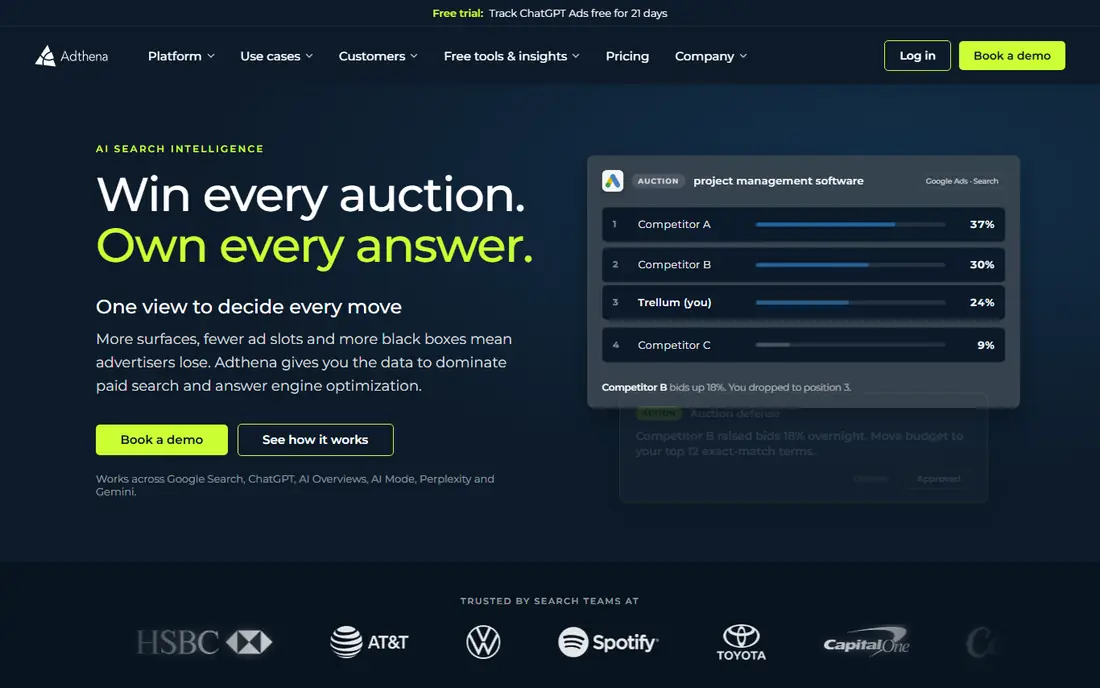
Adthena blends brand protection with competitive intelligence. It monitors paid search for trademark abuse and competitor bidding, alerts on market shifts, and helps submit trademark complaints to search engines. Large advertisers also use its data for strategy, since it shows how rivals position their ads and which terms they target.
Cost is the honest catch, with reviewers frequently calling it expensive, though many say the insight justifies the fee at scale. Smaller brands that only need violation alerts may find a focused monitor cheaper. Choose Adthena when competitive intelligence matters as much as enforcement.
- AI-driven search intelligence and market insights
- Trademark abuse alerts with takedown support
- Competitor ad copy trends
- Described by many users as expensive
- Best value for larger advertisers
AdPolice focuses on the core BrandVerity job: watching paid search ads for trademark misuse and affiliate fraud. Setup is straightforward, alerts are clear, and reports are built for enforcement conversations with affiliates and networks. Brands whose risk sits mainly in search will find that focus refreshing after broader platforms.
The limit is scope. AdPolice does not cover marketplace counterfeits, social impersonation, or phishing sites to the same depth, so a brand with wider abuse problems will need a second tool. Use it when PPC is the battlefield, and pair it with a broader protector if other channels matter too.
- Focused paid search and affiliate fraud detection
- Clear alerts and reporting
- Straightforward setup
- Limited scope beyond PPC
- Less help with marketplace or social abuse
Red Points suits brands whose main threat is counterfeit goods and pirated content rather than search ads alone. It scans marketplaces, websites, and social channels for infringing listings, then automates much of the takedown process. Consumer goods, fashion, and software brands with visible counterfeit problems get the most from it.
Paid search monitoring is present but not the center of the platform, so a brand whose main issue is affiliate bidding should still shortlist The Search Monitor or AdPolice. For cross-channel IP protection, Red Points is one of the strongest options here.
- Broad anti-counterfeit and piracy coverage
- Automated detection and takedowns
- Marketplace and social monitoring
- PPC monitoring is less central than in dedicated search tools
- May be more than a small brand needs
BrandShield covers the wider digital risk picture: fake websites, phishing pages, rogue apps, social impersonation, and domain abuse, alongside paid ad protection. Its threat-actor focus sets it apart, since investigations chase the people behind scam sites rather than removing one page at a time. Finance, crypto, and other heavily impersonated sectors benefit most.
That breadth comes with enterprise pricing and a fuller setup, so a small brand with a single PPC problem will find it heavy. Choose BrandShield when customers face phishing and impersonation scams, not just when an affiliate bids on your brand term.
- Wide digital risk coverage including phishing and domains
- Threat-actor focused investigations
- Fast takedown support
- Enterprise pricing and setup
- Broader than a pure PPC monitor needs
Corsearch, which includes the former Incopro platform, serves legal and IP teams that manage trademarks at scale. It covers trademark clearance, domain monitoring and disputes, and anti-counterfeiting enforcement, with workflows built for legal evidence and takedown records. Enterprises with large portfolios and formal IP processes will find it fits their structure.
Granular PPC monitoring is thinner than in The Search Monitor or AdPolice, so a performance marketing team may still want a search specialist alongside it. For IP-led brand protection with legal rigor, Corsearch is a strong enterprise pick.
- Trademark clearance, domain disputes, and anti-counterfeiting
- Legal-grade enforcement workflows
- Large IP portfolio support
- Less granular PPC monitoring than search specialists
- Enterprise-oriented pricing
Marcode is a newer entrant built for high-frequency monitoring of paid search and affiliate activity. Checking ads many times a day catches short-lived violations that a daily crawl would miss, which matters when affiliates run hijacked ads in bursts. AI detection helps flag ad hijacking patterns that manual review would overlook.
Being newer is both a plus and a risk: the product is modern and focused, but its track record is shorter than established rivals. Usage-based pricing can suit teams with variable monitoring needs. Trial it on your highest-risk keywords and compare detection speed with your current tool before switching fully.
- High-frequency ad checks for fast violation detection
- AI detection of ad hijacking
- Usage-based pricing option
- Newer vendor with a shorter track record
- Scope centers on affiliate and ad abuse
PerformLine serves regulated brands that must monitor marketing for compliance, not just trademark abuse. It watches web pages, calls, messaging, and social content for rule violations, with reporting built for audits. Banks, insurers, and education providers with regulatory duties will find that scope more relevant than a pure PPC monitor.
Trademark bidding is not its center, so a brand whose main issue is affiliate search abuse should pair it with a search specialist. For compliance-led organizations, PerformLine turns brand protection into a broader governance tool, which is exactly what regulators expect to see.
- Omnichannel compliance monitoring across web, calls, and messaging
- Strong fit for financial services
- Audit-ready reporting
- Less focused on trademark bidding than search monitors
- Enterprise pricing
How we picked these
We compared official product pages and public comparison material, and we favored tools that actively monitor paid search, affiliate activity, or brand abuse in 2026. We separated search specialists from broader IP and compliance platforms, since their strengths differ and a single ranking would hide that. Where pricing is quoted, we say so rather than repeating estimates as fact.
How to choose a BrandVerity alternative
Name your main violation type first
Trademark bidding, affiliate fraud, counterfeits, phishing, and regulatory breaches need different tools. The tool that matches your top violation type should lead the shortlist.
Compare monitoring frequency and coverage
Ask how often ads are checked, which search engines and countries are covered, and whether mobile and desktop are both monitored. A violation that runs for a week between checks costs more than a faster tool would.
Test the enforcement workflow
Detection without takedown is only half a product. Trial the alert, evidence pack, and takedown or affiliate notification flow on a real violation before signing.
Frequently asked questions
What is the most direct BrandVerity alternative?
The Search Monitor is the most direct BrandVerity alternative, covering paid search compliance, trademark bidding detection, and affiliate monitoring with competitive ad intelligence from the same data.
What is the best BrandVerity alternative for competitive intelligence?
Adthena is the best pick for competitive intelligence alongside brand protection, with AI-driven search insights, competitor ad trends, and trademark abuse alerts. Expect enterprise-level pricing.
What is the best BrandVerity alternative for counterfeit protection?
Red Points and BrandShield lead for counterfeit and wider brand abuse protection, with marketplace scanning and automated takedowns. Red Points leans toward counterfeits, while BrandShield leans toward phishing and impersonation.
What is the best BrandVerity alternative for small brands?
Small brands that mainly need visibility can start with a focused PPC monitor like AdPolice or a high-frequency tool like Marcode, and add broader protection only if counterfeits or phishing appear. Get a written quote tied to your keyword count first.
How much do BrandVerity alternatives cost?
Most tools on this list price by quote, based on keyword count, monitoring frequency, and channels covered. Marcode offers a usage-based option, but for most vendors you should expect a sales conversation and a custom proposal.
Do BrandVerity alternatives handle affiliate compliance?
Yes. The Search Monitor, AdPolice, and Marcode all monitor affiliate activity in paid search, including trademark bidding and ad hijacking. Confirm that affiliate network integrations and evidence reporting match your program's rules before choosing.
Sources we checked (8)

Online Jobs is an independent blog about careers, online work, learning new skills and the tools that help people earn. More about us.
Keep reading
All posts
n8n Alternatives
n8n alternatives compared for 2026, with Zapier, Make, Activepieces, and more, covering visual builders, code steps, self-hosting, and pricing models.

ZoomInfo Alternatives
The best ZoomInfo alternatives in 2026, compared on price, free plans, data coverage, and which tool fits small teams or large sales teams best in detail.
Yotpo Alternatives
Find cheaper alternatives to Yotpo for reviews and loyalty, with Judge.me, Loox, Stamped, and more compared for Shopify stores in 2026, all in one guide.