Best Website Analytics Tools in 2026: 9 Platforms Compared


General traffic reporting · Starting price: Free
How we put this together: we compare official feature and pricing pages, app store listings, privacy policies and public user reviews. Prices change, so check the provider's site before you pay.
Key takeaways
- Google Analytics 4 is free and remains the default for broad traffic, audience and conversion reporting.
- Plausible, Fathom and Matomo suit teams that want privacy-first tracking without a cookie banner in most cases.
- Mixpanel and PostHog are stronger for product behaviour, funnels and retention than for simple page traffic.
- Microsoft Clarity is free and adds heatmaps and session recordings beside any traffic tool.
- Adobe Analytics fits large enterprises with complex data needs, but it is priced on quote and needs specialist setup.
Quick comparison
| Name | Who it suits | Starting price | Free option | |
|---|---|---|---|---|
| Google Analytics 4 | General traffic reporting | Free | Yes | Visit |
 Matomo | Data ownership and privacy | Free | Yes | Visit |
 Plausible Analytics | Simple privacy-first stats | $9 per month | Free trial | Visit |
 Fathom Analytics | Simple privacy-first stats | $15 per month | Free trial | Visit |
 Mixpanel | Product funnels and retention | Free | Yes | Visit |
 PostHog | Product analytics and replay | Free | Yes | Visit |
 Microsoft Clarity | Free behaviour insight | Free | Yes | Visit |
 Adobe Analytics | Enterprise analytics | See website | No | Visit |
 Umami | Lightweight self-hosted stats | Free | Yes | Visit |
The best website analytics tools
Website analytics tools answer different questions. Some count visits and sources, some track what users do inside a product, and some show how people move through a page. The list below mixes traffic tools, product tools and behaviour tools so a reader can pick by the question they need answered, not by brand alone.
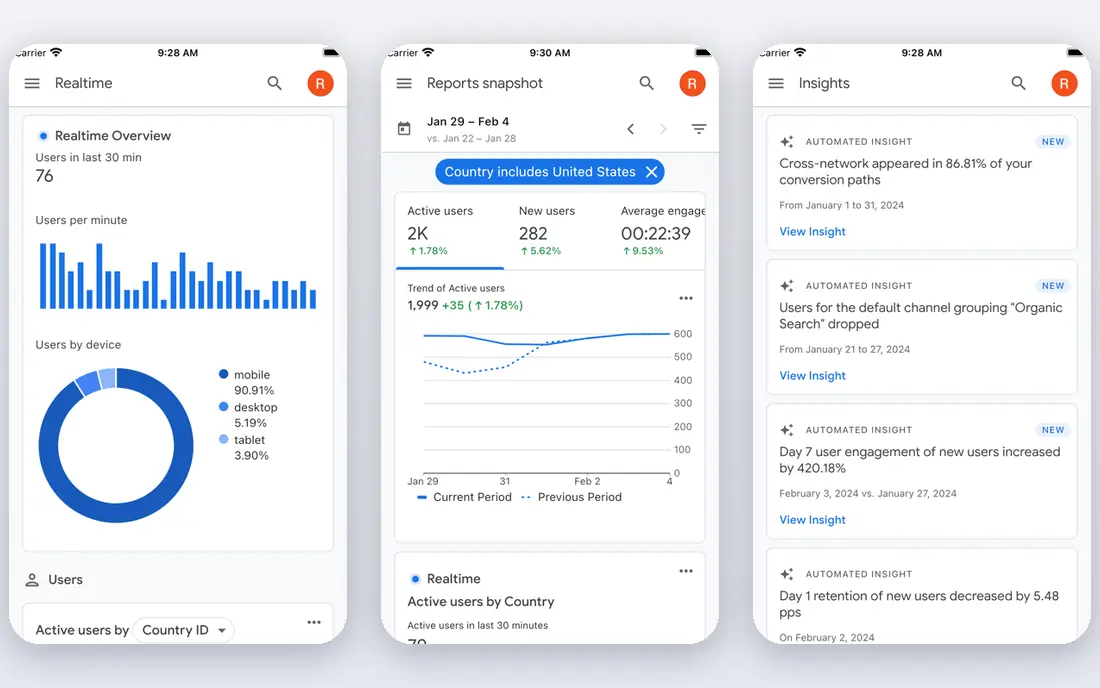
Google Analytics 4, often called GA4, is the default analytics tool for most websites because it is free and widely understood. It reports traffic sources, pages, events, conversions and audiences, and it links to Google Ads so a team can see which campaigns lead to actions on site. Agencies, freelancers and in-house teams can all read the same reports, which makes hiring and handover easier.
The downside is complexity. GA4 is event-based, so a team needs to plan events and conversions rather than just adding a script and reading pageviews. Cookie use also means consent handling matters in the EU and other regulated regions. For teams that accept that setup work, GA4 gives depth that no simple privacy tool can match at zero licence cost.
- Free at any traffic level for the standard product
- Deep event, audience and conversion reports
- Close links to Google Ads
- Setup and reporting can feel complex
- Cookie use needs consent handling in many regions
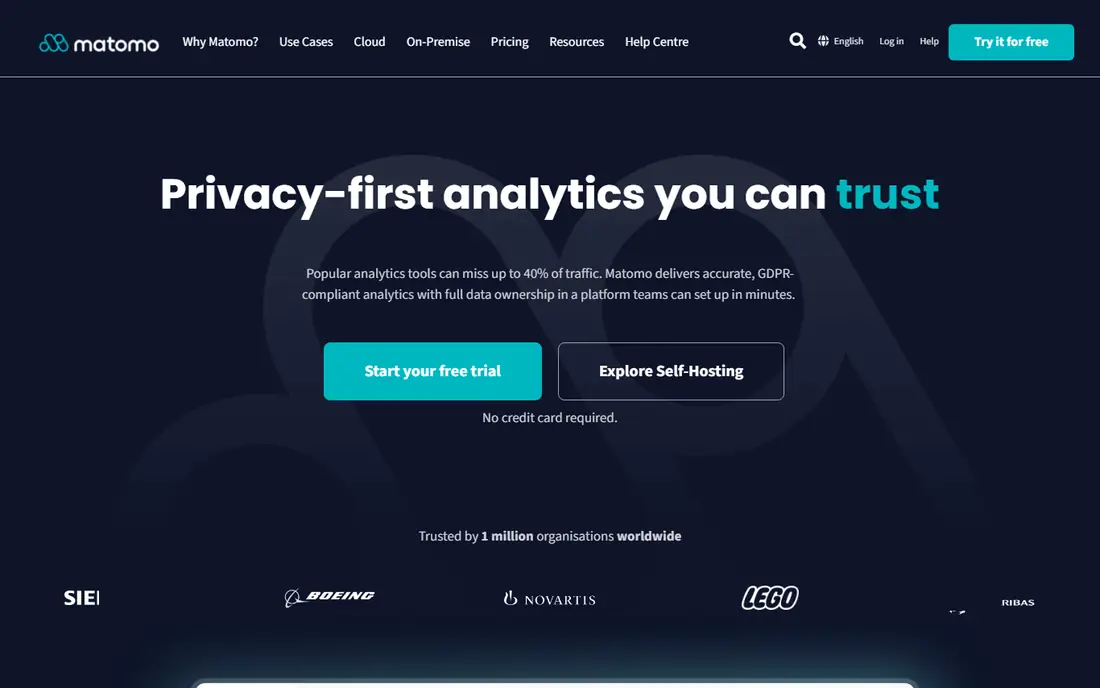
Matomo is the closest privacy-focused alternative to GA4 in terms of report depth. The self-hosted version is free, data stays on a team's own server, and reports cover visitors, pages, goals, funnels and campaigns in a familiar layout. A cookieless mode and privacy controls help teams that want to reduce consent banner friction while keeping detailed reporting.
Hosting is the trade. A team must install, update and back up Matomo, or pay for Matomo Cloud, where pricing rises with monthly hits. Organisations in the public sector, healthcare or other regulated areas often accept that work for data ownership alone. Smaller teams that want zero maintenance may prefer Plausible or Fathom instead.
- Self-hosted free version
- Full data ownership
- GA-style reports plus heatmaps and session recording options
- Self-hosting needs maintenance
- Cloud pricing rises with traffic
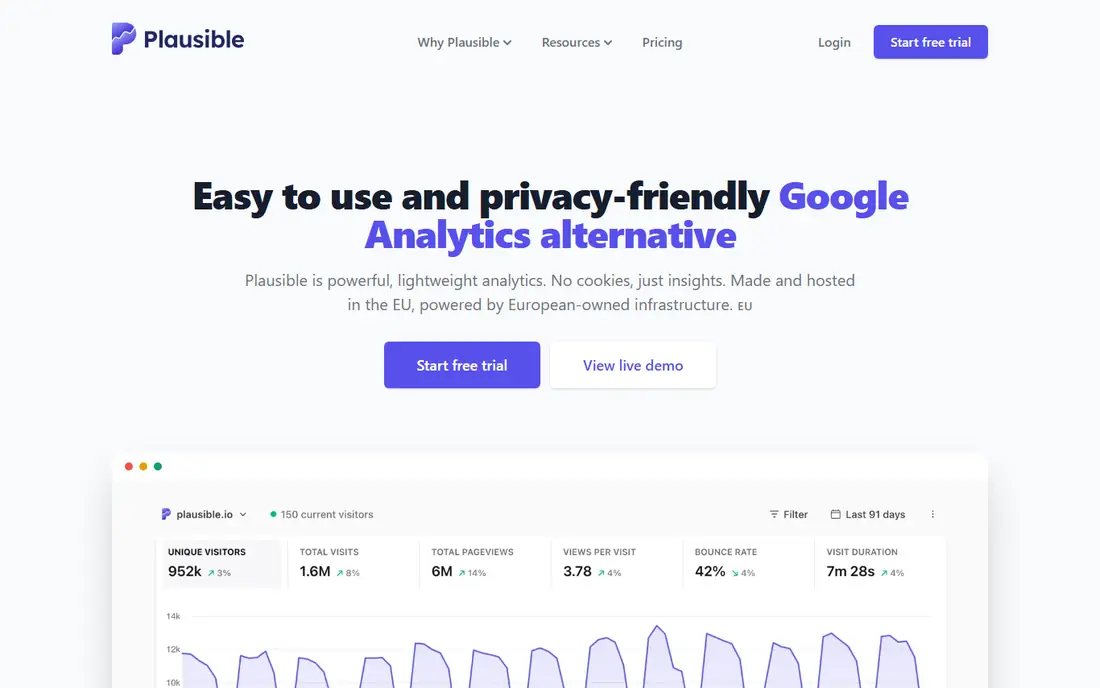
Plausible is built for teams that want to know how a site performs without wading through a complex analytics suite. Its script is lightweight, it does not use cookies by default, and its dashboard shows visitors, sources, pages, devices and goals in one clean view. Content sites, blogs, marketing sites and small businesses often find that view is enough to make decisions.
The simplicity is also the limit. Plausible does not offer the same funnel, cohort or product analysis as Mixpanel or PostHog, and it does not try to. A team that needs that depth should pair Plausible with a product tool, or choose GA4 or Matomo as its main reporting home.
- Lightweight script
- No cookies by default
- Clear dashboard for traffic, sources and goals
- Less depth than GA4 or Matomo
- Paid plans rise with pageviews
Fathom takes a similar privacy-first route to Plausible, with a focus on a simple dashboard and fast loading. It tracks pageviews, sources, goals and events without cookies by default, and it is popular with agencies and creators who manage several sites and want one clear view per site. The emphasis is on reading the numbers quickly and acting on them, rather than building complex reports.
Pricing starts higher than Plausible at the entry level, but the allowance covers more pageviews on some plans, so the better value depends on traffic. Teams should compare the pageview limits for their actual traffic before choosing between Fathom and Plausible, because both charge more as traffic grows.
- Simple, fast dashboard
- Privacy-first tracking
- Good for many sites under one account
- No free tier beyond a trial
- Less product analysis than Mixpanel or PostHog
Mixpanel is a product analytics tool rather than a simple traffic counter. It tracks events, such as signups, feature use and purchases, and turns them into funnels, retention curves and cohorts that show how groups of users behave over time. Product and growth teams use those views to find where users drop off and which features keep people coming back.
That power needs planning. A team must decide which events to track and keep naming consistent, or reports become hard to read. Event-based pricing also means costs rise with usage, so a team should check its event volume against the free tier and paid plans before building a full tracking plan around Mixpanel.
- Strong funnels, cohorts and retention analysis
- Free tier for smaller event volumes
- Clear product reporting
- Needs event planning
- Costs rise with event volume
PostHog bundles several product tools into one platform: web and product analytics, session replay, feature flags, experiments and surveys. That mix suits product teams that want to see what users do, watch a session where something went wrong, test a change and ask users a question without buying four separate tools. A free tier covers smaller usage, and open-source self-hosting is available for teams that want control.
The breadth is also a risk. A team that only needs simple traffic stats may find PostHog more than it needs, and usage-based pricing across several products needs regular checking. For product-led teams, though, the combination of analytics and replay in one place is a strong reason to choose it over a traffic-only tool.
- Product analytics, session replay, feature flags and surveys in one platform
- Free tier
- Self-hosting option
- Breadth can feel busy
- Usage-based pricing needs monitoring
Microsoft Clarity is free and does one job well: it shows how people use a page. Heatmaps reveal where visitors click and scroll, session recordings show real journeys through a site, and insight filters surface rage clicks, dead clicks and quick backs. That behaviour view explains why a page underperforms in a way that a traffic number alone cannot.
Clarity is not a replacement for GA4, Matomo or Plausible, because it does not provide the same traffic, source and conversion reporting. Its best role is as a companion tool. A team can use a traffic tool to find a weak page, then use Clarity to watch how visitors actually use that page before changing it.
- Free heatmaps and session recordings
- No traffic cap on the free product
- Simple setup
- Behaviour tool, not a full traffic suite
- Best paired with GA4 or another traffic tool
Adobe Analytics is built for large organisations with complex data, many properties and strict reporting needs. It offers deep segmentation, calculated metrics, multi-suite reporting and links to other Adobe products, which helps enterprise teams combine web data with campaign and customer data. For a global company with dedicated analysts, that depth is hard to match.
The cost and skill needs put it out of reach for most small teams. Pricing is quoted, implementation is a project, and day-to-day use rewards training. A team without a dedicated analyst or a clear enterprise reporting need will get faster value from GA4, Matomo or a product tool such as Mixpanel.
- Deep segmentation and reporting at scale
- Strong enterprise integrations
- Real-time data options
- Quote-only pricing
- Needs specialist skills to set up and maintain
Umami is a lightweight, open-source analytics tool for teams that want simple stats and full control. The self-hosted version is free, the script is small, and the dashboard covers visitors, pages, sources and events without cookies or personal data collection by default. It suits developers, small sites and teams that want a clean alternative to GA4 without paying for a privacy tool.
Feature depth is narrower than Matomo, and a hosted Umami plan is paid, so the free route means self-hosting. Teams that want GA-style funnels or product cohorts should look elsewhere, but teams that want simple, private traffic numbers with no licence cost will find Umami a good fit.
- Simple, privacy-friendly stats
- Free self-hosted version
- Lightweight script
- Fewer features than Matomo
- Hosted plans are paid
How we picked these
We compared official product pages, pricing pages, documentation and privacy statements, and we checked that each tool is still available in October 2026. We looked for a clear analytics job first, then for free tier terms, cookie behaviour, data ownership and report depth. We mixed traffic tools, product tools and a behaviour tool, because a single traffic number does not answer every question a site owner has. Prices that are quoted or usage-based without a simple entry rate are shown as See website, and we did not claim hands-on trials that did not take place.
What to check before you buy
Decide the privacy posture first
Cookie-based tools such as GA4 need consent handling in many regions, while Plausible, Fathom, Matomo in cookieless mode and Umami reduce that burden. Choosing the privacy approach first removes half the list and avoids a later migration.
Match the tool to the question
Traffic questions suit GA4, Matomo, Plausible, Fathom or Umami. Product questions about funnels and retention suit Mixpanel or PostHog. Page behaviour questions suit Clarity beside a traffic tool. Buying one tool for all three jobs usually means it does one job well and the others poorly.
Check how pricing scales
Many tools charge by pageviews, hits or events, so a price that looks low at launch can rise with traffic. Model the cost at current traffic and at double that traffic, and check what happens when a limit is hit.
Plan events before you install
For GA4, Mixpanel and PostHog, write down the events, conversions and naming rules before adding code. A week of planning saves months of messy reports and makes it possible to compare periods fairly.
Frequently asked questions
What is the best website analytics software for a small business?
GA4 is free and deep, while Plausible or Fathom are simpler and privacy-first for a monthly fee. A small business that runs Google Ads often starts with GA4, and a content site that wants a clean dashboard often starts with Plausible or Fathom.
What tools are best for website analysis without cookies?
Plausible, Fathom, Matomo in cookieless mode and Umami are the main options on this list. They still need a privacy check for a specific jurisdiction and site setup, but they remove the cookie consent burden that GA4 creates in many cases.
Is Google Analytics free?
The standard GA4 product is free. The enterprise version, Analytics 360, is priced on quote and suits large organisations with higher limits and dedicated support.
What is the best web analytics tool for product teams?
Mixpanel and PostHog lead for funnels, retention and user-level behaviour. PostHog adds session replay and feature flags, while Mixpanel offers a more focused product analytics experience.
Can I use Clarity with Google Analytics?
Yes, many teams do. GA4 or another traffic tool shows which pages and sources matter, and Clarity shows how visitors behave on those pages through heatmaps and recordings.
How do I choose between Plausible and Fathom?
Both are simple, privacy-first tools with similar dashboards. Compare pageview allowances at your traffic level, the number of sites covered, goal and event support, and trial experience, then pick the dashboard your team reads most easily.
Sources we checked (9)

Online Jobs is an independent blog about careers, online work, learning new skills and the tools that help people earn. More about us.
Keep reading
All posts
n8n Alternatives
n8n alternatives compared for 2026, with Zapier, Make, Activepieces, and more, covering visual builders, code steps, self-hosting, and pricing models.

iPhone Alternatives
Looking for iPhone alternatives in 2026? Compare 9 Android phones from Samsung, Google, OnePlus, and more, with cameras, battery life, and honest trade-offs.

eBay Alternatives
Looking for ebay alternatives? We compared 9 marketplaces for sellers on fees, buyer reach, categories and ease of listing, to help you sell with confidence.