Best Trading Card Scanner App in 2026: 9 Apps Compared

How we put this together: we compare official feature and pricing pages, app store listings, privacy policies and public user reviews. Prices change, so check the provider's site before you pay.
Key takeaways
- Ludex is our pick for accuracy on sports and trading cards, with values based on completed marketplace sales and a free tier for casual use.
- CollX is the best free starting point for casual collectors, with unlimited scans and a built-in marketplace.
- TCGplayer is the strongest pick for Magic and Pokemon players who want a marketplace tied to their collection.
- Card Ladder and PriceCharting suit collectors who care more about sales history and price research than quick scanning.
- Card values vary by condition, set, and recent sales, and scanner estimates are not appraisals, so check sold listings before buying or selling.
Quick comparison
| Name | Who it suits | Starting price | Free option | |
|---|---|---|---|---|
 Ludex | Accurate sports and TCG scanning | Free | Yes | Visit |
 CollX | Free casual collecting | Free | Yes | Visit |
 TCGplayer | Magic and Pokemon marketplace | Free | Yes | Visit |
 Sports Cards Pro | Sports card price research | Free | Yes | Visit |
 Card Ladder | Sales history and analytics | See website | Free trial | Visit |
 Beckett | Price guides and grading links | See website | No | Visit |
 PSA | Graded card tracking and verification | Free | Yes | Visit |
 PriceCharting | Video game and TCG price research | Free | Yes | Visit |
 Alt | High-end card marketplace and vault | Free | Yes | Visit |
The best trading card scanner app
A good card scanner does three jobs: identify the card, including its set and parallel, show a realistic value, and store it in a collection you can manage. No single app leads on all three, so the best pick depends on whether you collect sports cards, trading card games, or both. We compared official app listings and feature pages to sort scanners from price guides. Please note that card values vary with condition and recent sales, and scanner estimates are not appraisals or grading guarantees.
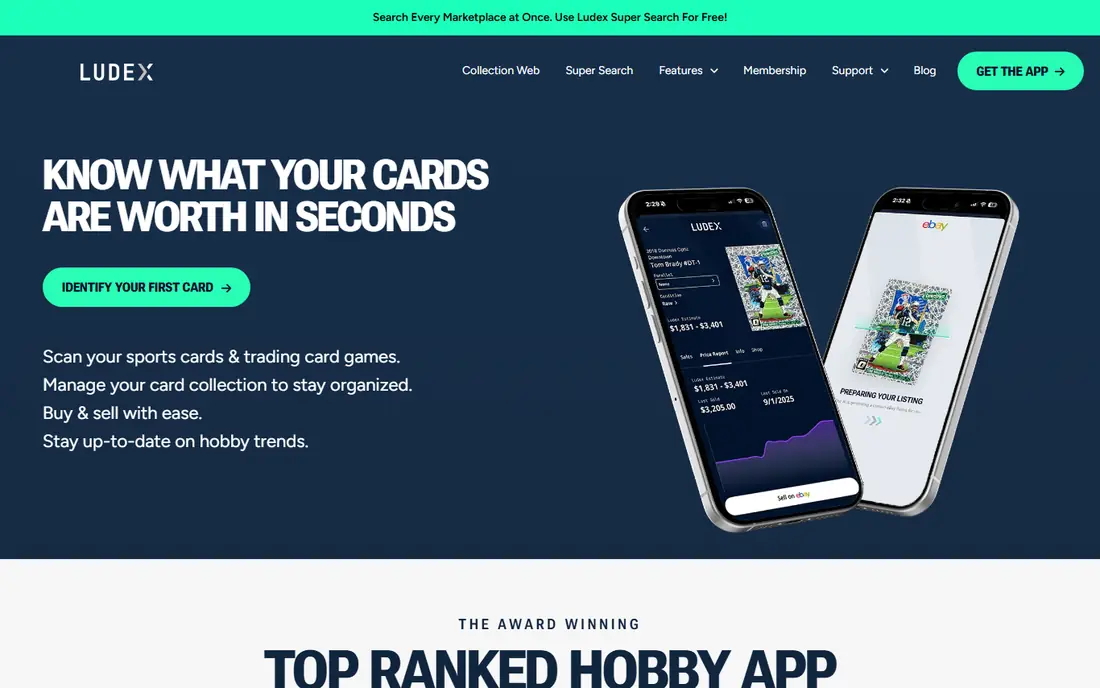
Ludex is the scanner most serious collectors reach for first. Photograph a card, and Ludex identifies the player or character, set, and parallel, then shows a value drawn from completed marketplace sales rather than asking prices alone. That sales-based approach matters, since asking prices often run higher than what cards actually sell for.
Ludex offers a free tier with unlimited scans and a capped collection size, plus paid tiers that add full categories, price reports, and more eBay listings. Sports collectors and trading card game collectors can both use it, covering baseball, basketball, football, soccer, hockey, Pokemon, and Magic. If accuracy on parallels matters to you, Ludex is our pick.
- Photo scanning for sports and trading card games
- Values based on completed sales
- Collection and eBay listing tools
- Full features need a paid plan
- Collection limits apply on the free tier
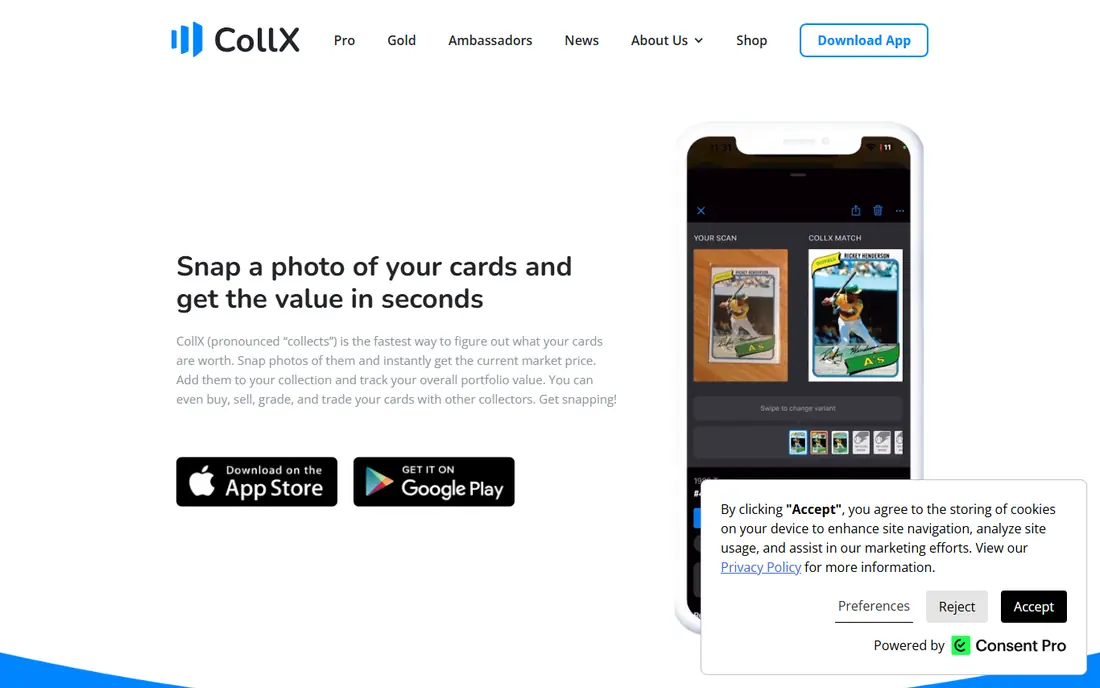
CollX is the best free starting point for casual collectors. Scanning is free and unlimited, the database covers sports and trading card games, and a built-in marketplace lets you buy and sell without leaving the app. For a collector sorting a box of cards from childhood, CollX gives fast answers at no cost.
CollX accuracy on parallels and its price estimates are less precise than Ludex, since its values blend asking prices with sales data. That means a CollX value should be treated as a starting point, not a sale price. Check recent sold listings for any card you plan to sell, especially for rarer parallels. For free, everyday scanning, CollX is still hard to beat.
- Free unlimited scans
- Very large card database
- Built-in marketplace for buying and selling
- Parallel accuracy and price estimates trail Ludex
- Values can run above sold prices

TCGplayer is the home base for many Magic: The Gathering and Pokemon collectors. Its app scans cards, adds them to a collection, and links each card to live marketplace prices from its large seller network. That link between collection and marketplace makes it easy to see what a deck or binder is worth and to list cards for sale.
TCGplayer is less useful for sports collectors, since its strength is trading card games. Selling through the marketplace also involves fees and seller rules, so casual sellers should read those terms first. For trading card game players who buy, sell, and track in one place, TCGplayer is the natural pick.
- Huge trading card game marketplace
- Card scanning in the app
- Collection tracking tied to market prices
- Sports card coverage is limited
- Marketplace fees apply when selling
Sports Cards Pro is a price guide first and a scanner second. Its free guide covers PSA, BGS, and ungraded sports card prices, with tools for collection tracking, lot values, and spotting big movers. That research depth helps collectors who already know what card they hold and want to check its market before a deal.
The app and scanning flow are less polished than Ludex or CollX, so Sports Cards Pro works best as a research companion rather than a sole scanner. Use Ludex or CollX to identify a card, then check Sports Cards Pro for graded and ungraded price context. For sports collectors who study prices, it is a useful free tool.
- Free price guide for graded and ungraded sports cards
- Collection tracker
- Lot value tools
- Scanning and app experience are lighter than Ludex or CollX
- Premium tools are paid
Card Ladder suits collectors who think in sales history rather than single snapshots. Its database covers millions of sports, trading card game, and non-sports cards, with verified sales from major marketplaces and population reports from grading firms. Collection values update daily, and analytics help collectors compare cards side by side.
Card Ladder offers a free trial, with full access behind paid plans, so casual collectors may find Ludex or CollX cheaper for basic scanning. Serious collectors and sellers, though, will value its sales depth when pricing a rare card. If you want to know what a card actually sold for over time, Card Ladder is the research pick.
- Very large historical sales database
- Value estimates and analytics
- Collection tracking with daily updates
- Paid plans needed for full access
- Research focus means scanning is not the main draw
Beckett has guided card collectors for decades, and its modern site and app still cover price guides, grading, and marketplace listings. Collectors who grew up with Beckett guides will find familiar pricing structure, plus links to grading submissions and population reports. That history gives Beckett authority for vintage cards in particular.
Full price guide access requires payment, and Beckett's scanning flow is not as central as Ludex or CollX. Beckett works best as a second source for pricing and grading research, especially for older sets where newer apps may have thinner data. For vintage collectors, Beckett remains a trusted name.
- Long-running price guides
- Grading services and population data
- Marketplace and news
- Full price guide access is paid
- App scanning is less central than Ludex or CollX
PSA is the grading firm behind many of the most valuable cards in the hobby, and its app and site help collectors verify graded cards and track sets. Scanning a PSA cert number confirms a card's grade and identity, which protects buyers from counterfeits and mislabeled cards. The set registry lets collectors track progress toward complete graded sets.
PSA is not a general scanner for raw, ungraded cards, so it will not identify a card from a photo in the way Ludex does. Grading itself costs money and takes time, and a grade can change a card's value sharply. Use PSA alongside a scanner: identify and value the raw card first, then decide whether grading is worth the cost.
- Cert verification for graded cards
- Set registry for collectors
- Grading submission tools
- Not a general raw-card scanner
- Grading costs extra and takes time
PriceCharting started with video game prices and now covers Pokemon, Magic, YuGiOh, Lorcana, and other trading card games. Its price charts show how a card's value has moved over time, and collection tools let users track total value across games and cards. That breadth suits collectors who hold both games and cards.
PriceCharting is a research site first, so its scanning and mobile collection flow are less developed than Ludex or CollX. Use it to check price history for a trading card game card you already identified, especially when deciding whether to hold or sell. For TCG price research, PriceCharting is a strong free companion.
- Price tracking for trading card games and video games
- Collection tools
- Sales history charts
- Scanning features are limited
- Sports coverage is thinner than TCG coverage
Alt focuses on the higher end of the hobby, with a marketplace, portfolio tools, and a vault option for storing valuable cards. Collectors with graded gems, rare parallels, or investment-grade cards can track value, list cards, and store them securely through Alt. Its data tools suit sellers who watch market movement closely.
Alt is less suited to casual scanning of common cards, since its marketplace and vault features target serious collectors. Fees and vault terms also need review before sending a valuable card for storage. For collectors moving from casual scanning into higher-value trading, Alt is a useful next step after Ludex or CollX.
- Marketplace for higher-value cards
- Vault storage option
- Price data and portfolio tools
- Geared to higher-value collecting
- Not a basic free scanner for casual users
How we picked these
We compared official app listings, feature pages, and price guide documentation for each product, and we favored apps that are available in the United States, actively maintained, and able to identify cards from photos or cert numbers. We mixed pure scanners with marketplace apps and research tools, since collectors use all three in practice. Where a vendor does not publish a price, we wrote See website rather than guessing a figure.
How to get a realistic value from a card scanner
Start by confirming the exact card, including set, year, parallel, and condition, since a small difference can change value sharply. A base card and a refractor parallel may look alike in a photo but sell for very different amounts. Check the scanner result against the card in hand, especially for parallels, foils, and short prints.
Next, compare the scanner estimate with recent sold listings for the same card in the same condition, graded or ungraded as your copy is. Scanner values often blend asking and sold prices, so sold data is the better guide for a sale. Finally, factor in fees, shipping, and grading cost before deciding to sell or grade. A card that scans at a high value may still net far less after those costs.
Frequently asked questions
What is the best trading card scanner app?
Ludex is our pick for most collectors, thanks to accurate scanning for sports and trading card games and values based on completed sales. CollX is the best free alternative for casual collectors, while TCGplayer is best for Magic and Pokemon players. Try Ludex and CollX on the same cards and keep the one that identifies your parallels best.
Is there a free trading card scanner app?
Yes. CollX offers free unlimited scans, Ludex offers a free tier with unlimited scans and a capped collection, and TCGplayer offers free scanning for trading card games. Free tiers often limit collection size or advanced price reports, so check those limits before you scan a large collection.
How accurate are trading card scanner apps?
Base card identification is usually reliable, while parallel and variation accuracy varies by app, with Ludex generally rated more accurate than CollX on parallels. Price estimates also vary, since some apps blend asking prices with sold prices. Always confirm the exact card and check recent sold listings before buying, selling, or grading.
Can a scanner tell me if my card is worth grading?
A scanner can help, but it cannot decide grading for you. It identifies the card and gives a raw value, while grading value depends on condition, including centering, corners, edges, and surface, which a scanner cannot judge fully. Compare the raw value with graded values for the same card, subtract grading and shipping costs, and only grade cards where the math clearly works.
What is the best app for Pokemon card scanning?
TCGplayer is a strong pick for Pokemon collectors who also buy and sell, while Ludex and CollX both scan Pokemon cards well. Ludex suits collectors who want sales-based values, and CollX suits casual collectors who want free scans. PriceCharting is a useful extra source for Pokemon price history.
Sources we checked (9)

Online Jobs is an independent blog about careers, online work, learning new skills and the tools that help people earn. More about us.
Keep reading
All posts
Best Lightsaber Company
Compare the best lightsaber companies for custom, Neopixel and duelling sabers, with hilt quality, soundboards and prices explained before you buy a saber.
Best Card Scanner App
Find the best card scanner app for trading and sports cards in 2026. We compare CollX, Cardbase, Ludex, Collectr, and more on scanning and prices in detail.

n8n Alternatives
n8n alternatives compared for 2026, with Zapier, Make, Activepieces, and more, covering visual builders, code steps, self-hosting, and pricing models.