Best Tools for Tracking LLM Brand Visibility in 2026: 8 Tools Compared

How we put this together: we compare official feature and pricing pages, app store listings, privacy policies and public user reviews. Prices change, so check the provider's site before you pay.
Key takeaways
- Brand visibility in AI answers is not one score, so track mentions, citations, sentiment, and competitor share together.
- Otterly.AI and Peec AI offer the clearest entry prices for small and mid-size teams, while Profound and Scrunch AI target larger brands.
- A single ChatGPT check can mislead you, because Gemini, Perplexity, and Google AI Overviews often cite different sources.
- Prompt quality decides value: buyer questions without your brand name reveal more than branded searches alone.
- AI answers change between runs, so judge trends over weeks, not one daily result.
Quick comparison
| Name | Who it suits | Starting price | Free option | |
|---|---|---|---|---|
 Peec AI | Mid-size teams and agencies | $95 per month | Free trial | Visit |
 Otterly.AI | Small teams starting out | $29 per month | Free trial | Visit |
 Profound | Enterprise brand tracking | $99 per month | Free trial | Visit |
 Semrush | SEO teams with AI needs | $99 per month | No | Visit |
 Ahrefs | Existing Ahrefs users | $129 per month | No | Visit |
 Scrunch AI | Accuracy and brand framing | $300 per month | No | Visit |
 PromptWatch | Prompt-level agency tracking | $95 per month | Free trial | Visit |
 Brand24 | Mentions plus social listening | $199 per month | Free trial | Visit |
The best tools for tracking LLM brand visibility
These tools run your prompts through large language models, record whether your brand is mentioned, cited, or recommended, and compare you with competitors. We focus on tracking, not on writing content for AI answers.
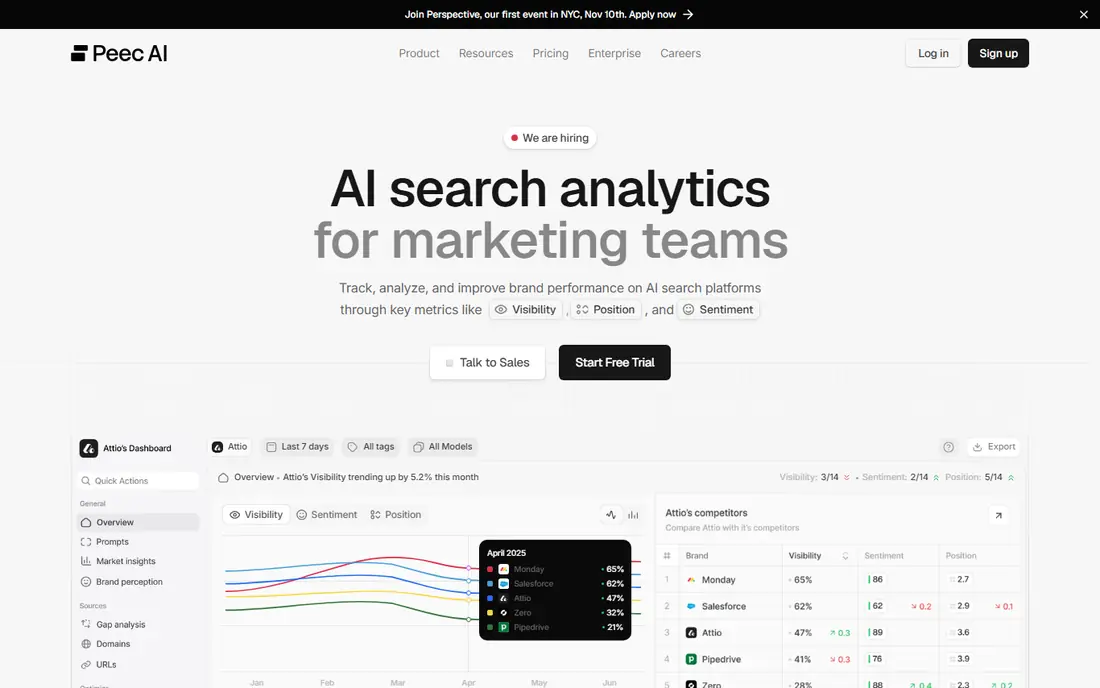
Peec AI is a good default for a marketing team that needs regular, readable reporting. You set a prompt list, it runs daily, and you see mentions, sentiment, and competitor share in one dashboard. Unlimited seats make it easy to share that view with clients or colleagues without extra seat fees. The limit is engine selection. Entry plans let you pick a set of models rather than every model at once, so confirm that your key engines are included. If you track 50 to 350 prompts and need agency-friendly reporting, Peec AI balances price, clarity, and depth well.
- Daily prompt tracking
- Unlimited seats on many plans
- Clear prompt tiers
- Model choice limited on entry plans
- Higher tiers needed for large prompt lists
Otterly.AI is the lowest-cost way to start tracking LLM brand visibility properly. The Lite plan checks a short prompt list daily across ChatGPT, Google AI Overviews, Perplexity, and Copilot, which is enough to learn where your brand appears and where competitors win. Setup is simple, and reports are easy to read for non-technical teams. The trade-off is scale. Fifteen prompts will not cover a full catalog, and Claude, Gemini, and Google AI Mode may cost extra. Use Otterly.AI to prove the value of tracking, then upgrade when your prompt list and engine needs grow. For a first quarter of tracking, it is good value.
- Lowest entry price here
- Daily checks
- Simple setup
- Lite plan covers only 15 prompts
- Some engines are add-ons
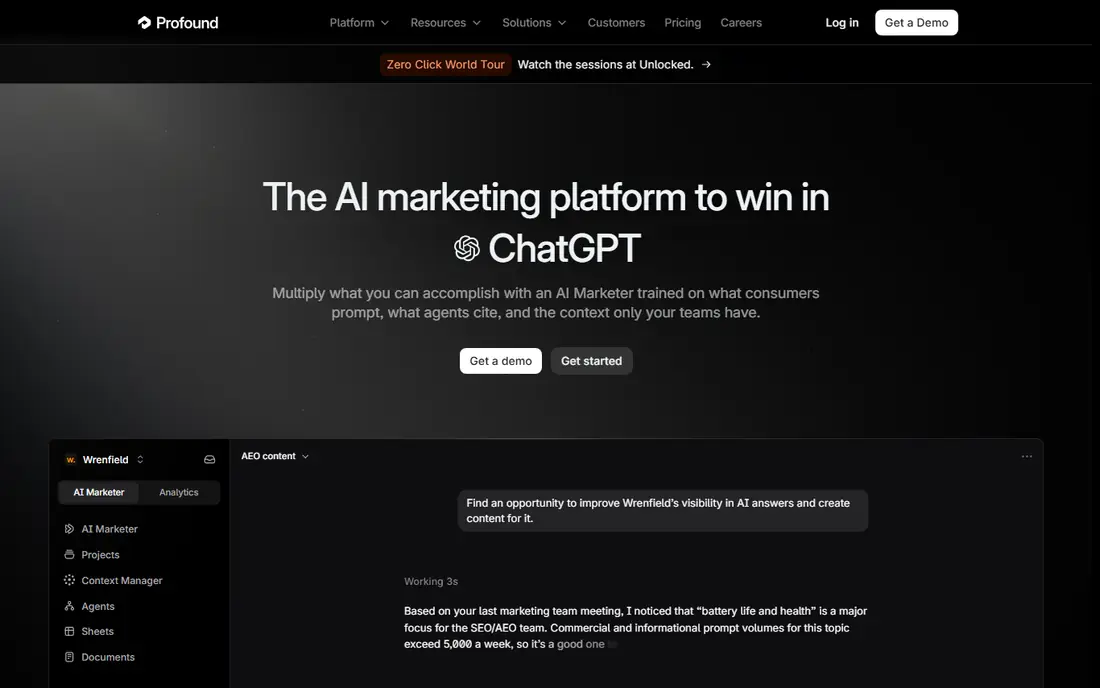
Profound suits brands that need to defend AI visibility in board and budget discussions. It tracks mentions and citations, compares share of voice with competitors, and shows which sources AI answers rely on. That source evidence helps content and PR teams decide where to invest, rather than guessing from a single score. The catch is that Starter covers fewer engines than Growth and Enterprise, so the $99 entry price does not buy the full multi-engine view. Confirm engine coverage and prompt limits on a trial before you compare Profound with cheaper trackers. Choose it when reporting depth matters more than the lowest price.
- Detailed citation analysis
- Share of voice
- Multi-engine plans
- Entry plan is narrower on engines
- Full enterprise pricing needs a quote
Semrush works best when LLM tracking is part of a wider SEO job. Its AI Visibility Toolkit covers ChatGPT, Gemini, Perplexity, Google AI Overviews, and other surfaces, and it connects results to keyword, content, and backlink tools. That connection helps you turn a weak AI mention into a concrete content or link task. The downside is cost for single-purpose use. At $99 per month for the toolkit, Semrush is not a cheap standalone tracker, and teams that do not use its SEO suite may get better value elsewhere. Pick Semrush when you already live in its SEO tools and want AI visibility in the same account.
- Wide engine coverage
- Strong SEO integration
- Competitor research
- Costly if you only need LLM tracking
- Toolkit pricing sits on top of SEO plans in some cases
Ahrefs Brand Radar is the natural add-on for teams already using Ahrefs. It tracks brand mentions across AI answers and links them to web sources, which helps you understand why an AI answer favors a competitor. If your team already checks Ahrefs for links and content gaps, adding brand tracking there avoids another login and another export routine. The limit is total cost. The $129 per month starting price is for Ahrefs itself, and Brand Radar pricing needs checking on top of that, so the combined cost can exceed a dedicated tracker. Choose Ahrefs when link and content context matters as much as the mention count itself.
- Brand Radar mention tracking
- Strong link data
- Familiar SEO workflow
- Brand Radar is tied to a paid Ahrefs plan
- Less specialized than dedicated trackers
Scrunch AI stands out when accuracy matters as much as presence. It tracks ChatGPT, Claude, Gemini, Perplexity, Google AI Mode, and AI Overviews, and it separates custom prompts from industry prompts. That helps brand teams spot when AI describes a product wrongly, omits a key feature, or frames a competitor more favorably. The price limits its audience. At $300 per month, Scrunch AI is aimed at larger and content-led teams, not solo marketers. If your main risk is misleading AI descriptions, the framing analysis may justify the cost. If you only need mention counts, a cheaper tracker will cover the basics.
- Broad engine coverage
- Framing and accuracy checks
- Custom and industry prompts
- High starting price
- No free plan
PromptWatch appeals to agencies and advanced SEO teams because it works at prompt level. It covers ChatGPT, Claude, Gemini, and Perplexity, and it stores responses so you can see exactly what an AI answer said on a given date. That detail helps when a client asks why a mention changed, because you can show the answer, not just a score. The catch is that response limits and plan tiers need careful reading, especially for high-volume prompt lists. Beginners may find simpler dashboards easier, while advanced teams will value the depth. Choose PromptWatch when prompt-level evidence and agency reporting matter most.
- Prompt-level monitoring across major models
- Agency plans
- Detailed response data
- Usage-based limits need care
- Interface suits advanced users more than beginners
Brand24 is different because it is a listening tool first, with AI mention tracking added to social, news, and web monitoring. That breadth helps PR teams that need one place for brand mentions, sentiment spikes, and crisis alerts, rather than a separate tool for every channel. Real-time alerts are useful when a story or review suddenly spreads. The trade-off is focus and price. At $199 per month, Brand24 costs more than dedicated AI trackers, and its AI depth may not match a specialist tool. Choose Brand24 when you need social listening and AI tracking together. Choose a dedicated tracker when LLM visibility is your only job.
- Real-time mention alerts
- Sentiment trends
- Social and web coverage beyond AI
- AI tracking is part of a wider listening tool
- Starting price is high for AI-only use
How we picked these
We selected tools that run defined prompts through AI models, store the prompt, engine, date, mention, and citation, and report change over time. We checked official feature and pricing pages, plus public reviews, for engine coverage, prompt limits, sentiment, share of voice, and trial terms, and we listed See website where pricing was unclear. We did not claim hands-on testing, and we excluded tools that only estimate AI visibility from search rankings without querying AI answers.
Building a prompt list that actually measures brand visibility
Start with buyer questions, not brand names. Write prompts like a customer would ask them, such as asking for the best option for a specific need, budget, or use case, and include a few branded prompts to check direct mentions. Aim for 25 to 50 unbranded prompts at first, grouped by product, use case, and buyer stage, so you can see which groups you win and which you lose. Next, keep the list stable for at least a month, because changing prompts every week makes trends hard to read. Review mentions, citations, and competitor share weekly, and look at the actual AI answers when a score moves sharply. Finally, act on citation gaps: improve the pages AI cites, add clear product facts and comparisons, and seek coverage from trusted sources in your niche, then watch the next month for movement.
Frequently asked questions
What is the best tool for tracking llm brand visibility for a small business?
Otterly.AI is a strong start at $29 per month, because it covers daily tracking across major engines for a short prompt list. Peec AI suits teams that need more prompts and unlimited seats. Both give you mention and competitor data without enterprise pricing, so start small and upgrade as your prompt list grows.
How is LLM brand visibility different from SEO rankings?
SEO rankings show where your pages appear in search results, while LLM visibility shows whether AI answers mention, cite, or recommend your brand when users ask a question. A page can rank well in search but never be cited by an AI answer, and vice versa. Track both, because customers now discover brands through both routes.
How many prompts do I need to track?
Start with 25 to 50 unbranded buyer prompts plus a small set of branded prompts, and keep that list stable for 30 days. That size shows patterns without overwhelming your weekly review. Expand only when you can act on new data, such as updating pages or targeting new citation sources.
Why do AI answers change so much between runs?
AI models generate answers from patterns and retrieved sources, and small changes in wording, date, or source availability can change the result. That is why single-day scores bounce and why trends over weeks matter more. Keep prompts identical, record the engine and date, and judge movement over two to four weeks.
Can tracking tools fix my AI visibility?
No. Tracking tools measure mentions, citations, and sentiment, but they do not rewrite your site or earn coverage for you. Use their citation data to find which pages AI answers trust, improve those pages with clear facts, and build credible third-party coverage. Tracking tells you where to work, not the work itself.
Do I need to track competitors too?
Yes, because share of voice only makes sense in context. If your mentions rise but a competitor rises faster, you are still losing ground in AI answers. Track two to five direct competitors on the same prompts, compare citation sources, and focus on the prompt groups where competitors consistently win.
Sources we checked (8)

Online Jobs is an independent blog about careers, online work, learning new skills and the tools that help people earn. More about us.
Keep reading
All posts
Constant Contact Alternatives
Compare the best constant contact alternatives for small businesses, creators and nonprofits, with free plans and automation notes to guide your switch.
Best keyword difficulty tool
Looking for the best keyword difficulty tool? We compare 9 SEO tools on difficulty scores, SERP data, price, and ease of use for sites of all sizes in 2026.
Best Visibility Tracking Tools
Looking for the best visibility tracking tool? We compared nine visibility and rank tracking tools on keyword tracking, competitor views, and reporting.