Best Tools for Miniatur Sound System in 2026: 8 Tools Compared

Free room and speaker measurement · Starting price: Free
How we put this together: we compare official feature and pricing pages, app store listings, privacy policies and public user reviews. Prices change, so check the provider's site before you pay.
Key takeaways
- We read this keyword as tools for miniature and small sound systems, because the wording looks truncated, and we built the list around that reading.
- Design tools like WinISD and VituixCAD help you size a small enclosure and crossover before you cut wood or buy parts.
- Measurement tools like Room EQ Wizard and Dayton Audio DATS V3 show what a small speaker actually does, rather than what a spec sheet suggests.
- A compact DSP unit and a small amplifier turn a good design into a finished system you can tune in a real room.
Quick comparison
| Name | Who it suits | Starting price | Free option | |
|---|---|---|---|---|
| Room EQ Wizard | Free room and speaker measurement | Free | Yes | Visit |
 WinISD | Small enclosure design | Free | Yes | Visit |
 VituixCAD | Crossover and enclosure design | Free | Yes | Visit |
 Dayton Audio DATS V3 | Driver measurement hardware | See website | No | Visit |
 miniDSP 2x4 HD | Compact DSP tuning | See website | No | Visit |
 Fosi Audio BT20A | Small stereo amplifier | See website | No | Visit |
 Audacity | Test tones and audio editing | Free | Yes | Visit |
 ARTA | Measurement and analysis suite | See website | Free trial | Visit |
The best tools for miniatur sound system
A small sound system rewards careful design more than large speakers do, because a tiny enclosure leaves little room for error. We picked tools that help you design, measure, power, and tune miniature and small systems, from a desktop speaker to a compact room setup. Note on wording: the keyword in this brief looks truncated, so we treat it as miniature and small sound systems throughout, and we flag that reading here so you can judge the fit.
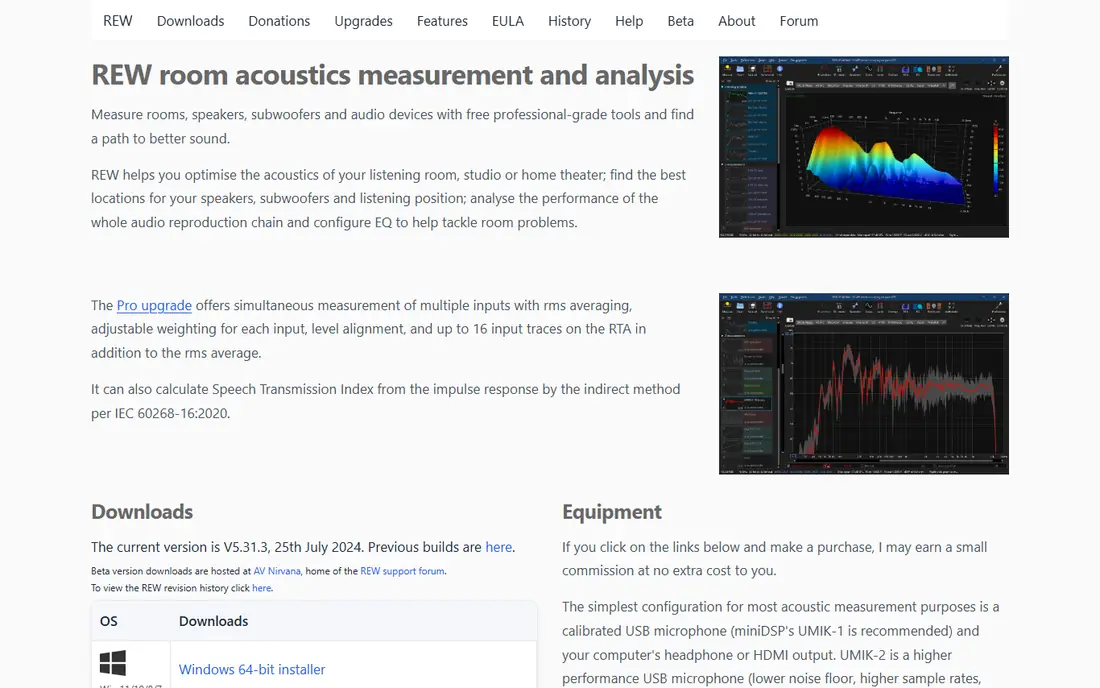
Room EQ Wizard, usually called REW, is the measurement starting point for many small-system builders. It can show how a speaker and room interact, where bass peaks and dips sit, and whether a change to placement or tuning actually helped. That evidence matters for miniature systems, where a desk, a wall, or a shelf can change the sound more than the driver itself. REW runs on common desktop systems and pairs with widely available USB measurement microphones. The learning curve is real. First-time users should follow an official guide, set levels carefully, and take repeat measurements before trusting a single graph. REW also measures what you give it: a poor microphone position or a noisy room will produce a poor graph. With care, though, it turns guesswork into a repeatable process, and it costs nothing to download.
- Measures frequency response, room modes, and decay
- Works with common measurement microphones
- Strong community guides
- Interface takes learning for first-time measurers
- You still need a calibrated microphone for trusted results
WinISD helps you answer the first small-system question: how big should the box be? Enter a driver model or its key specs, and the tool models how sealed and ported enclosures will behave at low frequencies. For miniature speakers, that model can save a wasted build, because a box that is too small can choke bass, while a badly tuned port can sound boomy and loose. WinISD does not design your whole speaker. It focuses on the enclosure and bass response, so you will still need a crossover tool and listening tests for the full sound. Treat its graphs as a guide, build carefully, and measure the finished speaker with REW to confirm the result. For a first miniature build, that design-then-measure loop is the safest path.
- Models sealed and ported boxes from driver specs
- Shows bass response and port behaviour
- Simple for a first build
- Focus is mainly on low-frequency box design
- Crossover and room effects need other tools
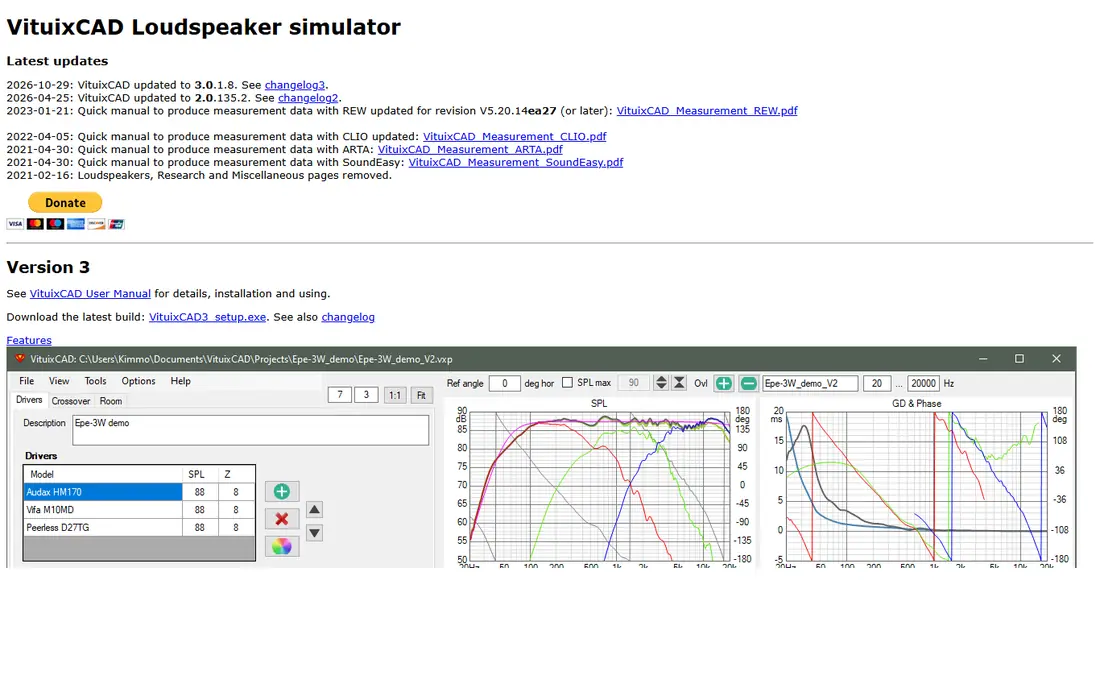
VituixCAD goes further than a box calculator by bringing crossover design, driver response, and enclosure effects into one project. That matters for small speakers, where the crossover point, baffle shape, and driver spacing all shape what you hear off axis, not just straight ahead. You can test component values on screen before soldering, and compare how changes affect the predicted response. Beginners should expect a slower start. VituixCAD rewards measured driver data and careful setup, and a model built on guessed specs will only be as good as those guesses. If you are building a simple full-range miniature speaker, WinISD may be enough. If you are building a two-way small speaker with a real crossover, VituixCAD is the deeper tool worth learning.
- Models crossovers, drivers, and enclosures together
- Diffraction and off-axis views help small speaker design
- Active community
- Interface is dense for beginners
- Needs measured driver data for best results
Dayton Audio DATS V3 is a small hardware and software system for measuring loudspeaker drivers. It can derive the specs that box design tools need, which helps when a driver has no reliable data sheet, when you buy a surplus driver, or when you want to check a driver before building around it. For miniature systems, where many drivers are small and data can be thin, that check can prevent a design based on wrong numbers. It is still a measurement tool, not a magic fix. Mounting, leads, and test conditions affect results, so follow the guide and repeat tests for consistency. DATS V3 also does not replace room measurement or listening. Its role is clear and valuable: give your design tools trustworthy driver numbers, so the enclosure model starts from fact rather than guesswork.
- Measures driver specs quickly with dedicated hardware and software
- Useful for unknown or salvaged drivers
- Compact for a bench
- Hardware purchase is needed
- Results still depend on correct test setup and mounting
The miniDSP 2x4 HD is a compact box that lets you shape sound with software instead of fixed analogue parts. In a small system, it can act as an active crossover, apply EQ to tame a room peak, set delays, and balance levels between drivers or speakers. That flexibility suits miniature builds where a passive crossover would be bulky, costly to revise, or hard to tune by ear alone. Flexibility brings responsibility. A wrong crossover slope or a heavy EQ boost can damage a small driver or make sound worse, so start with conservative settings, measure with REW, and change one thing at a time. Check which plugin and power supply your setup needs before ordering, because miniDSP sells the hardware and software in parts. Used carefully, it is one of the most useful tools for turning a small prototype into a tuned system.
- Compact digital signal processor for crossovers and EQ
- USB control with a clear plugin interface
- Suits small active systems
- Needs a basic grasp of crossovers and EQ
- Plugin and accessory choices can confuse first buyers
Fosi Audio BT20A fits the miniature brief in the most direct way: it is a small amplifier for small speakers. It takes up little desk space, drives a pair of compact passive speakers, and accepts Bluetooth from a phone alongside a wired input. For a desktop system, a workshop setup, or a small bedroom system, that simple combination is often all you need. Its limits are honest ones. The BT20A is not meant to fill a large living room or drive demanding large speakers at high volume. Pair it with efficient small speakers, keep expectations nearfield and small-room, and check speaker impedance and power handling before connecting. For the systems this list targets, its size, price position, and simplicity make it a practical power choice.
- Compact stereo amplifier for desk and small-room systems
- Bluetooth input for phones
- Simple controls and small footprint
- Power suits small speakers and nearfield listening, not large rooms
- Input and feature set are basic
Audacity earns a place here as a practical helper, not as a replacement for REW or ARTA. You can generate test tones, create short sweeps or pink noise clips, trim recordings, and check whether left and right channels, polarity, and levels behave as expected. Those simple checks catch wiring mistakes early, before you blame a design for a swapped channel. Use test signals with care. A loud sine tone at one frequency can stress a small driver, so keep levels low, start quietly, and do not leave a test tone running unattended. Audacity also will not analyse a speaker like a measurement suite will. Think of it as the bench notebook for sound: useful for quick checks, edits, and test files, while dedicated tools handle serious measurement.
- Free audio editor for test tones, sweeps, and clips
- Useful for checking channels and polarity
- Exports common formats
- Not a speaker measurement suite
- Test signals need care to avoid driver damage at high levels
ARTA is a measurement suite aimed at builders who want deeper analysis than a single frequency graph. It can measure impulse response, frequency response, and distortion, and it offers tools for stepped sine testing and other detailed checks. For a miniature speaker, distortion and impulse behaviour can reveal problems that a simple response curve hides, such as a driver struggling near its limits. That depth comes with setup demands. You need a suitable audio interface, a measurement microphone, and patience to learn the workflow. Beginners should start with REW, then move to ARTA when they want more analysis or when a specific problem needs it. For serious DIY builders, ARTA is a strong second measurement tool that complements, rather than replaces, good design and listening tests.
- Impulse, frequency, and distortion measurement in one suite
- Stepped sine and noise tools
- Suits serious DIY builders
- Learning curve is steeper than REW for beginners
- Full use may need a suitable sound interface and microphone
How we picked these
We compared official product pages, documentation, and community guides for tools that design, measure, power, or tune small loudspeaker systems. We favoured tools that are still available, that work with common measurement microphones or small speakers, and that cover a distinct step in a miniature build, from box modelling to final tuning. Where pricing could not be confirmed from the vendor site at the time of writing, we listed it as See website. We did not claim hands-on testing, and we treated the truncated keyword as miniature and small systems, as noted in the introduction and key takeaways.
How to choose the right option
Start with design, then measure
For a first miniature build, start with WinISD for the box, add VituixCAD if you need a crossover, and measure the result with REW. That order prevents the most common mistake: building first, then discovering the enclosure or crossover was wrong. A short design pass saves wood, time, and driver cost.
Match power to the speaker size
Small drivers have limits. Check impedance, sensitivity, and power handling before picking an amplifier, and keep listening levels realistic for the room. A compact amplifier like the BT20A suits nearfield and small-room use, while a larger system needs a different power plan. When in doubt, start quiet and measure, rather than pushing a small driver to prove a point.
Change one variable at a time
Tuning a small system can feel confusing when placement, EQ, crossover, and volume all change together. Move the speaker, or change one EQ band, or adjust one crossover point, then measure and listen. Keep notes on each change, because a small system often improves through a series of small, documented steps rather than one large fix.
Frequently asked questions
What does miniatur sound system mean in this guide?
The keyword looks truncated, so we read it as miniature and small sound systems. That means compact speakers, desktop systems, and small-room setups, plus the tools used to design, measure, power, and tune them. If you meant a specific brand or product line, check the design and measurement tools here first, because they apply to most small builds.
What tools do I need to build a miniature speaker?
At minimum, you need a box design tool, a way to measure the result, and a suitable amplifier. WinISD covers the box, REW covers measurement with a microphone, and a compact amplifier powers the finished speaker. A crossover tool like VituixCAD and driver measurement with DATS V3 help for two-way designs or unknown drivers.
Is Room EQ Wizard really free?
Yes, Room EQ Wizard is free to download from its official site. You still need a measurement microphone and, in many cases, an audio interface or USB microphone setup to get trusted results. The software cost is free, but the measurement chain is what determines accuracy, so budget for a decent microphone.
Can a small amplifier drive any small speaker?
No. Check the speaker impedance and power handling, and match them to the amplifier rating. Small amplifiers suit efficient speakers in nearfield and small-room listening. Driving a low-impedance or power-hungry speaker loudly can cause distortion or shutdown, so start at low volume and listen for strain.
How do I know if my miniature speaker sounds right?
Measure it, listen to familiar music, and compare it with a known good speaker in the same room. A frequency graph shows peaks and dips, but listening reveals harshness, muddiness, or a missing midrange that a graph alone may not explain. Use both, and test with voices and acoustic music as well as bass-heavy tracks.
Sources we checked (8)

Online Jobs is an independent blog about careers, online work, learning new skills and the tools that help people earn. More about us.
Keep reading
All posts
n8n Alternatives
n8n alternatives compared for 2026, with Zapier, Make, Activepieces, and more, covering visual builders, code steps, self-hosting, and pricing models.

eBay Alternatives
Looking for ebay alternatives? We compared 9 marketplaces for sellers on fees, buyer reach, categories and ease of listing, to help you sell with confidence.

ZoomInfo Alternatives
The best ZoomInfo alternatives in 2026, compared on price, free plans, data coverage, and which tool fits small teams or large sales teams best in detail.