Best Tools for API Threat Detection in 2026: 9 Tools Compared


Behavioral runtime detection · Starting price: See website
How we put this together: we compare official feature and pricing pages, app store listings, privacy policies and public user reviews. Prices change, so check the provider's site before you pay.
Key takeaways
- Salt Security and Traceable lead on behavioral runtime detection, learning normal API traffic and flagging abuse that signatures miss.
- Akamai API Security and Cloudflare API Shield suit teams that want protection at the edge, close to where traffic enters.
- Wallarm and Imperva fit organizations that already run a web application firewall and want API security in the same estate.
- 42Crunch and StackHawk cover the pre-production side, testing APIs and enforcing contracts before release.
- Almost every serious tool here is quote-priced, so budget for a proof of concept, not just a subscription line.
Quick comparison
| Name | Who it suits | Starting price | Free option | |
|---|---|---|---|---|
| Salt Security | Behavioral runtime detection | See website | No | Visit |
 Traceable | Trace-context runtime security | See website | No | Visit |
 Akamai API Security | Edge-integrated API protection | See website | No | Visit |
 Cequence Security | API and bot threat defense | See website | No | Visit |
 Wallarm | Unified WAAP with API security | See website | Free trial | Visit |
 Imperva API Security | WAAP-estate API protection | See website | No | Visit |
 42Crunch | Design-time contracts and testing | See website | Free trial | Visit |
 Cloudflare API Shield | Bundled edge API protection | See website | Free trial | Visit |
 StackHawk | API testing in CI pipelines | See website | Free trial | Visit |
The best tools for API threat detection
API attacks rarely look like classic exploits. Attackers abuse legitimate endpoints, guess object IDs, and run low-and-slow campaigns that signature-based tools miss. The tools here detect those patterns by learning normal API behavior, discovering forgotten endpoints, and blocking abuse in real time.
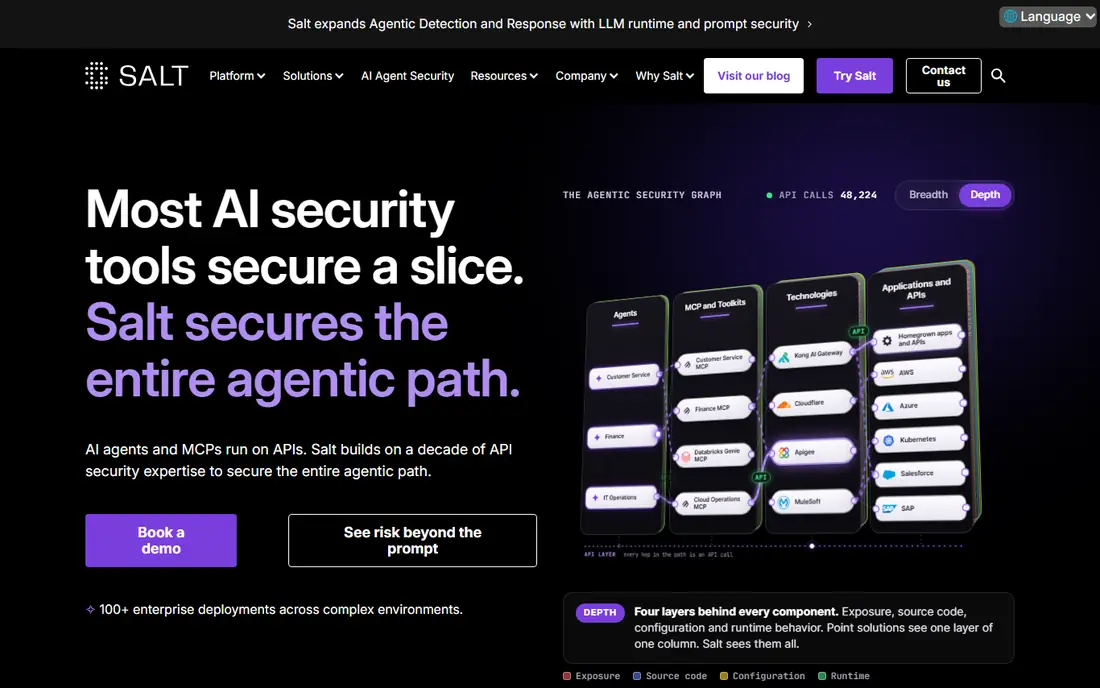
Salt Security is the reference point for behavioral API detection. It learns what normal traffic looks like for each API, then flags deviations such as unusual data access patterns or credential misuse that static rules would miss. Automated discovery finds shadow and forgotten APIs, and attacker timelines reconstruct campaigns for incident response.
The product is enterprise-priced by quote, so small teams will find it a stretch. Implementation also takes real effort, since baselining needs representative traffic. For organizations whose APIs carry sensitive data, Salt is the strongest pure runtime detection platform on this list.
- Big-data baselining of normal API behavior
- Automated discovery of shadow APIs
- Attacker timelines for investigation
- Quote-based pricing
- A dedicated budget line, not a casual purchase
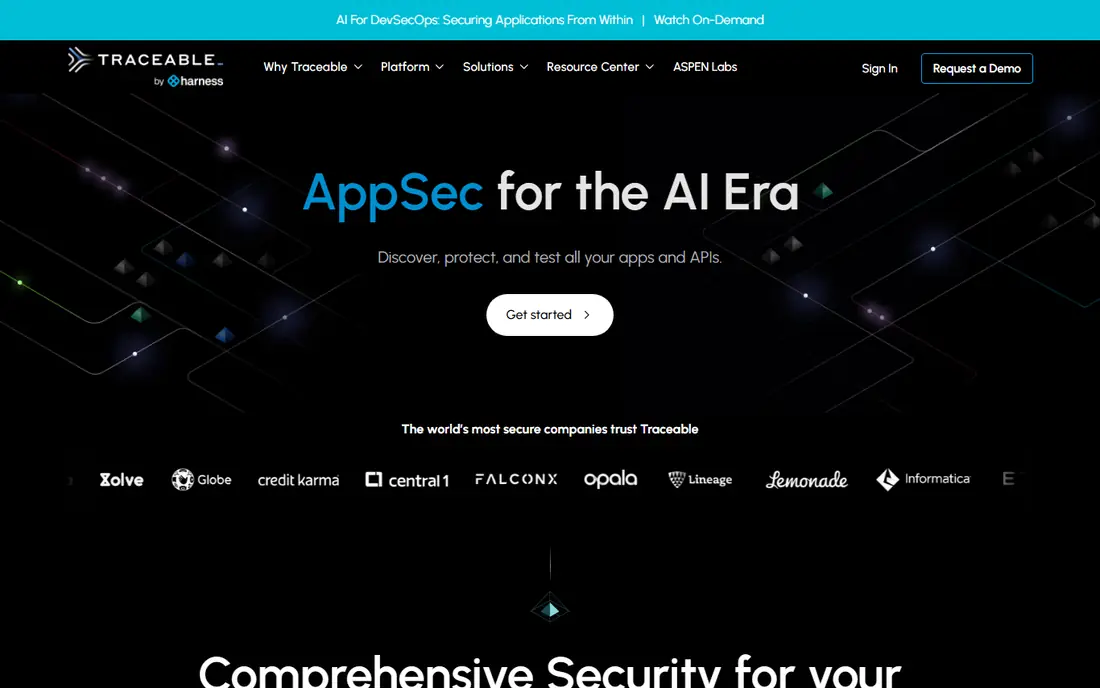
Traceable builds API security on distributed tracing, which gives each request a rich context: who called what, with which data, across which services. That depth helps separate genuine abuse from odd but legitimate traffic, and it supports blocking in production rather than alert-only monitoring. Discovery from live traffic keeps the inventory current as services change.
Like Salt, Traceable is quote-priced and aimed at larger organizations. Smaller teams with a handful of APIs may find it more than they need. For complex microservice estates where context decides whether a call is an attack, Traceable is a strong contender.
- Deep distributed tracing context
- Runtime blocking
- Discovery from live traffic
- Quote-based pricing
- Best suited to larger, distributed estates
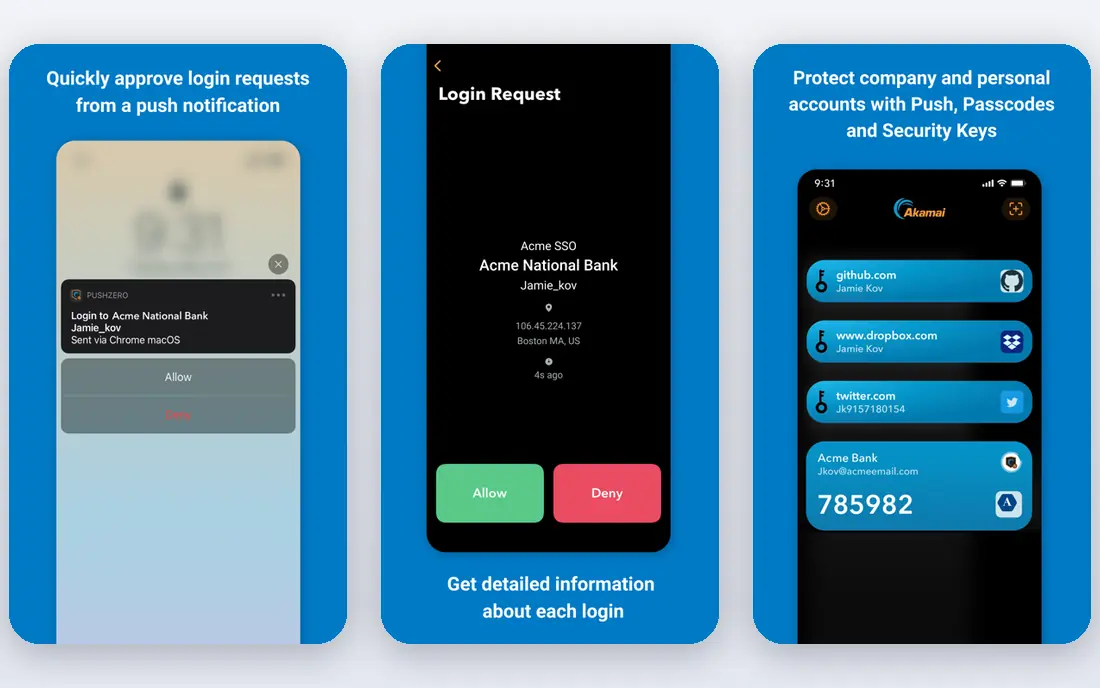
Akamai API Security grew from the acquisition of Noname Security, and it combines that platform's discovery and behavioral detection with Akamai's edge network. Blocking happens at the edge, before abusive traffic reaches your origin, which suits high-volume APIs. Discovery from traffic maps the real API estate, including endpoints your documentation forgot.
The natural buyer is an organization already using Akamai or planning to. Standalone, it competes directly with Salt and Traceable on detection depth. Pricing is by quote, and a proof of concept is the sensible way to compare it against the dedicated platforms.
- Built from the Noname Security platform
- Edge-native blocking
- Deep discovery from traffic
- Quote-based pricing
- Most value comes inside a wider Akamai estate
Cequence stands out by treating API abuse and bot traffic as one problem. Many API attacks arrive through automated clients, and Cequence's bot defense layer helps separate real users from scripted abuse before behavioral analysis even starts. Native blocking and hybrid deployment options suit teams with mixed cloud and on-prem estates.
Pricing is by quote, and the breadth of the platform can be more than a small API team requires. If your threat model includes scraping, credential stuffing, and business-logic abuse alongside classic API flaws, Cequence covers more of it in one product than most rivals.
- Combines API security with bot mitigation
- Native runtime blocking
- SaaS and hybrid deployment
- Quote-based pricing
- Bot features may be more than pure API teams need
Wallarm unifies web application firewall protection with API security, which appeals to teams that want one policy plane for apps and APIs. It discovers APIs from traffic, blocks attacks natively, and deploys as SaaS, on-prem, or hybrid. A free trial lets teams test it before committing.
The trade-off is depth. Dedicated API platforms go further on behavioral analysis and business-logic abuse, while Wallarm's strength is breadth across the whole application estate. For organizations standardizing on a single WAAP vendor, Wallarm is a practical and capable choice.
- Web application and API protection in one platform
- Native blocking
- SaaS, on-prem, and hybrid deployment
- API-specific depth is thinner than dedicated platforms
- Tiered pricing needs careful comparison
Imperva API Security extends the company's web application and API protection platform with discovery, threat detection, and blocking for APIs. Organizations already running Imperva for WAF and DDoS protection get API coverage without adding a vendor, and the platform handles both SaaS and on-prem deployment.
Bought standalone, it faces strong competition from dedicated API platforms on behavioral depth. Bought as part of an Imperva estate, it is a natural extension. Pricing is by quote, and existing Imperva customers should compare the bundle cost against a dedicated tool before deciding.
- Strong fit for existing Imperva customers
- Discovery from traffic
- SaaS and on-prem deployment
- Quote-based pricing
- Most compelling inside an Imperva estate
42Crunch works from the other end of the lifecycle. It audits OpenAPI specifications for security flaws, tests APIs before release, and enforces contracts at runtime with a firewall that rejects traffic violating the spec. That design-time focus catches problems like weak authentication and excessive data exposure before attackers can find them.
The limit is that it depends on specifications. Teams with undocumented or shadow APIs need a discovery tool alongside it, since 42Crunch does not learn the estate from traffic. Paired with a runtime platform, it covers the shift-left half of API security better than any tool here.
- Strongest design-time contract enforcement
- API security testing in development
- Runtime contract firewall
- No discovery from live traffic
- Needs good API specifications to work well
Cloudflare API Shield suits teams already on Cloudflare. It adds API discovery, schema validation, and abuse detection to the edge, so protection sits where traffic arrives. For organizations using Cloudflare for DNS, CDN, and WAF, the bundled value is hard to match, and setup is straightforward.
The catch is depth. Pure-play API platforms offer richer behavioral analysis and investigation tooling. If API security is your top risk and you run a complex estate, compare Shield against a dedicated platform. If you want solid edge protection at a bundled price, Shield is a sensible pick.
- Runs on the Cloudflare edge network
- Schema validation and discovery
- Strong value when bundled with other Cloudflare products
- Less dedicated API depth than pure-play platforms
- Advanced features need higher tiers
StackHawk brings API security testing into the build pipeline. Developers point it at an OpenAPI specification, and it runs dynamic tests for common flaws such as broken authentication and authorization as part of continuous integration. Findings land where developers already work, which shortens the fix cycle.
StackHawk does not protect production traffic, so it complements rather than replaces a runtime tool. Its published pricing is clearer than most rivals, which helps smaller teams plan. For teams building an API security program from scratch, StackHawk plus a runtime platform is a solid two-part strategy.
- API security testing driven from specifications in CI
- Developer-friendly workflow
- Published pricing tiers
- Pre-production only, with no runtime blocking
- Needs accurate specs
How we picked these
We compared vendor documentation, capability comparisons, and the OWASP API Security Top 10 checklist, favoring tools with real runtime detection or testing capability rather than marketing claims. We included dedicated platforms, edge and WAAP options, and pre-production testing tools because a complete program needs more than one layer. Pricing is quote-based for most enterprise tools, so we say so instead of inventing figures.
Building an API threat detection program
Start with discovery. You cannot protect APIs you do not know exist, so run a discovery pass from live traffic before buying detection depth. Shadow and zombie endpoints, old API versions, and forgotten test endpoints are common findings, and fixing the inventory often reduces risk faster than any new control.
Next, test before release and watch in production. Specification testing with a tool like 42Crunch or StackHawk catches design flaws early, while a runtime platform like Salt or Traceable catches abuse that only appears in live traffic. Neither layer alone is enough, since testing cannot see attacker behavior and runtime tools cannot fix design flaws.
Finally, run a proof of concept against your own traffic. Vendor demos use clean data, while your APIs carry your quirks, and detection quality depends on them. Measure false positives, blocking accuracy, and investigation time over a few weeks. The best tool for API threat detection is the one your team can operate confidently, not the one with the longest feature list.
Frequently asked questions
What is the best tool for API threat detection?
Salt Security and Traceable lead on behavioral runtime detection, while Akamai API Security suits edge-based estates. The right choice depends on the depth of behavioral analysis you need, edge blocking, or a bundled WAAP. Run a proof of concept on your own traffic before committing.
How is API threat detection different from a WAF?
A traditional WAF matches known attack signatures, while API threat detection learns normal API behavior and flags abuse of legitimate endpoints, such as broken object-level authorization. Both matter, but signature tools miss the low-and-slow business-logic abuse that API platforms are built to catch.
Do I need API discovery before detection?
Yes. Shadow and zombie APIs are among the most common findings in real estates, and undocumented endpoints cannot be protected by policies written for known ones. Discovery from live traffic is a core feature of Salt, Traceable, Akamai, and Cequence.
Can small teams afford API threat detection tools?
Most dedicated platforms are quote-priced for enterprises, but Cloudflare API Shield and StackHawk offer more accessible entry points. Small teams should start with discovery, specification testing, and gateway controls, then add a runtime platform as API traffic and sensitivity grow.
What does the OWASP API Security Top 10 cover?
It lists the most common API risks, including broken object-level and function-level authorization, broken authentication, unrestricted resource consumption, and improper inventory management. Use it as a checklist when testing vendor claims in a proof of concept.
Sources we checked (9)

Online Jobs is an independent blog about careers, online work, learning new skills and the tools that help people earn. More about us.
Keep reading
All posts
Surfshark Alternatives
Looking for Surfshark alternatives? We compare 8 VPN services on price, privacy, streaming, and device limits to help you find a VPN that fits your needs.
NordPass Alternatives
We compared NordPass alternatives for families, solo users and teams, checking pricing, free plans, passkeys and sharing, so you can switch safely today.
Best background check app
We compared the best background check app options in 2026 for employers, landlords and individuals, with published prices, coverage and compliance notes.