Best Tools for Measuring Visibility in AI Search in 2026: 8 Tools Compared


Affordable AI search monitoring · Starting price: $29 per month
How we put this together: we compare official feature and pricing pages, app store listings, privacy policies and public user reviews. Prices change, so check the provider's site before you pay.
Key takeaways
- Measuring AI search visibility means tracking mentions, citations, and share of voice across engines, not just counting website traffic.
- Otterly and ZipTie are the most affordable ways to start, while Peec AI and Scrunch suit teams that need competitor and crawler detail.
- Semrush and Ahrefs suit teams that already pay for an SEO suite and want AI data alongside keyword and backlink data.
- Profound and AthenaHQ offer the broadest engine coverage, at enterprise or higher mid-market prices.
- Prompt choice matters more than tool choice, since a weak prompt set produces neat charts that mean little.
Quick comparison
| Name | Who it suits | Starting price | Free option | |
|---|---|---|---|---|
| Otterly.AI | Affordable AI search monitoring | $29 per month | Free trial | Visit |
 Peec AI | Competitor share of voice | $95 per month | Free trial | Visit |
 Profound | Enterprise AI search measurement | See website | Free trial | Visit |
 Scrunch AI | Citation and crawler measurement | $250 per month | Free trial | Visit |
 AthenaHQ | Broad engine measurement | $295 per month | Yes | Visit |
 Semrush AI Visibility Toolkit | SEO teams already on Semrush | $99 per month | Free trial | Visit |
 Ahrefs Brand Radar | SEO teams already on Ahrefs | $199 per month | No | Visit |
 ZipTie | Flexible prompt volume | $42.75 per month | Free trial | Visit |
The best tools for measuring visibility in AI search
When buyers ask an AI engine for a recommendation, the answer may cite your site, a competitor, or nobody at all. These tools measure that outcome by running prompts through AI engines and recording mentions, citations, sentiment, and share of voice. The right tool depends on how many prompts you need, which engines matter, and whether you already pay for an SEO suite.
Otterly is the simplest way to start measuring AI search visibility. The Lite plan at $29 per month tracks a small prompt set across core engines, including Google AI surfaces that many brands care about first. Share of voice views show how often your brand appears next to competitors, which is enough to spot a gap or a win.
The limits are prompt volume and engine breadth. Lite covers a small set, and adding engines raises the price, so a brand with many products or markets will outgrow it. For a first measurement program, Otterly gives a credible baseline without a large commitment, and that baseline is what makes later tool comparisons meaningful.
- Low entry price
- Covers core engines and Google AI surfaces
- Simple share of voice views
- Small prompt allowance on Lite
- Some engines are add-ons
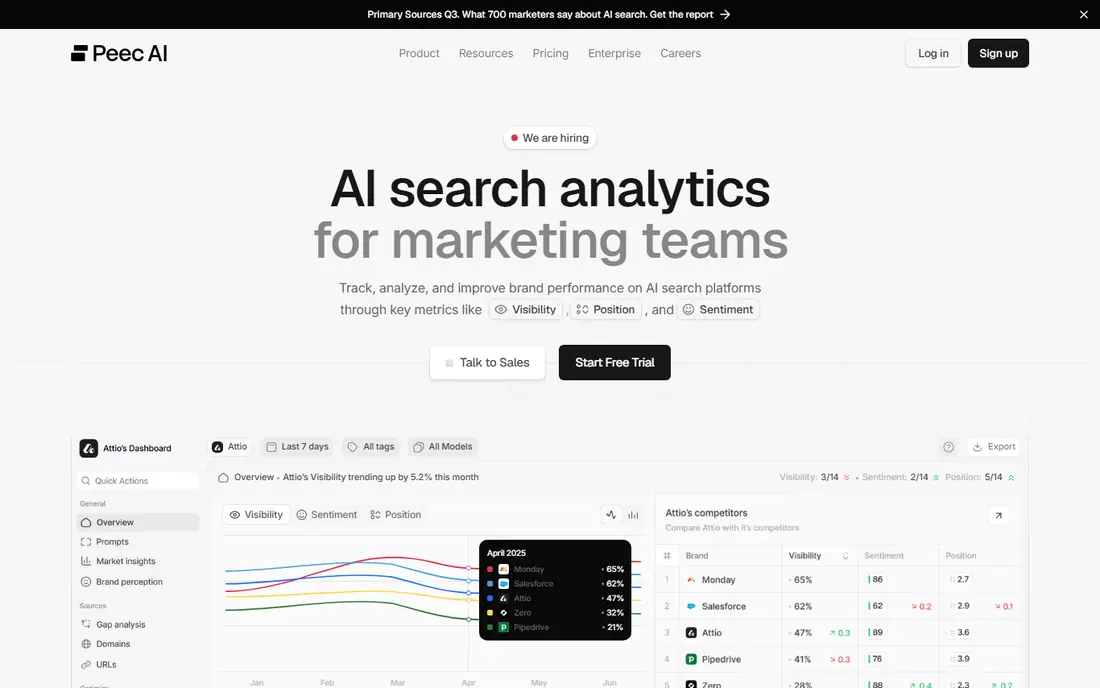
Peec AI measures visibility with a competitor lens, which is useful because AI search is a zero-sum answer. If a rival is cited and you are not, that gap is the story, and Peec shows it across prompts, models, and markets. Source analysis reveals which pages and publishers the engines cite, which helps a content team fix the right pages first.
Entry pricing at $95 per month covers a limited prompt set and a subset of models, with broader coverage on higher plans. That is a fair starting point for a mid-market team, but buyers who need every engine should price the higher tier first. For share of voice reporting that a manager can understand at a glance, Peec is a strong pick.
- Clear competitor comparisons
- Source analysis
- Multi-market tracking
- Entry plan limits models and prompts
- Full coverage needs higher tiers
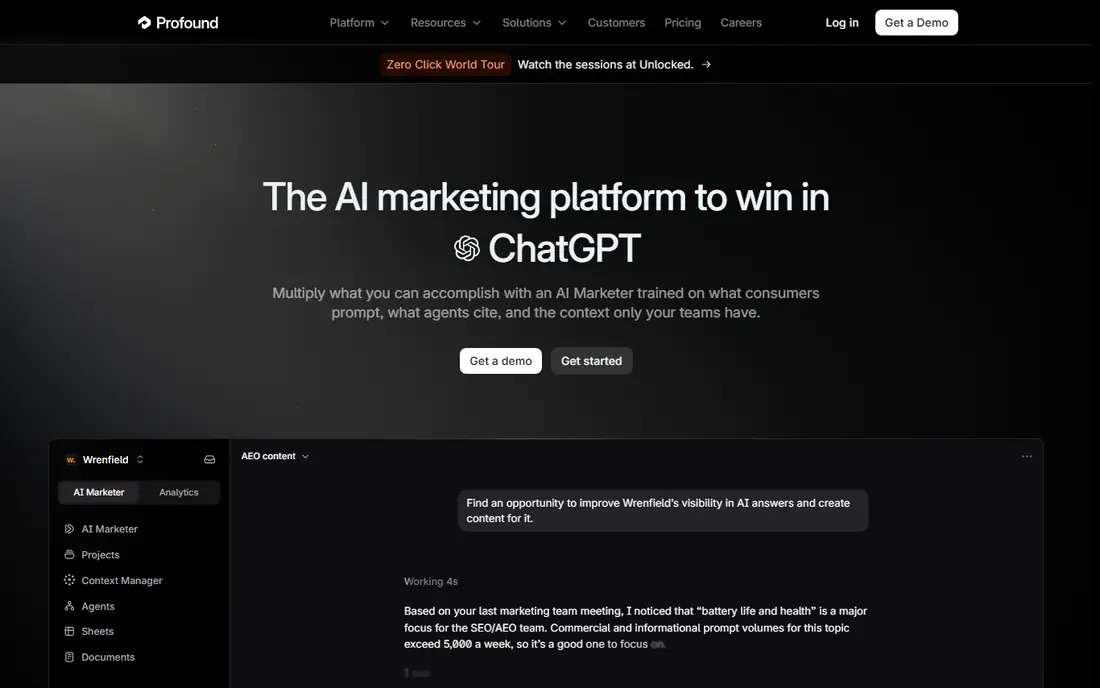
Profound measures AI visibility at enterprise scale, tracking up to nine engines on higher plans and pairing mention data with prompt volume and crawler signals. That combination helps a large brand see not just whether it appears, but how often people ask the underlying questions and whether AI crawlers can read the relevant pages. Integrations with hosting and analytics tools add context that smaller tools lack.
The price is the barrier. Enterprise plans are custom, and entry plans do not include the full engine list, so a small team will pay for depth it cannot use. Large brands with many products, markets, and competitors will find Profound the most complete measurement system on this list.
- Broadest engine coverage here
- Prompt volume data
- Crawler and traffic connections
- Custom enterprise pricing
- Entry plans cover fewer engines
Scrunch measures visibility through citations and crawler behavior, which suits teams that want to know why an engine cites one page and not another. It tracks seven or more engines, maps citation patterns, and shows how AI crawlers interact with a site. That technical depth helps SEOs and developers fix crawl blocks, thin pages, and missing structure.
Entry pricing around $250 per month billed annually puts Scrunch above budget tools, and its reports reward a team that will dig into the data. A solo marketer who only needs a monthly mention count will find it heavy. For a technical team building an AI search program, Scrunch offers measurement that connects directly to site fixes.
- Citation graph analysis
- Crawler analytics
- Published entry pricing
- Higher entry price
- Technical reports need a team that will act on them
AthenaHQ measures visibility across a broad engine list on a credit model, where each answer costs one credit. The free Essential plan lets a team test measurement on a small scale, while the Starter plan at $295 per month adds thousands of credits and more engines, including Claude. That breadth without an enterprise sales process is a real advantage for larger teams.
Credit math is the catch. Prompts, engines, and frequency all consume credits, so a team must model its real workload before signing. A team that tracks a few dozen prompts weekly will fit comfortably, while a team tracking hundreds daily may need a larger plan. For broad, self-serve measurement, AthenaHQ is a solid choice.
- Broad engine coverage
- Free Essential plan
- Credit-based flexibility
- High Starter price
- Credit consumption needs careful planning
Semrush AI Visibility Toolkit
Who it suits: SEO teams already on Semrush
Semrush adds AI visibility tracking to a suite many SEO teams already use, which avoids a separate tool and a separate login. The AI Visibility Toolkit starts at $99 per month per domain, with a defined prompt allowance, and sits next to keyword, backlink, and site audit data. That context helps a team see AI visibility as part of search performance, not as an isolated metric.
The limit is that the toolkit is an add-on, so the total cost includes the base Semrush plan, and entry prompt counts are modest. Teams that do not already use Semrush may find a dedicated tool cheaper. For existing Semrush users, the toolkit is the most convenient way to add AI measurement.
- AI data alongside keyword and site data
- Familiar Semrush workflow
- Per-domain pricing
- AI toolkit is an add-on cost
- Prompt allowance is limited on entry tiers
Ahrefs Brand Radar brings AI visibility data into the Ahrefs world, tracking citations across AI Overviews, AI Mode, ChatGPT, Perplexity, Gemini, and Copilot against a large prompt index. For a team that already trusts Ahrefs for backlinks and keywords, Brand Radar adds the AI layer without a new vendor relationship. Pricing starts at $199 per month per platform index in current listings.
The catch is cost and packaging. Brand Radar is sold separately, so the total bill includes the core Ahrefs plan, and the entry price rules it out for small teams. For an established SEO team that wants AI data next to backlink data, Brand Radar is a natural fit.
- AI citation data on top of strong backlink data
- Large prompt index
- Familiar Ahrefs reports
- Sold separately from core Ahrefs plans
- Entry price is high
ZipTie suits teams that want flexible prompt volume without enterprise pricing. Paid plans start from $42.75 per month in current listings, with configurable prompt slots and seven engines on paid plans. That flexibility helps a team that tracks a focused set of high-value questions rather than a huge prompt library.
The trade-off is maturity and depth. ZipTie is less widely covered than Profound, Peec, or Semrush, and some advanced features sit on higher plans. A trial on your own brand and competitors will show quickly whether its data quality fits your needs. For flexible, budget-conscious measurement, ZipTie is worth testing.
- Configurable prompt slots
- Seven engines on paid plans
- Lower entry price than many rivals
- Less well known than larger platforms
- Feature depth varies by plan
How we picked these
We compared official feature pages, pricing pages, and documentation, along with current pricing summaries checked in October 2026. Only tools that exist and work today for measuring AI search visibility made the list. We included both dedicated AI visibility tools and SEO suite add-ons, since the right choice often depends on tools a team already pays for. Where pricing is credit-based or per domain, we say so rather than forcing a simple monthly figure.
How to set up measurement that means something
Start by writing prompts the way buyers actually ask them. Include direct brand questions, comparison questions, and problem questions where your product is one possible answer, and add the same set for two or three competitors. A prompt set built only from brand names will flatter you, while a set built from buyer problems will show where you actually lose.
Next, decide how often to track. Daily tracking suits fast-moving categories, while weekly tracking suits most brands and saves credits. Record a baseline before you change content, then track the same prompts after changes so you can see what moved. Finally, pair AI visibility with traffic and conversion data, since a mention that never brings a visit is a weaker win than a citation that does.
Common measurement mistakes
The most common mistake is tracking too many prompts and reading none of them. A focused set of 25 to 50 high-value prompts, reviewed monthly, beats a thousand prompts that nobody opens. Another mistake is comparing tools on different prompt sets, which makes every vendor look best. Use the same prompts across trials to get a fair comparison.
Frequently asked questions
What is the best tool for measuring visibility in AI search?
For most small teams, Otterly is the best starting point, while Peec AI suits teams that need competitor share of voice. Larger teams should compare Profound, Scrunch, and AthenaHQ, and SEO teams should check the Semrush and Ahrefs add-ons first.
What are the best tools for measuring AI search visibility?
Otterly, Peec AI, Profound, Scrunch, AthenaHQ, ZipTie, and the Semrush and Ahrefs AI tools all measure AI search visibility, with different prices and engine coverage. The best choice depends on prompt volume, engine needs, and tools you already pay for.
How is AI search visibility measured?
Tools run a set of prompts through AI engines, then record brand mentions, citations, sentiment, and share of voice against competitors. Some tools also track which pages are cited and how AI crawlers interact with your site.
Is there a free AI search visibility tool?
AthenaHQ offers a free Essential plan with limited credits, and several tools offer free trials or free checkers with a small number of lookups. Sustained tracking with a useful prompt set usually needs a paid plan.
How often should I track AI visibility?
Weekly tracking suits most brands, while daily tracking suits fast-moving categories or active campaigns. The key is consistency, since the same prompts tracked on the same schedule produce the only comparisons you can trust.
Sources we checked (8)

Online Jobs is an independent blog about careers, online work, learning new skills and the tools that help people earn. More about us.
Keep reading
All posts
n8n Alternatives
n8n alternatives compared for 2026, with Zapier, Make, Activepieces, and more, covering visual builders, code steps, self-hosting, and pricing models.

ZoomInfo Alternatives
The best ZoomInfo alternatives in 2026, compared on price, free plans, data coverage, and which tool fits small teams or large sales teams best in detail.

Workday Alternatives
We compared the best workday alternatives for HR, payroll, and global hiring, from BambooHR and Gusto to Rippling, Deel, and HiBob for growing teams in 2026.