Best Threat Intelligence Tools in 2026: 8 Platforms Compared


Broad enterprise intelligence · Starting price: See website
How we put this together: we compare official feature and pricing pages, app store listings, privacy policies and public user reviews. Prices change, so check the provider's site before you pay.
Key takeaways
- A threat feed is data, while a platform collects, enriches, and pushes that data into your security tools.
- Recorded Future suits large teams that need broad collection and analyst research, while Mandiant suits teams facing targeted threats.
- CrowdStrike suits teams already running Falcon, since its intelligence ties closely to endpoint telemetry.
- Anomali, ThreatConnect, and OpenCTI suit teams that need a central platform for many feeds and security tool integrations.
- Most enterprise platforms price by quote, so budget by use case and team size, and start with a free platform plus free feeds where possible.
Quick comparison
| Name | Who it suits | Starting price | Free option | |
|---|---|---|---|---|
| Recorded Future | Broad enterprise intelligence | See website | No | Visit |
 Mandiant Advantage | Targeted threat research | See website | No | Visit |
 CrowdStrike Falcon Intelligence | Endpoint-linked intelligence | See website | No | Visit |
 Microsoft Defender Threat Intelligence | Microsoft-centric teams | See website | No | Visit |
 Anomali ThreatStream | Multi-feed platform | See website | No | Visit |
 ThreatConnect | Mid-market threat platform | See website | No | Visit |
 Flashpoint | Dark web and fraud intelligence | See website | No | Visit |
 OpenCTI | Free open source platform | Free | Yes | Visit |
The best threat intelligence tools
Threat intelligence tools answer different questions: who targets you, what infrastructure attackers use, which of your credentials leaked, and which alerts deserve action first. No single vendor covers all four equally, so pick by your most urgent question, your existing security stack, and whether you have analysts to use the data. The platforms below cover enterprise, mid-market, and free starting points.
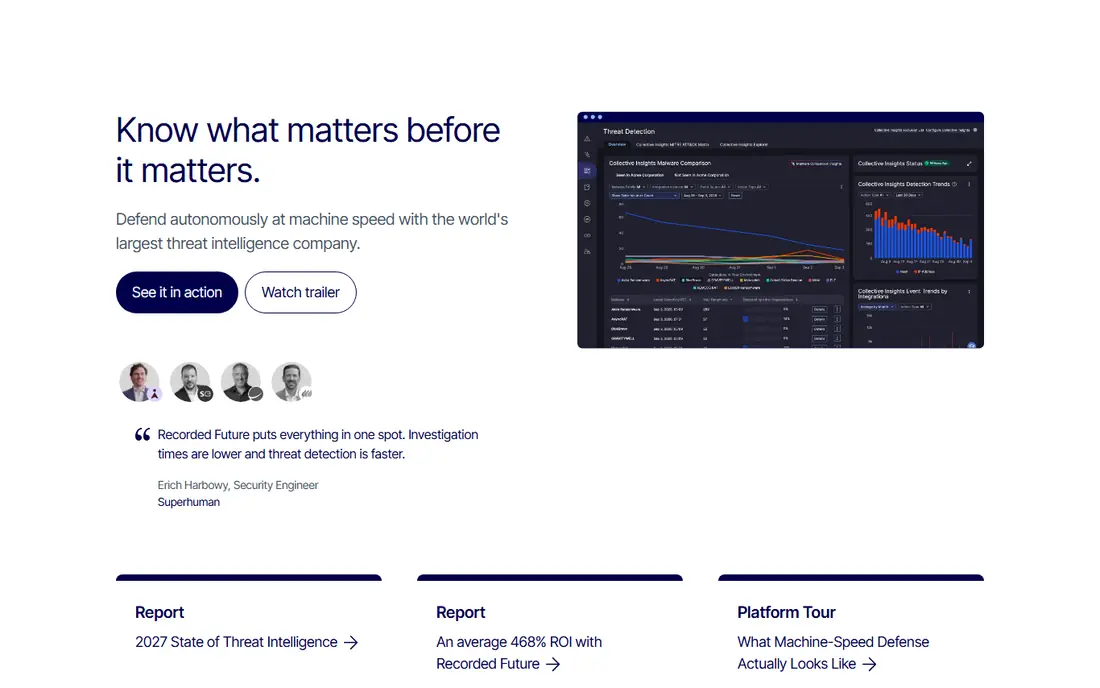
Recorded Future is the category-defining enterprise choice for teams that need wide collection plus human analysis. Its Intelligence Cloud pulls from open, dark web, and technical sources, and its analyst team produces finished reports on actors, campaigns, and vulnerabilities. Integrations push indicators into SIEM, SOAR, and endpoint tools, so intelligence reaches detection rules rather than sitting in a portal.
That breadth comes with cost and staffing needs. Pricing is quote-based and sits at enterprise level, and lean teams can drown in signal volume without dedicated threat intelligence staff. Large enterprises with a CTI function get the most value. Smaller teams should trial it against a narrower, cheaper option and judge whether analyst research justifies the premium.
- Broad open and dark web collection
- Analyst research and finished reports
- Mature SIEM and SOAR integrations
- Enterprise pricing out of reach for many mid-market teams
- High signal volume needs dedicated analysts
- Learning curve is steep
Mandiant Advantage, from Google Cloud, suits organizations worried about targeted or nation-state threats. Its attribution draws on frontline incident response, giving actor profiles and campaign detail that generic feeds lack. Reports map to MITRE ATT&CK techniques, which helps detection engineers turn intelligence into concrete defenses.
Dark web exposure monitoring and credential leak coverage are less central here than with some rivals, so teams whose main worry is leaked employee passwords should pair it with a credential-focused feed. Pricing is quote-based at enterprise level. For firms where attribution quality decides response priorities, Mandiant research depth is hard to match.
- Deep actor and campaign attribution from incident response work
- High-quality technical reports
- Google Security Operations links
- Enterprise pricing
- Less focus on dark web credential monitoring
- Best value for teams facing targeted threats
CrowdStrike Falcon Intelligence
Who it suits: Endpoint-linked intelligence
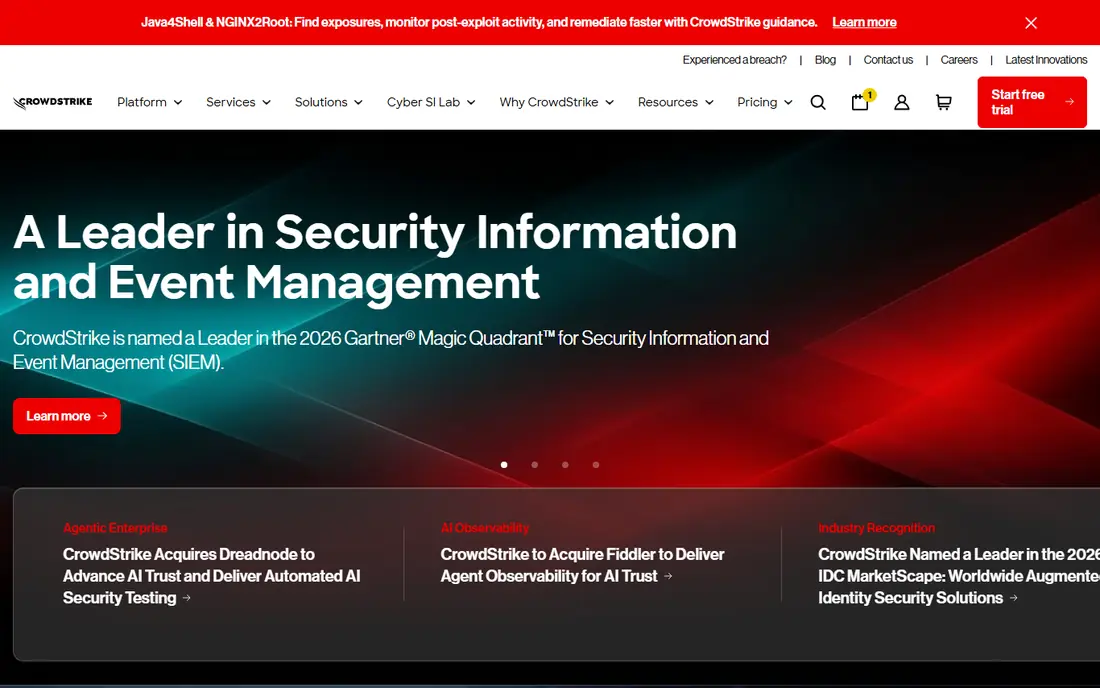
CrowdStrike Falcon Intelligence works best inside a Falcon deployment. Adversary profiles, eCrime tracking, and indicators connect directly to endpoint telemetry, so analysts can move from an external report to affected hosts and automated response in one workflow. That tight loop shortens triage for teams already standardized on Falcon.
Standalone buyers get less. Without Falcon endpoints, much integration value fades, and the platform competes less well as a neutral hub for many feeds. Pricing is quote-based and varies by module. Existing CrowdStrike customers should evaluate it first, while non-Falcon teams should shortlist a neutral platform like Anomali or ThreatConnect instead.
- Adversary tracking tied to endpoint telemetry
- Strong eCrime coverage
- Automated response inside Falcon
- Most value pairs with Falcon endpoint
- Standalone platform use is more limited
- Pricing is quote-based
Microsoft Defender Threat Intelligence
Who it suits: Microsoft-centric teams
Microsoft Defender Threat Intelligence suits organizations already committed to Microsoft security licensing. It draws on broad Microsoft telemetry, maps threats across the kill chain, and feeds Defender and Sentinel workflows. Security Copilot features help analysts query and summarize intelligence in plain language, which speeds up triage for Microsoft shops.
Teams outside the Microsoft stack gain less, and licensing complexity can obscure total cost, since some access sits inside E5 plans. Small teams without Microsoft security tooling should not buy it as a standalone first platform. For Microsoft-centric enterprises, though, it turns existing telemetry into actionable intelligence with minimal new integration work.
- Broad Microsoft telemetry and threat graph
- Security Copilot assistance
- Links to Defender and Sentinel
- Best value inside Microsoft licensing
- Smaller teams face cost and complexity
- Standalone use is limited
Anomali ThreatStream is a true platform rather than a single feed: it collects indicators from many sources, enriches them, and pushes them to SIEM, SOAR, and firewall tools. STIX-native handling and ISAC sharing integrations suit organizations that participate in sector sharing groups and need standard formats. Analysts can investigate indicators, actors, and campaigns in one workspace.
Pricing is quote-based at enterprise level, and setup takes integration effort across security tools. Teams that only need one feed may find a simpler vendor cheaper. Teams juggling many feeds, sharing groups, and automation workflows benefit most from ThreatStream central hub role.
- STIX-native platform for many feeds
- Strong ISAC integrations
- SIEM and SOAR enrichment workflows
- Enterprise pricing
- Premium features sit in higher tiers
- Needs integration work to reach full value
ThreatConnect combines a threat intelligence platform with SOAR-style playbooks, so teams can move from indicator to automated response workflow. Risk scoring, ATT&CK mapping, and integrations help analysts prioritize threats that match their own environment and industry. That combination suits mid-market security teams with some automation investment already in place.
Playbook building takes skill and tuning, so new teams should budget onboarding time rather than expecting instant automation. Pricing is quote-based, though its mid-market positioning often lands below larger enterprise platforms for comparable scope. For teams ready to operationalize intelligence rather than just read reports, ThreatConnect is a strong platform pick.
- Threat platform plus SOAR playbooks
- Risk scoring and ATT&CK mapping
- Mid-market sweet spot
- Playbook complexity for new teams
- Enterprise pricing still applies
- Needs analyst time to tune
Flashpoint suits teams whose main question is what criminals say and sell about them. Its dark web, illicit forum, and fraud coverage tracks stolen data, phishing kits, and impersonation activity that generic feeds miss. Brand protection and fraud teams use it to find takedown targets and early warnings before attacks reach customers.
It is not the best general platform for pushing thousands of indicators into a SIEM, and pricing sits at enterprise level. Small teams should use it only when dark web exposure is a proven priority, not as a first general purchase. For fraud, brand, and underground monitoring, Flashpoint depth justifies its specialist price.
- Deep dark web and illicit community coverage
- Fraud and brand monitoring
- Analyst research support
- Enterprise pricing
- Less suited as a general SIEM feed hub
- Not a budget option for small teams
OpenCTI is the best free starting point for teams that want a real threat platform without enterprise pricing. The community edition is free and open source, supports STIX and TAXII standards, and connects to free feeds such as abuse.ch sources and government exploited-vulnerability lists. Self-hosting gives full data control, which suits regulated teams.
The trade-off is effort. You host, update, and maintain it, and you still need paid feeds for credential leaks and private underground data that free feeds do not cover. Small teams can start with OpenCTI plus free feeds, prove the workflow, and add one paid feed later for their biggest gap. That staged path beats buying an enterprise platform before the team can use it.
- Free community edition
- STIX and TAXII support
- Many free feed connectors
- Self-hosted control
- Needs hosting and maintenance
- No built-in paid collection
- Credential leak data needs a separate vendor feed
How we picked these
We compared vendor product pages, platform documentation, and current threat intelligence comparisons, and we checked that each vendor homepage loads and matches the product named. We favored platforms that are actively sold and documented in 2026, covering enterprise collection, targeted research, endpoint-linked intelligence, multi-feed platforms, and a free open option. Where vendors do not publish prices, we wrote See website rather than repeating third-party price estimates as vendor facts.
How to choose a threat intelligence platform
Start with one question your team must answer weekly. If the question is who targets us, shortlist Recorded Future and Mandiant. If it is which alerts to ignore, shortlist a platform with enrichment and noise filtering like Anomali or GreyNoise-style feeds. If it is what leaked about us, shortlist Flashpoint or a credential-focused vendor. One clear question prevents buying broad data nobody uses.
Match the platform to your stack and staff
A platform that integrates with your SIEM, SOAR, and endpoint tools delivers value daily, while a portal-only product becomes shelfware. Count analyst hours honestly: enterprise platforms need dedicated staff, while OpenCTI needs hosting effort but less license cost. Trial with your own indicators and past incidents, and judge whether the tool would have changed a real decision.
Start free, then add one paid feed
Small teams should deploy OpenCTI or MISP with free feeds first, build enrichment into the SIEM, and track which gaps actually hurt. Add one paid feed for the top gap, such as credential leaks or dark web monitoring, rather than buying a full enterprise suite at once. That sequence builds skill and evidence for larger spending later.
Frequently asked questions
What is the best threat intelligence platform?
Recorded Future suits large enterprises needing broad collection, Mandiant suits targeted threat research, and CrowdStrike suits Falcon customers. Anomali and ThreatConnect suit teams needing a central multi-feed platform, while OpenCTI suits teams starting free.
What is the difference between a threat feed and a platform?
A feed delivers data, such as indicators or leaked credentials, through a stream or API. A platform collects many feeds, enriches them, and pushes combined indicators to your SIEM or SOAR. Recorded Future and Flashpoint collect data, while Anomali and OpenCTI act as platforms for many feeds.
How much do threat intelligence tools cost?
Most enterprise platforms in this list price by quote and do not publish a starting price, so budget depends on modules, users, and data scope. OpenCTI community edition is free, while other vendors require a sales conversation. Ask for total cost including feeds, users, and integrations.
Can small teams use threat intelligence tools?
Yes, by starting with OpenCTI or MISP plus free feeds, then adding one paid feed for the biggest gap. That approach gives real indicator enrichment and SIEM matching without enterprise pricing, and it builds the skills needed for larger tools later.
Which tool is best for dark web monitoring?
Flashpoint suits deep dark web and fraud monitoring, while Recorded Future also covers dark web collection at enterprise scale. Teams focused only on leaked credentials should compare credential-specific vendors against Flashpoint coverage for their industry.
Do I need a threat intelligence platform if I have a SIEM?
Not always. A SIEM can ingest feeds directly, so a separate platform is optional for small teams. A platform adds value when you manage many feeds, need enrichment and sharing workflows, or want playbook automation beyond basic SIEM matching.
Sources we checked (8)

Online Jobs is an independent blog about careers, online work, learning new skills and the tools that help people earn. More about us.
Keep reading
All posts
Telegram Alternatives
Compare the best telegram alternatives in 2026 for private, group, and team messaging, with encryption, features, and pricing for each app in this guide.
Surfshark Alternatives
Looking for Surfshark alternatives? We compare 8 VPN services on price, privacy, streaming, and device limits to help you find a VPN that fits your needs.
NordPass Alternatives
We compared NordPass alternatives for families, solo users and teams, checking pricing, free plans, passkeys and sharing, so you can switch safely today.