Best Test Management Software in 2026: 9 Tools Compared

How we put this together: we compare official feature and pricing pages, app store listings, privacy policies and public user reviews. Prices change, so check the provider's site before you pay.
Key takeaways
- TestRail remains the clearest standalone choice for teams that want one home for cases, plans and results.
- Zephyr Scale and Xray are the strongest options for teams that want testing to live inside Jira.
- PractiTest and Tricentis qTest suit larger QA groups that need traceability, dashboards and wider toolchain links.
- Testmo and Tuskr give smaller teams modern test management without enterprise pricing or setup.
- TestLink is the free, self-hosted route, but it needs internal time for hosting, updates and support.
Quick comparison
| Name | Who it suits | Starting price | Free option | |
|---|---|---|---|---|
 TestRail | Standalone QA teams | See website | Free trial | Visit |
 Zephyr Scale | Jira-based testing | See website | Free trial | Visit |
 PractiTest | Data-led QA reporting | See website | Free trial | Visit |
 Testmo | Modern small QA teams | See website | Free trial | Visit |
 Tricentis qTest | Enterprise test orchestration | See website | Free trial | Visit |
 Xray | Native Jira test management | See website | Free trial | Visit |
 Tuskr | Low-cost test management | Free | Yes | Visit |
 SpiraTest | Regulated and traceable testing | See website | Free trial | Visit |
 TestLink | Free open-source testing | Free | Yes | Visit |
The best test management software
Test management software keeps test cases, plans, runs and results in one place so a team can see what was tested, what passed and what still needs work. The best choice depends less on a feature list and more on where a team already works, how much automation it runs and how strict its traceability needs are.
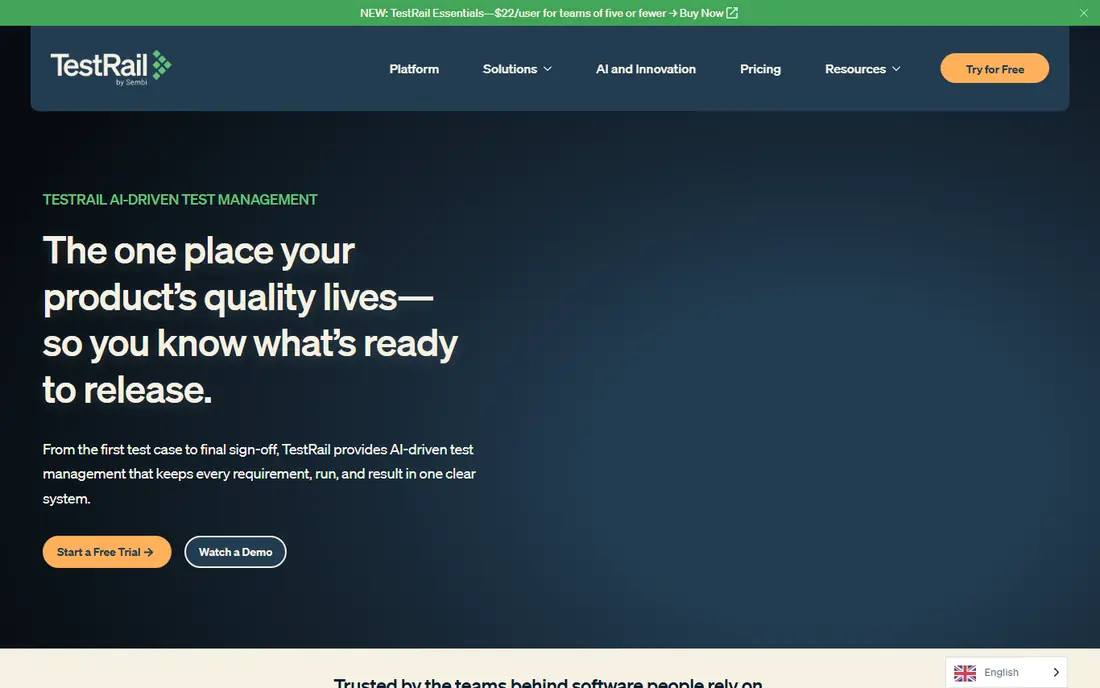
TestRail is the reference point many QA teams compare other tools against, because its structure is easy to grasp. Cases sit in suites, suites feed plans, plans produce runs, and results feed reports that managers can read without digging through spreadsheets. That clarity helps when a release involves hundreds of cases across web, mobile and API work.
The tool also links to issue trackers such as Jira and to automation frameworks, so manual and automated results can sit in the same run where a team wants them to. The main watch-out is discipline. Without naming rules and regular pruning, a large TestRail library can grow messy, and the cost rises with team size, so a small team should check the current plan before committing.
- Clear case, plan and run structure
- Strong reporting
- Wide integrations with issue trackers and automation tools
- Pricing is not a simple public monthly rate on every plan
- Large libraries need good housekeeping

Zephyr Scale, from SmartBear, is built for teams that already plan work in Jira and do not want testers to switch systems to record results. Test cases, cycles and executions live alongside issues, which makes traceability from a requirement to a test result much easier to show. Developers can see test status in the same place they see tickets, and testers avoid copying results between tools.
That Jira link is also its limit. A team that does not use Jira, or that wants a standalone QA home, will get less value from Zephyr Scale than from TestRail or Testmo. For Jira teams, though, the fit is strong, especially for agile teams that run tests in sprints and need cycle reports tied to releases.
- Testing inside Jira
- Test cycles and traceability
- Automation links for common frameworks
- Jira dependency
- Pricing follows Atlassian marketplace rules
PractiTest stands out for QA leaders who need answers from test data rather than just a place to store cases. Its dashboards, custom fields and filters let a team slice results by product area, release, tester or requirement, which helps when a manager asks where risk remains before a launch. Traceability links requirements to tests and issues, so gaps are easier to spot than in a flat case list.
The tool is flexible, and that flexibility means a team should plan its fields and workflows before importing thousands of cases. Done well, PractiTest gives a clear, business-readable view of testing. Done in a rush, it can feel busy. It suits mid-size and larger QA groups more than a two-person team that just needs a simple run tracker.
- Custom dashboards and filters
- Requirements traceability
- Integrations with Jira, automation and CI tools
- Setup takes thought to get reporting right
- Pricing is quoted for larger teams
Testmo is a newer option that appeals to teams put off by older, heavier tools. Its interface is clean, cases and runs are quick to create, and automated results can be reported into the same projects as manual tests. That mix matters for teams that run a growing automation suite but still do manual exploratory work around each release.
Testmo does not yet match the largest tools on every enterprise feature, and its integration list is shorter than TestRail's. For small and growing QA teams, that trade is often worth it, because the team gets modern test management quickly and can scale plans as headcount and case counts grow.
- Clean, fast interface
- Manual and automated results in one place
- Jira and automation integrations
- Smaller ecosystem than TestRail
- Enterprise governance features are narrower
Tricentis qTest is aimed at large organisations that run testing across many teams, tools and delivery pipelines. It centralises test design, execution and reporting, and it connects to automation and DevOps tools so results from different systems can be viewed together. For regulated or complex programmes, that central view and traceability help QA leaders show coverage and control.
The cost and setup reflect that enterprise scope. A small team will find qTest heavy, and pricing is agreed rather than picked from a simple price list. Large teams already using Tricentis products, or teams that need orchestration across a wide toolchain, are the natural audience.
- Enterprise scale and traceability
- Broad toolchain and automation links
- Portfolio-level reporting
- Enterprise pricing and implementation
- More tool than a small team needs
Xray takes a different approach from Zephyr Scale: it treats tests, test sets, plans and executions as native Jira issue types. That means Jira workflows, permissions, boards and reporting apply to testing in the same way they apply to development work. Teams that use behaviour-driven development will also like its Cucumber support, which links feature files to Jira tests.
Because Xray lives inside Jira, a team needs good Jira governance to keep test projects clean, and a non-Jira team cannot use it at all. For Jira-native agile teams, though, it is one of the two serious choices, and the decision against Zephyr Scale often comes down to workflow preference and automation needs.
- Tests as native Jira issue types
- Strong BDD and automation support
- Traceability inside Jira
- Tied to Jira
- Can add complexity to Jira projects if not governed
Tuskr is a practical pick for teams that want capable test management starting at no cost. It covers the core job, organising cases, running tests, tracking results and linking issues, without the price or setup burden of an enterprise platform. Small teams, startups and freelancers can start on the free tier and move to paid plans only when they need more users or features.
The trade-off is depth. Tuskr does not offer the same reporting, orchestration or integration breadth as TestRail, PractiTest or qTest. Teams with strict traceability rules or large automation estates may outgrow it, but teams that need a solid, affordable home for manual testing will find it hard to beat on value.
- Free tier to start
- Clear case and run organisation
- Simple setup for small teams
- Smaller feature set than enterprise tools
- Fewer deep integrations
SpiraTest, from Inflectra, combines requirements, test management and defect tracking in one platform, which suits teams in regulated industries or complex product programmes. Traceability is the point: a team can follow a requirement through to test cases, runs and defects, and show that chain during an audit or release review. That end-to-end view is harder to maintain when requirements live in one tool and tests in another.
The interface is more functional than modern, and teams used to Testmo or TestRail may need time to adjust. For teams where audit evidence and requirements coverage matter as much as test execution, SpiraTest earns its place on the shortlist despite that dated feel.
- Requirements, tests and defects in one system
- Traceability and audit trails
- Automation links
- Interface feels dated next to newer tools
- Pricing varies by deployment
TestLink is the free, open-source option for teams that can self-host and do not need vendor support. It covers test specification, planning and execution, and it has been used by QA teams for many years, so its core workflow is proven even if its design looks old. For a team on a tight budget, or a team that wants full control over its test data, that zero licence cost is a real advantage.
The cost shows up as time instead of money. A team must install, update, back up and secure TestLink itself, and help comes from documentation and community forums rather than a support desk. Teams that accept that trade get a capable free tool. Teams that want a polished hosted service should look at Tuskr or Testmo instead.
- Free and open source
- Test plans, cases and results
- Self-hosted control
- Needs self-hosting and maintenance
- Interface is dated
- Support comes from the community
How we picked these
We compared official product pages, pricing pages, documentation and integration lists, and we checked that each tool is still actively sold or maintained in October 2026. We looked for the core test management job first, cases, plans, runs, results and reporting, then for Jira links, automation support and traceability where those matter to the audience. We mixed standalone tools, Jira-native tools and a free open-source option so teams of different sizes and budgets can find a fit. Prices that are not published as a simple list rate are shown as See website, and we did not claim hands-on trials that did not take place.
What to check before you buy
Decide where testing should live
If work already lives in Jira, Zephyr Scale or Xray will reduce switching and improve traceability. If QA needs its own home, or the team uses several trackers, a standalone tool such as TestRail, Testmo or PractiTest is usually cleaner.
Test automation reporting early
Ask how automated results arrive in the tool, what a failed run looks like and how flaky tests are handled. A tool that only handles manual cases well will become a second system once automation grows, and that split creates extra work every release.
Check traceability needs honestly
Regulated teams need requirement-to-test-to-defect links and audit trails, which favour SpiraTest, PractiTest or qTest. Other teams may only need to know which cases passed for a release, and a simpler tool will serve them better at lower cost.
Run a real release in the trial
Import a real suite, run a real release cycle and produce the report a manager would actually ask for. That trial reveals import pain, permission issues and reporting gaps far better than a demo with sample data.
Frequently asked questions
What is the best test management tool for Jira teams?
Zephyr Scale and Xray are the two leading choices, with Zephyr Scale feeling like a Jira app and Xray treating tests as native Jira issues. The right pick depends on workflow preference, BDD needs and how much Jira governance a team wants to take on.
What is the best free test management software?
TestLink is free and open source for teams that can self-host, while Tuskr offers a free hosted tier for small teams. TestLink gives more control, Tuskr gives less maintenance, so the choice comes down to whether a team has time to host a tool itself.
Is TestRail still worth it in 2026?
Yes for teams that want a dedicated, standalone home for testing with strong reporting and integrations. Teams that live entirely in Jira may prefer Zephyr Scale or Xray, and very small teams may prefer Testmo or Tuskr on cost and simplicity.
What is the difference between test management and test automation tools?
Test management organises cases, plans, runs and results, while automation tools write and execute tests. Many teams use both, with automation results reported into a management tool so manual and automated coverage appear in one place.
How much does test management software cost?
Free options exist, mid-range tools often sit in a per-user monthly band, and enterprise tools are priced on quote. Check seat rules, automation limits and whether viewers or stakeholders need paid seats, because those details change the real monthly total.
Do I need test management software for a small team?
A small team can start with a spreadsheet, but it becomes hard to track coverage, reruns and release readiness as cases grow. A free tier from Tuskr or a low-cost plan from Testmo is often enough to replace spreadsheets without adding enterprise weight.
Sources we checked (9)

Online Jobs is an independent blog about careers, online work, learning new skills and the tools that help people earn. More about us.
Keep reading
All posts
n8n Alternatives
n8n alternatives compared for 2026, with Zapier, Make, Activepieces, and more, covering visual builders, code steps, self-hosting, and pricing models.

iPhone Alternatives
Looking for iPhone alternatives in 2026? Compare 9 Android phones from Samsung, Google, OnePlus, and more, with cameras, battery life, and honest trade-offs.

eBay Alternatives
Looking for ebay alternatives? We compared 9 marketplaces for sellers on fees, buyer reach, categories and ease of listing, to help you sell with confidence.