Best Study Apps for Young Children in 2026: 8 Apps Compared

How we put this together: we compare official feature and pricing pages, app store listings, privacy policies and public user reviews. Prices change, so check the provider's site before you pay.
Key takeaways
- Khan Academy Kids is the best free starting point, with reading, math and social-emotional learning for ages 2 to 8 and no ads or subscriptions.
- ABCmouse offers the broadest guided curriculum, with more than 13,000 activities for ages 2 to 8, at $14.99 per month after a 30-day free trial.
- Reading Eggs is the strongest reading-first pick, with phonics, sight words and a large ebook library, at $9.99 per month for up to four profiles.
- PBS Kids Games and Duolingo ABC are strong free options for short, playful sessions, especially for younger children.
- Short sessions, a parent dashboard and no ads matter more than a large activity count, so test one app for two weeks before paying.
Quick comparison
| Name | Who it suits | Starting price | Free option | |
|---|---|---|---|---|
 Khan Academy Kids | Free all-round learning | Free | Yes | Visit |
 ABCmouse | Guided curriculum | $14.99 per month | Free trial | Visit |
 Reading Eggs | Learning to read | $9.99 per month | Free trial | Visit |
 Starfall | Early reading basics | See website | Yes | Visit |
 Duolingo ABC | Letter sounds and tracing | Free | Yes | Visit |
 PBS Kids Games | Playful learning games | Free | Yes | Visit |
 Endless Alphabet | Vocabulary and letters | See website | Yes | Visit |
 Homer | Personalized reading path | See website | Free trial | Visit |
The best study apps for young children
Study apps for young children work best as short, playful supplements to reading, play and conversation, not as a replacement for them. The eight apps below cover ages roughly 2 to 8, with a mix of free and paid options, so a parent can start free and pay only when a child clearly benefits.
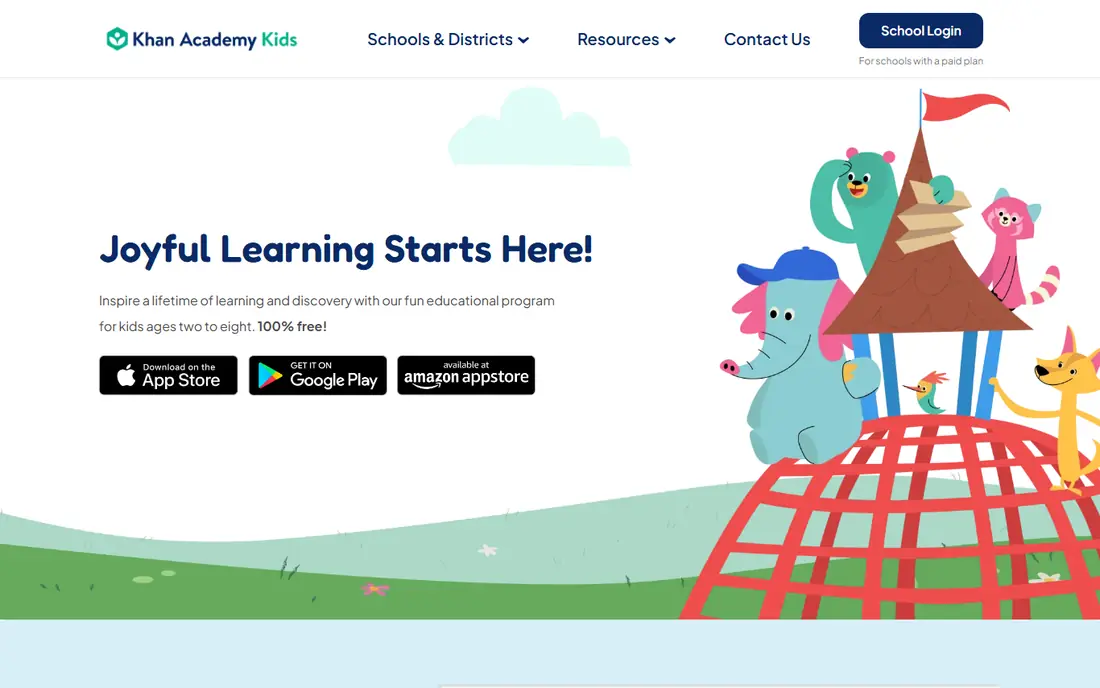
Khan Academy Kids is the first app to try, because it is free, ad-free and covers the core early learning areas without a subscription trap. Children follow an adaptive path through early literacy, vocabulary, stories, math and social-emotional activities, with characters and rewards that keep short sessions fun. It suits ages 2 to 8, though the sweet spot is preschool to early elementary.
The honest limit is depth of reporting and curriculum structure. Paid apps such as ABCmouse offer a longer guided path and more detailed parent tools, while Khan Academy Kids keeps things simpler. For most families, though, starting free removes the pressure to justify a subscription, and a child who enjoys it daily is already getting the main benefit.
- Completely free with no ads or subscriptions
- Covers reading, math and social-emotional skills
- Adaptive learning path
- App only, with no full web version
- Less of a guided curriculum than ABCmouse
- Parent reporting is simpler than paid apps
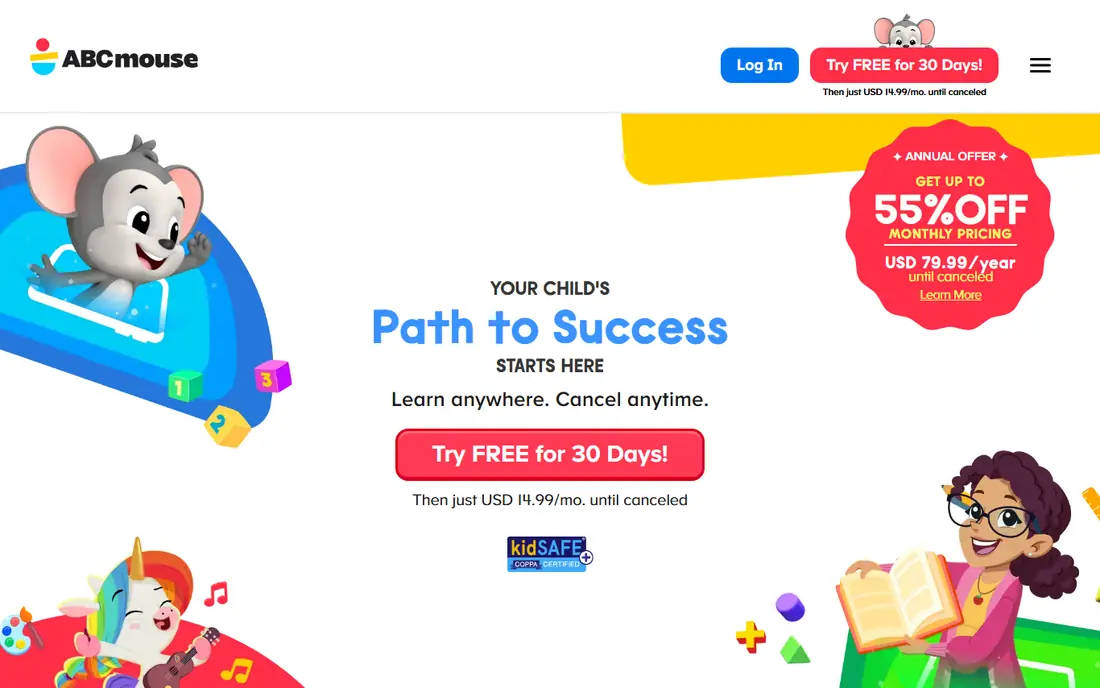
ABCmouse is the broadest guided curriculum here, with a step-by-step path through reading, math, language arts, science, social studies and art for ages 2 to 8. Children earn tickets and rewards as they complete activities, and parents can track progress across up to three child profiles. That structure suits a child who likes a clear path and a parent who wants one app to cover many subjects.
Pricing needs a careful read. Monthly billing is $14.99 per month after a 30-day free trial, while annual offers have varied between $45 and $79.99 per year depending on promotion, so check the current offer at signup. An Assessment Center for testing what a child has learned is a paid add-on, not part of the base plan, so factor that in if formal progress checks matter to you.
- More than 13,000 activities across reading, math, science and art
- Clear step-by-step learning path
- Up to three child profiles
- Monthly cost adds up over a year
- Annual price varies by offer
- Assessment tools are a paid add-on
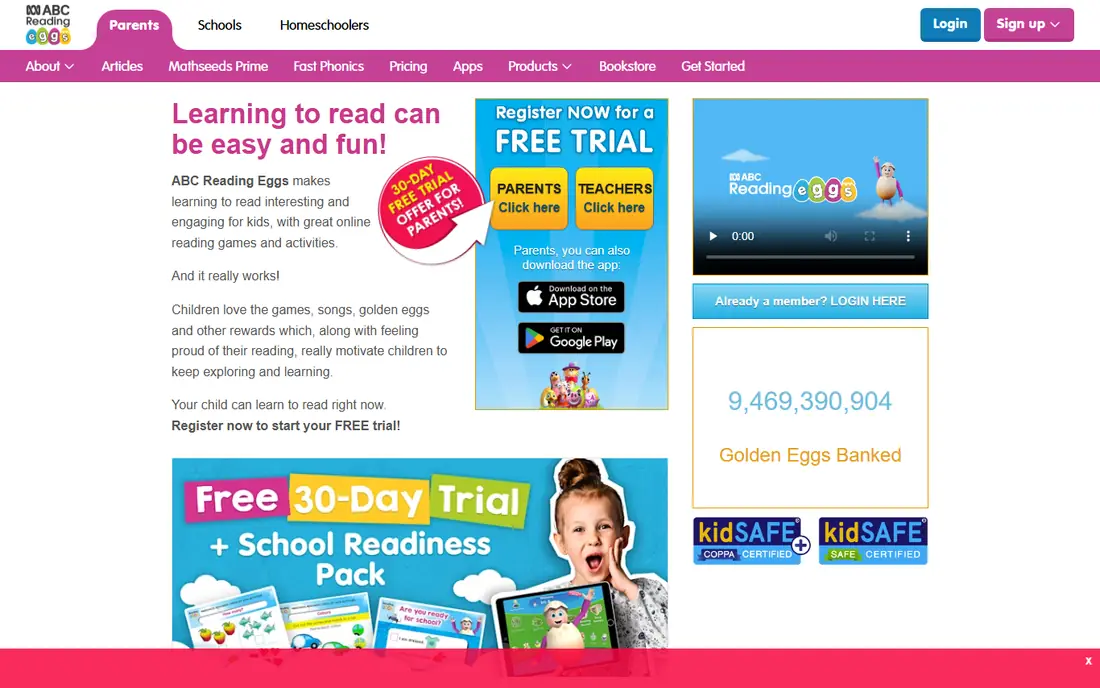
Reading Eggs is the reading-first pick, with 120 reading lessons plus spelling, sight words and stories that build from letter sounds to independent reading. It suits ages 3 to 7, with a companion program for older readers, and the ebook library gives children plenty to read once they can decode words. Parents get progress tracking that shows lessons completed and books read.
The plan is listed at $9.99 per month for up to four profiles, with annual pricing also offered, so a family with several children gets good value. The limit is scope: Reading Eggs teaches reading, not math or science, so pair it with Khan Academy Kids or ABCmouse if you want a broader curriculum. Some parents also find the pace fast for a four-year-old, so watch early lessons and repeat them rather than pushing ahead.
- Phonics, sight words and stories in one program
- More than 4,000 ebooks in the library
- Progress tracking for parents
- Reading only, with no math or science curriculum
- Pace can feel fast for younger children
- Cost for a single subject
Starfall has taught early reading for years, with a free learn-to-read program on the web and a home membership at $35 per year for the full site and app content. It covers letters, phonics, sight words and early stories in a calm, uncluttered style that suits younger children who get overwhelmed by busy games. Teachers and parents have used it for pre-K to third grade.
The trade is polish. Starfall looks plainer than ABCmouse or Khan Academy Kids, and its subject range is narrower, focused mainly on reading and early math. That simplicity is also a strength for a child who needs clear, slow steps, and the free reading program means you can test it properly before paying for a membership.
- Learn-to-read program free on the web
- Simple, calm design for young children
- Home membership at $35 per year
- Plainer look than newer apps
- Fewer subjects than ABCmouse
- Mobile experience is simpler than web
Duolingo ABC brings the Duolingo style to early reading, with short, game-like lessons on letter sounds, tracing, phonics and early words for ages 3 to 6. Lessons are brief, which suits short attention spans, and the app is free, so there is no subscription decision to make. It works well as a first reading app or as a companion to a broader program such as Khan Academy Kids.
The limit is age and depth. Duolingo ABC is aimed at the youngest readers, so a child who can already read simple books will outgrow it quickly, and it does not cover math or other subjects. Use it for letter confidence and early phonics, then move to Reading Eggs or Starfall when the child is ready for longer stories and spelling work.
- Free with no subscription
- Short lessons on letter sounds, tracing and early decoding
- Friendly characters and rewards
- Reading only and aimed at ages 3 to 6
- Less depth than Reading Eggs
- No parent dashboard as detailed as paid apps
PBS Kids Games is the best free choice for playful learning, with more than 280 games featuring familiar PBS characters across literacy, math, science and creativity for ages 2 to 8. Children can choose games by show or subject, which makes it easy to follow a child's interest, and parents can trust that the app is free with no subscription upsell in the main experience.
The catch is structure. PBS Kids Games is a collection of games, not a guided curriculum, so a child may play favourites rather than building skills in order, and parent progress tracking is thinner than ABCmouse or Reading Eggs. Use it for fun, interest-led sessions and for discovering what a child enjoys, then add a structured app if you want a clear learning path.
- Free with more than 280 games
- Familiar PBS characters
- Covers literacy, math, science and creativity
- Games vary in learning depth
- No single adaptive curriculum
- Less progress tracking than paid apps
Endless Alphabet, from Originator, teaches letters and vocabulary through animated monsters that act out word meanings, which preschoolers tend to remember far better than flashcard drills. Each word comes with a short animation and a puzzle, so children learn spelling, letter order and meaning together. It suits ages 3 to 5 as a first vocabulary app.
The limit is scope and cost structure. Endless Alphabet covers vocabulary, not phonics progression, reading comprehension or math, and extra word packs are sold as in-app purchases, so check the current pack pricing in the app store. Pair it with Duolingo ABC for letter sounds or Khan Academy Kids for broader learning, and treat it as a delightful supplement rather than a complete curriculum.
- Playful monster animations that teach letters and words
- Strong vocabulary building
- Works well for preschoolers
- Vocabulary only, not a full reading program
- In-app purchases for extra word packs
- No adaptive path
Homer, now Learn with Homer, builds a personalized path from a short assessment of a child's level and interests, then serves reading, math, creativity and social-emotional activities along that path. That personalization suits a child who is ahead in one area and behind in another, since the path adjusts rather than forcing a single grade level. It covers ages 2 to 8, with a parent dashboard for progress.
Pricing varies by plan and current offer, so check the Homer site at signup rather than relying on a single quoted rate, and note that reading is the stronger side of the program. Homer is a good middle ground between the free breadth of Khan Academy Kids and the long guided path of ABCmouse, especially for a child who benefits from a path that fits their level rather than their age alone.
- Personalized learning path based on a child's level and interests
- Reading and math activities for ages 2 to 8
- Parent progress tools
- Pricing varies by plan and offer, so check at signup
- Less content depth than ABCmouse
- Reading focus means math is thinner
How we picked these
We compared official feature pages, pricing pages, app store listings and public reviews for study apps that were live in October 2026 and aimed at young children, roughly ages 2 to 8. We kept apps that teach real early skills, not just entertainment, and we favoured a mix of free, reading-first and broad curriculum options. Prices are vendor and app store list rates checked in October 2026, and where an annual price varied by offer we say so instead of quoting one rate as fixed.
How to choose a study app for a young child
Start free and watch for two weeks
Begin with Khan Academy Kids, Duolingo ABC or PBS Kids Games, and watch whether your child asks for the app, completes sessions without frustration, and remembers skills the next day. A paid app only makes sense when a free app is clearly too easy, too narrow or missing a subject your child needs. Two weeks of real use tells you more than any feature list.
Keep sessions short and supervised
Short sessions of 10 to 20 minutes suit young children better than long stretches, and a parent nearby can help with tricky words, talk about what was learned, and spot frustration early. Use the parent dashboard, where offered, to check progress weekly, and balance app time with books, drawing, outdoor play and conversation, which build skills apps cannot.
Check ads, purchases and privacy
Choose apps with no ads or with ads clearly off on paid plans, and turn off in-app purchases or set a device password so a child cannot buy packs by accident. Check the privacy policy for data collection, especially for apps aimed at children, and prefer apps with a clear child privacy statement. A free app with ads and data tracking is a worse deal than a paid app with neither.
Frequently asked questions
What is the best study app for young children?
Khan Academy Kids is the best free all-round pick, ABCmouse is best for a broad guided curriculum, and Reading Eggs is best for learning to read. The right app depends on age, subject and whether you want a free, structured or reading-first tool, so start free and add a paid app only when needed.
Is ABCmouse worth the cost?
ABCmouse is worth it for families who want one guided curriculum across many subjects for ages 2 to 8, with progress tracking for up to three children. At $14.99 per month, it costs more over a year than free alternatives, so try the 30-day free trial first and check whether your child follows the path daily.
Is Khan Academy Kids really free?
Yes. Khan Academy Kids is free with no ads and no subscriptions, covering early literacy, math and social-emotional learning for ages 2 to 8. It is funded as a nonprofit learning product, which is why it can stay free while paid apps charge monthly or annual fees.
What age is best for study apps?
Most apps here target ages 2 to 8, with Duolingo ABC and Endless Alphabet suiting ages 3 to 6, and Reading Eggs, Starfall and ABCmouse covering up to ages 7 or 8. Match the app to your child's reading level rather than age alone, and keep sessions short, with a parent nearby for younger children.
How much screen time is right for a young child?
Short, focused sessions of 10 to 20 minutes work well for preschool and early elementary children, balanced with books, play and conversation. Use app time as one part of learning, not the main part, and stop a session when frustration rises, since pushing through rarely builds a skill faster.
Can study apps replace school or tutoring?
No. Study apps supplement school, reading at home and play, but they do not replace a teacher, a tutor or conversation with a parent. They work best when a parent talks about what a child learned, reads books together, and uses app progress to spot areas that need extra help offline.
Sources we checked (8)

Online Jobs is an independent blog about careers, online work, learning new skills and the tools that help people earn. More about us.
Keep reading
All posts
Best Tools for Virtual Tutoring
Compare the best tools for virtual tutoring, from one-to-one tutor marketplaces to free self-paced learning, with pricing, subjects and honest limits.
Best Study Apps for Kids
Looking for the best study apps for kids? We compare Khan Academy Kids, ABCmouse, Prodigy, IXL and more on age, safety, price and subjects for home learning.
Best Spanish Learning Apps
Looking for the best Spanish learning app? We compared eight leading apps for beginners, travelers, and serious learners to help you choose with confidence.