Best Star Gazing App in 2026: 9 Apps Compared

How we put this together: we compare official feature and pricing pages, app store listings, privacy policies and public user reviews. Prices change, so check the provider's site before you pay.
Key takeaways
- Stellarium and SkySafari lead for serious observing, with deep star catalogues and planning tools for telescope users.
- Star Walk 2 and Sky Tonight suit beginners and families who want to point a phone at the sky and learn what they see.
- Sky Map remains a simple, free option for quick star identification on Android, with no ads in its basic form.
- Satellite trackers such as ISS Detector and Heavens-Above answer a different question: when will a satellite pass overhead.
- NASA App and Clear Outside are useful companions, for space news and sky conditions, rather than replacements for a sky map.
Quick comparison
| Name | Who it suits | Starting price | Free option | |
|---|---|---|---|---|
 Stellarium | Realistic planetarium view | Free | Yes | Visit |
 SkySafari | Serious observers | Free | Yes | Visit |
 Star Walk 2 | Beautiful AR sky view | See website | Yes | Visit |
 Sky Tonight | What is visible tonight | See website | Yes | Visit |
 Night Sky | iPhone stargazing | See website | Yes | Visit |
 Sky Map | Simple free identification | Free | Yes | Visit |
 ISS Detector | Satellite passes | Free | Yes | Visit |
 Heavens-Above | Satellite and pass data | Free | Yes | Visit |
 NASA App | Space news and images | Free | Yes | Visit |
The best star gazing apps
A star gazing app uses your phone location, compass, and clock to show the sky above you in real time. Point the phone at the sky and labels appear for stars, planets, and constellations. The best app for you depends on whether you want a quick identification, a planning tool for a telescope session, or a tracker for satellites and the space station.
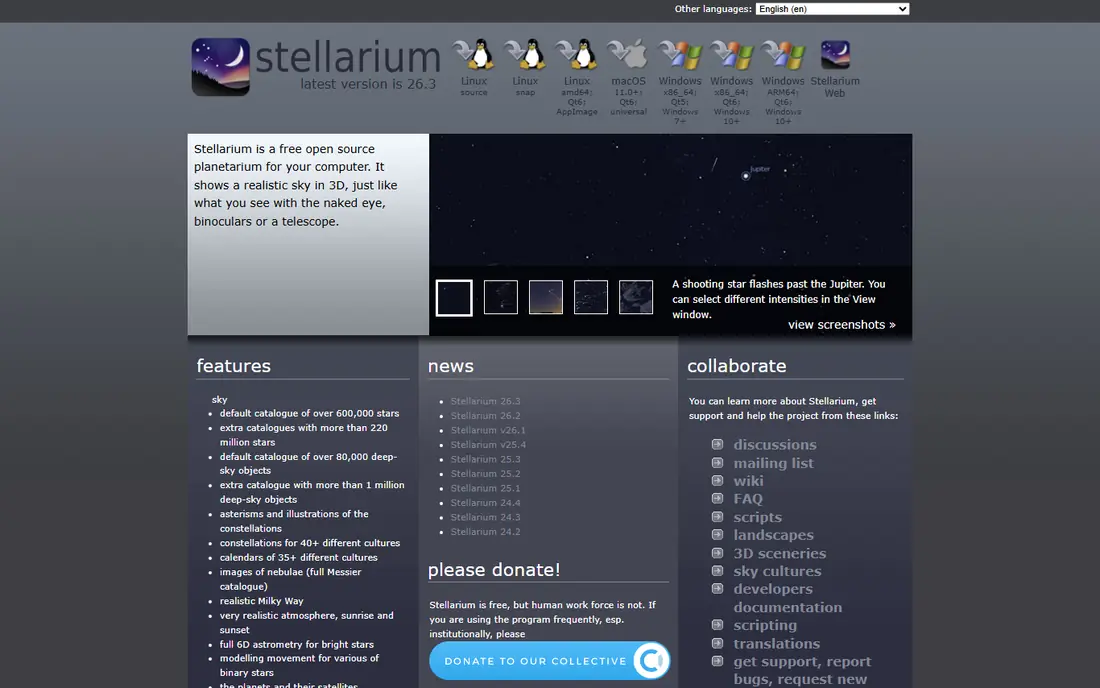
Stellarium has been a desktop planetarium standard for many years, and the mobile app brings the same realistic sky to your phone. The horizon, atmosphere, and Milky Way look close to what you see outside, which helps beginners connect the screen to the real sky. You can move time forward or back, jump to any date, and view the sky from any location, which is useful for planning a session before you go outside.
The free mobile app already includes a large catalogue and works offline, so it is a strong starting point for most stargazers. The paid Plus upgrade adds a deeper catalogue and telescope control over Wi-Fi, which matters mainly once you own a telescope worth pointing. For learning the sky and planning observations, the free version is hard to beat.
- Realistic sky rendering with atmosphere and Milky Way views
- Desktop and web versions for planning
- Large star catalogue in the mobile app
- Time controls can take practice to reset
- Paid Plus version needed for the deepest catalogue and telescope control
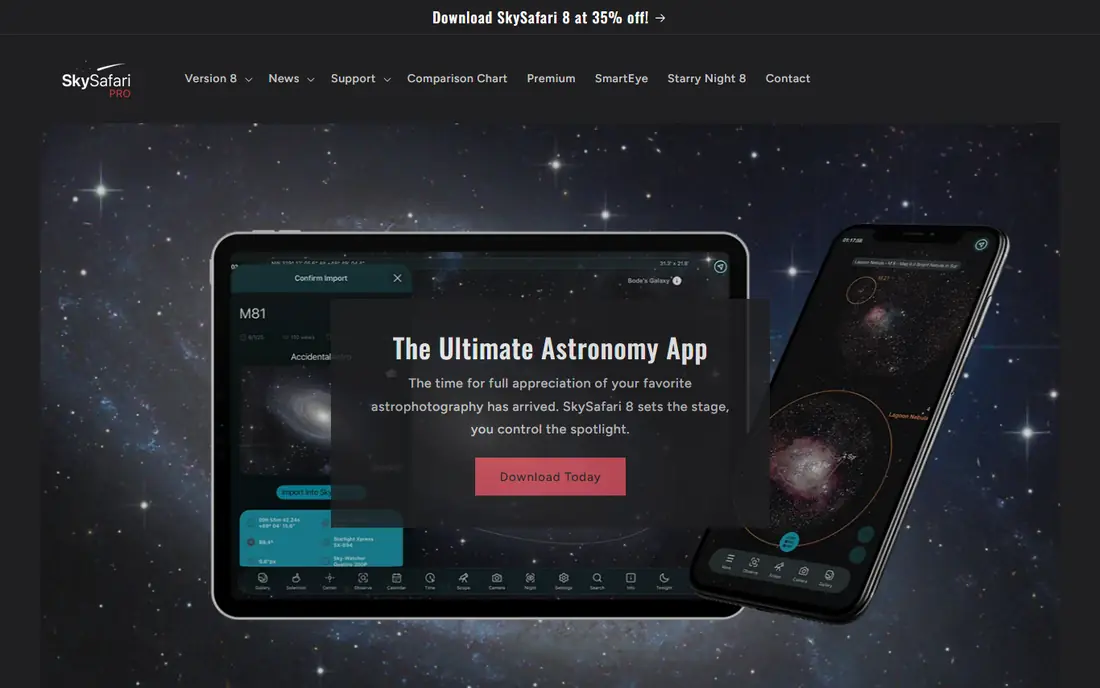
SkySafari is the app many amateur astronomers turn to when they want more than a quick identification. The basic version is free and includes a large star database, all major constellations, planets, and satellites, plus a time travel mode for planning. Point at sky mode works well, and the traditional chart view suits pre session planning at a desk or at the telescope.
Paid tiers add millions more objects, deeper deep sky catalogues, and Bluetooth telescope control. Beginners do not need those tiers at first, and the free version covers a long period of learning. If you buy a telescope later, SkySafari grows with you, which makes it a sensible long term choice.
- Large object database even in the basic version
- Planning tools and observing lists
- Telescope control in paid tiers
- Paid tiers add cost for the deepest catalogues
- Interface has more options than a beginner may want at first

Star Walk 2 is the app to open when you want to impress someone with the night sky. Point your phone upward and constellation art, star names, and planet labels overlay the real sky in a clean, attractive view. It is easy to use, which makes it a good choice for families, school groups, and anyone trying stargazing for the first time.
The trade off is depth. Star Walk 2 is better for identification and learning than for detailed session planning or telescope control. The free version includes ads, and an ad free edition is offered as a paid option. For casual stargazing and sharing the sky with others, it is one of the most enjoyable apps on this list.
- Attractive augmented reality sky view
- Good for showing friends and children what is overhead
- Works on iOS and Android
- Free version includes ads
- Some features require a paid edition
- Catalogue depth lags specialist planning apps
Sky Tonight answers the most common stargazing question: what can I see tonight. The app shows visible planets, stars, and constellations for your location, with an augmented reality mode for pointing at the sky and a calendar for upcoming events such as meteor showers and eclipses. That focus makes it easy to plan a short evening outside without learning a complex planetarium interface.
It is not the deepest planning tool here, and serious observers will still want Stellarium or SkySafari for telescope sessions. For beginners and casual observers who want a quick, clear answer about tonight, Sky Tonight is a strong pick, and its free version covers the core job well.
- Clear tonight view of visible objects
- Augmented reality pointing mode
- Event calendar for planets, meteors, and eclipses
- Paid features vary by platform
- Less suited to deep telescope planning than SkySafari or Stellarium
Night Sky is a polished choice for Apple users who want a beautiful sky view without a steep learning curve. Point your device at the sky to identify stars, planets, and constellations, and use the Apple Watch companion to check what is overhead without taking your phone out. The design is clean, and the app suits evening walks and family stargazing.
The limits are platform and pricing. Night Sky is made for Apple devices, so Android users should look elsewhere on this list. Some features sit behind a subscription, so check what the free version includes before you rely on a particular tool. For casual iPhone stargazing, it remains an attractive option.
- Polished augmented reality view on iPhone and iPad
- Apple Watch companion for sky alerts
- Good for casual identification
- Apple devices only
- Some features require a subscription
- Less planning depth than specialist apps
Sky Map is the simplest app on this list, and that is its strength. Open it, point your phone at the sky, and labels appear for stars and planets, with no account, no ads, and no complex menus to learn. It grew out of an early Google sky project and remains a useful fallback when you want a fast answer and nothing else.
The design is plain, and Sky Map lacks the event calendars, deep catalogues, and learning content of newer apps. It also focuses on Android, so iPhone users need another pick. If you want a free, no fuss identifier for Android, Sky Map still does the core job well.
- Free with no ads in its basic form
- Very simple to use
- Works well for quick star identification
- Android only in its main form
- Basic design compared with newer apps
- Fewer planning and learning features
ISS Detector does one job well: it tells you when the International Space Station and other satellites will pass overhead. The app gives pass times, directions, and brightness details, with alerts so you do not miss a bright pass. That makes it a good companion to a sky map app, since a satellite pass is one of the most rewarding things to watch with the naked eye.
It is not a general star finder, so it should not be your only stargazing app. Use it alongside Stellarium, SkySafari, or Star Walk 2, and check the pass forecast before you go outside. The free version covers the main satellites, with a paid upgrade for wider satellite groups.
- Alerts for International Space Station and satellite passes
- Clear pass times and directions
- Useful alongside a sky map app
- Focused on satellites, not general star identification
- Paid upgrade needed for some satellite groups
Heavens-Above suits stargazers who want detailed data about satellites, including pass times, brightness, and ground tracks. The site and app cover the space station, Starlink trains, and many other satellites, with charts that help you plan exactly where to look. It is a favourite among satellite watchers for good reason.
The interface is more about tables and charts than about a pretty sky view, so beginners may prefer ISS Detector for simple alerts. Pair Heavens-Above with a sky map app if you want both satellite data and star identification. For satellite tracking alone, it is the most detailed free option here.
- Detailed satellite pass predictions
- Covers many satellites beyond the space station
- Website and app for planning
- Interface is data heavy and less visual than AR apps
- Better for planning than for live sky pointing
NASA App is not a star finder, but it belongs on a stargazing list as a companion. It offers NASA images, videos, mission updates, and live coverage, plus information about space station sightings. On a cloudy night, or while waiting for dark, it gives context for what you will see when the sky clears.
Do not rely on NASA App alone to identify stars or plan a telescope session. Use it for inspiration and learning, and pair it with Stellarium or SkySafari for the sky itself. As a free, official NASA app, it is an easy addition to any stargazer's phone.
- Free NASA images, videos, and mission news
- Space station sighting information
- No subscription needed
- Not a sky map for star identification
- Content focus is news and missions rather than observing planning
How we picked these
We compared official app listings, vendor sites, and astronomy guides for current stargazing apps, and we favoured apps that are actively maintained, available on iOS or Android, and genuinely useful under a real sky. We included a mix of planetarium apps, augmented reality identifiers, satellite trackers, and companions, rather than nine versions of the same sky map. Prices shown come from vendor or app store listings where we could confirm them, and we used See website where pricing varies by platform or edition.
Choosing the right star app for you
Start with how you stargaze. If you go outside and point your phone at the sky, an augmented reality app such as Star Walk 2 or Sky Tonight will feel natural. If you plan sessions, own a telescope, or want to learn constellations in depth, Stellarium or SkySafari will serve you longer. Most stargazers end up with two apps: a sky map for identification and a satellite tracker for passes.
Practical tips for a better night out
Let your eyes adapt to the dark for at least fifteen minutes, and use a red light or a night mode in your app to protect that adaptation. Charge your phone before you go out, since GPS and screen use drain the battery, and download offline catalogues where the app offers them. A clear sky matters more than any app, so check cloud cover before you travel to a dark site.
What to check before you pay
Try the free version first and check whether the paid upgrade adds anything you will actually use, such as telescope control or a deeper catalogue. For beginners, the free versions of Stellarium and SkySafari already cover a great deal. Pay only when you hit a clear limit, such as ads you dislike or a catalogue that no longer meets your observing needs.
Frequently asked questions
What is the best astronomy app for beginners?
Star Walk 2 and Sky Tonight are easy starting points, since they show what is overhead with a simple point and view layout. Stellarium is also beginner friendly, and its free version gives you room to grow into deeper observing later.
What is the best star finder app?
Stellarium, SkySafari, and Star Walk 2 all identify stars well, but they differ in style. Stellarium gives the most realistic planetarium view, SkySafari gives the deepest planning tools, and Star Walk 2 gives the most attractive augmented reality view.
What are the best apps for stargazing on Android?
Stellarium, SkySafari, Star Walk 2, Sky Tonight, Sky Map, and ISS Detector all work on Android. Sky Map is the simplest free option, while Stellarium and SkySafari suit observers who want more depth.
What is the best star tracker app for satellites?
ISS Detector gives simple alerts for space station passes, while Heavens-Above gives more detailed pass data for many satellites. Use one of these alongside a sky map app, since satellite tracking and star identification are different jobs.
What is the best star viewing app for families?
Star Walk 2 and Sky Tonight suit families, with clear labels and attractive sky views that children can follow. Night Sky is another good family option for Apple households, and the NASA App adds space images and mission stories for younger stargazers.
Do stargazing apps work without internet?
Many planetarium apps, including Stellarium and SkySafari, work offline once their catalogues are downloaded, since they calculate the sky from your location, compass, and clock. Satellite pass predictions need up to date data, so refresh those before you lose signal.
Sources we checked (9)

Online Jobs is an independent blog about careers, online work, learning new skills and the tools that help people earn. More about us.
Keep reading
All posts
Best Vocabulary Apps
We compare 8 vocabulary apps in 2026, free and paid, for English learners, students, and test prep, with honest notes on what each one does best for daily use.

Best Udemy Alternatives
Explore the best Udemy alternatives for 2026, including Coursera, Skillshare, and LinkedIn Learning, with pricing, certificates, and who each platform suits.

Best Tools for Virtual Tutoring
Compare the best tools for virtual tutoring, from one-to-one tutor marketplaces to free self-paced learning, with pricing, subjects and honest limits.