Best Runtime Application Security Tools in 2026: 8 Platforms Compared


Deepest in-process protection · Starting price: See website
How we put this together: we compare official feature and pricing pages, app store listings, privacy policies and public user reviews. Prices change, so check the provider's site before you pay.
Key takeaways
- Runtime security watches what code actually does in production, which cuts the false alarms that plague scan-only tools.
- Contrast offers the deepest in-process protection, while Datadog and Dynatrace suit teams that already run those observability platforms.
- Java-heavy estates with legacy systems should look at Waratek first, and browser-focused teams at Jscrambler.
- Start in monitor-only mode on one important application before turning on blocking, or false blocks will erode trust fast.
- Most vendors price by quote, so budget conversations matter more than list prices in this category.
Quick comparison
| Name | Who it suits | Starting price | Free option | |
|---|---|---|---|---|
| Contrast Security | Deepest in-process protection | See website | No | Visit |
 Datadog Application Security | Datadog observability estates | See website | No | Visit |
 Dynatrace Application Security | Dynatrace observability estates | See website | Free trial (15 days) | Visit |
 Waratek | Legacy Java estates | See website | No | Visit |
 Jscrambler | Browser and payment page defense | See website | No | Visit |
 Oligo Security | Runtime exploit proof | See website | No | Visit |
 Fastly | Edge-layer runtime defense | See website | No | Visit |
 Appdome | Mobile app runtime defense | See website | No | Visit |
The best runtime application security tools
Scanners find possible problems. Runtime tools watch live applications and judge real attacks as they happen, inside the running process. That difference matters because it separates vulnerabilities that can actually be exploited from the long list of theoretical ones, and it lets teams block attacks without waiting for a patch cycle. The eight platforms below cover the main approaches, from deep in-process agents to edge and mobile defenses.

Contrast built its name on runtime protection that lives inside the application itself, observing real requests, data flows and attacks rather than guessing from scans. Its platform maps live attacks to the exact lines of code involved, which helps developers fix the real problem instead of chasing scanner output. The company positions runtime as the right model for AI-written code too, since it judges behavior rather than authorship.
The trade-off is procurement and rollout. Pricing is quote-based and scoped per application, and deploying agents across a large estate takes planning. For teams that want the deepest runtime view of their most important applications, Contrast remains the reference product in this category.
- Agent runs inside the application process
- Links attacks to specific lines of code
- Covers many languages
- Quote-only pricing
- Dedicated agents need rollout planning across services
Datadog Application Security
Who it suits: Datadog observability estates
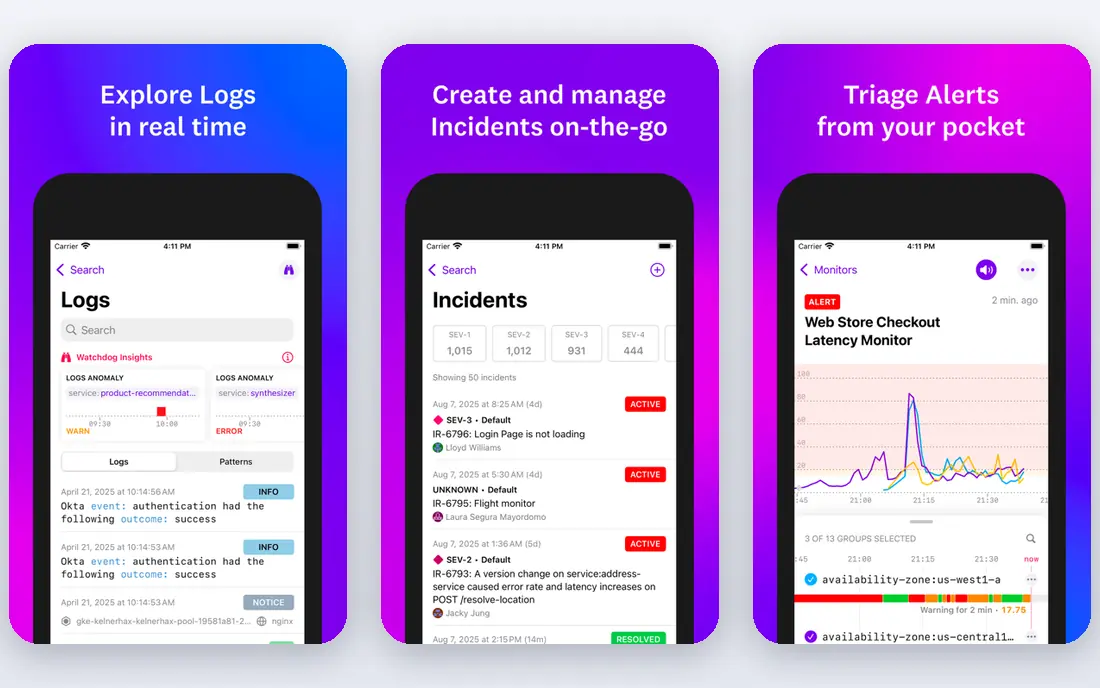
Datadog Application Security adds runtime threat detection to the observability agent many teams already deploy, which makes adoption unusually simple: no new agent to roll out, and attacks appear alongside traces, logs and metrics. Its engine descends from Sqreen, a runtime security company Datadog acquired, and it covers common attack classes with blocking available.
Because it rides on an observability platform, its in-process depth is shallower than a dedicated tool like Contrast, and teams that do not use Datadog gain little from it. If Datadog already monitors your stack, turning on its application security is the lowest-friction runtime upgrade available.
- Reuses the Datadog agent teams already run
- Ties attacks to traces and logs
- Usage-based billing
- Runtime depth trails dedicated tools
- Best value only inside a Datadog estate
Dynatrace Application Security
Who it suits: Dynatrace observability estates

Dynatrace Application Security runs on OneAgent, the same agent that provides its observability, so teams already on Dynatrace can add runtime vulnerability detection and attack blocking without new instrumentation. Findings carry application context, showing which services, libraries and exposures are actually reachable, which helps prioritize fixes. A 15-day free trial is listed on the Dynatrace homepage.
As with Datadog, the value concentrates inside its own platform, and usage-based pricing needs careful modeling for large estates. For organizations standardized on Dynatrace, it is the natural runtime security choice.
- OneAgent already covers the estate
- Vulnerability and attack context in one console
- Free trial available
- Full value needs the Dynatrace platform
- Pricing is usage-based and complex
Waratek takes a different technical route: compiler-based instrumentation of Java applications, which lets it protect legacy systems that teams cannot rewrite or redeploy easily. Its platform pairs pre-production vulnerability detection with production blocking, including virtual patching for known flaws, and it targets older Java runtimes and application servers that other agents no longer support.
The limit is scope. Waratek is Java only, so polyglot estates need a second tool for other languages, and pricing is quoted per JVM. For banks, insurers and enterprises running critical Java systems that cannot change quickly, Waratek is often the only practical runtime option.
- Compiler-level instrumentation for Java
- Protects apps that cannot be rewritten
- Virtual patching for known flaws
- Java only
- Quote-only pricing scoped per JVM
Jscrambler defends the part of the application other runtime tools cannot see: JavaScript running in the browser. Its platform obfuscates code, blocks tampering, and monitors third-party scripts on payment pages, which matters for PCI DSS payment-page requirements. It reports billions of protected web sessions and focuses on data theft through compromised scripts.
Client-side protection complements server-side runtime tools rather than replacing them, and browser instrumentation carries a performance cost to measure. Teams with payment pages, heavy third-party scripts or valuable browser-side logic should budget Jscrambler separately from their server runtime tool.
- Protects JavaScript in the browser
- Payment page integrity monitoring
- Code obfuscation and anti-tampering
- Client-side only, not a server replacement
- Adds runtime overhead to web pages
Oligo focuses on one painful problem: scanner output full of vulnerabilities that never execute in production. Its runtime sensor watches function-level execution, so teams learn which flaws are genuinely exploitable and can ignore the rest, cutting triage work dramatically. It also blocks attacks at the function level, stopping exploits without shutting down the application.
Oligo is newer than Contrast or the observability vendors, so its long-term track record is shorter, and pricing is quote-based. For teams drowning in vulnerability backlogs, its exploitability proof is the most immediately useful feature in this list.
- Proves which vulnerabilities actually execute
- Cuts scanner noise sharply
- Blocks at function level
- Newer vendor with a smaller track record
- Quote-only pricing
Fastly defends applications at the edge, inspecting traffic before it reaches origin servers, with WAF rules, bot management and DDoS protection on one platform. Its edge network lets teams change rules instantly and see attack traffic in real time, which suits high-traffic sites and APIs. The Signal Sciences technology behind its WAF lineage gives it a strong detection pedigree.
Edge defense sees requests, not code execution, so it cannot match in-process tools for context on what happens inside the application. Pairing Fastly at the edge with an in-process agent on crown-jewel services gives most teams the best balance of coverage and depth.
- Edge deployment stops attacks before origin
- WAF, bot management and DDoS in one platform
- Instant config changes
- Service-layer view, not in-process depth
- Edge pricing needs traffic modeling
Appdome protects mobile apps without requiring developers to embed an SDK: protections are fused into the finished Android or iOS binary during CI, covering tampering, fraud, bots, API abuse and identity threats. Its platform reports threat telemetry from every defended app, helping teams measure which defenses actually trigger. That no-code approach suits mobile teams that cannot slow releases for security integration work.
Mobile is the boundary. Appdome does nothing for server or web applications, so it belongs alongside, not instead of, a server runtime tool. For businesses whose revenue runs through mobile apps, it is the most practical runtime defense available.
- No SDK needed, protections fused into the app binary
- Covers fraud, bots and API abuse
- Threat telemetry built in
- Mobile only
- Desktop and web apps need other tools
How we picked these
We compared vendor feature pages, documentation and recent buyer guides, and checked that every homepage listed here loads and belongs to the product named. We excluded tools with announced end-of-life dates and absorbed brands counted twice under new owners. Because most vendors price by quote, we list "See website" rather than inventing figures, and we favored tools with a clear, current runtime story in October 2026.
What to check before you buy
Audit what you already own first: Datadog and Dynatrace estates often include runtime security that was never switched on. Deploy in monitor-only mode on one important application, measure overhead and false blocks against real traffic, and only then enable blocking on routes where the evidence supports it. Decide where depth matters most, since putting the deepest agent on every service wastes budget, while leaving crown-jewel applications on edge-only defense leaves real risk.
Frequently asked questions
What are the best runtime application security tools?
Contrast Security offers the deepest in-process protection, Datadog and Dynatrace suit teams already on those platforms, Waratek fits legacy Java, Jscrambler covers the browser, and Oligo proves exploitability. The right pick depends on your stack, not on a single ranking.
What is the difference between RASP and runtime application security?
RASP, runtime application self-protection, is the older name for agents that live inside applications and block attacks. Runtime application security is the broader current term, covering in-process agents, observability-delivered detection and edge defenses under one umbrella.
Do runtime tools replace a WAF?
No. A WAF filters traffic at the edge, while runtime tools judge what happens inside the application. Most mature setups run both, letting the edge absorb volumetric noise and the runtime agent handle requests that need code-level judgment.
How much do runtime security tools cost?
Most vendors price by quote, scoped per application, host or JVM, and observability vendors bill by usage. Expect enterprise budgets rather than per-seat SaaS prices, and ask vendors for a scoped quote against your real application count.
Should I start in blocking or monitor-only mode?
Monitor-only mode first. It shows what the tool sees, what it would block, and what overhead it adds, without risking legitimate traffic. Move selected routes to blocking once the evidence supports it.
Sources we checked (8)

Online Jobs is an independent blog about careers, online work, learning new skills and the tools that help people earn. More about us.
Keep reading
All posts
Surfshark Alternatives
Looking for Surfshark alternatives? We compare 8 VPN services on price, privacy, streaming, and device limits to help you find a VPN that fits your needs.

NordPass Alternatives
We compared NordPass alternatives for families, solo users and teams, checking pricing, free plans, passkeys and sharing, so you can switch safely today.
Best background check app
We compared the best background check app options in 2026 for employers, landlords and individuals, with published prices, coverage and compliance notes.