Best Running Training App in 2026: 9 Apps Compared

How we put this together: we compare official feature and pricing pages, app store listings, privacy policies and public user reviews. Prices change, so check the provider's site before you pay.
Key takeaways
- Nike Run Club is the best free starting point, with guided runs and training plans at no cost.
- Runna offers the most structured adaptive coaching for race goals, but it is a paid subscription.
- Strava is best for community and segment competition, not for a full coaching plan on its free tier.
- Garmin Connect is excellent if you already own a Garmin watch, and free for basic use.
- Pick the app that matches your goal first: finish a first 5K, train for a marathon, or track runs socially.
Quick comparison
| Name | Who it suits | Starting price | Free option | |
|---|---|---|---|---|
 Nike Run Club | Free guided coaching | Free | Yes | Visit |
 Runna | Adaptive race coaching | $19.99 per month | Free trial | Visit |
 Strava | Social running and segments | $11.99 per month | Yes | Visit |
 Runkeeper | Simple plans and tracking | See website | Yes | Visit |
 Garmin Connect | Garmin watch owners | Free | Yes | Visit |
 TrainingPeaks | Coach-led structured training | See website | Yes | Visit |
 Couch to 5K | Beginner walk-to-run plan | See website | Yes | Visit |
 Adidas Running | Multi-sport tracking | See website | Yes | Visit |
 Hal Higdon | Free written race plans | Free | Yes | Visit |
The best running training app
A training app should do more than record distance. It should give you a plan that fits your current fitness, adjust when life gets in the way, and show progress you can trust. The apps below cover that range, from free guided runs to coach-led platforms, and we compare them on plans, coaching depth, and price.
Nike Run Club remains the best free training app for most runners. Its guided runs pair audio coaching with music, and its training plans cover 5K through marathon distances without a subscription. Because there is no paid tier, you do not hit a paywall halfway through a plan, which is a common frustration with other apps.
The gaps are modest. Strength and mobility work lives in the separate Nike Training Club app, and the social side is quieter than Strava. If you want free coaching and a clear plan, start here, and only pay for another app if you need adaptive coaching or deeper data.
- Free guided runs and training plans
- Audio coaching during runs
- No premium tier to upsell
- No integrated strength training
- Social features are lighter than Strava
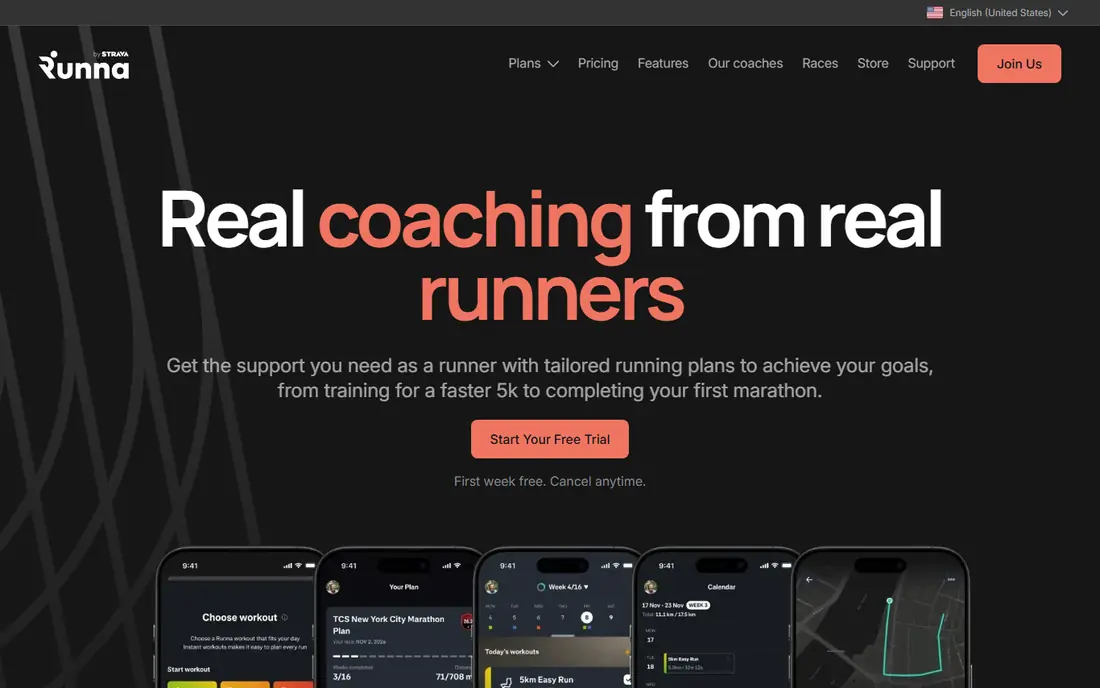
Runna builds a plan around your goal race, current fitness, and available training days, then adjusts it as you complete workouts. That adaptive approach is its main advantage over a static PDF plan, because missed runs and faster-than-expected progress both change what you should do next. Strength sessions are included, which many running apps leave out.
The price is the main trade-off, at $19.99 per month or $119.99 per year from app store listings. True beginners may also find the early weeks demanding, so a Couch to 5K plan may be a better first step before Runna. For runners with some base fitness who want a coach in their pocket, Runna is our top paid pick.
- Personalized plans that adapt to your training
- Strength and mobility sessions included
- Plans for 5K to marathon
- Paid subscription with no full free plan
- New-to-running plan ramps up quickly for true beginners
Strava is where many runners log runs, follow friends, and compete on local segments. The free tier covers GPS tracking, the activity feed, kudos, and basic stats, which is enough for many casual runners. The subscription, at $11.99 per month or $79.99 per year, adds full segment leaderboards, a training log, route suggestions, and deeper analysis.
Strava is not a full coaching app. It does not build an adaptive marathon plan in the way Runna does, so runners who want a structured plan should pair Strava with Nike Run Club or Runna, or use Strava mainly for tracking and motivation. Its strength is accountability through community, and for many runners that is what keeps training consistent.
- Large running community
- Segment leaderboards
- Route discovery and activity feed
- Full analysis and training log sit behind subscription
- Coaching plans are limited
Runkeeper, owned by ASICS, offers dependable GPS tracking, a full activity history, and training plans for common race distances. The free tier covers the basics well, and the paid Runkeeper Go tier adds personalized plans and deeper insights. Its interface is straightforward, which suits runners who want tracking without a busy social feed.
The paid tier has been priced around $9.99 per month or $39.99 per year in recent listings, though app store prices vary, so check the current price in your store before subscribing. Runkeeper is a solid middle ground between Nike Run Club's free coaching and Runna's adaptive plans.
- Reliable GPS tracking
- Guided workouts and race plans
- Long history as a running app
- Paid tier needed for personalized plans
- Social features are quieter than Strava
Garmin Connect is the companion app for Garmin watches, and it is free for core use. It stores activity history, maps routes, tracks sleep and heart rate, and offers Garmin Coach plans for 5K through marathon distances. If you already own a Garmin watch, you have effectively already paid for a capable training platform.
Without a Garmin watch, the app loses much of its value, because its best metrics come from the watch sensors. A paid Connect+ tier exists for extra features, but most runners will get what they need from the free tier. Check Garmin Coach's marathon plan limits before building a full season around it.
- Free with a Garmin device
- Garmin Coach plans
- Detailed health and training metrics
- Best only with a Garmin watch
- Paid Connect+ tier adds features some runners may not need
TrainingPeaks is the platform many coaches use to assign and review training. It tracks training stress, fitness, and fatigue over time, and it lets a coach see your completed workouts and adjust the plan. Athletes can also buy structured plans from its marketplace for common race distances.
For a beginner, TrainingPeaks can feel like too much data too soon. It shines for runners working with a coach, or for self-coached athletes who want to study training load rather than just follow a daily plan. If you like numbers and long-term planning, it is worth a look alongside a simpler daily app.
- Detailed training load and fitness charts
- Coach sharing and plan marketplace
- Strong for serious athletes
- Interface can feel dense for beginners
- Best features need a paid plan or a coach
Couch to 5K, including the NHS version, is a 9-week program that alternates walking and running in gradually longer running intervals. It is designed for people who are not currently running at all, and its slow build reduces injury risk compared with jumping into a generic plan. Audio cues tell you when to walk and when to run.
The program ends at 5K, so you will need another app or plan after graduation. That is fine: Couch to 5K is a starting ramp, not a lifetime training app. Pair it with Nike Run Club or Runkeeper once you can run 5K comfortably.
- Gentle 9-week walk-to-run structure
- Audio guidance
- Proven beginner approach
- Only covers the first 5K
- No marathon or advanced plans
Adidas Running, formerly Runtastic, tracks running alongside cycling, walking, and other sports, which suits people who train across disciplines. The free tier covers GPS tracking and basic stats, while the premium tier adds training plans and deeper analysis. Community challenges add a light social layer.
It does not match Runna for adaptive race coaching, and its premium pricing is only shown inside the app, so check there before committing. Adidas Running is a good pick for multi-sport athletes who want one tracker, rather than runners seeking a dedicated race coach.
- GPS tracking across running and other sports
- Training plans on premium
- Community challenges
- Premium is bought in-app only
- Coaching depth is lighter than Runna
Hal Higdon's training plans have guided runners for decades, and many remain free on his website. Novice marathon and half marathon plans assume little experience and build mileage gradually, while intermediate and advanced plans add speed work and longer runs. The weekly structure is easy to follow on paper or in any tracking app.
Because the plans are static, they do not adapt if you miss a week or progress faster than expected. Use a Hal Higdon plan inside Nike Run Club, Strava, or Runkeeper for tracking, and adjust manually if life interrupts training. For runners who prefer a simple, free plan without a subscription, it remains a reliable choice.
- Free plans from novice to advanced
- Marathon and half marathon focus
- Simple weekly structure
- Plans are static documents, not adaptive apps
- No GPS tracking built in
How we picked these
We compared apps that offer a real training plan or coaching feature, not just GPS tracking, and that are currently available on iOS and Android or the web. We weighted plan quality, coaching depth, price, and whether the app suits beginners, race runners, or data-focused athletes. We left out apps that only track steps or that have stopped updating their training content.
We also checked current pricing where vendors publish it, and marked prices as See website where app store pricing varies by region. A training app's value depends on whether you follow the plan, so we favored apps with clear weekly structure over apps with many features but no clear path.
How to choose a training plan
Match the plan to your current fitness, not your goal race alone. If you cannot yet run for 20 minutes without stopping, a Couch to 5K or beginner plan is the right start, even if your goal is a marathon next year. If you already run regularly, an adaptive plan from Runna or a structured plan from TrainingPeaks will use your time better.
Also check the weekly time commitment. A marathon plan that asks for five runs a week will fail if you only have three days available. Pick a plan you can follow for 12 to 20 weeks, build in rest days, and add strength work twice a week if the app does not include it.
Frequently asked questions
What is the best running app for training?
Nike Run Club is best for free training, Runna is best for paid adaptive coaching, and Strava is best for social motivation. The best app for training depends on whether you want a free plan, a coach that adapts, or community accountability. Many runners use two apps: one for the plan, one for tracking.
What is the best app for running training plans?
Runna offers the most personalized and adaptive plans for race goals, while Hal Higdon offers strong free static plans. Nike Run Club sits between them, with free guided plans that do not adapt as deeply as Runna. Choose Runna if you want adaptation, and Hal Higdon if you want a free plan you can follow anywhere.
What is the best running coach app?
Runna is the strongest coach-style app in this list, because it adjusts your plan based on completed workouts. Garmin Coach is a good free alternative if you own a Garmin watch. A human coach on TrainingPeaks can beat both, but at a higher cost and with more manual communication.
Are free running training apps good enough?
Yes, for many runners. Nike Run Club and Hal Higdon plans cover 5K through marathon distances at no cost, and Couch to 5K covers the beginner stage. Paid apps add adaptation, deeper data, and strength sessions, which matter more as goals get more ambitious.
How do I pick between Strava and Nike Run Club?
Pick Nike Run Club if you want free coaching and plans, and pick Strava if you want community, segments, and route discovery. Many runners use both: Nike Run Club for guided workouts, Strava for logging and social motivation. Both have free tiers, so trying both costs nothing.
Do I need a watch to use a running training app?
No. A phone with GPS works for most training apps, including Nike Run Club, Runna, Strava, and Runkeeper. A watch adds convenience, heart rate data, and easier mid-run checks, but it is not required to follow a plan. Start with your phone, and add a watch later if you want deeper metrics.
Sources we checked (9)

Online Jobs is an independent blog about careers, online work, learning new skills and the tools that help people earn. More about us.
Keep reading
All posts
n8n Alternatives
n8n alternatives compared for 2026, with Zapier, Make, Activepieces, and more, covering visual builders, code steps, self-hosting, and pricing models.
eBay Alternatives
Looking for ebay alternatives? We compared 9 marketplaces for sellers on fees, buyer reach, categories and ease of listing, to help you sell with confidence.

ZoomInfo Alternatives
The best ZoomInfo alternatives in 2026, compared on price, free plans, data coverage, and which tool fits small teams or large sales teams best in detail.