Best Run Tracking App in 2026: 9 Apps Compared

How we put this together: we compare official feature and pricing pages, app store listings, privacy policies and public user reviews. Prices change, so check the provider's site before you pay.
Key takeaways
- Nike Run Club is the best free run tracking app for most runners, since guided runs and training plans are included at no cost.
- Strava is the best run tracker app for social motivation and segment competition, but its best analysis sits behind a subscription.
- Runkeeper is a solid middle ground, with reliable free GPS tracking and paid plans for runners who want structured training.
- Garmin Connect, Coros, and Polar Flow are excellent if you already own their watch, but they are less appealing as phone-only trackers.
Quick comparison
| Name | Who it suits | Starting price | Free option | |
|---|---|---|---|---|
 Strava | Social running and segments | Free | Yes | Visit |
 Nike Run Club | Free coaching and plans | Free | Yes | Visit |
 Runkeeper | Simple tracking with paid plans | Free | Yes | Visit |
 Garmin Connect | Garmin watch owners | Free | Yes | Visit |
 adidas Running | Multi-sport tracking | Free | Yes | Visit |
 MapMyRun | Route mapping and community | Free | Yes | Visit |
 Coros | Coros watch training data | Free | Yes | Visit |
 Polar Flow | Polar watch training data | Free | Yes | Visit |
 Runna | Structured running plans | See website | Free trial | Visit |
The best run tracking apps
We compared official feature pages, app store listings, and recent running app guides, focusing on GPS tracking, training plans, social features, watch support, and what the free tier actually includes. Running apps should support your health, not push you to train through pain, so listen to your body, build mileage gradually, and seek medical advice if you have a health condition or an injury.
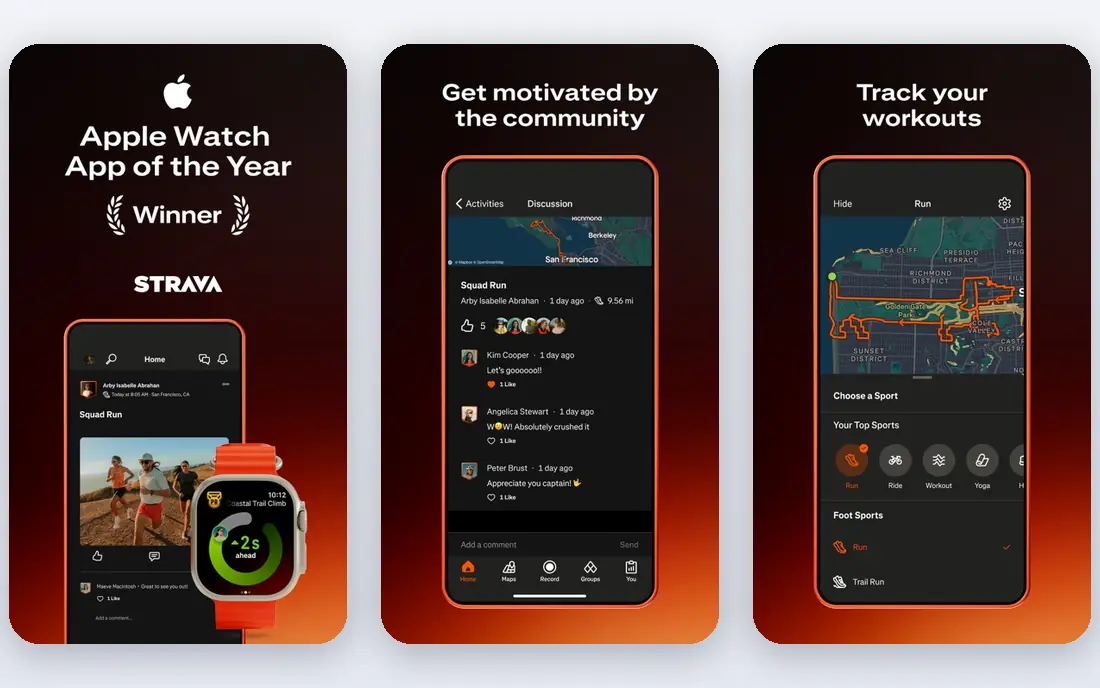
Strava is the social hub of running, and that is why many runners stay with it even when other apps track just as well. The activity feed, kudos, clubs, and challenges make regular running feel shared, and segments turn a familiar route into a friendly competition. GPS tracking, basic stats, and the feed work in the free tier, so you can test the community before paying.
The subscription is the catch. At $11.99 per month or $79.99 per year in recent guides, it adds full segment rankings, deeper training analysis, and route suggestions. Casual runners may not need it. Competitive runners who chase segments and study training load often will. If social motivation keeps you running, Strava is worth the free start.
- Large running community
- Segment leaderboards
- Strong route and activity feed
- Full segment leaderboards, training log, and route suggestions sit behind a subscription at $11.99 per month or $79.99 per year
Nike Run Club is our pick for most people because it is genuinely free in a way no other major running app matches. GPS tracking, pace, splits, elevation, run history, guided runs from coaches, and training plans for 5K through marathon are all included without a subscription. For a beginner who wants structure without paying, that is a rare combination.
The limits are analysis and availability. You will not get Strava-style segment competition or detailed training load charts, and training plans are not available in every country. Nike also uses the app to keep you close to its brand, so expect a Nike account and product marketing. If you want free coaching first and deep data second, start here.
- Fully free with no premium tier
- Guided runs and training plans
- Challenges and community features
- No deep training analysis
- Training plans are limited by country
- Requires a Nike account
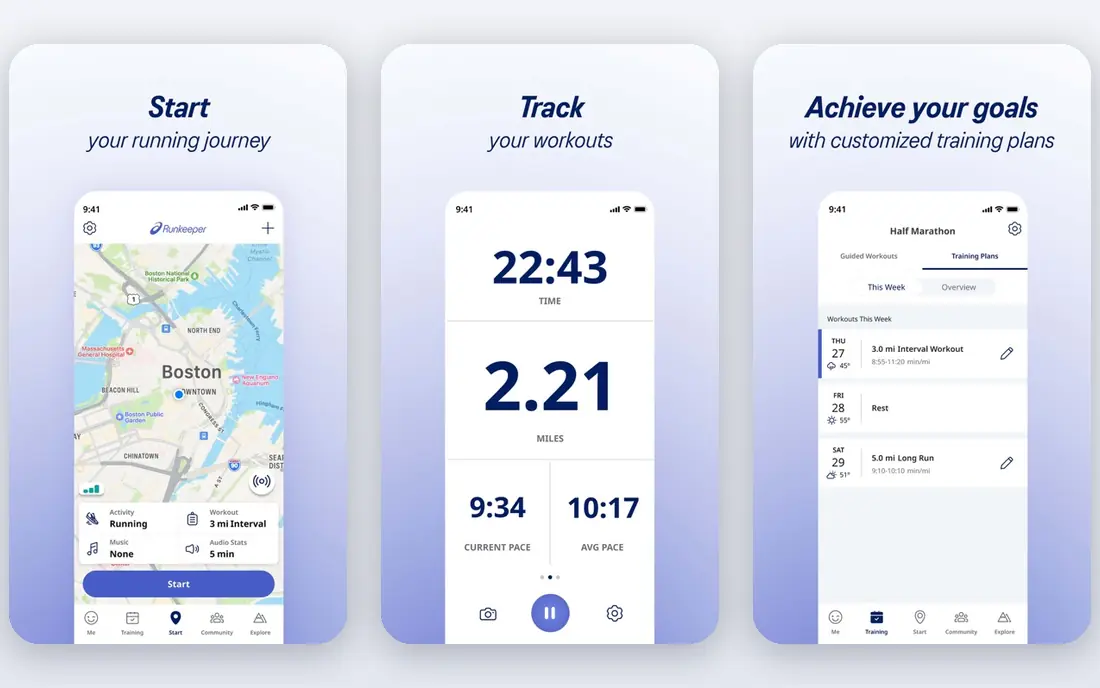
Runkeeper suits runners who want a clean, dependable tracker without a noisy social feed. The free tier covers GPS tracking, manual entries, basic stats, and full history, which is enough for many weekly runners. If you later want a structured plan, Runkeeper Go adds personalised training, deeper insights, and live tracking features.
At $9.99 per month or $39.99 per year, Go is cheaper than Strava's subscription, but it still sits behind a paywall for features Nike Run Club gives away free. Choose Runkeeper if you like its interface, use a Garmin or other wearable that syncs well with it, and want plans without joining a large social network.
- Reliable free GPS tracking
- Full run history
- Personalised plans on Runkeeper Go
- Training plans and advanced features require Go at $9.99 per month or $39.99 per year
- Social features are quieter than Strava
Garmin Connect is excellent, but only in context: it is the companion app for Garmin watches, and its strength comes from the watch sensors. You get detailed pace, heart rate, training effect, sleep, and route data in one place, plus a free training and activity history that rivals paid apps. For a Garmin owner, there is little reason to pay for another tracker.
As a phone-only app, it is less compelling, since GPS tracking from the phone alone does not use its main strengths. Garmin also offers Connect+ at $6.99 per month or $69.99 per year for extra insights. If you already run with a Garmin, use Connect as your home base and add Strava only for social features.
- Deep training, sleep, and heart rate data
- Free with a Garmin device
- Route mapping and live stats
- Needs a Garmin watch for full value
- Connect+ subscription adds extra features at $6.99 per month or $69.99 per year
adidas Running, formerly Runtastic, is a capable tracker for runners who also cycle, hike, or log other workouts. Free GPS tracking covers distance, pace, and basic stats, and the app supports live tracking so friends can follow a run. The design is straightforward, which suits runners who do not want a complex data dashboard.
The premium tier, which adds training plans and deeper analysis, is sold inside the app rather than through a clear web pricing page, so check the store listing before you commit. Social features are present but quieter than Strava. Choose adidas Running if you track several sports in one place and like a simple tracker.
- GPS tracking for running and other sports
- Live tracking and challenges
- Simple interface
- Premium tier is bought inside the app, so web pricing is less clear
- Training plans are paid
MapMyRun has long been popular for route planning, and that remains its strength. You can build and save routes, track runs by GPS, and share routes with a community that spans running, cycling, and walking. Wearable sync covers many major brands, so it works as a central log even if you switch watches.
The free version includes ads, and the most useful training and analysis features sit behind a paid tier. The interface also packs in more than a simple tracker, which some runners find distracting mid-run. If route discovery and mapping matter most to you, MapMyRun is a strong free start.
- Strong route builder and mapping
- Large community
- Works with many wearables
- Free version shows ads
- Premium features require a subscription
- Interface can feel busy
Coros is a favourite among trail and ultra runners because its watches offer long battery life and detailed training data, and the companion app presents that data cleanly. You get training load, recovery, route navigation support, and activity history without a subscription for the core app. For a Coros owner, it is a complete training home.
Phone-only runners will find less here, since the app is built around Coros hardware. The community is also smaller than Strava, so social motivation is weaker. If you run trails, ultras, or long mountain routes with a Coros watch, this app is a natural fit.
- Free app with deep training metrics for Coros watches
- Long battery life on Coros devices
- Clean training views
- Full value needs a Coros watch
- Smaller social community than Strava or Nike Run Club
Polar Flow is the companion for Polar watches and heart rate sensors, and it excels at heart rate based training. Training load, recovery, sleep, and fitness test views help runners who train by heart rate zones rather than pace alone. The core app is free, and the data is presented in a clear, coach-friendly way.
As with Garmin and Coros, the phone alone is not the point. You need Polar hardware to get the full benefit, and the social side is modest. Runners who already train with a Polar watch or chest strap will get the most from Flow, and can sync key activities to Strava for social sharing if they want both.
- Detailed heart rate and training analysis for Polar watches
- Free core app
- Strong sleep and recovery views
- Needs a Polar device for full value
- Social features are limited compared with Strava
Runna is different from the trackers above because its main product is the plan, not just the log. You set a goal, such as a 5K, 10K, half marathon, or marathon, and Runna builds an adaptive weekly plan with runs, strength work, and guidance. That structure helps runners who know they need a plan but do not know how to build one safely.
The trade-off is cost and focus. After a free trial, Runna requires a paid subscription, and it is not the best choice if you only want free GPS tracking. Check current pricing on the Runna site before subscribing, since plans and offers change. If a structured plan is what keeps you consistent, Runna is worth a trial alongside Nike Run Club's free plans.
- Personalised, adaptive running plans
- Strength and mobility sessions
- Clear weekly structure
- Paid subscription after trial
- Less useful as a simple free tracker
- Plans work best with consistent training
How we picked these
We compared official feature pages, app store listings, and recent running guides, and we weighted free tier value, GPS reliability, training plans, watch support, and social features. We included watch companion apps because many runners already own a watch, but we noted clearly where a watch is needed. Where pricing could not be confirmed on the vendor site, we wrote See website rather than guessing.
Choosing by how you run
If you are just starting
Start with Nike Run Club. Its free guided runs and plans remove the two biggest beginner questions: what should I run today, and how fast should I go. Add Strava later only if you want friends and segments to keep you motivated. Keep early runs easy, build gradually, and rest when you feel pain rather than pushing through it.
If you love data and competition
Strava plus a watch app is the usual combination. Track with Garmin Connect, Coros, or Polar Flow for deep data, and sync to Strava for segments, clubs, and challenges. Pay for Strava only if full leaderboards and training analysis matter to you weekly. Otherwise, the free tier plus a watch app covers most needs.
If you want a plan, not just a log
Compare Nike Run Club's free plans with Runkeeper Go and Runna before paying. Nike's plans are free but limited by country and less adaptive. Runna is more personalised but paid. Runkeeper Go sits in the middle. Pick the plan you will actually follow for eight to twelve weeks, since consistency beats a perfect plan you abandon.
Frequently asked questions
What is the best run tracking app?
Nike Run Club is the best free run tracking app for most runners, thanks to free guided runs and plans. Strava is the best app for tracking runs socially, with segments and clubs, while Runkeeper is a good simple tracker with paid plans. The best app for tracking runs depends on whether you value free coaching, social features, or deep watch data most.
What is the best app for tracking runs for free?
Nike Run Club is the strongest free option, since it has no premium tier and includes coaching and plans. Strava, Runkeeper, adidas Running, and MapMyRun also offer useful free GPS tracking. Watch apps such as Garmin Connect, Coros, and Polar Flow are free too, but they need their brand of watch for full value.
Is Strava worth paying for?
Strava's subscription is worth it if you use full segment leaderboards, route suggestions, and training analysis every week, and if clubs and challenges keep you running. At $11.99 per month or $79.99 per year in recent guides, it is a real cost. If you mainly log runs and check friends, the free tier is enough.
Can I track runs without a smartwatch?
Yes, all the phone apps here track runs by GPS without a watch, and Nike Run Club, Strava, Runkeeper, and MapMyRun work well on a phone alone. A watch adds heart rate, more accurate data in some conditions, and easier mid-run checks, but it is not required to start. Carry your phone securely and check GPS signal before a run in a new area.
Do run tracking apps work for beginners?
Yes, and Nike Run Club is especially beginner friendly, with guided runs that explain pace and effort in plain language. Runkeeper and MapMyRun also work for beginners with simple tracking. Start with short, easy runs, follow a beginner plan, and increase distance gradually rather than jumping to long runs in the first weeks.
How accurate is GPS run tracking?
Phone GPS is usually accurate enough for distance, pace, and route tracking on open roads and trails, but tall buildings, dense trees, and tunnels can cause small errors. Watches with multi-band GPS tend to do better in those conditions. If a run looks wrong, check the map for GPS jumps, and compare with a known route distance before worrying about pace.
Sources we checked (9)

Online Jobs is an independent blog about careers, online work, learning new skills and the tools that help people earn. More about us.
Keep reading
All posts
Leg Extension Alternatives
We compare leg extension alternatives that build quad strength at home or in the gym, with honest notes on form, equipment, and knee comfort. for 2026.
Best workout apps for women
Compare the best workout apps for women in 2026, from free guided classes to structured strength plans, with current prices, free plans and honest trade-offs.
Best app for counting calories
Find the best app for counting calories in 2026. We compare MyFitnessPal, Cronometer, Lose It and more on food databases, free plans and ease of use today.