Best Restaurant Reservation Software in 2026: 8 Tools Compared

How we put this together: we compare official feature and pricing pages, app store listings, privacy policies and public user reviews. Prices change, so check the provider's site before you pay.
Key takeaways
- OpenTable suits restaurants that need the largest diner network for discovery, while Resy suits upscale city restaurants with strong waitlist tools.
- SevenRooms leads for guest CRM and direct bookings across multi-location groups, while Tock leads for prepaid and ticketed dining.
- Eat App, Resos-style value tools, and Toast Tables suit smaller restaurants that want flat pricing without per-cover fees.
- Per-cover fees can outweigh a low monthly price at volume, so model total cost at your actual cover count before you sign.
- Check contract length, data ownership, POS integrations, and cancellation terms before you commit to a platform.
Quick comparison
| Name | Who it suits | Starting price | Free option | |
|---|---|---|---|---|
 OpenTable | Diner discovery and network reach | See website | No | Visit |
 Resy | Upscale city restaurants | See website | No | Visit |
 SevenRooms | Guest CRM and direct bookings | See website | No | Visit |
 Tock | Prepaid and ticketed dining | See website | No | Visit |
 Yelp Guest Manager | Yelp-driven reservations | See website | No | Visit |
 Eat App | Flat-rate value and data ownership | See website | Yes | Visit |
 ResDiary | European operations and groups | See website | No | Visit |
 Toast Tables | Restaurants already on Toast POS | See website | No | Visit |
The best restaurant reservation software
We compared platforms on booking, table management, waitlists, guest CRM, POS integrations, pricing model, and contract terms. The list mixes network platforms with direct-booking tools, because discovery and guest data are different priorities for different restaurants.
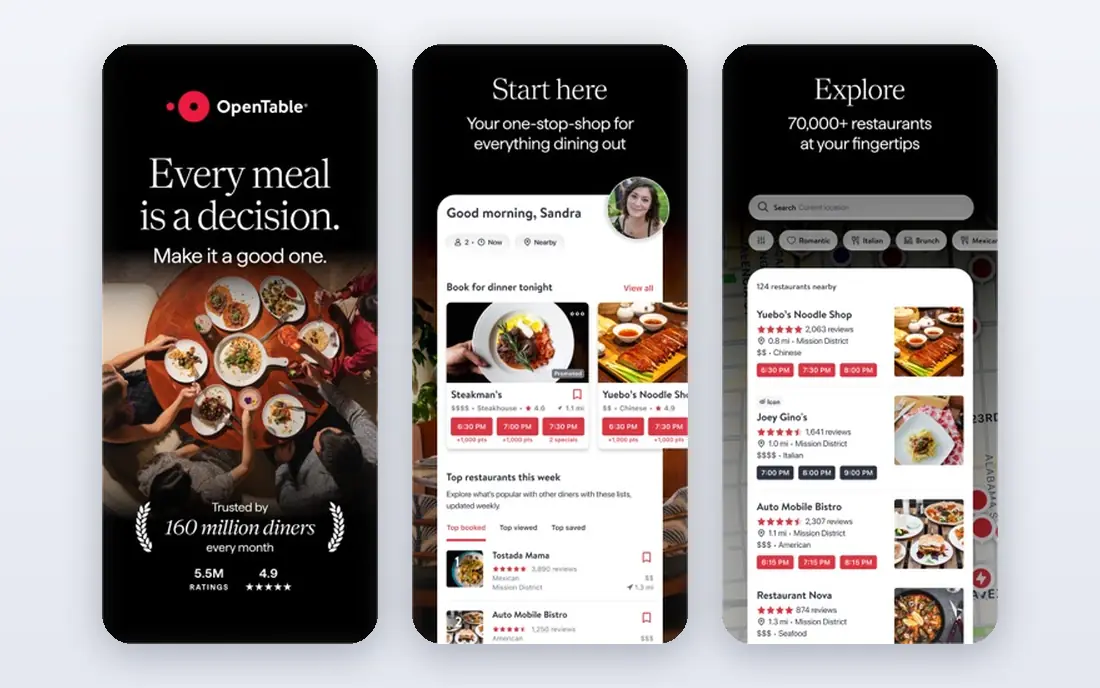
OpenTable remains the first choice when discovery matters most. Diners search OpenTable for a table, and restaurants listed there can fill seats from that network in addition to their own website bookings. Table management, waitlists, and guest notes help front-of-house teams run a busy service, and POS integrations support consistent availability.
The cost model needs modelling. OpenTable charges a monthly subscription plus per-cover fees on network bookings, with phone and walk-in reservations generally free on current plans. A restaurant doing high network volume can pay far more than the headline monthly price, so calculate total cost at your real cover count and compare it with flat-rate tools such as Resy or Eat App.
- Largest diner network for new guest discovery
- Table management and guest tools
- Integrations with many POS systems
- Per-cover fees on network bookings add up at volume
- Guest CRM depth varies by plan
Resy, owned by American Express, suits upscale and trend-led restaurants in major cities. Its waitlist and Notify tools help fill cancellations, and its diner base includes many food-focused guests who book ahead for popular rooms. Flat monthly pricing without per-cover fees makes total cost more predictable than OpenTable at volume, though exact plans are often quoted.
Resy network strength varies by city, so check local diner volume before you switch from OpenTable. For a neighbourhood restaurant outside a major city, a flat-rate direct tool may offer better value. For a city restaurant where buzz and waitlists drive revenue, Resy is a strong shortlist option.
- Strong cachet with food-focused diners in major cities
- Powerful waitlist and Notify features
- Flat monthly pricing without per-cover fees in many plans
- Pricing is often unpublished and quote-based
- Network is strongest in major cities
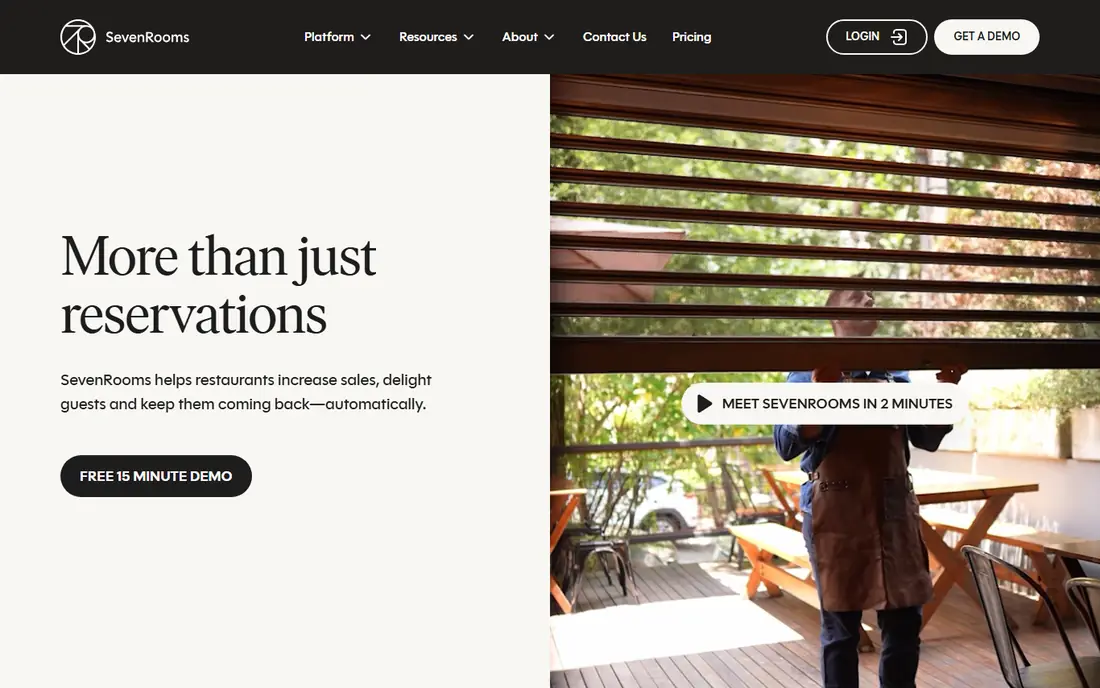
SevenRooms is built around guest data. Profiles combine reservation history, preferences, spend, and notes, so teams can personalise service and target marketing without relying on a third-party marketplace. Direct booking widgets keep guests on your website, and automation can handle confirmations, reminders, and post-visit follow-up.
That depth suits multi-location groups, hotels, and restaurants where repeat guests drive revenue. Smaller independents may find SevenRooms more than they need, and its pricing is quote-based for many plans. Choose SevenRooms when guest data, direct bookings, and group-wide consistency matter more than marketplace discovery alone.
- Deep guest profiles and CRM
- Direct booking widgets for your website
- Automation for marketing and guest experience
- Higher cost than simpler tools
- Best value for groups and larger operations
Tock leads for restaurants that sell an experience, not just a table. Tasting menus, chef counters, winery visits, and special events can be sold as prepaid tickets, which reduces no-shows and improves cash flow. Deposit options and cancellation policies give operators control that standard reservation tools lack.
Fees and fit need checking. Tock plans include transaction fees on prepaid reservations on some tiers, and the platform suits booked, experience-led dining more than casual walk-in trade. For a fine dining room, winery, or event-led venue, Tock is often the best fit. For a casual bistro, a simpler table tool may be cheaper and easier.
- Prepaid reservations and ticketed experiences
- Strong for tasting menus, wineries, and events
- Deposit and no-show controls
- Transaction fees apply on prepaid bookings on some plans
- Less suited to walk-in heavy casual dining
Yelp Guest Manager suits restaurants that already receive strong traffic from Yelp. Diners who find you on Yelp can book, join a waitlist, and receive confirmations without leaving that flow, which reduces lost bookings from search. Table management and guest messaging help staff handle a busy service from one view.
If Yelp is not a major source of guests for your restaurant, the value is lower than a network tool such as OpenTable or a direct tool such as SevenRooms. Check your Yelp traffic and booking share before you commit, and compare Yelp Guest Manager pricing against Eat App and ResDiary for a similar feature set.
- Converts Yelp search traffic into bookings
- Waitlist and table management
- Guest messaging tied to bookings
- Value depends on your Yelp presence
- Pricing is higher than some flat-rate tools
Eat App is the value pick for restaurants that want strong table management and CRM without per-cover fees. Its free plan suits very small operations, and paid plans use flat monthly pricing, so total cost stays predictable as covers grow. The focus on data ownership means your guest list remains yours, which matters if you later switch platforms.
The trade-off is discovery. Eat App does not bring the same diner network as OpenTable or Resy, so restaurants that rely on marketplace guests should pair it with their own marketing or keep a network listing. For independents with a steady local base, Eat App offers a strong balance of features and cost.
- Flat-rate pricing with no per-cover fees on many plans
- Free plan for small operations
- Guest data ownership is a focus
- Smaller diner network than OpenTable or Resy
- Advanced group features are more limited
ResDiary suits restaurants and groups in Europe and other markets where its diary and channel integrations are strongest. It offers table management, online bookings, waitlists, and reporting, with multi-site tools for groups that need consistent diary control across locations. Channel partnerships help distribute availability beyond your own website.
US restaurants that need diner discovery should compare ResDiary with OpenTable, Resy, and SevenRooms first, since its network strength differs by region. For European operations, groups, and hotels, ResDiary is a credible alternative to larger network platforms, with a focus on operations rather than marketplace fees.
- Strong table and diary management for European restaurants
- Multi-site tools
- Integrations with POS and channel partners
- US network discovery is limited
- Pricing varies by market and plan
Toast Tables suits restaurants already running Toast POS, because reservations, tables, and point-of-sale data live in one system. Staff can manage bookings, waitlists, and table status without switching platforms, and guest data flows into Toast for reporting and marketing. That integration reduces double entry and training time for front-of-house teams.
The limit is clear: Toast Tables requires Toast POS, so it is not a standalone choice for restaurants on Square, Lightspeed, or another system. If you already use Toast and want reservations without a separate platform, Toast Tables is the simplest path. If you plan to change POS soon, choose a platform-independent tool instead.
- Integrates directly with Toast POS
- Table management and waitlists in one system
- Simple pricing for existing Toast users
- Requires Toast POS
- Standalone value is limited if you use another POS
How we picked these
We checked each vendor homepage to confirm the platform is active, offers restaurant reservations, and provides current plans in 2026. We compared booking, table management, waitlists, guest CRM, POS integrations, pricing model, and contract terms. We read public pricing summaries and vendor documentation to check per-cover fees, free plans, and plan differences, and we used See website where pricing is unpublished or could not be verified from the vendor site. We left out platforms that closed in 2026, such as Quandoo, which is no longer available.
Modelling total cost and protecting guest data
Headline monthly prices mislead in this category, because per-cover fees, transaction fees, and contract terms change the total. Model cost at your real volume, and check who owns your guest data before you sign a contract that lasts a year or more.
Calculate cost at your cover count
Add monthly subscription, per-cover fees on network bookings, prepaid transaction fees, and any add-ons for CRM or marketing. A low monthly plan with high per-cover fees can cost more than a higher flat-rate plan at 1,000 covers a month. Ask for a written total-cost example at your volume, and check whether website and phone bookings carry the same fees as network bookings.
Check data, contract, and integrations
Confirm that you can export guest and reservation data, how long the contract runs, and what happens at renewal. Check POS, payment, and marketing integrations you actually use, and test the booking widget on mobile before launch. A platform that fits your POS and data needs will save more staff time than a cheaper tool that forces manual workarounds.
Frequently asked questions
What is the best restaurant reservation software?
OpenTable suits discovery, Resy suits upscale city restaurants, SevenRooms suits guest CRM and direct bookings, and Tock suits prepaid dining. Eat App and Toast Tables suit value and POS-integrated needs. The best choice depends on cover volume, location, POS system, and whether you prioritise discovery or guest data.
What is the best restaurant reservation app for small restaurants?
Eat App offers a free plan and flat-rate pricing that suit small operations, while Toast Tables suits small restaurants already on Toast POS. ResDiary and Yelp Guest Manager suit specific markets and traffic sources. Start with a free or low-cost plan, test table management during a busy service, and upgrade only when cover limits or CRM needs require it.
How much does restaurant reservation software cost?
Costs range from free plans for small volumes to several hundred dollars a month for network and CRM platforms, plus per-cover or transaction fees on some plans. OpenTable-style network pricing includes per-cover fees, while Resy and Eat App often use flat monthly pricing. Model total cost at your actual cover count, not just the headline monthly price.
Do I own my guest data with reservation software?
Data ownership varies by platform and plan, so check the contract before you sign. SevenRooms and Eat App emphasise guest data ownership and direct bookings, while marketplace platforms may limit CRM access on lower tiers. Ask how to export guest data, what fields are included, and whether export is available at cancellation.
Can reservation software reduce no-shows?
Yes, with automated confirmations, reminders, deposit or card-hold options, and waitlist tools that refill cancelled tables. Tock prepaid bookings and Resy Notify are strong for no-show control, while most platforms offer SMS and email reminders. Set a clear cancellation policy, remind guests close to the booking time, and track no-show rates by channel to see what works.
Sources we checked (8)

Online Jobs is an independent blog about careers, online work, learning new skills and the tools that help people earn. More about us.
Keep reading
All posts
n8n Alternatives
n8n alternatives compared for 2026, with Zapier, Make, Activepieces, and more, covering visual builders, code steps, self-hosting, and pricing models.
iPhone Alternatives
Looking for iPhone alternatives in 2026? Compare 9 Android phones from Samsung, Google, OnePlus, and more, with cameras, battery life, and honest trade-offs.
eBay Alternatives
Looking for ebay alternatives? We compared 9 marketplaces for sellers on fees, buyer reach, categories and ease of listing, to help you sell with confidence.