Best Prebuilt Gaming PC Company in 2026: 9 Products Compared

How we put this together: we compare official feature and pricing pages, app store listings, privacy policies and public user reviews. Prices change, so check the provider's site before you pay.
Key takeaways
- NZXT and Corsair suit buyers who want clean builds, standard parts and a clear upgrade path, while Alienware suits buyers who want a strong brand and wide support.
- iBUYPOWER and CyberPowerPC usually give the most gaming power per pound or dollar at the budget and mid-range ends of the market.
- HP OMEN, ASUS ROG and Lenovo Legion are strong picks when you want a big-brand warranty and a machine you can buy from a major retailer.
- Check the exact graphics card, power supply and warranty length for the configuration you buy, since builders change specs often.
Quick comparison
| Name | Who it suits | Starting price | Free option | |
|---|---|---|---|---|
 NZXT | Clean custom builds | See website | No | Visit |
 Alienware | Brand support and design | See website | No | Visit |
 Corsair | Premium compact builds | See website | No | Visit |
 iBUYPOWER | Budget value | See website | No | Visit |
 CyberPowerPC | Mid-range value | See website | No | Visit |
 HP OMEN | Retail availability | See website | No | Visit |
 ASUS ROG | Gaming focused parts | See website | No | Visit |
 Lenovo Legion | Balanced mainstream PCs | See website | No | Visit |
 Origin PC | Fully custom high-end builds | See website | No | Visit |
The best prebuilt gaming pc company
A prebuilt gaming PC company earns its place by doing three things well: picking parts that work together, building the machine neatly, and standing behind it when something fails. Price matters too, but a cheap machine with a weak power supply or a short warranty can cost more in the long run. The companies below cover budget, mid-range and high-end buyers, and each one is still selling prebuilt gaming PCs in October 2026.
NZXT built its name on cases and cooling, and that shows in its prebuilt PCs. The Player range and the BLD configurator let you pick a graphics card, processor, memory and storage, then NZXT builds the machine in one of its own cases. Cable management is tidy, airflow is planned rather than left to chance, and the parts list reads like a parts list you would pick yourself.
That transparency is the main draw. When you can see the exact power supply, motherboard and cooler, you can judge the build and plan upgrades. The catch is price. NZXT rarely wins a straight price fight with iBUYPOWER or CyberPowerPC at the same graphics card level. You pay for the build quality, the case design and the support, and for many buyers that trade is worth it.
- Configurator with clear part choices
- Neat cable work and airflow focused cases
- Standard parts that are easy to upgrade later
- Prices sit above the cheapest rivals
- High-end configurations get expensive fast
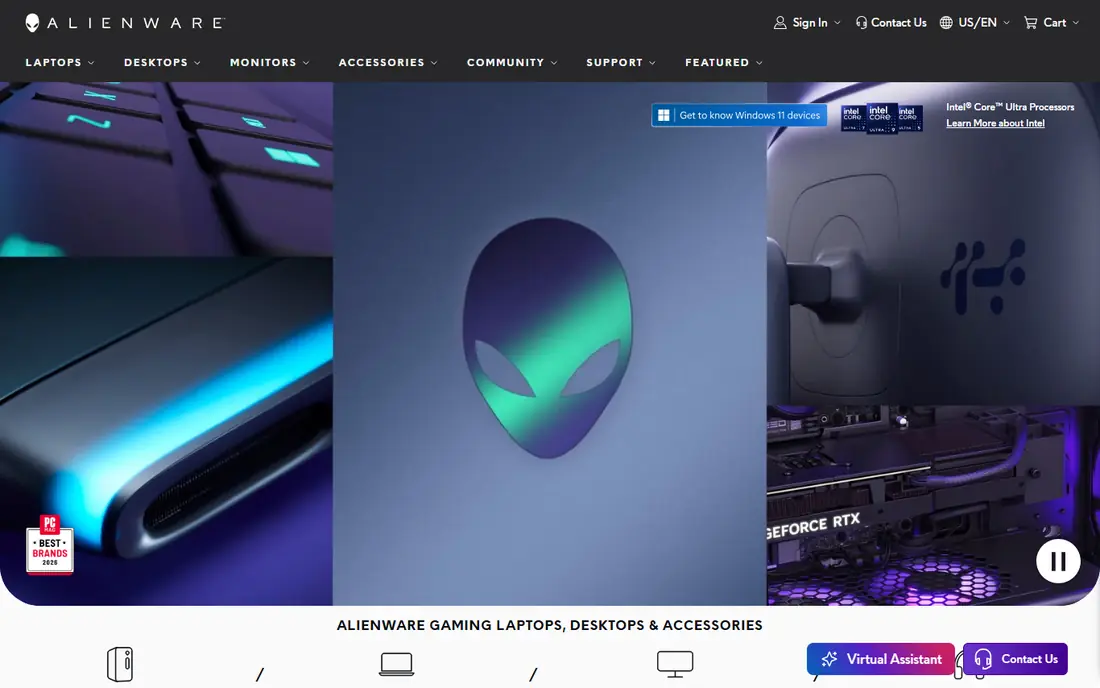
Alienware, owned by Dell, is the most recognisable name in prebuilt gaming PCs. The Aurora range covers mainstream to high-end gaming, with current graphics cards and processors and a design that stands out on a desk. Buying through Dell also brings a large support network, next-day service options in many regions, and the chance to buy in stores as well as online.
The design comes with a trade. Some Aurora models use parts shaped for that case, which can limit later upgrades compared with a standard tower from NZXT or Corsair. Check the case size, power supply rating and motherboard layout for the exact model you are buying. If you want a machine that looks sharp, runs current games well and comes with big-brand support, Alienware remains a safe pick.
- Wide retail and online availability
- Strong warranty and support network through Dell
- Distinctive design and lighting
- Some models use proprietary parts
- Upgrades can be harder in compact cases
Corsair makes many of the parts inside other builders' machines, so its own Vengeance and Corsair One PCs start with an advantage. Memory, power supplies, cooling and cases come from its own catalogue, and the builds tend to be neat, quiet and well cooled. The Vengeance range is the mainstream choice, while the Corsair One is a compact tower for buyers who want power in a small footprint.
The compact One models look superb on a desk, but a small case always means less room for larger graphics cards and extra drives later. The larger Vengeance towers avoid that problem and are easier to upgrade. Corsair prices sit at the higher end, yet the part quality and cooling help justify the cost for buyers who plan to keep the machine for years.
- Excellent cooling and case design
- High quality memory, power supplies and cooling parts
- Vengeance range covers many budgets
- Premium models carry premium prices
- Compact models can limit future upgrades
iBUYPOWER is often the first name budget buyers meet, and for good reason. Its Trace and Element ranges offer current graphics cards at prices that undercut many rivals, and ready to ship systems mean you do not wait weeks for a build. Retail availability through large stores also makes it easy to compare prices and to return a machine if needed.
Value is the story, and you should read the full spec sheet to get it. Two systems with the same graphics card can differ in memory speed, storage type and power supply. Check those details, and be ready for a plainer case and simpler cooling than a premium build. If the specs check out, iBUYPOWER gives you more frames per pound or dollar than most builders in this list.
- Strong value at budget and mid-range prices
- Wide range of ready to ship systems
- Frequent deals through major retailers
- Part choices can vary between configurations
- Build quality varies more than with premium builders
CyberPowerPC competes head to head with iBUYPOWER on value, and the contest benefits buyers. Its Gamer Xtreme and Gamer Master ranges cover 1080p and 1440p gaming at sensible prices, while the configurator lets you change the processor, graphics card, memory, storage and cooling before you order. That flexibility suits buyers who know roughly what they want but do not want to build it themselves.
As with any value builder, the details matter. A base model may pair a strong graphics card with a basic air cooler, which is fine for casual gaming but less ideal for long sessions in a warm room. Spending a little more on cooling or a better power supply is often money well spent. Support reviews are mixed, so keep your order details and warranty paperwork in one place.
- Competitive prices across the range
- Deep configurator for custom builds
- Strong presence with major retailers
- Support experience can vary
- Entry models may need a cooling upgrade for heavy use
HP OMEN has improved a great deal in recent years, and the current OMEN towers are far more upgrade friendly than older HP gaming PCs. Recent models use standard sized parts in many configurations, with tool free access to memory and storage in some designs. That makes OMEN a practical choice for buyers who want a big-brand machine they can open up later.
Retail availability is another plus. You can often see an OMEN machine in a store, compare it with rivals on the same shelf, and take it home the same day. The catch is that HP sells many configurations, and not every one is equally upgrade friendly. Check the exact model, not just the OMEN name, and confirm the power supply size if you plan to fit a larger graphics card later.
- Easy to buy from HP and major retailers
- Clean, upgrade friendly tower designs in recent ranges
- Solid warranty and support options
- Some older models used proprietary parts
- Gaming software adds bloat for some users
ASUS ROG covers almost every part of a gaming PC, from motherboards and graphics cards to monitors and laptops. Its prebuilt ROG Strix desktops draw on that range, with gaming tuned cooling, fast memory and current graphics cards. For buyers who already use ASUS parts, a ROG desktop keeps the whole system in one ecosystem.
The range is broad, which is both a strength and a risk. A budget ROG Strix machine and a high-end ROG machine share a brand, not a spec sheet. Compare the exact graphics card, processor, memory and storage, and ignore the lighting when you judge value. When the specs line up, ROG builds offer a good mix of gaming performance and part quality.
- Strong motherboards and graphics cards from its own range
- Gaming focused cooling and lighting
- Wide model range from budget to high-end
- Prices vary widely by model
- Software suite can feel heavy
Lenovo Legion towers are the quiet achievers of this list. They rarely top a headline for style or extreme specs, but they pair a current graphics card with a solid processor, enough memory and fast storage at a fair price. Recent Legion towers also cool better than older Lenovo gaming desktops, which helps during long gaming sessions.
The plain design will not suit buyers who want a showpiece PC, and the top end of the Legion range is narrower than NZXT or Origin PC. For most gamers, though, that hardly matters. Legion is a sensible pick when you want a machine that plays current games well, comes from a major brand, and leaves money for a better monitor or headset.
- Sensible specs with little waste
- Good cooling in recent tower designs
- Strong support and warranty options
- Design is plain next to Alienware or Corsair
- High-end range is smaller than rivals
Origin PC sits at the premium end, where buyers choose almost every part and the builder assembles, tests and ships a machine that is ready to run. The Neuron and Millennium ranges cover high-end gaming, streaming and content creation, with careful cable work, strong cooling and a long list of case and lighting options. If you want a specific graphics card, a specific cooler and a specific storage layout, Origin PC will build it.
That freedom costs money, and it costs time. Origin PC machines are rarely the cheapest way to get a given graphics card, and custom builds take longer than buying a ready system off a shelf. The buyers who gain most are those who know exactly what they want and want it built to a high standard. For everyone else, a ready system from NZXT or Corsair gives most of the benefit for less money and less waiting.
- Deep customisation down to individual parts
- Premium build quality and cable work
- Strong support for high-end buyers
- Prices are high
- Lead times can be longer than ready to ship rivals
How we picked these
We started with companies that are actively selling prebuilt gaming PCs in October 2026, through their own stores or major retailers, and that publish full spec sheets and warranty terms. We then judged each company on part transparency, build quality, cooling, upgrade room, warranty and support, and value at its price level. Companies that hide key parts, such as the power supply model or memory speed, lost ground even when their headline price looked low.
We did not test every configuration, since each company sells dozens of them. Instead we focused on what stays true across a company's range: how it builds, how it supports buyers, and where it cuts costs. Prices change weekly with deals and part availability, so check the exact configuration and warranty before you order.
What to check before you buy
Start with the graphics card and the resolution you play at. A card that handles 1080p smoothly may struggle at 1440p with high settings, and a card built for 4K is wasted on a 1080p monitor. Match the card to your monitor first, then pick a processor that will not hold it back. For most gamers, 16 GB of memory is the floor and 32 GB is the comfortable pick, while a 1 TB solid state drive is the smallest size that feels roomy once games are installed.
Next, check the parts that do not appear in headlines. A power supply with enough wattage and a good efficiency rating protects your parts and leaves room for a later graphics card upgrade. Cooling matters too: a machine with a single small fan will run hot and loud, while a machine with good airflow and a decent cooler will stay quieter and last longer. Ask for the full spec sheet, including power supply wattage, memory speed and storage type, before you pay.
Warranty and support
Read the warranty length, what it covers, and whether support is by phone, chat or return to base. A one year warranty is standard, while some builders offer two years or longer on parts and labour. Keep the order number, the spec sheet and photos of the machine as it arrived. If a part fails in the first weeks, those records make a claim much faster.
Upgrades and future proofing
A standard tower case, a standard motherboard size and a power supply with spare wattage make future upgrades simple. Compact cases and proprietary parts can block a larger graphics card or an extra drive. If you plan to upgrade in two or three years, favour a larger case and a stronger power supply now, even if it costs a little more.
Frequently asked questions
Which prebuilt gaming PC company is best overall?
NZXT is our top pick for most buyers because its part lists are clear, its builds are neat, and its cases leave room to upgrade. Alienware and Corsair are close behind for buyers who value brand support or premium design more than the lowest price.
Is it cheaper to build your own gaming PC?
Building your own can save money when part prices are low, and it gives you full control over every part. A prebuilt wins when you value a warranty on the whole machine, a tested build, and support from one company instead of several part makers.
How much should I spend on a prebuilt gaming PC?
Budget machines handle 1080p gaming well, mid-range machines suit 1440p gaming, and high-end machines target 4K or high refresh rate play. Spend most on the graphics card and monitor pairing, then make sure memory, storage and cooling are not cut back to hit a price.
Do prebuilt PCs come with a warranty?
Yes, most builders offer at least a one year warranty covering parts and labour, with some offering longer cover or on-site service. Check whether the warranty covers the whole machine or only individual parts, and how you start a claim.
Can I upgrade a prebuilt gaming PC later?
Most standard towers allow memory, storage and graphics card upgrades, provided the power supply and case have room. Compact or proprietary designs can limit upgrades, so check the case size and power supply before you buy if upgrades matter to you.
What is the best prebuilt gaming PC company for beginners?
iBUYPOWER and HP OMEN are good beginner picks because their ready systems are easy to buy, the specs are clear, and support is easy to reach. NZXT is also beginner friendly when you use its configurator, since it explains each part choice.
Sources we checked (9)

Online Jobs is an independent blog about careers, online work, learning new skills and the tools that help people earn. More about us.
Keep reading
All posts
n8n Alternatives
n8n alternatives compared for 2026, with Zapier, Make, Activepieces, and more, covering visual builders, code steps, self-hosting, and pricing models.

eBay Alternatives
Looking for ebay alternatives? We compared 9 marketplaces for sellers on fees, buyer reach, categories and ease of listing, to help you sell with confidence.

ZoomInfo Alternatives
The best ZoomInfo alternatives in 2026, compared on price, free plans, data coverage, and which tool fits small teams or large sales teams best in detail.