Best Pre Settlement Funding Companies in 2026: 8 Companies Compared


National personal injury funding · Starting price: See website
How we put this together: we compare official feature and pricing pages, app store listings, privacy policies and public user reviews. Prices change, so check the provider's site before you pay.
Key takeaways
- Oasis Financial and USClaims are strong national starting points for personal injury plaintiffs with attorney representation.
- Peachtree Financial Solutions suits people who also need structured settlement or annuity help alongside pre-settlement funding.
- Tribeca Lawsuit Loans and Uplift Legal Funding are useful comparisons for plaintiffs who want more than one national quote.
- Funding terms vary widely and are often disclosed only after approval, so get every quote in writing and have your attorney review it.
Quick comparison
| Name | Who it suits | Starting price | Free option | |
|---|---|---|---|---|
| Oasis Financial | National personal injury funding | See website | Yes | Visit |
 USClaims | Established pre-settlement funding | See website | Yes | Visit |
 Peachtree Financial Solutions | Settlement and annuity help | See website | Yes | Visit |
 Tribeca Lawsuit Loans | Plaintiffs awaiting settlement | See website | Yes | Visit |
 Uplift Legal Funding | Clear comparison quotes | See website | Yes | Visit |
 High Rise Financial | Fast national funding | See website | Yes | Visit |
 Prime Case Funding | Low-rate comparison | See website | Yes | Visit |
 Bridgeway Legal Funding | Attorney-friendly funding | See website | Yes | Visit |
The best pre settlement funding companies
Pre-settlement funding gives a plaintiff money now against a future settlement, repaid from settlement proceeds if the case succeeds. With non-recourse funding, you generally owe nothing back if you lose, but the cost can be high, and terms vary a great deal between companies. We compared official service pages, case types, and application processes for national funders, and we focused on companies with a clear United States product and attorney cooperation process.
This article is not legal advice, and it is not financial advice. Funding terms, rates, fees, and availability vary by state and case, and many companies disclose full rates only after approval. Before you sign anything, get quotes from at least three companies, ask for the total repayment amount in writing under different settlement timelines, and have your attorney review the agreement. Your attorney must usually cooperate with the funder, so talk to them before you apply.
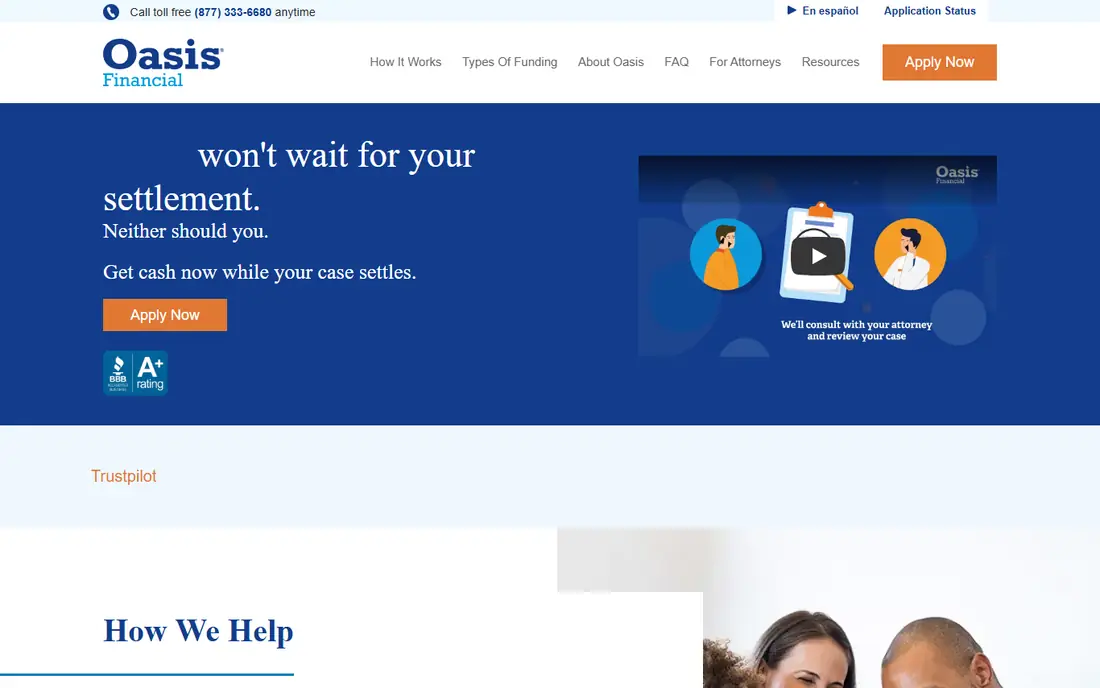
Oasis Financial, founded by attorneys, is one of the best-known national pre-settlement funders, focused mainly on personal injury cases such as auto accidents, premises liability, and workers compensation in selected states. Applicants must have attorney representation, and funding decisions rest on case merits rather than credit score. The company states that it charges no application fee, and approved applicants can receive advances that vary by case value.
The main drawback is transparency before approval. Full rate and fee details are generally given only after a case is approved, which makes it hard to compare Oasis with rivals on price alone. Availability also varies by state, and workers compensation funding is limited to certain states. Treat Oasis as a strong first quote, then compare its written repayment terms with at least two other funders before deciding.
- Long-running national funder
- No application fee stated
- Advances for many personal injury case types
- Full rates disclosed only after approval
- Not available in every state
- Requires attorney representation
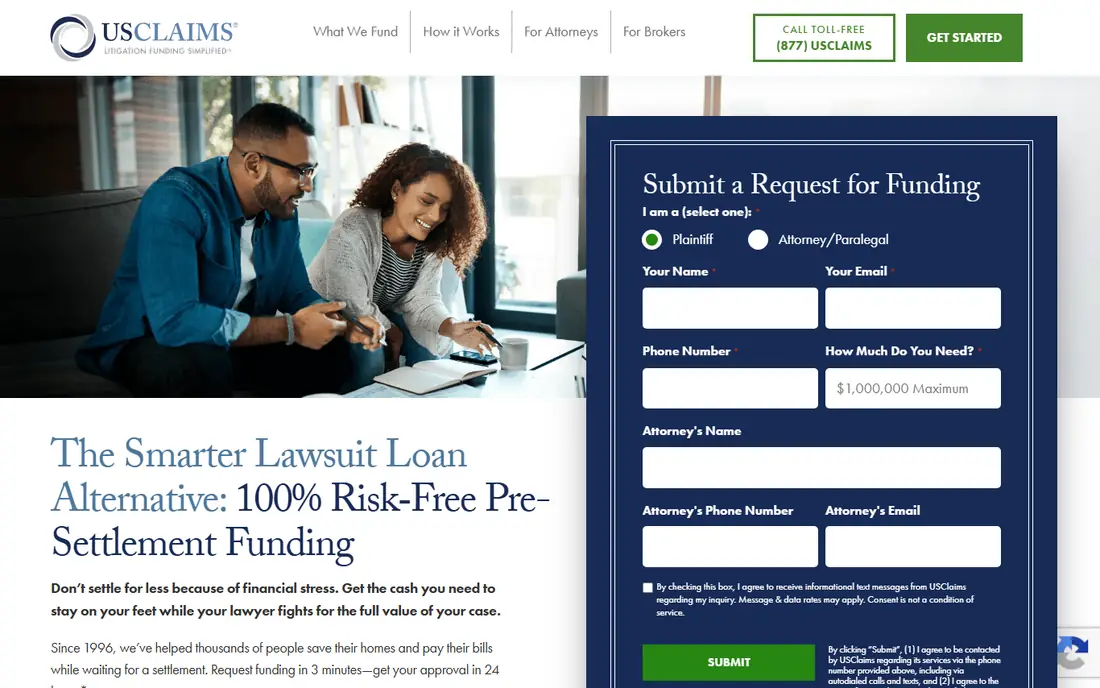
USClaims is a long-running pre-settlement funding firm focused on plaintiffs in personal injury cases who need financial support while a case is pending. Its funding is non-recourse, meaning repayment comes from settlement proceeds and you generally owe nothing if the case does not succeed. The application process runs through your attorney, who provides case details and agrees to handle repayment from proceeds.
As with most funders, the exact cost depends on your case and is confirmed after review, so a headline claim about speed or size tells you little about total cost. Ask USClaims for a written repayment schedule showing what you would owe if the case settles in six months, one year, and two years, and compare that schedule with other quotes. An established name is a good starting point, but the written terms are what matter.
- Long-established pre-settlement funder
- Non-recourse funding
- Personal injury focus with attorney process
- Rates and fees vary by case and are confirmed after review
- Requires attorney cooperation
Peachtree Financial Solutions
Who it suits: Settlement and annuity help
Peachtree Financial Solutions is widely known for structured settlements and annuities, and it also serves plaintiffs seeking pre-settlement funding. Its broader settlement experience can help if your needs go beyond a single advance, such as selling future payments later or understanding how an advance interacts with a structured settlement. The company describes a representative-led service model, with one contact guiding a client through the process.
One point needs care. Peachtree's own materials note that it connects some plaintiffs with other companies that may fund their claims, rather than funding every claim directly. Ask early whether Peachtree itself will fund your case or refer it, and get the funding terms from the actual funder in writing. That clarity matters, since the company whose name is on the agreement is the company whose terms bind you.
- Broad settlement funding experience
- Structured settlement and annuity services
- Assigned representative model
- Company notes it connects some plaintiffs with other funders rather than funding directly in all cases
- Terms vary by case
Tribeca Lawsuit Loans offers pre-settlement funding to plaintiffs waiting for personal injury case proceeds, with a non-recourse structure that limits repayment to settlement proceeds when a case succeeds. Its application process follows the usual pattern: you apply, Tribeca reviews the case with your attorney, and an offer follows if the case qualifies. That attorney step is essential, since the funder needs case documents and a repayment arrangement from proceeds.
The usual cautions apply. Rates, fees, and total repayment depend on the case and are confirmed after review, so do not judge Tribeca on speed alone. Ask for the full fee list, including any processing or delivery fees, and for a repayment cap if one is offered. Compare the written schedule with other national funders, and let your attorney check for compounding charges that grow faster than expected over a long case.
- National lawsuit funding coverage
- Non-recourse structure
- Personal injury case focus
- Rates and fees confirmed after case review
- Availability varies by state and case type
Uplift Legal Funding is a national legal funder that also publishes guidance on comparing pre-settlement offers, including the questions plaintiffs should ask each funder. That educational stance is useful in a market where rates are rarely published upfront, since it gives you a checklist to use with every company, including Uplift itself. Its funding is non-recourse, with repayment from settlement proceeds when a case succeeds.
Uplift still prices by case, so its guidance does not replace a written quote for your own situation. Ask for the rate structure, whether it is simple or compounding, any fees beyond the rate, and the total repayment at several settlement dates. Use its comparison questions with all funders, not just Uplift, and let your attorney review the final agreement before you sign.
- National funder with published comparison guidance
- Non-recourse funding
- Encourages written term comparison
- Rates vary by case
- Funding amounts depend on case value and state rules
High Rise Financial is a national funder serving personal injury plaintiffs, with a process built around quick case review and funding after approval. Its non-recourse structure means repayment comes from settlement proceeds, and you generally owe nothing if the case does not succeed. For plaintiffs facing urgent bills, a fast review is a real benefit, provided the terms are fair.
Speed is not a price, though. A fast offer with high compounding rates can cost more over a long case than a slower offer with simpler terms, so ask High Rise for the full repayment schedule in writing and compare it with slower rivals. Check for fees, caps, and whether additional advances are available if the case runs longer than expected, since a second advance changes the total cost picture.
- National personal injury funding
- Fast review process described
- Non-recourse structure
- Rates and fees vary by case
- Speed claims do not show total cost
Prime Case Funding is a New York-based funder that describes itself as offering lower rates than many rivals, with simple or compound interest depending on the case. It offers both pre-settlement and post-settlement funding, which suits plaintiffs who need money at different stages of a case. Funding after approval is described as fast, often within a day in its materials.
The rate you get depends on your case, so a low-rate description is not a quote. Ask Prime Case Funding whether your rate is simple or compounding, what fees apply, and what you would owe at several settlement dates, then compare those numbers with other funders. A simple rate over a long case can beat a lower-looking compound rate, so the repayment schedule matters more than the advertised rate label.
- Describes low-rate options with simple and compound structures by case
- Post-settlement funding also offered
- Fast funding after approval described
- Rate depends on case and structure
- Availability varies by state
Bridgeway Legal Funding is a national funder focused on personal injury plaintiffs, with a process built around attorney cooperation. Your attorney provides case information, reviews the funding agreement, and handles repayment from settlement proceeds, which is the standard pattern for reputable funders. Non-recourse terms mean you generally owe nothing if the case does not succeed.
As with every funder here, the written terms decide the value. Ask Bridgeway for the rate, fee list, repayment cap if any, and total repayment at different settlement timelines, and compare those figures with at least two other quotes. Your attorney's comfort with the agreement is also a signal: if your attorney raises concerns about fees or compounding, take that seriously before signing.
- National funder with attorney cooperation process
- Non-recourse funding
- Personal injury focus
- Rates and fees confirmed after review
- Terms vary by case and state
How we picked these
We compared official service pages, case types, funding structures, and application processes for national pre-settlement funders, and we checked industry comparison pages for corroboration. We favored established funders with a non-recourse structure, an attorney cooperation process, and a clear United States presence, and we left out brokers with no clear funding product and companies with no current official site. Rates are rarely published upfront in this market, so we did not rank on price and instead stress written comparison, which is the only fair way to compare these companies.
Questions to ask every funder before you sign
Ask for the rate in writing, and whether it is simple or compounding. Ask for every fee, including application, processing, underwriting, and delivery fees, and whether the total repayment is capped. Ask what you would owe if your case settles in six months, one year, and two years, since timelines change everything. Ask whether you can take a second advance later, and what that would cost.
Then ask about your attorney's role. Your attorney must usually sign off and agree to repay the funder from proceeds, so confirm they are comfortable with the terms and the funder. Ask which states the funder serves and whether your case type qualifies, since availability varies. Finally, ask yourself whether you need the full advance or a smaller one, since borrowing less against an uncertain settlement reduces the amount that comes out of your recovery.
When funding may not be the right choice
Pre-settlement funding is expensive compared with most borrowing, and it reduces what you keep from a settlement. If you can cover urgent bills another way, such as a payment plan with a creditor, help from family, or a short delay negotiated through your attorney, that route usually costs less. Funding makes most sense when bills are urgent, the case has clear merit and value, and your attorney agrees the terms are fair. If any of those conditions fail, wait and explore other options first.
Frequently asked questions
What is pre-settlement funding?
Pre-settlement funding is money advanced to a plaintiff while a lawsuit is pending, repaid from settlement proceeds if the case succeeds. With non-recourse funding, you generally owe nothing if you lose. It is not a traditional loan in most states, since repayment depends on the case outcome, but it can still be costly, so read the agreement carefully and have your attorney review it.
Do I need a lawyer to get pre-settlement funding?
Yes, in practice. Funders require attorney representation, since they review case merits with your attorney and arrange repayment from settlement proceeds through your attorney. If you do not have a lawyer, a funder will usually decline, and you should speak with a personal injury attorney about your case first. Your attorney can also help you compare funding offers.
How much can I borrow against my case?
It depends on your case value, its stage, and the funder's assessment, and amounts vary widely between companies. Some funders describe advances from a few hundred dollars to six figures or more for strong cases, but your offer depends on your own case. Borrow only what you need for urgent expenses, since every dollar advanced plus fees and rates comes out of your eventual settlement.
How long does pre-settlement funding take?
Many funders describe approval and funding within a day or two after your attorney provides case documents, though complex cases take longer. The attorney cooperation step often sets the pace, since the funder needs case details and a repayment arrangement. Ask your funder for a realistic timeline for your case, and do not rely on a same-day promise for urgent bills until approval is confirmed.
What happens if I lose my case?
With non-recourse funding, you generally owe nothing back if you lose, which is the main protection these agreements offer. Read the agreement to confirm it is non-recourse, since terms vary, and check for any exceptions or fees that might still apply. Your attorney should confirm the non-recourse language before you sign, since that protection is the reason many plaintiffs choose funding over other borrowing.
Is pre-settlement funding available in every state?
No. Availability varies by state and case type, and some funders exclude certain states or limit workers compensation funding to selected states. Check with each funder whether your state and case type qualify before you spend time on an application. State rules on legal funding also differ, so your attorney's advice on your state's rules matters.
Sources we checked (8)

Online Jobs is an independent blog about careers, online work, learning new skills and the tools that help people earn. More about us.
Keep reading
All posts
Top AI Financial Software
Searching for top AI financial software? We compared 9 AI finance tools for AP, spend, close, forecasting and bookkeeping to help teams choose wisely.
Quicken Alternatives
Compare the best quicken alternatives for Mac, Windows, and small business owners, from Monarch Money and YNAB to Copilot, Tiller, and Banktivity in 2026.

QuickBooks Online Alternatives
Looking for quickbooks online alternatives? We compared 8 accounting tools on invoicing, bank feeds, payroll, pricing and fit for small businesses today.