Top AI Financial Software in 2026: 9 Tools Compared

How we put this together: we compare official feature and pricing pages, app store listings, privacy policies and public user reviews. Prices change, so check the provider's site before you pay.
Key takeaways
- This is not financial advice. AI finance tools help with data entry, coding and reporting, but humans must approve payments and close decisions.
- Ramp is our pick for most startups because spend, cards, expenses and AP automation start on a free tier.
- BILL suits small and mid sized teams that want published pricing and mature AP and AR workflows.
- Vic.ai and Datarails suit larger teams with high invoice volume or complex forecasting in Excel.
- Start with one pain point, such as AP coding or month end close, and pilot one tool before buying a full stack.
Quick comparison
| Name | Who it suits | Starting price | Free option | |
|---|---|---|---|---|
 Ramp | Startups wanting spend plus AP | Free | Yes | Visit |
 BILL | SMB AP and AR automation | $49 per month per user | Free trial | Visit |
 Vic.ai | High volume autonomous AP | See website | No | Visit |
 Datarails | FP&A teams staying in Excel | See website | No | Visit |
 FloQast | Month end close management | See website | No | Visit |
 Numeric | Faster close with AI flux notes | See website | No | Visit |
 Brex | Startup spend with policy controls | Free | Yes | Visit |
 Zeni | AI bookkeeping plus human team | See website | No | Visit |
 Puzzle | Early startups needing AI accounting | Free | Yes | Visit |
The best top AI financial software
AI financial software covers a wide range, from invoice coding to forecasting, close management and bookkeeping. We compared official feature pages, pricing pages and public reviews, and we kept only tools that still serve finance teams in 2026 with clear AI features, not only a chatbot added to an old product. Our pick for most startups is Ramp, with BILL for AP and AR, and Vic.ai and Datarails for larger, specialised needs. This is not financial advice, and AI output should always be reviewed before it posts or pays.
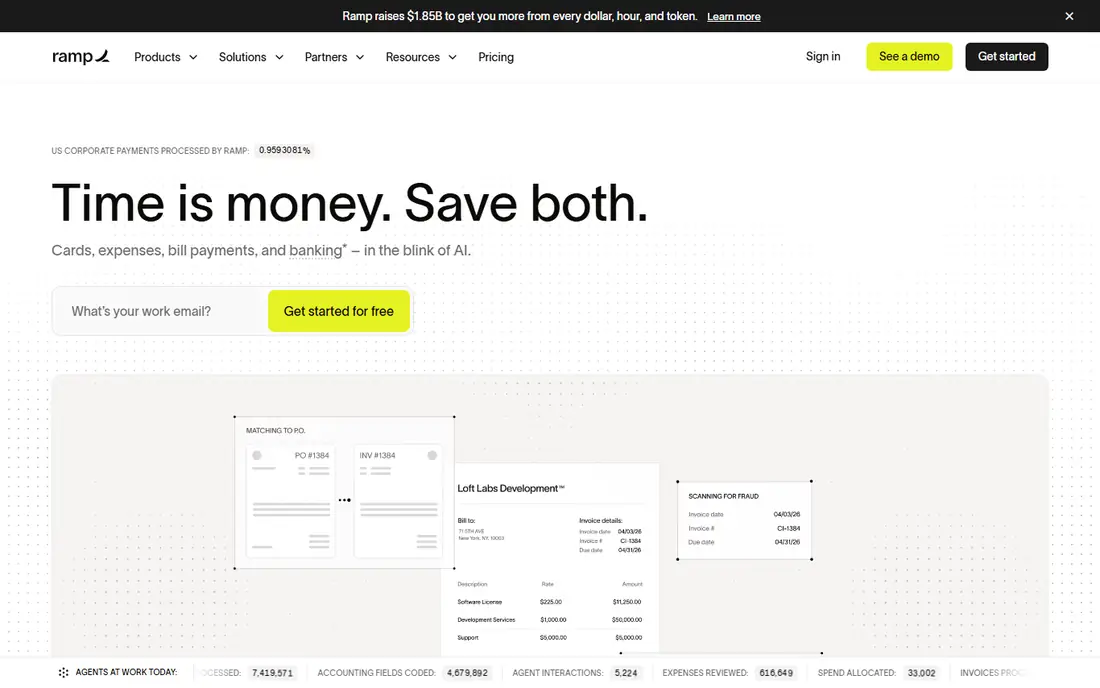
Ramp combines corporate cards, expense management and bill pay in one system, with AI that codes transactions and flags policy issues. That combination helps startups control spend at the point of purchase, rather than chasing receipts after the fact. The free tier makes it easy to trial real workflows, and Plus, listed at $15 per user per month on public pricing pages, adds deeper controls and integrations.
Ramp is not a replacement for a full accounting system, and teams still need QuickBooks, Xero or NetSuite as the ledger. The free model is funded in part by card interchange, so teams that rarely use cards get less value. For startups that want spend control and AP automation without an enterprise sales cycle, Ramp is the most accessible starting point.
- Free tier covers cards, expenses and AP basics
- AI coding for transactions
- Plus adds advanced controls at a published price
- Free value depends on card spend
- Plus platform fees scale with team size
- Not a full ERP for complex accounting
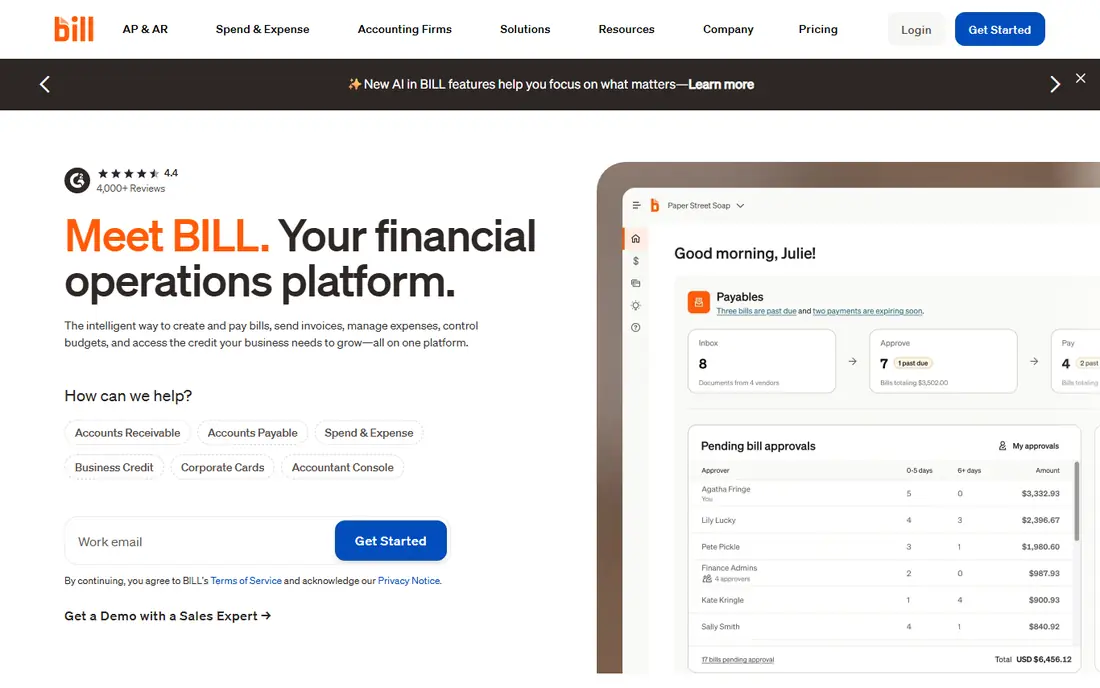
BILL is the established standard for small and mid sized AP and AR automation. Invoices are captured, coded with AI help, routed for approval and paid, while receivables cover invoicing and collections in the same platform. Approvals, roles and audit trails are mature, which matters for controllers who need to show who approved what and when. Sync with QuickBooks and Xero keeps the ledger clean without manual re entry.
Per user pricing means costs rise with approvers, not only with invoice volume, so model your user count before budgeting. AI extracted fields can also be wrong on complex or foreign language invoices, so review remains essential. BILL fits teams that want a proven, published price AP and AR system with strong accounting integrations.
- Published pricing for AP and AR tiers
- Mature approvals and audit trails
- Strong QuickBooks and Xero sync
- Per user pricing adds up for large teams
- AI coding still needs review for complex invoices
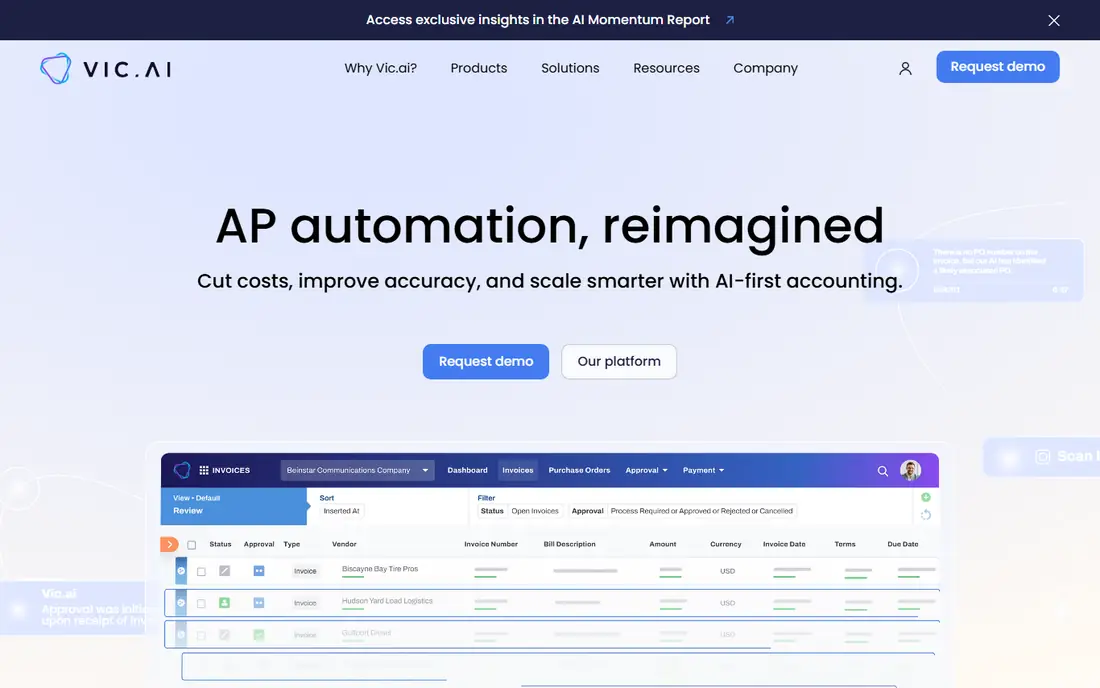
Vic.ai is built for AP teams that process thousands of invoices a month and cannot keep up with manual coding. Its AI learns from historical coding, vendor patterns and approvals, then codes new invoices with high straight through rates for routine bills. That automation frees AP staff for exceptions, vendor issues and analysis, rather than data entry. Integrations with major ERPs help it sit inside existing finance systems.
It is not a small business tool. Pricing is by quote, onboarding needs historical data and approval rules, and low volume teams will not see enough benefit to justify the project. Vic.ai fits mid market and enterprise AP teams where volume, not price alone, is the main pain point, and where a human still reviews exceptions and payments.
- Autonomous invoice coding at high volume
- Learns from past coding and approvals
- Strong ERP integrations for mid market and enterprise
- Quote only pricing
- Implementation and training take time
- Overkill for low invoice volumes
Datarails suits finance teams that refuse to leave Excel, and for good reason. Many FP&A teams live in spreadsheets, and Datarails adds consolidation, version control, dashboards and AI assisted forecasting without forcing a new modelling language. Reports update from live data, which cuts the manual copy and paste that causes close errors. Controllers and FP&A leads get a single source for budgets, forecasts and board reporting.
Pricing is by quote and typically sits in the mid five figure annual range in public comparisons, so it is an enterprise FP&A purchase, not a startup tool. Teams that do not use Excel heavily will get less value. Choose Datarails when Excel is already your planning home and you need control, consolidation and AI help on top of it.
- FP&A workflows inside Excel
- Automated consolidation and reporting
- AI help for forecasts and variance analysis
- Quote only pricing
- Best for teams already committed to Excel
- Not a bookkeeping tool for startups
FloQast organises the month end close, which is often a mess of spreadsheets, emails and status meetings. Tasks, reconciliations, checklists and approvals live in one workflow, with AI assistance for drafting flux explanations and spotting missing items. Managers see close progress in real time, instead of asking for updates on a call. That visibility shortens close cycles and reduces last minute surprises.
It works best when a close process already exists to standardise. Teams with chaotic, undocumented closes should fix roles and checklists first, or FloQast will only digitise the chaos. Pricing is by quote. FloQast fits growth stage and mid market teams that want a faster, more controlled close with an audit trail.
- Close checklists, reconciliations and task tracking in one place
- AI help for flux and variance notes
- Strong ERP integrations
- Quote only pricing
- Value depends on a standardised close process
- Not an AP or bookkeeping tool on its own
Numeric focuses on the close itself, with task management, reconciliations and AI drafted flux and variance explanations. For controllers, the time saved is not only in ticking tasks, but in writing the first draft of why numbers moved. That draft still needs human review, but it removes a blank page problem that slows many closes. Growth stage teams praise its speed compared with heavier enterprise close tools.
Data quality matters. If ERP data is messy or accounts are poorly structured, AI narratives will reflect that mess. Pricing details should be confirmed on the vendor site, as public listings vary by tier. Numeric fits teams that want a modern close tool without a full enterprise FP&A project, and that are ready to review AI drafts carefully.
- Close task coordination and AI drafted variance narratives
- Strong for growth stage teams
- Integrations with common ERPs
- Pricing is not fully published for all tiers
- Less broad than a full FP&A platform
- Needs clean ERP data to work well
Brex gives startups cards, expenses and spend controls with AI policy checks before money is spent, not after. That point of spend control helps finance teams enforce budgets, block out of policy purchases and reduce receipt chasing. Multi currency support suits startups with global contractors or travel. A free tier makes it easy to start, with paid plans for larger teams and advanced controls.
Like Ramp, Brex value depends on card use, and it is not a full ledger or AP system on its own. Teams still need an accounting system and, for high invoice volume, a dedicated AP tool. Brex fits venture backed startups that want policy enforcement early, global spend support, and a clean expense workflow without an enterprise purchase.
- Free startup tier for cards and expenses
- AI policy enforcement at point of spend
- Multi currency support for global teams
- Advanced features sit on paid plans
- Value is strongest for venture backed startups with card spend
Zeni is a managed finance service, not only software. AI handles bookkeeping, categorisation and reporting, while a human team reviews work, answers questions and supports close and tax preparation workflows. That mix suits founders who need accurate books and clear dashboards, but are not ready to hire a full time controller. Pricing is monthly and listed by tier on the vendor site, with Starter plans in public listings from $549 per month billed annually.
Software only buyers will find Zeni expensive compared with Ramp or Puzzle, because they are paying for people as well as software. Zeni fits venture backed startups that want books, reporting and human support in one service, and that prefer to outsource finance operations rather than build a finance team early.
- AI bookkeeping combined with a human finance team
- Dashboards and reporting for founders
- Useful for venture backed startups without a full finance hire
- Monthly cost is higher than software only tools
- Best for startups that want a managed service, not only software
Puzzle is built as an AI native accounting system for early stage startups. Transactions are categorised with AI help, reporting updates in real time, and founders get a clearer view of cash, burn and runway without waiting for month end. A free tier lets very early startups start bookkeeping without a paid subscription, with paid plans for larger teams and more features.
Complex companies with multi entity structures, advanced revenue recognition or heavy audit needs may outgrow Puzzle sooner than a full ERP. Check integrations with your bank, payroll and billing tools before committing. Puzzle fits early startups that want modern, AI assisted accounting from day one, with a path to paid plans as they grow.
- AI native accounting for early startups
- Free tier to start
- Modern ledger design with real time reporting
- Less mature for complex multi entity or enterprise needs
- Paid plans and features should be checked for your accounting stack
How we picked these
We compared official feature pages, pricing pages and public reviews, focusing on the finance workflow each tool actually automates, ERP integrations, audit trails, approval controls and price transparency. We kept only tools that still serve finance teams in 2026 with clear AI features. We did not claim hands on testing that did not happen, and we used See website where pricing is by quote or varies by volume.
Security and control mattered as much as AI claims. A tool that drafts journal entries or approves payments without human checkpoints is a risk, not a benefit. We favoured tools with role based approvals, audit trails and configurable thresholds for human review.
What to check before you buy
Keep a human in the loop for money movement
AI should draft, match and flag, while humans approve payments, new vendors and policy exceptions above a set threshold. Ask for segregation of duties, audit logs and threshold controls in writing.
Pilot on one workflow, not the whole stack
Start with AP coding, spend control or close tasks, measure time saved and error rates at 90 days, then expand. A full stack purchase before a pilot often buys features no one uses.
Check ERP and bank integrations early
A finance tool that does not sync cleanly with your ledger, bank and payroll creates manual work that cancels AI savings. Test sync with real data during a trial, not only in a demo.
Frequently asked questions
What is the best AI tool for finance teams?
It depends on the workflow. Ramp leads for startup spend and AP, BILL for SMB AP and AR, Vic.ai for high volume AP, Datarails for FP&A in Excel, and FloQast or Numeric for close management. Start with your biggest pain point, not with a general AI claim.
Are AI finance tools safe?
They can be safe when used with controls, including role based approvals, audit trails, data encryption and human review for payments. Do not give an AI agent unsupervised write access to your ledger or bank, and ask vendors for SOC reports before a purchase.
How much do AI finance tools cost?
Costs range from free tiers at Ramp, Brex and Puzzle, to $49 per user per month at BILL, to quote based enterprise pricing at Vic.ai, Datarails and FloQast. Model seats, invoice volume and implementation costs, not only the headline monthly price.
Can AI replace accountants?
No, not in 2026. AI replaces repetitive tasks like data entry, coding and draft reporting, while accountants still apply judgment, review exceptions, handle audits and advise on decisions. Teams that use AI well spend more time on analysis and less on manual entry.
What is the best AI tool for financial services?
For financial services firms, the shortlist depends on regulation, audit needs and ERP stack. Vic.ai, Datarails, FloQast and BILL cover AP, FP&A and close workflows, while Brex and Ramp cover spend. Regulated firms should add security, audit and data residency checks to any shortlist.
Is this financial advice?
No. This article compares software features and pricing for information only. It is not financial, tax or investment advice, and you should review any AI output and any payment decision with a qualified finance professional.
Sources we checked (9)

Online Jobs is an independent blog about careers, online work, learning new skills and the tools that help people earn. More about us.
Keep reading
All posts
Who Is the Best Company to Get Travel Insurance
Compare the best travel insurance companies, including World Nomads, Allianz Travel, SafetyWing and AXA, with coverage types, limits and who each suits.
Quicken Alternatives
Compare the best quicken alternatives for Mac, Windows, and small business owners, from Monarch Money and YNAB to Copilot, Tiller, and Banktivity in 2026.

GoFundMe Alternatives
Looking for GoFundMe alternatives? We compared 8 fundraising platforms on fees, campaign types, donor tools and who each platform suits best in 2026 today.