Best Multi Vendor Marketplace Platform in 2026: 9 Platforms Compared


Service and rental marketplaces · Starting price: $199 per month
How we put this together: we compare official feature and pricing pages, app store listings, privacy policies and public user reviews. Prices change, so check the provider's site before you pay.
Key takeaways
- Sharetribe is the easiest way to launch a service, rental or booking marketplace without code, with Live plans from $199 per month on annual billing.
- CS-Cart Multi-Vendor suits product marketplaces that want ownership and control, with Cloud plans from $75 per month on annual billing.
- Arcadier, Mirakl and Marketplacer suit larger or B2B marketplaces, but pricing is custom, so expect a sales process and implementation work.
- Commission, payout and payment processing rules matter as much as the storefront, so test vendor onboarding and payouts before launch.
Quick comparison
| Name | Who it suits | Starting price | Free option | |
|---|---|---|---|---|
| Sharetribe | Service and rental marketplaces | $199 per month | Free trial (14 days) | Visit |
 CS-Cart Multi-Vendor | Product marketplaces with control | $75 per month | Free trial | Visit |
 Arcadier | B2B and custom marketplaces | See website | No | Visit |
 Webkul | Product marketplaces on Magento and WooCommerce | See website | No | Visit |
 Mirakl | Enterprise marketplace platforms | See website | No | Visit |
 Marketplacer | Retail and enterprise marketplaces | See website | No | Visit |
 Dokan | WooCommerce multi-vendor stores | See website | Yes | Visit |
 WCFM Marketplace | WordPress multi-vendor stores | See website | Yes | Visit |
 Spryker | Composable enterprise commerce | See website | No | Visit |
The best multi vendor marketplace platform, compared
A multi-vendor marketplace is not just a store with many sellers. It needs vendor onboarding, product approval, commission rules, split payouts, shipping logic and customer support across sellers. The platforms below handle those jobs in different ways, from no-code SaaS to self-hosted software and enterprise systems.

Sharetribe is designed for marketplaces where the product is a service, a rental or a booking, rather than a shipped item in a warehouse. Availability calendars, booking flows, messaging between customers and vendors, and Stripe-based payments are built in, so a founder can launch a tutor, cleaner, equipment rental or venue marketplace without building those flows from scratch. The Build plan starts at $39 per month for building, while Live plans start at $199 per month on annual billing. The limit is catalogue depth. Very large product marketplaces with complex variants, warehouses and fulfilment rules may outgrow Sharetribe, and deep customisation needs developer work. For service and rental ideas, and for founders who want to validate demand quickly, Sharetribe is the most practical starting point on this list.
- No-code setup for service, rental and booking marketplaces
- Availability calendars and messaging built in
- Stripe payment handling
- Less suited to very large product catalogues
- Custom work needs developer help on higher plans
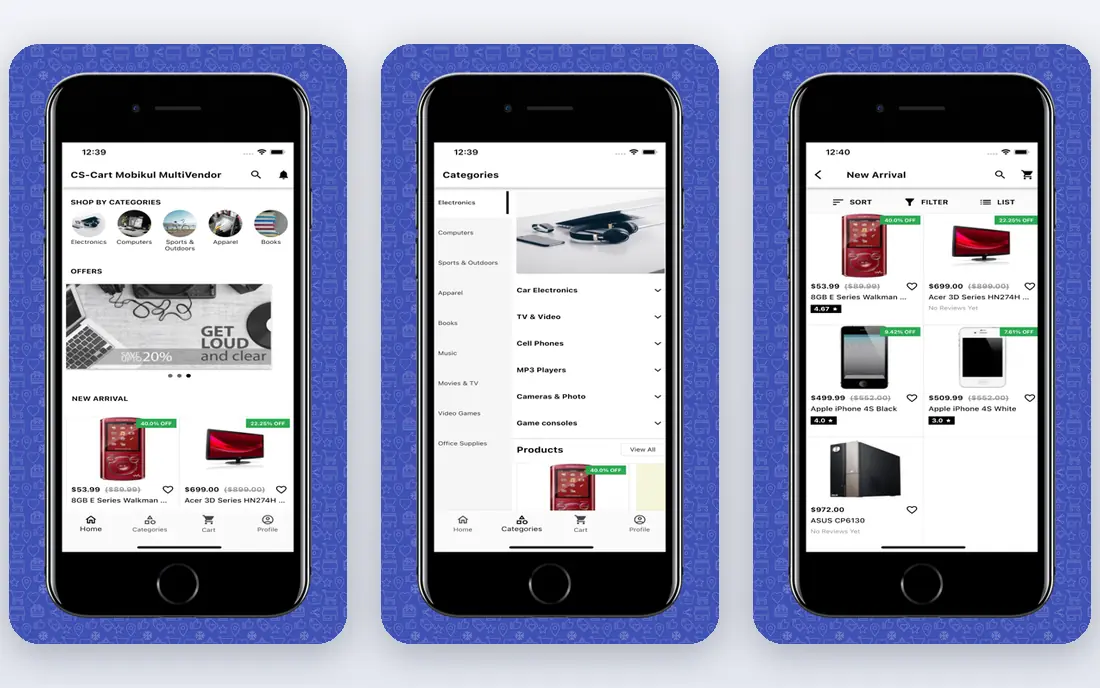
CS-Cart Multi-Vendor is a long-running, purpose-built marketplace platform for product marketplaces. Vendors get their own panels to manage products, orders and payouts, admins set commissions by vendor or category, and the platform supports multiple storefronts, promotions, shipping and payment options. Cloud Basic plans start at $75 per month on annual billing, with higher plans for more products and vendors. The trade-off is ownership versus convenience. Self-hosted editions give you source code and control, but you own hosting, updates and security. Cloud plans remove much of that work, but still need setup and design effort. For product marketplaces that expect high volume and want control over costs and data, CS-Cart is a strong and proven choice.
- Purpose-built marketplace features
- Vendor panels, commissions and payouts
- Self-hosted and cloud options
- Self-hosting needs technical maintenance
- Design feels less modern than newer SaaS tools out of the box

Arcadier is a cloud marketplace platform that covers product, service and B2B models, with templates that can be shaped for retail, wholesale and service marketplaces. Request-for-quote tools make it a good fit for B2B marketplaces where buyers ask for prices rather than buying at a fixed list price. API-first design and webhooks help teams connect Arcadier to existing systems. Pricing is custom, based on deployment, growth and complexity, and the current pricing page states that there are no feature gates in the same way as some rivals. That flexibility helps larger projects, but smaller founders may find the sales process slow. For B2B and integrated marketplace projects, Arcadier is worth a detailed evaluation.
- Flexible marketplace templates for products, services and B2B
- Request-for-quote tools
- API-first integrations
- No public starting price
- Enterprise features need a sales process
Webkul offers multi-vendor marketplace extensions for Magento and WooCommerce, aimed at product marketplaces that already use one of those platforms. Vendors get dashboards to manage products and orders, admins set commissions and approve sellers, and the wider Webkul extension range can add features such as bookings, subscriptions and mobile apps where needed. That platform fit is the main reason to choose Webkul over a standalone SaaS marketplace. The main drawback is that Webkul is an extension provider rather than a single hosted marketplace product, so pricing, support and setup vary by extension and platform version. Custom design and feature work may also need developer help. For a product marketplace already built on Magento or WooCommerce, with technical support available, Webkul is a credible alternative to CS-Cart.
- Multi-vendor extensions for Magento and WooCommerce
- Vendor dashboards and commission tools
- Wide extension range
- Pricing and feature details need vendor confirmation
- Setup needs technical help for larger stores
Mirakl is an enterprise marketplace platform used by large retailers and brands to add third-party sellers to an existing store or to build a large marketplace from scratch. It handles vendor onboarding, catalogue management, order splitting, commissions and payouts at scale, with tools for quality control and seller performance. That depth suits companies with complex catalogues and high order volumes. The cost and implementation effort put Mirakl out of reach for most startups. Pricing is custom, and projects usually involve integration work with existing ecommerce, ERP and payment systems. For an established retailer that wants to become a marketplace, Mirakl is one of the leading enterprise options. For a new founder, a SaaS platform like Sharetribe or CS-Cart Cloud will launch faster and cheaper.
- Enterprise marketplace engine used by large retailers
- Vendor onboarding and payout tools
- Strong catalogue and order handling
- Enterprise pricing and implementation
- Not suited to small startups
Marketplacer helps retailers and brands run marketplaces by connecting third-party sellers, product data and orders to an existing store. Vendor onboarding, catalogue tools and order management are designed for retail use, where product data quality and fulfilment matter as much as the storefront. Integrations with major ecommerce platforms help larger retailers add a marketplace without rebuilding their store. Pricing is custom and implementation needs real planning, especially for catalogue mapping, shipping rules and payout flows. Smaller teams without an existing store or technical resources may find Marketplacer heavy. For retailers that already sell online and want to expand range through third-party sellers, Marketplacer is a strong enterprise candidate.
- Marketplace engine for retailers
- Vendor onboarding and product data tools
- Integrations with major ecommerce platforms
- Custom pricing
- Implementation needs planning and resources
Dokan is a WordPress plugin that turns a WooCommerce store into a multi-vendor marketplace. Vendors get dashboards to manage products, orders, coupons and withdrawals, while admins set commissions, approve vendors and control store settings. A free core version lets small marketplaces start, with paid plans for advanced features such as vendor subscriptions and auction or booking add-ons. The trade-off is WordPress maintenance. Hosting, updates, security and plugin compatibility are your responsibility, and performance depends on good hosting as vendor and product counts grow. For teams already comfortable with WordPress and WooCommerce, Dokan is the fastest and most affordable way to launch a product marketplace. For teams that want fully managed hosting, a SaaS platform may be easier.
- Turns WooCommerce into a multi-vendor marketplace
- Vendor dashboards and commission settings
- Large WordPress ecosystem
- Needs WordPress and WooCommerce care
- Performance depends on hosting and plugins
WCFM Marketplace, also known as WCFM, is another WordPress plugin for turning WooCommerce into a multi-vendor marketplace. It offers vendor panels, product and order management, shipping zones, commission settings and payout tools, with a free core version and paid add-ons for bookings, subscriptions, memberships and other features. That modular approach lets a marketplace grow feature by feature. Complexity is the main risk. As add-ons accumulate, setup, updates and support can become harder to manage, especially for teams without WordPress experience. For a WordPress team that wants a flexible, low-cost start and is happy to manage plugins, WCFM is a capable alternative to Dokan. Compare both plugins against your vendor and payout needs before choosing.
- Free core plugin for WooCommerce marketplaces
- Vendor panels, shipping and payout tools
- Many add-ons for bookings and subscriptions
- Add-ons and setup can become complex
- Support quality varies by add-on
Spryker is a composable commerce platform that can support marketplace models for large B2B and B2C businesses, with flexible architecture for complex catalogues, pricing, fulfilment and integrations. It suits enterprises that need to build a tailored marketplace inside a wider commerce system, rather than launching a simple store quickly. Developer teams can compose services and customise workflows in depth. That flexibility comes with cost and effort. Spryker projects need developer resources, architecture planning and enterprise budgets, and they are not a no-code launch. For a large enterprise with complex marketplace needs, Spryker offers control that SaaS tools cannot match. For a startup marketplace, Sharetribe, CS-Cart or Dokan will be faster and far cheaper.
- Composable commerce platform with marketplace capabilities
- Flexible architecture for complex B2B and B2C models
- Strong for large enterprises
- Enterprise pricing and developer resources needed
- Not a quick no-code launch
How we picked these
We compared official feature and pricing pages, vendor onboarding tools, payout and commission features, and public reviews for multi-vendor platforms that are still offered in October 2026. We favoured platforms with real vendor panels, commission controls and payout handling, rather than single-seller stores with a vendor plugin claim but no marketplace workflow. Where pricing is custom or has changed over time, we wrote See website instead of publishing an outdated figure.
Choosing the best multi vendor marketplace software
Start with your marketplace model. Service, rental and booking marketplaces should shortlist Sharetribe and Arcadier. Product marketplaces should shortlist CS-Cart, Webkul, Dokan and WCFM. Large retail and B2B marketplaces should shortlist Mirakl, Marketplacer, Arcadier and Spryker, with a proper implementation plan.
Test vendor onboarding and payouts first
Before you commit, test the full vendor journey: sign-up, approval, product upload, order, commission calculation and payout. Check how refunds, split payments and shipping are handled, and who supports the customer when a vendor fails to deliver. A marketplace that looks good as a storefront can fail on payouts, which is where vendor trust is won or lost.
Plan for trust, quality and support
Marketplaces need review systems, vendor performance rules, dispute handling and clear policies on returns and refunds. Decide who owns customer support, how vendor quality is measured, and what happens when a vendor goes inactive. Those rules matter more for long-term growth than a long feature list, because trust is what keeps buyers and sellers returning.
Frequently asked questions
What is the best multi vendor marketplace platform for beginners?
Sharetribe is the best starting point for most beginners, especially for service, rental and booking marketplaces, because it offers no-code setup and built-in calendars, messaging and payments. For product marketplaces, CS-Cart Cloud and Dokan offer easier starts than enterprise platforms. Begin with the smallest marketplace that proves demand, then move to a larger platform only when vendor and order volume demand it.
What is the best marketplace software for product marketplaces?
CS-Cart Multi-Vendor and Webkul are strong choices for product marketplaces, with vendor panels, commissions and order tools built in. Dokan and WCFM suit WordPress and WooCommerce teams, while Mirakl and Marketplacer suit large retailers. Choose based on catalogue size, fulfilment complexity and whether you want SaaS convenience or self-hosted control.
How does the best multi vendor ecommerce platform handle commissions and payouts?
Most platforms let admins set commission rates by vendor, category or product, then split payments between the marketplace and vendors, minus payment processing fees. Payout timing, minimums and refund handling vary by platform and payment provider, so test a full order, refund and payout cycle before launch. Clear commission and payout rules also help vendors trust the marketplace and stay active.
Is there a best platform for multi vendor marketplace with a free plan?
Dokan and WCFM offer free core versions for WooCommerce marketplaces, and Sharetribe and CS-Cart offer free trials rather than permanent free plans. Free cores are useful for testing, but advanced vendor features, payouts and support usually need paid plans. Budget for hosting, payment fees and at least one paid plan before you launch, even if you start on a free core.
What is the best software marketplace option for B2B marketplaces?
Arcadier is a strong B2B option, thanks to request-for-quote tools and flexible marketplace templates, while Mirakl, Marketplacer and Spryker suit larger B2B projects with complex catalogues and integrations. B2B buyers often need quotes, bulk ordering, approval workflows and account pricing, so test those flows specifically rather than assuming a retail marketplace will fit B2B needs.
Sources we checked (9)

Online Jobs is an independent blog about careers, online work, learning new skills and the tools that help people earn. More about us.
Keep reading
All posts
Best Loyalty Program Software
Looking for the best loyalty program software? We compare 10 loyalty platforms on points, tiers, referrals, pricing, and Shopify and POS fit for stores.

n8n Alternatives
n8n alternatives compared for 2026, with Zapier, Make, Activepieces, and more, covering visual builders, code steps, self-hosting, and pricing models.

eBay Alternatives
Looking for ebay alternatives? We compared 9 marketplaces for sellers on fees, buyer reach, categories and ease of listing, to help you sell with confidence.