Best Loyalty Program Software in 2026: 10 Platforms Compared

How we put this together: we compare official feature and pricing pages, app store listings, privacy policies and public user reviews. Prices change, so check the provider's site before you pay.
Key takeaways
- Smile.io is the easiest launch for small Shopify stores, while LoyaltyLion suits growing brands that need tiers and segmentation.
- Yotpo suits brands already using its reviews suite, but loyalty alone may not justify its price.
- Talon.One and Open Loyalty suit enterprises that need a rules engine or headless API, not a simple widget.
- Pricing often scales with order volume, so model peak months, not average months, before choosing.
- Points alone do not build loyalty. Rewards, tiers, and referrals must match what your customers actually value.
Quick comparison
| Name | Who it suits | Starting price | Free option | |
|---|---|---|---|---|
 Smile.io | Small Shopify launch | $15 per month | Yes | Visit |
 LoyaltyLion | Tiers and VIP logic | $199 per month | Yes | Visit |
 Yotpo | Loyalty plus reviews | $199 per month | Yes | Visit |
 Gameball | Gamified loyalty beyond Shopify | See website | Yes | Visit |
 Rivo | Shopify Plus loyalty | See website | Yes | Visit |
 Okendo | Reviews plus loyalty | $19 per month | Yes | Visit |
 Stamped | Reviews and loyalty bundle | See website | No | Visit |
 Marsello | Retail POS plus online | $60 per month | Free trial | Visit |
 Joy Loyalty | Flexible programs at scale | See website | Yes | Visit |
 Talon.One | Enterprise promotion engine | See website | No | Visit |
The best loyalty program software
Loyalty software runs points, tiers, VIP programs, and referrals, and connects them to your store, email tools, and point of sale. The platforms below differ mainly by stack: some are built for Shopify alone, some cover retail POS as well, and some are headless engines for custom builds. We compare them on that basis, plus pricing structure.
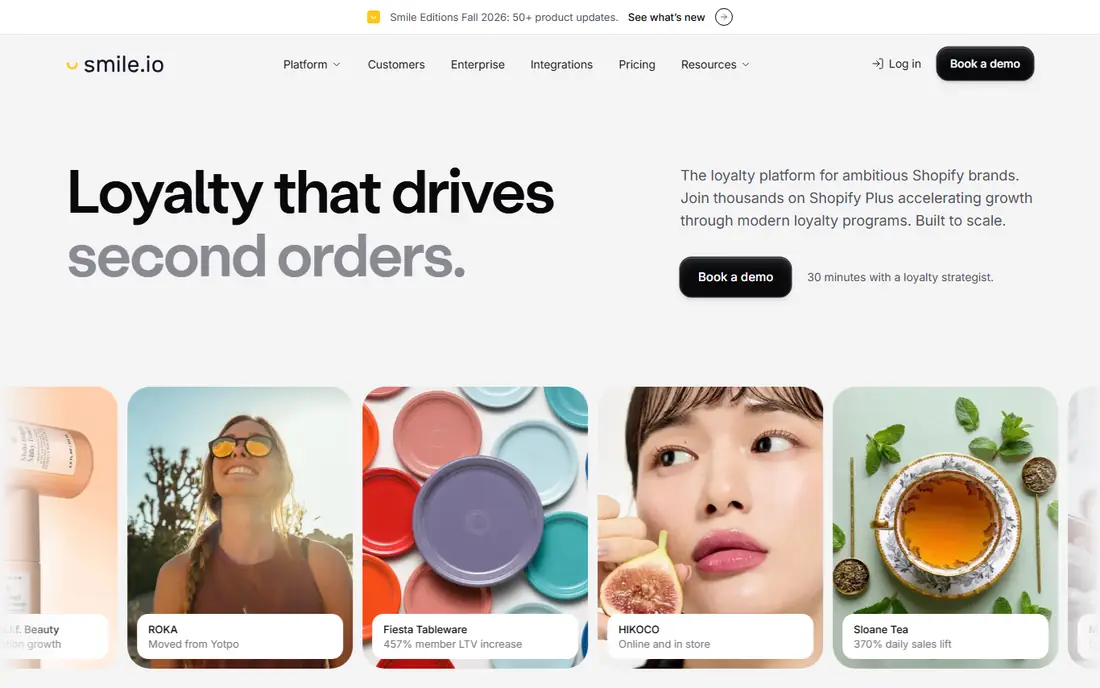
Smile.io is the simplest route to a working loyalty program on Shopify. Its free plan covers up to 200 orders a month, and its Essential plan starts at $15 per month, with higher tiers at $79 and $199 and a Plus plan at $999 per month billed annually. Points, referrals, and VIP tiers are configured in a single widget, and Klaviyo and email integrations connect rewards to campaigns.
The limits appear at scale. Costs rise with order volume, and Smile offers no native mobile wallet, push notifications, or QR in-store redemption, which matters for brands with physical stores. For a small Shopify store launching its first program, Smile is the fastest and most proven pick.
- Fast Shopify setup
- Points, referrals, and VIP tiers in one widget
- Built for Shopify badge and partner directory listing
- Cost rises steeply at volume
- No native wallet or in-store QR redemption
- Feature ceiling for advanced programs
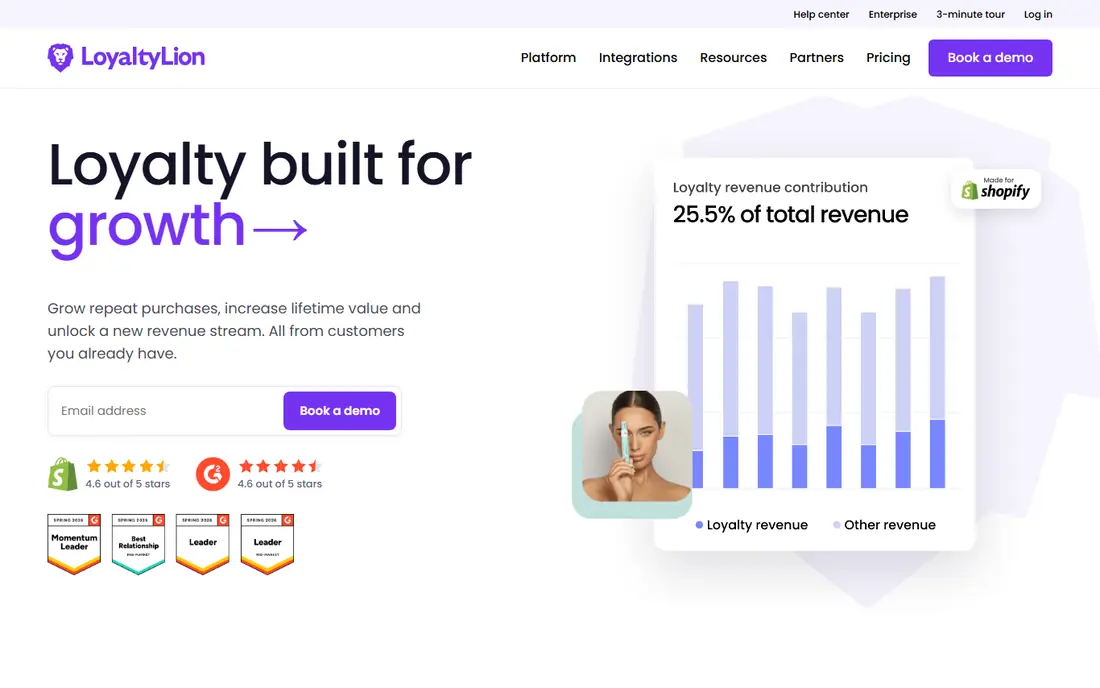
LoyaltyLion suits direct-to-consumer brands that have outgrown a simple points widget. Its Classic plan starts at $199 per month, with a free plan for up to 400 orders a month, and it offers advanced reward rules, customer segmentation, referrals, and VIP programs. Its Klaviyo sync lets teams target rewards by segment, which is where loyalty programs start to affect repeat purchase rates.
The entry price puts it out of reach for very small stores, and its strength is mainly inside Shopify and Klaviyo. Growing ecommerce brands that want data-driven loyalty, rather than a basic points display, will get the most from LoyaltyLion.
- Flexible tiers and VIP rules
- Deep Shopify and Klaviyo sync
- Segmentation for targeted rewards
- Higher entry price than Smile
- Best value for growing brands, not tiny stores
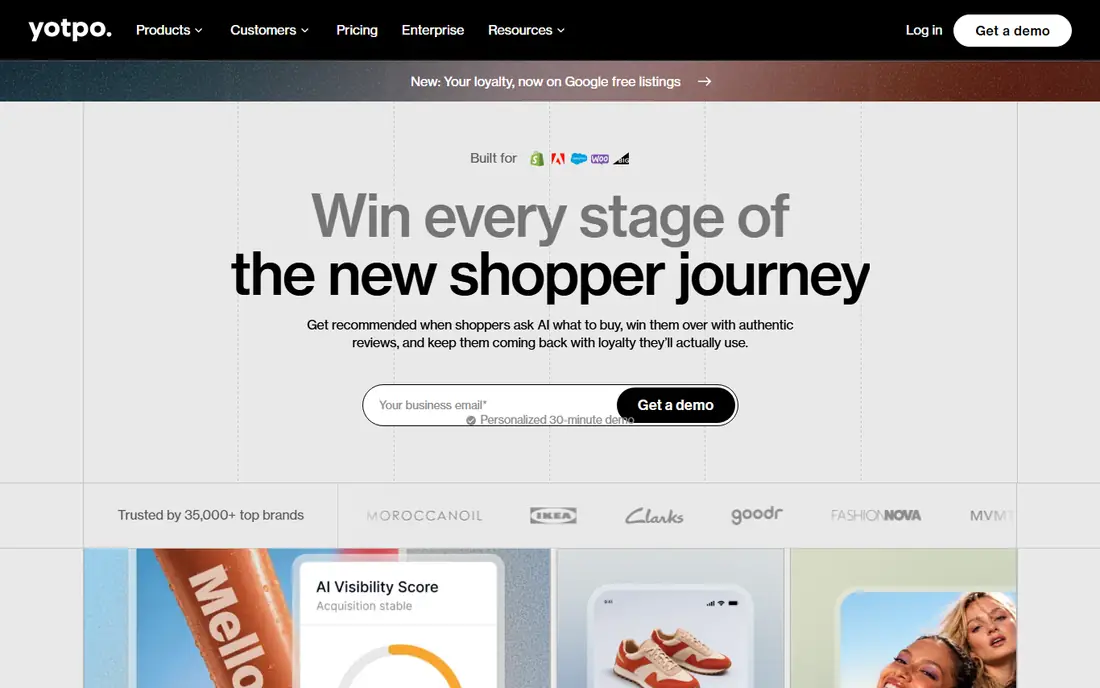
Yotpo Loyalty and Referrals starts with a free plan for up to 100 orders a month, with Pro at $199 per month plus per-order fees from 500 orders a month. Its case is strongest when a brand already uses Yotpo Reviews, because points can reward verified reviews and the data sits in one retention suite. That consolidation can simplify vendor management for larger brands.
If you only need loyalty, Yotpo's price is harder to justify against Smile or LoyaltyLion, and per-order fees need modeling at your volume. Yotpo suits brands that will use reviews and loyalty together, rather than loyalty as a standalone purchase.
- Loyalty, reviews, and referrals in one vendor
- Native review rewards
- Broad ecommerce integrations
- Loyalty alone may not justify the price
- Per-order fees apply above thresholds
- Support depth varies by tier
Gameball adds gamification to loyalty, with challenges, missions, and leaderboards alongside points and tiers. On Shopify it offers a free tier, Starter at $34 per month, and Pro at $159 per month, while direct plans start from $399 per month for higher volume and multi-platform setups. Its analytics report RFM segments and redemption behavior, not just point totals.
For a single Shopify store that only needs a simple widget, Gameball is more than necessary. For brands that run a mobile app, a second storefront, or a fintech product alongside a store, its single member wallet across channels is a real advantage.
- Gamification with points, tiers, challenges, and referrals
- Works beyond Shopify on apps and other storefronts
- RFM analytics
- More platform than a single Shopify store needs
- Direct plans start higher than Shopify starter tiers
Rivo offers loyalty, referrals, and VIP programs for Shopify and Shopify Plus brands, with a free tier and paid tiers including a Plus plan at $499 per month. Its integrations cover a broad martech stack, and its support includes live chat, which helps during launch. The setup is self-serve, with a trial to test before committing.
Rivo's range is mainly inside Shopify, so brands with large physical retail estates should check POS coverage before choosing it. For Shopify Plus brands that want a straightforward loyalty app with broad integrations, Rivo is a credible alternative to Smile and LoyaltyLion.
- Simple Shopify setup
- Broad martech integrations
- Live chat support and trial
- Plus tier at $499 per month is a large step up
- Shopify-focused, like most rivals here
Okendo combines loyalty with reviews, quizzes, and surveys, and its loyalty pricing starts from $19 per month tiered by order volume. That low entry price makes it attractive for small Shopify stores that also want reviews, without paying for a separate reviews vendor. Its Shopify integration keeps setup simple.
The loyalty logic itself is less deep than LoyaltyLion for brands that need complex VIP rules and segmentation. Okendo suits stores that want reviews and loyalty on one invoice at a low entry price, with the option to grow into higher tiers as order volume rises.
- Loyalty tied to reviews, quizzes, and surveys
- Low entry price tiered by order volume
- Shopify-native
- Loyalty is part of a wider suite
- Advanced loyalty logic is lighter than LoyaltyLion
Stamped sells reviews, loyalty, and related retention products, with loyalty listed from $199 per month and multi-product bundles from $798 per month in recent comparisons. Bundling can simplify billing and data for brands that use several Stamped products, and its Shopify presence is well established.
As a standalone loyalty purchase, Stamped is priced above Smile and Okendo at entry level. It suits brands that already use or plan to use Stamped reviews and want loyalty from the same vendor, rather than buyers seeking the cheapest loyalty widget alone.
- Reviews, loyalty, and referrals in one platform
- Bundle pricing for multiple products
- Strong Shopify presence
- Loyalty alone starts from $199 per month in recent listings
- Bundles from $798 per month are sales-led
Marsello is built for retail chains that sell both in store and online. Its Launch plan starts at $60 per site per month, with Accelerate at $120 per site, and it connects Shopify POS loyalty to online earning and redemption. Email and SMS campaigns are included, which helps retailers drive repeat visits across channels.
For online-only stores, Marsello's POS strength is unnecessary, and per-site pricing can look costly. For retailers with several physical locations plus an online store, Marsello's unified loyalty across channels is its main advantage over Shopify-only apps.
- Loyalty across Shopify POS and online stores
- Per-site pricing for retail chains
- Email and SMS campaigns included
- Per-site cost adds up for many locations
- Less suited to online-only stores
Joy Loyalty, listed on the Shopify App Store with a free tier and paid plans up to $499 per month in recent comparisons, positions itself on program flexibility. Brands that need custom earning rules, varied reward types, or a program that does not fit a standard template will find more room to shape the program here than in a basic widget.
That flexibility requires more setup and testing. Joy suits brands that have a clear loyalty concept and want to build it faithfully, rather than brands that want the fastest possible launch with default settings.
- Flexible program design beyond standard templates
- Free tier available
- Built for Shopify badge
- Pricing scales with volume
- Advanced flexibility needs more setup than a template widget
Talon.One is not a plug-in widget. It is a headless promotion and loyalty engine that lets enterprises define complex rules for discounts, points, referrals, and campaigns, and apply them across web, app, POS, and other channels through an API. That flexibility suits large retailers and multi-brand groups with custom stacks.
Pricing is by custom quote, and implementation needs engineering time and onboarding. Small and mid-size Shopify stores should choose Smile, LoyaltyLion, or a similar app instead. Talon.One earns its place for enterprises that have outgrown widget-based loyalty and need a rules engine they can shape freely.
- API-first promotion and loyalty rules engine
- Works across any channel or stack
- Enterprise-grade logic
- Custom pricing only
- Requires engineering build and onboarding
- Overkill for a simple Shopify widget
How we picked these
We compared loyalty platforms that are actively sold in 2026, checking their pricing pages, Shopify listings, and feature descriptions. We weighted Shopify and POS fit, points and tier flexibility, referral features, integration depth with email tools, and pricing transparency at different order volumes. We left out pure punch-card apps with no tier or referral logic, because they do not meet the scope of loyalty program software.
Pricing for loyalty vendors changes often and scales with orders, so the figures here are entry points to check, not lifetime costs. Model your peak month, check per-order fees above free thresholds, and confirm what happens when you cross into the next tier.
How to design a program customers actually use
Start with the reward your customers value, not the points mechanic. A discount, free shipping, early access, or a gift may each motivate different customers, and a program that only offers points for points' sake will see low redemption. Next, set earning rules that are easy to understand: one point per dollar, clear tier thresholds, and visible progress toward the next reward.
Then connect loyalty to email and SMS, so tier upgrades and expiring points trigger a message, not silence. Finally, measure redemption rate, repeat purchase rate, and average order value for members versus non-members, and adjust rewards that nobody redeems. A loyalty program is a retention tool, not a widget to install and forget.
Frequently asked questions
What is the best loyalty program software?
Smile.io is best for small Shopify stores, LoyaltyLion is best for growing brands that need tiers and segmentation, and Talon.One is best for enterprises that need a custom rules engine. The best software depends on your platform, order volume, and whether you sell in store as well as online.
What is the best loyalty software for Shopify?
Smile.io is the easiest Shopify launch, LoyaltyLion is best for data-driven Shopify brands, and Joy Loyalty offers more program flexibility at scale. All three are Shopify-native, so the choice comes down to budget, volume, and how complex your tier and reward rules need to be.
How much does loyalty program software cost?
Entry prices range from free tiers with order limits to $15 to $60 per month for small stores, $199 per month for growing brands, and custom pricing for enterprises. Most vendors scale price with order volume, so check per-order fees and tier thresholds at your peak volume.
Do loyalty programs work for small businesses?
Yes, if rewards match what customers value and redemption is easy. A simple points and referral program on Smile or Okendo can lift repeat purchases for a small store, provided the store promotes the program at checkout and in email. A complex tier system with weak rewards will not help, regardless of software.
What are companies with the best rewards programs?
The best-known consumer programs, such as airline, coffee, and retail rewards, succeed because rewards are clear, attainable, and tied to frequent purchases. Software alone does not create that effect. The program design, reward value, and communication matter as much as the platform you choose.
Can loyalty software work with a physical store?
Yes, if the platform supports POS. Marsello is built for POS plus online loyalty, while Gameball and Talon.One support multi-channel setups. Shopify-only apps may not offer in-store earning and redemption, so check POS coverage before choosing if you have physical locations.
Sources we checked (10)

Online Jobs is an independent blog about careers, online work, learning new skills and the tools that help people earn. More about us.
Keep reading
All posts
n8n Alternatives
n8n alternatives compared for 2026, with Zapier, Make, Activepieces, and more, covering visual builders, code steps, self-hosting, and pricing models.
eBay Alternatives
Looking for ebay alternatives? We compared 9 marketplaces for sellers on fees, buyer reach, categories and ease of listing, to help you sell with confidence.

ZoomInfo Alternatives
The best ZoomInfo alternatives in 2026, compared on price, free plans, data coverage, and which tool fits small teams or large sales teams best in detail.