Best Meditation Apps in 2026: 9 Apps Compared


Beginners learning step by step · Starting price: $12.99 per month
How we put this together: we compare official feature and pricing pages, app store listings, privacy policies and public user reviews. Prices change, so check the provider's site before you pay.
Key takeaways
- Headspace is the clearest starting point for beginners, thanks to structured courses that teach the basics step by step.
- Calm is the strongest choice for sleep, with a large library of Sleep Stories, music and soundscapes.
- Insight Timer offers the largest free library in this list, though quality varies because many teachers contribute.
- Smiling Mind and UCLA Mindful are fully free, which makes them the best first try before paying for any subscription.
- Meditation apps support a daily habit and relaxation, but they are not a substitute for professional care for anxiety, depression or sleep disorders.
Quick comparison
| Name | Who it suits | Starting price | Free option | |
|---|---|---|---|---|
| Headspace | Beginners learning step by step | $12.99 per month | Free trial | Visit |
 Calm | Sleep stories and winding down | $14.99 per month | Free trial | Visit |
 Insight Timer | A large free library | Free | Yes | Visit |
 Balance | Personalised daily plans | $11.99 per month | Free trial | Visit |
 Happier | Sceptics who want clear teaching | $14.99 per month | Free trial | Visit |
 Waking Up | Deeper theory and practice | $14.99 per month | Free trial | Visit |
 Smiling Mind | Free programs for all ages | Free | Yes | Visit |
 UCLA Mindful | Free research-based basics | Free | Yes | Visit |
 Buddhify | Meditation fitted around daily life | See website | No | Visit |
The best meditation apps
We compared official feature pages, pricing pages, app store listings and public reviews, and we looked closely at how much content is free, since a meditation app that locks almost everything behind a paywall is a different purchase from one with a usable free tier. The list below covers beginners, sleep, anxiety and experienced meditators.
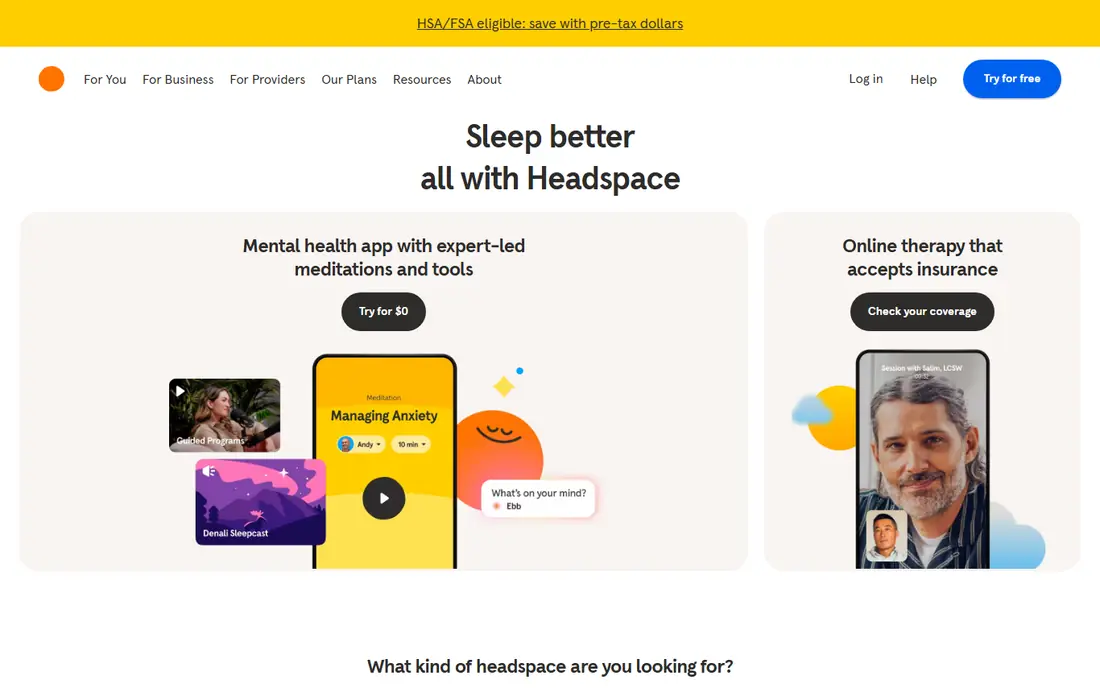
Headspace is our pick for a first meditation app because it never leaves you wondering what to do next. Its Basics courses build skills in small steps, with short animations that explain ideas like noticing thoughts without chasing them. Beyond the courses, you get short SOS exercises for stressful moments, focus music, movement sessions and sleepcasts for winding down at night.
The limitation is that the free content is limited once the trial ends, and the annual price of $69.99 is a real commitment for a habit you have not yet formed. Headspace also offers coaching and therapy through separate plans in some regions, but those are not part of the standard app subscription everywhere. Start with the trial, finish a Basics course, and only then decide if the structure is worth paying for.
- Structured courses that teach basics in order
- Short exercises for stress and focus
- Sleepcasts and sleep sounds included
- Most content needs a subscription after the trial
- Coaching and therapy options vary by plan
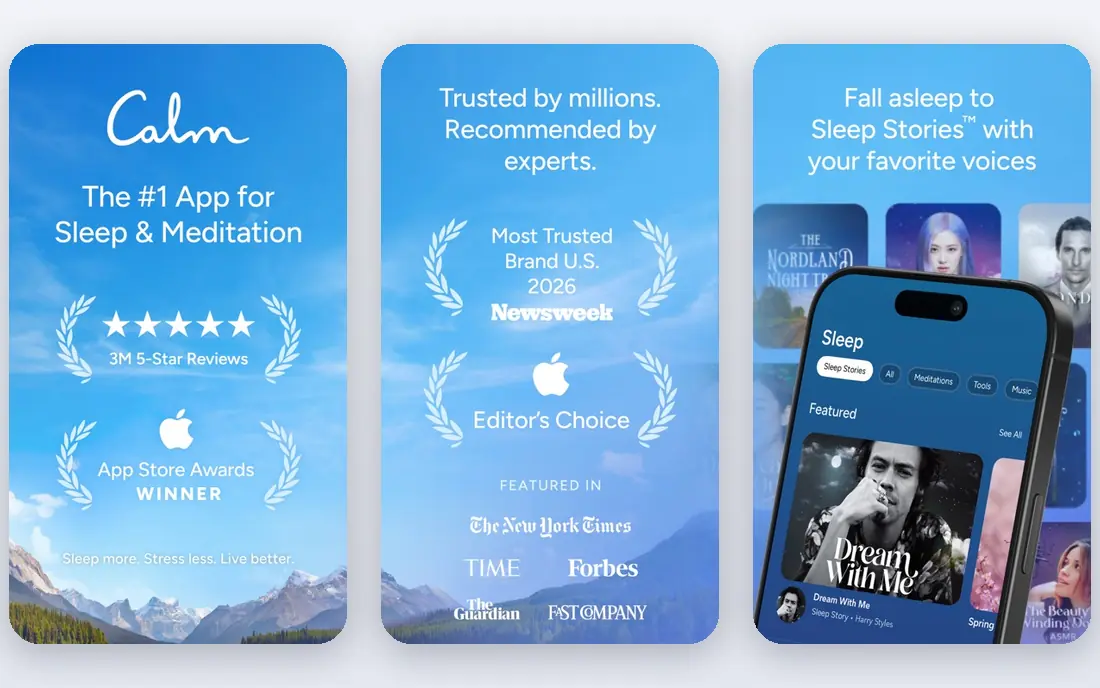
Calm is the strongest app here for falling asleep. Its Sleep Stories, read by narrators including well-known actors, give a restless mind something gentle to follow, and its sleep music and nature sounds help create a bedtime routine. The Daily Calm offers a short daily session, and there are programs for anxiety, focus and gratitude alongside breathing exercises.
If your main goal is learning to meditate rather than sleeping better, Calm can feel harder to use. The library is large, and meditation content sits among sleep, music and celebrity stories, so finding a clear learning path takes more effort than in Headspace. The annual price is also $69.99 in many listings, with a lifetime option listed at $499.99 in some app store pages, so check the current offer before buying.
- Large Sleep Story library with familiar narrators
- Daily Calm sessions
- Music and nature sounds
- Free content is limited
- Meditation teaching is less structured than Headspace
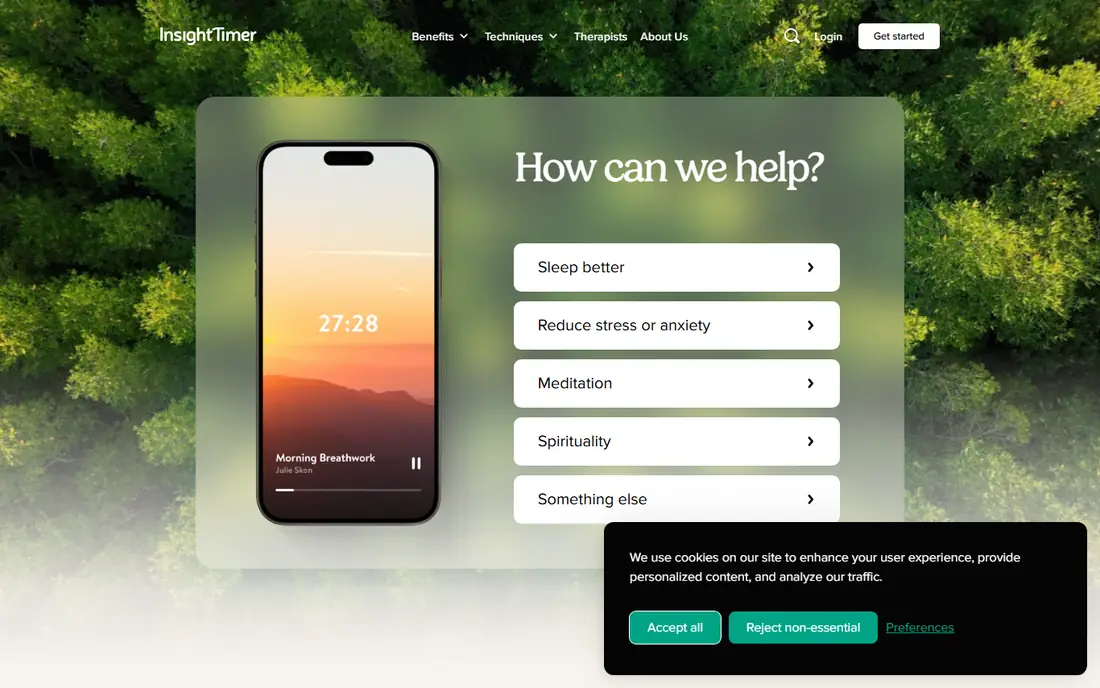
Insight Timer is the best free meditation app for most people, because its free library is far larger than any rival here. Teachers from around the world contribute sessions for anxiety, sleep, grief, self-compassion, body scans and breathwork, and the app also offers a customisable timer, talks and live events. If you like variety and you enjoy discovering new teachers, you may never need to pay.
That size is also the drawback. Quality varies, since anyone can contribute, and the interface can feel busy compared with Headspace or Calm. The paid Member Plus plan, listed at $9.99 per month or $59.99 per year, adds courses, offline listening and higher quality audio. Try the free library for two weeks first, follow a few teachers you like, and only upgrade if offline listening or structured courses matter to you.
- Thousands of free guided meditations
- Timer, talks and live events
- Community groups by interest
- Quality varies between teachers
- Finding favourites takes searching
Balance takes a different approach from a fixed course library. It asks about your goals, experience and available time, then builds a daily plan that adapts as you practise. That personal touch suits people who have tried meditation before and drifted away, because each session feels chosen for that day rather than pulled from a long list. Progress tracking also helps you see a habit forming over weeks.
The catch is pricing clarity. Balance has often offered a free first year in promotions, with a monthly price of $11.99 and an annual price of $69.99 listed in many comparisons, but the offer you see can differ by region and time. Its library is also smaller than the big names, so a listener who wants endless variety may prefer Insight Timer. If personalisation matters more than library size, Balance is worth a trial.
- Daily plans adapt to your goals and experience
- First year is often offered free in promotions
- Clear progress tracking
- Promotional pricing changes often
- Library is smaller than Calm or Insight Timer
Happier, formerly Ten Percent Happier, is built for people who roll their eyes at vague wellness language. Its teachers explain meditation in practical terms, with courses, guided sessions, talks and podcasts that cover stress, focus and relationships without jargon. That tone helps a sceptical beginner stick with practice, because each session explains why a technique is used and what to expect.
The annual price, listed at $99.99 in many comparisons, is higher than Headspace or Calm, and sleep content is less of a focus. If you mainly want help falling asleep, Calm is stronger. If you want clear teaching and you have tried other apps and found them too soft or too mystical, Happier is the better fit, and its trial is the right way to test that tone.
- Plain-language teaching from experienced instructors
- Courses, talks and podcasts
- Good for people who dislike vague language
- Higher annual price than Headspace or Calm
- Sleep content is thinner
Waking Up, from Sam Harris, suits meditators who want to understand the practice, not just follow a relaxing voice. Its introductory course builds theory alongside practice, and its lessons, talks and interviews explore attention, awareness and the nature of thought in more depth than most apps. For someone who already meditates and wants a richer framework, that depth is the main attraction.
It is less suited to a quick wind-down before bed, since sessions lean toward instruction rather than soothing stories. The annual price is listed at $99.99 in many comparisons, though the app states that free access is available on request if you cannot afford it. That policy makes it worth contacting the company rather than skipping it for price alone, if the teaching style appeals to you.
- Thoughtful lessons on attention and awareness
- Talks and interviews
- Free access if you cannot afford it
- Less suited to quick relaxation sessions
- Annual price is higher than many rivals
Smiling Mind is a not-for-profit app that offers its full program library for free, which makes it the best first try for families and for anyone unsure about paying. Its programs cover children, teens and adults, with sessions for school, work and home, and they were developed with psychologists and educators. That background shows in the clear, age-appropriate language.
The library is smaller than Calm or Insight Timer, and sleep stories and music are thinner, so a listener who wants endless bedtime content will look elsewhere. For a daily practice, a classroom or a family routine, though, Smiling Mind proves that a useful meditation app does not need a subscription. Try it before paying for any other app on this list.
- Completely free
- Programs for children, teens and adults
- Developed with psychologists and educators
- Smaller library than paid rivals
- Fewer sleep stories and music options
UCLA Mindful is the simplest app here, and that simplicity is its strength. It offers a small set of free guided meditations based on the university mindfulness program, in English and Spanish, with a timer for silent practice. There are no subscriptions, no upsells and no large library to search through, which suits someone who wants the basics without distraction.
The limits are plain. You get a handful of sessions, not a growing library, and there are no courses, sleep stories or detailed progress tools. If you finish the set and want more variety, move to Insight Timer or Smiling Mind. If you want a free, trustworthy starting point and you value research backing over quantity, UCLA Mindful is a fine place to begin.
- Free
- Based on university research
- Simple guided meditations in English and Spanish
- Very small library
- No courses, sleep stories or progress features
Buddhify organises meditation by activity rather than by topic alone. Its wheel lets you pick a session for walking, working, waking up or going to sleep, which suits people who struggle to find a separate quiet time for practice. The app is sold as a one-time purchase on app stores, with an optional membership in some listings, so it avoids the yearly subscription cycle that dominates this list.
There is no free tier, so you pay before you can test the full library, and the total content is smaller than Calm or Insight Timer. The design is also simpler, with less music and fewer celebrity voices. If you like the idea of fitting short sessions into a busy day, and you prefer paying once, Buddhify is a practical alternative to a subscription.
- Sessions organised by what you are doing, like walking or working
- One-time purchase model
- Works offline
- No free tier
- Smaller library than subscription rivals
How we picked these
We compared official feature pages, pricing pages, app store listings and public reviews, and we checked how much content is free, since that decides whether an app is useful before you pay. We included structured courses, sleep-focused apps, large free libraries and fully free programs, so the list covers different goals rather than repeating the same two brands.
We did not run hands-on trials for this guide, and we say so plainly. Our comparisons rest on vendor documentation and published reviews, not on our own clinical testing. Where a price could not be verified on the vendor site at the time of writing, we wrote See website rather than repeating a figure from a review site. This guide is for general information only and is not medical advice. If anxiety, low mood or sleep problems persist, speak to a qualified health professional.
How to build a habit that lasts
Pick the smallest session you will actually do, not the longest one you admire. Ten minutes a day, at the same time, beats an ambitious hour that you skip after a week. Attach practice to an existing routine, like after brushing your teeth or before bed, and keep the app on your home screen so opening it takes one tap.
Choose by goal, not by popularity
A sleep app will not teach meditation well, and a teaching app will not help you fall asleep fast. Decide whether your main goal is sleep, stress, focus or learning the practice itself, then pick the app that leads with that goal. You can always switch later, and trying a free app first costs nothing.
Use trials properly
Finish a full course or a full week of daily sessions during a trial, not just one session. That test shows whether the voices, pacing and structure suit you, and whether you return without a reminder. Cancel before the trial ends if you are unsure, since a subscription you forget is the most expensive kind.
Frequently asked questions
What is the best meditation app for beginners?
Headspace is the best starting point for most beginners, thanks to structured Basics courses that teach skills in order. Smiling Mind and UCLA Mindful are good free alternatives if you want to learn the basics before paying.
What is the best free meditation app?
Insight Timer has the largest free library, with thousands of guided sessions, a timer and live events. Smiling Mind is fully free with programs for all ages, and UCLA Mindful offers a small free set of research-based sessions.
Which meditation app is best for anxiety?
Headspace offers structured courses and short SOS exercises for stressful moments, while Calm offers anxiety programs and breathing tools. These apps support coping skills, but they are not a replacement for therapy or medical care if anxiety is severe or persistent.
Which meditation app is best for sleep?
Calm is the strongest sleep choice, with Sleep Stories, sleep music and soundscapes. Headspace also offers sleepcasts, and Insight Timer includes free sleep tracks, though its library is less focused on sleep alone.
How long should I meditate each day?
Ten minutes a day is a practical starting point for most beginners, and many apps offer sessions from three minutes upward. Consistency matters more than length, so a short daily session you keep is better than a long session you skip.
Are meditation apps worth paying for?
Paid apps are worth it if you use their courses, sleep content or offline listening regularly. If you only meditate occasionally, a free app like Insight Timer or Smiling Mind may cover your needs, and you can upgrade later if a specific feature becomes important.
Sources we checked (9)

Online Jobs is an independent blog about careers, online work, learning new skills and the tools that help people earn. More about us.
Keep reading
All posts
Best Workout Tracker App
We compared the best workout tracker app options for gym, home, and running training, checking prices, free plans, and logging tools in detail. See inside.
Best Workout Apps
Looking for the best workout apps? We compared 9 fitness apps for gym, home, running and classes on free plans, pricing and training style in 2026 now.
Best Running App
Best running app compared for 2026, with GPS tracking, training plans, route mapping, and free options for beginners and regular runners across the US.