Best Marketing Automation Platform for Startups in 2026: 8 Platforms Compared

How we put this together: we compare official feature and pricing pages, app store listings, privacy policies and public user reviews. Prices change, so check the provider's site before you pay.
Key takeaways
- HubSpot suits startups that want CRM, marketing and sales in one place, with a free tier to start.
- ActiveCampaign offers the deepest automation logic at a startup friendly price, but it takes longer to learn.
- Mailchimp and Brevo are the easiest low cost starts for email first startups, with free plans for small lists.
- Klaviyo is the strongest pick for online stores, while Moosend and EngageBay suit startups on very tight budgets.
Quick comparison
| Name | Who it suits | Starting price | Free option | |
|---|---|---|---|---|
 HubSpot | All in one CRM and marketing | Free | Yes | Visit |
 Mailchimp | Email first beginners | $13 per month | Yes | Visit |
 ActiveCampaign | Deep behaviour based automation | $15 per month | Free trial | Visit |
 Klaviyo | Ecommerce lifecycle marketing | Free | Yes | Visit |
 Brevo | High volume email and SMS | $25 per month | Yes | Visit |
 Moosend | Low cost automation | $9 per month | Free trial | Visit |
 Kit | Creator and content startups | $25 per month | Yes | Visit |
 EngageBay | All in one on a budget | See website | Yes | Visit |
The best marketing automation platforms for startups
We compared official feature pages, pricing pages, app store listings and public reviews to find platforms that help a small team capture leads, send useful messages and measure results without a large marketing ops team. The eight platforms below cover all in one suites, email specialists and ecommerce tools, so you can match the platform to your main channel and budget.

HubSpot suits startups that want one system for contacts, marketing, sales and service, rather than several disconnected tools. The free tier covers basic CRM, forms, landing pages and email, which is enough to capture leads and send simple campaigns while a startup finds its first customers. As the team grows, paid Marketing Hub plans add workflows, lead scoring, A/B testing and deeper reporting.
The main advantage is data unity. When marketing, sales and service share the same contact record, a startup can see the full journey from first visit to closed deal to support request, without manual exports. Integrations with common tools, plus built in AI helpers, help small teams automate routine tasks such as lead routing and follow up reminders.
The drawback is cost at scale. The most powerful automation features sit on Professional plans, and seat pricing means total cost rises as staff are added. Startups should start free, prove which workflows matter, and only upgrade when a specific feature will clearly save time or win deals. For a CRM centred growth plan, HubSpot is the safest all in one pick.
- Free CRM and starter marketing tools
- Native link between marketing, sales and service data
- Wide integration range
- Advanced automation needs higher, costly plans
- Seat based pricing can grow fast for larger teams
Mailchimp remains the easiest starting point for email first startups. The builder is friendly, templates cover common campaign types, and the customer journey builder lets a small team set up welcome series, abandoned cart messages and post purchase follow ups without coding. Ecommerce integrations, especially for Shopify and WooCommerce, help online stores sync products and orders.
The free plan covers up to 500 contacts in recent pricing, which is enough to test a newsletter or a first launch list. Paid Essentials and Standard plans raise send limits and add A/B testing, behavioural targeting and more advanced journeys.
The limits appear as a startup grows. Advanced automation and segmentation sit on higher plans, and contact based pricing means list hygiene matters: unsubscribed contacts can count toward limits unless archived. If you outgrow simple email and need complex branching journeys, ActiveCampaign or HubSpot may fit better. For a simple, polished start, Mailchimp still works well.
- Easy drag and drop builder
- Wide template library
- Simple customer journey builder for beginners
- Advanced automation is limited on lower plans
- Pricing scales by contacts, including some unsubscribed contacts unless archived
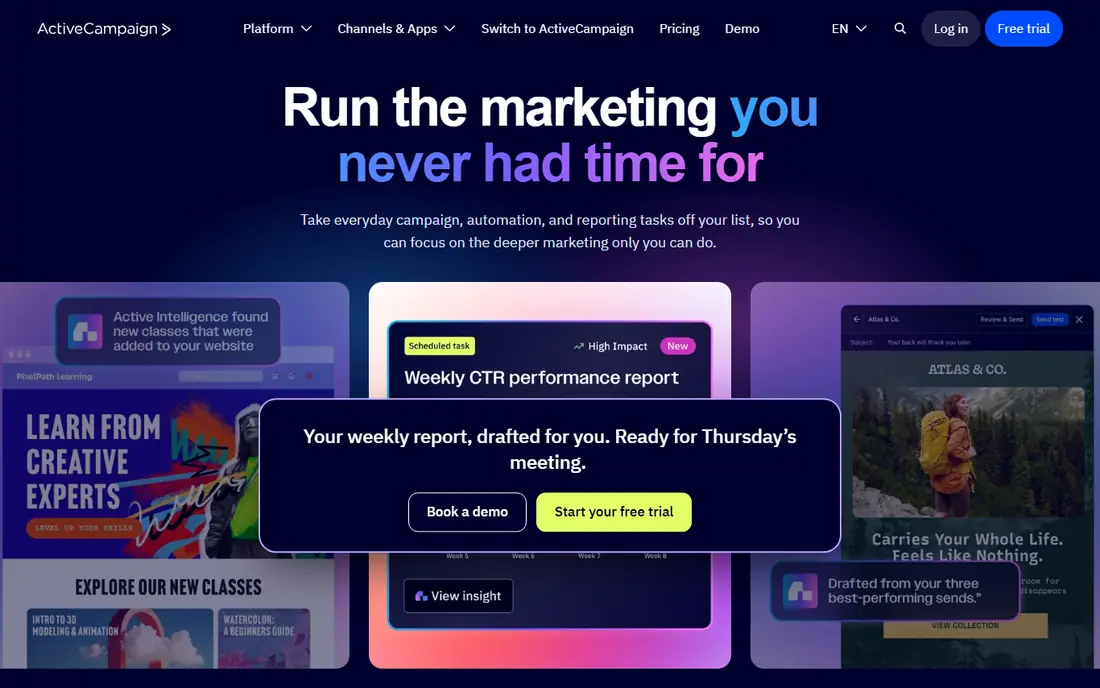
ActiveCampaign is the best marketing automation tool for startups that need real journey logic, not just scheduled newsletters. Its visual builder supports conditions, splits, goals and site tracking, so you can send different messages based on pages visited, purchases, tags or scores. That depth helps service businesses, SaaS startups and ecommerce brands with longer sales cycles.
A built in CRM keeps sales follow up in the same system, and automation maps show the whole journey at a glance, which helps a small team spot dead ends and missing steps. Predictive sending and split testing help improve open and click rates over time, and integrations cover major ecommerce, CRM and form tools. Public reviews often praise deliverability, which matters when every email counts.
The trade off is learning time. New users may find the builder and settings dense at first, and a poorly planned automation can confuse contacts if branches are not tested. Start with one or two core journeys, such as welcome and onboarding, then add complexity as you learn what works. For automation power at a startup price, ActiveCampaign is hard to beat.
- Visual builder with conditions, splits and goals
- Built in CRM and site tracking
- Strong deliverability reports in public reviews
- Interface can overwhelm beginners
- Setup takes longer than Mailchimp or Brevo
Klaviyo suits online stores that live on repeat purchases and lifecycle email. Its data platform pulls order, browsing and customer data from Shopify and other stores, then powers flows for welcome, abandoned cart, browse abandonment, post purchase and winback. Revenue per flow and campaign is visible in reports, so a startup can see which messages actually drive sales, not just opens.
SMS can be added beside email in the same flows, which helps stores reach customers who prefer text for offers and shipping updates. Segmentation is detailed, with behaviour, purchase history and predicted values, and AI product recommendations can personalise content without manual work for every customer. For a store with a growing list, those features often pay for themselves quickly.
Klaviyo is less useful for a B2B service startup that does not sell online, because its strength is commerce data. Costs also scale with contacts and message volume, so a large but inactive list can be costly. Clean your list regularly and focus on active buyers. For ecommerce startups, Klaviyo is the clear specialist pick.
- Native Shopify integration
- Revenue tracking per flow and campaign
- Strong SMS plus email lifecycle flows
- Less versatile for non ecommerce startups
- Costs scale with contacts and sends
Brevo, formerly Sendinblue, suits startups that send many emails to a large list, but do not want contact based pricing. Paid plans are priced mainly by monthly email volume, so a startup with 20,000 contacts but modest sends can pay less than on a contact based rival. The free plan offers a daily send limit, which is enough to test campaigns and small automations.
Beyond email, Brevo supports SMS, WhatsApp, landing pages, forms and a basic CRM, so a small team can run multichannel campaigns from one account. Automation workflows cover welcome series, transactional messages and behaviour based sends, and the editor is straightforward for newsletters and promotions. That breadth helps startups that need more than email, without paying for a full enterprise suite.
Automation depth stops short of ActiveCampaign for complex branching journeys, and some features, such as advanced reporting and landing page limits, need higher plans. If your main need is affordable high volume sending with solid automation, Brevo offers good value and a fair free start.
- Priced by email volume, not contact count
- Free plan with daily send limit
- Email, SMS and WhatsApp in one platform
- Automation is less deep than ActiveCampaign
- Some advanced features need higher plans
Moosend suits startups on a very tight budget that still want real automation. Its starting price is among the lowest on this list, and it offers a visual automation builder with triggers for signups, purchases, page visits and other events. Templates, landing pages and forms help a small team launch campaigns without a designer.
For a new business, that low cost matters. You can run welcome flows, newsletters and simple ecommerce automations, test what your audience responds to, and keep monthly costs low while revenue grows.
The integration range is smaller than HubSpot, Mailchimp or Klaviyo, and analytics are less deep than enterprise tools. If you rely on a niche tool that Moosend does not connect with, check integrations before buying. For low cost, capable email automation, Moosend is a strong budget pick.
- Low starting price
- Easy automation with many triggers
- Good editor and landing pages
- Smaller integration range than HubSpot or Mailchimp
- Advanced analytics are lighter than larger rivals
Kit, formerly ConvertKit, suits creator led startups, newsletters and small digital product businesses. Its subscriber centred model organises people by tags and segments, rather than by lists, which makes it easier to send relevant content to different interests from one account. Visual automations, landing pages and forms help creators grow a list and sell products without a complex marketing suite.
For a content startup, Kit feels focused. You can build a welcome sequence, tag readers by topic, promote a product launch and track subscriber growth in a clean interface.
Kit is less suited to B2B startups that need CRM pipelines, lead scoring and complex sales workflows. Its paid starting price is also higher than Moosend or Mailchimp Essentials for small lists. If your business is content, courses or newsletters, Kit is a natural fit. If it is complex B2B sales, HubSpot or ActiveCampaign will serve you better.
- Subscriber centred model for creators
- Visual automations and landing pages
- Good for newsletters and digital products
- Less suited to complex B2B sales automation
- Starting paid price is higher than some rivals
EngageBay suits startups that want all in one breadth without HubSpot prices. It combines email marketing, automation, CRM, landing pages, social scheduling and helpdesk tools in one account, with a free plan for small teams. That breadth helps a founder who needs a little of everything, but cannot pay for several separate tools.
Workflows cover welcome series, lead nurturing and behaviour based messages, while the CRM tracks deals and contacts beside marketing activity. Social scheduling and a simple helpdesk add further value for a small team that handles marketing and support together. For a startup testing its first growth system, EngageBay offers a low risk way to try an integrated setup.
Depth is the trade off. Automation, reporting and integrations are more basic than HubSpot or ActiveCampaign, and the interface can feel less polished. If you later need deep automation or a large integration ecosystem, you may outgrow EngageBay. As a budget all in one start, it is a practical choice.
- Marketing, CRM and service tools in one low cost account
- Free plan for small teams
- Good for startups that need breadth on a budget
- Interface and depth lag larger rivals
- Some features feel basic compared with HubSpot
How we picked these
We compared official feature pages, pricing pages, app store listings, privacy policies and public reviews for each platform. We gave weight to automation depth, CRM quality, email and SMS tools, ecommerce integrations, ease of use for a small team and total cost at startup scale. We also checked that each homepage loaded and matched the product named, and we used vendor pricing where it was clear, with See website where pricing was not verified at the time of writing.
We did not claim hands on testing for every workflow. Instead, we focused on published features, plan limits and reviewer reports about setup time, deliverability and support. Prices change often and scale by contacts, seats or sends, so check the vendor pricing page for your exact list size before buying.
What to check before you choose
Start with your main channel and your list size. Email first startups need a strong builder and journey tool. Ecommerce startups need store data and lifecycle flows. B2B startups need CRM, lead scoring and sales handover. Choosing by channel prevents paying for features you will not use in the first year.
Next, test one core journey end to end on a free plan or trial. Build a signup form, send a welcome series, tag a contact and check the report. Note how long setup takes, whether the editor feels clear, and whether support answers quickly. A platform that looks powerful in a demo can still slow a small team if daily tasks are awkward.
Pricing models that change the bill
HubSpot charges by seats and hubs, Mailchimp and Klaviyo charge mainly by contacts, Brevo charges mainly by email volume, and ActiveCampaign charges by contacts and plan tier. Work out your cost at three stages: launch list, first 5,000 contacts and steady growth. A cheap start that jumps sharply at 5,000 contacts may cost more than a slightly dearer platform with smoother scaling.
Privacy, consent and deliverability
Check consent tools, unsubscribe handling, data storage and privacy policy terms, especially if you email customers in the EU or UK. Use double opt in where it fits your audience, clean inactive contacts regularly and avoid buying lists, which harm deliverability and trust. A platform with clear consent and suppression tools will protect your sender reputation as you grow.
Frequently asked questions
What is the best marketing automation platform for startups on a budget?
Moosend, Brevo and EngageBay offer the best low cost starts, with free plans or low starting prices. Mailchimp is also affordable for small email lists. Choose Moosend for low cost automation, Brevo for high volume sending, and EngageBay for all in one breadth on a budget.
What is the best marketing automation software for small business email?
Mailchimp suits beginners who want simple email and journeys, while ActiveCampaign suits small businesses that need deeper behaviour based automation. Brevo suits high volume senders. If email is your main channel, start with the builder and journey tools you will actually use each week.
What is the best marketing automation tool for ecommerce startups?
Klaviyo is the best pick for ecommerce startups, thanks to its store data, lifecycle flows and revenue reporting. Mailchimp and ActiveCampaign also support ecommerce, but Klaviyo is built around purchase behaviour. For a Shopify store, Klaviyo usually gives the fastest return on lifecycle flows.
Is HubSpot good for startups?
Yes, HubSpot is good for startups that want CRM plus marketing in one place and can start free. It suits teams that plan to grow into sales and service tools together. The main risk is cost on higher plans, so start free, prove your workflows, and upgrade only when a paid feature will clearly help.
What are the best marketing automation tools for small business lead nurturing?
ActiveCampaign, HubSpot and EngageBay are strong for lead nurturing, because they combine automation with CRM and scoring. ActiveCampaign offers the deepest journey logic at a startup price, HubSpot offers the most unified data, and EngageBay offers a budget all in one option. Test a welcome and nurture sequence before you commit.
How do I choose between Mailchimp and ActiveCampaign?
Choose Mailchimp if you want the easiest start, simple journeys and a polished builder for newsletters. Choose ActiveCampaign if you need branching journeys based on behaviour, tags and scores, and you are willing to spend more time on setup. Many startups start with Mailchimp and move to ActiveCampaign when journeys get complex.
Sources we checked (8)

Online Jobs is an independent blog about careers, online work, learning new skills and the tools that help people earn. More about us.
Keep reading
All posts
Best Web Scraping Tools
Compare the best web scraping tools in 2026, from no-code Octoparse and Browse AI to Apify, Firecrawl, Bright Data, Zyte, ScraperAPI and free Scrapy, with prices.
Best Web Hosting Services
Find the best web hosting services for your site in 2026. We compare prices, speed, support and ease of use across eight leading hosting providers today.
Best Video Conferencing Software
Looking for the best video conferencing software? We compare 8 meeting apps on price, meeting limits, features, security and ease of use. Read the guide.