Best Marketing Attribution Software in 2026: 8 Tools Compared

How we put this together: we compare official feature and pricing pages, app store listings, privacy policies and public user reviews. Prices change, so check the provider's site before you pay.
Key takeaways
- Dreamdata is our pick for B2B teams that want account-level attribution with a free tier to start.
- HockeyStack suits larger B2B revenue teams that want one view from first touch to closed-won revenue.
- HubSpot is the simplest choice for teams already running marketing and sales on HubSpot.
- Triple Whale and Northbeam fit ecommerce brands, while Ruler Analytics fits teams that win work by phone and form.
- Attribution only works if your CRM, ad, and website data are clean, so budget time for setup and data checks, not just for the tool.
Quick comparison
| Name | Who it suits | Starting price | Free option | |
|---|---|---|---|---|
 Dreamdata | B2B account attribution | Free | Yes | Visit |
 HockeyStack | Larger B2B revenue teams | See website | No | Visit |
 HubSpot | HubSpot users | See website | Free trial | Visit |
 Ruler Analytics | Calls and offline revenue | $400 per month | No | Visit |
 Triple Whale | Shopify ecommerce | Free | Yes | Visit |
 Northbeam | Ecommerce multi-channel | $1500 per month | No | Visit |
 Wicked Reports | Direct response ecommerce | $499 per month | No | Visit |
 Factors.ai | Mid-market ABM teams | $199 per month | Yes | Visit |
The best marketing attribution software
Marketing attribution tries to answer a simple question with messy data: which touches helped create pipeline and revenue. Tools differ in the models they offer, how they handle accounts rather than single leads, and how well they connect to your CRM and ad platforms. The eight below cover B2B, ecommerce, and lead generation, so pick by your business model first, then by model depth.
Dreamdata is built for B2B teams that sell to accounts, not just to individual leads. It maps the full journey of an account, from first ad click to closed-won deal, and it lets you compare models such as first touch, last touch, linear, and data-driven views. That account view matters in B2B, where several people from one company may touch your marketing before a deal closes.
The free tier is a real advantage, since most rivals in this space require a sales call before you can test anything. The drawback is time: a full setup with CRM, ad, and website data takes weeks, and the paid plan is quote-based, so smaller teams should confirm the cost early. If you run HubSpot or Salesforce and need credible B2B attribution, Dreamdata is the place to start.
- Free tier for evaluation
- Account-level journey mapping
- Standard and custom attribution models
- Paid plans are quote-based and can be costly
- Setup takes weeks for a full implementation
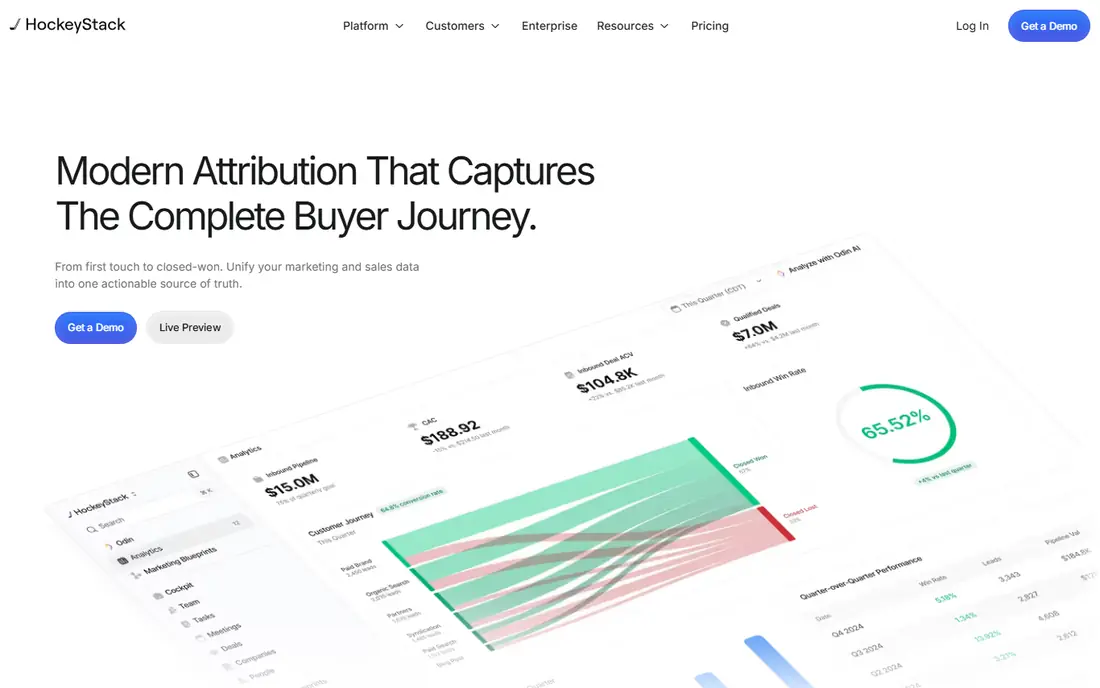
HockeyStack aims to be one source of truth for revenue teams, combining website, ad, CRM, and product usage data in one place. Its models learn from your own closed-won deals, and its reporting is flexible enough for leadership, marketing, and sales to work from the same numbers. For larger B2B teams with long sales cycles, that unified view can replace a patchwork of spreadsheets and dashboard tools.
The cost and effort are the limits. Pricing is quote-based and reported at enterprise levels, and the platform needs a RevOps owner to manage data, models, and reporting. Smaller teams with modest ad spend will often get more value from Dreamdata or HubSpot first, and move to HockeyStack when pipeline volume justifies it.
- Unified view of marketing, sales, and product data
- Predictive models trained on closed-won deals
- Flexible reporting
- Quote-based pricing, often at enterprise levels
- Needs a RevOps owner to get full value
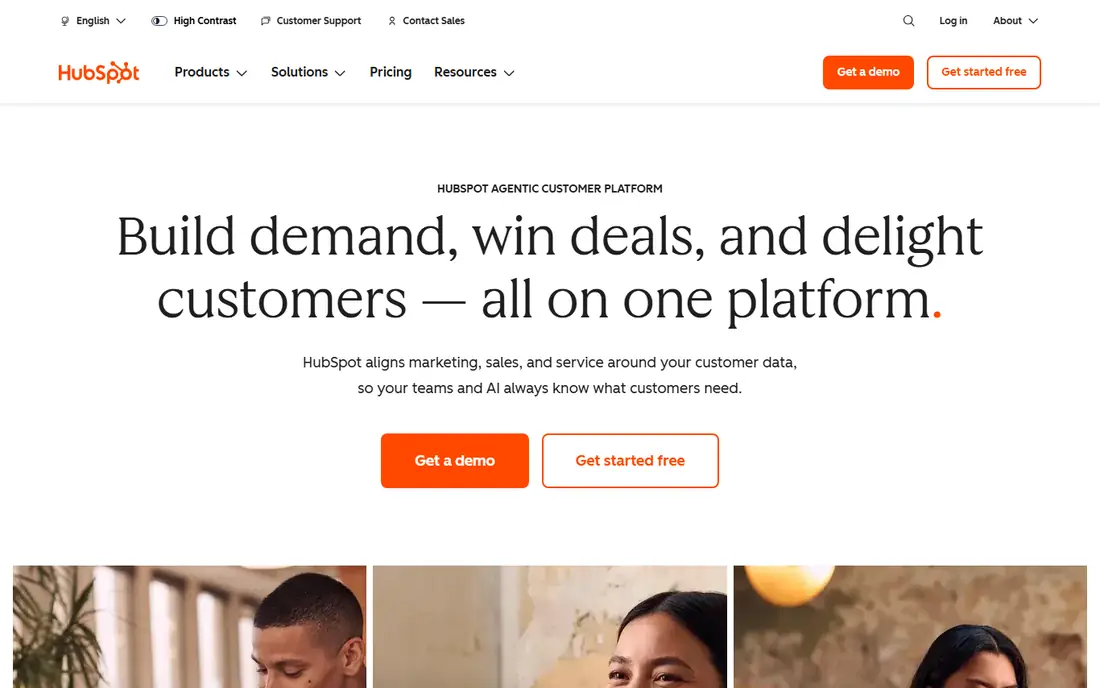
HubSpot is the practical pick if your marketing, sales, and service data already live in HubSpot. Attribution reports sit next to contacts, deals, and campaigns, so you do not need to build a separate data pipeline to answer basic questions about which channels create pipeline. For teams without a dedicated data or RevOps team, that simplicity is worth a lot.
The limit is depth. Specialist tools such as Dreamdata and HockeyStack offer more models, more account-level analysis, and more control over data. HubSpot attribution also requires higher-tier plans for the full reports, so check the plan you would actually buy. If you are already on HubSpot and want attribution without a new system, start here.
- Attribution inside the CRM you already use
- Contact, deal, and campaign reporting in one place
- Good for teams without a separate data team
- Best attribution reports sit on Professional plans and above
- Less flexible than specialist B2B tools for complex models
Ruler Analytics solves a problem many attribution tools miss: work that starts online and closes offline, often by phone. It tracks calls, forms, and live chats, links them to a visitor journey, and ties them to closed revenue in your CRM. That makes it useful for agencies, service businesses, and B2B teams where the phone is still a central sales channel.
The starting price, reported from around $400 per month, puts it above a simple analytics add-on, so it fits teams with enough lead volume to justify it. Pure ecommerce brands will get more from a Shopify-focused tool, but for lead generation with offline closes, Ruler is one of the clearest options in this list.
- Links calls, forms, and chats to revenue
- Multiple attribution models
- Revenue passed back to ad platforms
- Starting price is high for small teams
- Less suited to pure ecommerce than Triple Whale or Northbeam
Triple Whale is built for Shopify brands that need to see which ads and channels drive orders, not just clicks. Its dashboards combine attribution, profit, and creative data, and its tools can send conversion signals back to Meta, Google, and other ad platforms. For a direct-to-consumer brand, that loop between measurement and ad optimisation is the main value.
Pricing by sales volume means costs rise as you grow, so check the tier for your current and expected revenue, not just the free plan. B2B teams with long sales cycles and CRM deals will find Dreamdata or HockeyStack a better fit, but for Shopify ecommerce, Triple Whale is a strong, practical pick.
- Free plan to start
- Shopify-native attribution and dashboards
- Sends conversion data back to ad platforms
- Paid tiers are priced by sales volume, so costs grow with revenue
- Less suited to B2B sales cycles
Northbeam targets larger ecommerce brands that spend across many channels and need a more careful view than last-click reporting gives. It offers multi-touch models, including view-through attribution, and higher tiers add media mix modelling and incrementality testing. That depth helps brands decide where the next dollar should go when several channels claim the same sale.
The price is the barrier. A starting point around $1,500 per month puts Northbeam out of reach for small stores, which should start with Triple Whale or a free analytics setup first. For brands with serious multi-channel spend, however, Northbeam gives a level of rigour that cheaper tools do not.
- Multi-touch models including view-through
- Media mix and incrementality options on higher tiers
- Ad platform feedback tools
- High starting price for smaller brands
- Setup and data work need a dedicated owner
Wicked Reports focuses on direct response and subscription ecommerce, where the question is not just which ad drove the first order, but which channel drives lifetime value. Its first-party, click-based approach and long lookback help brands see repeat purchases and subscription revenue tied to the original source, which last-click tools often miss.
It is not a B2B account tool, and there is no free plan, with paid tiers reported from $499 per month. For ecommerce brands that live on paid ads and subscriptions, that focus is a strength. For B2B teams, the account and pipeline view of Dreamdata or HockeyStack will be more useful.
- First-party, click-based attribution
- Lifetime lookback on customer value
- Strong for subscription and direct response brands
- No free plan
- Less B2B account depth than Dreamdata or HockeyStack
Factors.ai combines account identification with attribution, which helps mid-market B2B teams see which companies visit, engage, and convert, even when individual leads are not yet known. Its entry price, reported from $199 per month for a Lite plan, is lower than enterprise attribution platforms, and a free option lets teams test the basics.
The trade-off is depth at enterprise scale. Larger teams with complex Salesforce setups and long, multi-stage cycles may need HockeyStack or Dreamdata for full model control. For a mid-market ABM team that wants account insight and attribution without an enterprise contract, Factors.ai is a balanced starting point.
- Account identification and attribution in one platform
- Lower entry price than enterprise rivals
- Useful for ABM teams
- Less enterprise depth than HockeyStack
- Some features require higher tiers
How we picked these
We compared official feature pages, pricing pages, and public reviews, and we favoured tools that are still maintained, that offer more than last-click reporting, and that connect to a CRM or ecommerce platform. We checked for model choice, account versus lead views, ad platform feedback, and published pricing, and we kept a mix of B2B, ecommerce, and lead-generation tools. We did not run these tools on live campaigns for this guide, and where pricing is by quote we say so rather than presenting a third-party estimate as a vendor price.
What to check before you buy
Start with your data, not the model menu. An attribution tool can only report on the CRM, ad, and website data you feed it, so check that contacts, deals, and campaign costs are clean and connected before you judge any model. Next, decide whether you need lead-level, account-level, or order-level reporting, since B2B and ecommerce tools answer different questions. Ask how the tool handles privacy rules, cookie limits, and offline conversions, because those gaps change results more than a new model does. Finally, plan for ownership: someone needs to maintain the setup, check the data each month, and explain the numbers to leadership, or even the best tool will fall out of use.
Frequently asked questions
What is the best marketing attribution tool for B2B?
Dreamdata is our pick for most B2B teams because it offers account-level journeys, several models, and a free tier to test. HockeyStack suits larger revenue teams that want a unified view, while HubSpot is simplest for teams already on HubSpot.
What is the best marketing attribution platform for ecommerce?
Triple Whale is a strong start for Shopify brands, with a free plan and dashboards built for orders and ad feedback. Northbeam suits larger multi-channel brands that need deeper models and incrementality testing, at a higher price.
Is last-click attribution enough?
Rarely, for teams spending across several channels. Last-click gives all credit to the final touch, which understates early channels such as content, search, and social that create demand. Multi-touch models, used with care, give a fairer view, but they still depend on clean data and sensible interpretation.
How much does marketing attribution software cost?
Costs range from free tiers to several thousand dollars per month. Small teams can start free with Dreamdata, Triple Whale, or Factors.ai, mid-market teams often pay $199 to $500 per month, and enterprise B2B tools are usually quote-based. Always ask for the full price, including data volume, seats, and implementation.
Do I need attribution software if I already use Google Analytics?
Google Analytics helps with traffic and basic conversion reporting, but it does not normally link multi-touch journeys to CRM pipeline and closed revenue in the way specialist tools do. If your main question is which channels create revenue, not just visits, a specialist tool adds value. If you only need traffic and simple conversion counts, it may not.
How long does attribution setup take?
Simple setups can take days, while full B2B implementations often take two to six weeks, depending on CRM, ad, and website connections. Allow time for data cleaning, model testing, and a comparison period where you run the new tool alongside your old reporting before you rely on it for budget decisions.
Sources we checked (10)
- https://opollo.com/blog/the-10-best-lead-attribution-tools-in-2026/
- https://soku.ai/blog/best-marketing-attribution-software
- https://dreamdata.io
- https://hockeystack.com
- https://www.hubspot.com
- https://www.ruleranalytics.com
- https://triplewhale.com
- https://www.northbeam.com
- https://www.wickedreports.com
- https://factors.ai

Online Jobs is an independent blog about careers, online work, learning new skills and the tools that help people earn. More about us.
Keep reading
All posts
n8n Alternatives
n8n alternatives compared for 2026, with Zapier, Make, Activepieces, and more, covering visual builders, code steps, self-hosting, and pricing models.

eBay Alternatives
Looking for ebay alternatives? We compared 9 marketplaces for sellers on fees, buyer reach, categories and ease of listing, to help you sell with confidence.

ZoomInfo Alternatives
The best ZoomInfo alternatives in 2026, compared on price, free plans, data coverage, and which tool fits small teams or large sales teams best in detail.