Best LLM SEO Tracking Software in 2026: 7 Tools Compared


Small teams starting with AI search tracking · Starting price: $29 per month
How we put this together: we compare official feature and pricing pages, app store listings, privacy policies and public user reviews. Prices change, so check the provider's site before you pay.
Key takeaways
- Most LLM SEO trackers charge by prompts, models or credits, so the headline price rarely tells the full cost of a larger tracking setup.
- Otterly and Rankscale are the cheapest entry points in this list, at $29 and $20 per month, while Profound and Scrunch do not publish starting prices.
- Every tool here tracks mentions and citations across ChatGPT, Perplexity and Google AI Overviews, but engine counts range from a handful to more than 17.
- A free trial is common, but none of these seven tools offers a permanent free plan, so plan a paid budget from the start.
- If you already pay for classic SEO software, SE Ranking is the only option here that combines AI visibility with traditional rank tracking in one subscription.
Quick comparison
| Name | Who it suits | Starting price | Free option | |
|---|---|---|---|---|
| Otterly | Small teams starting with AI search tracking | $29 per month | Free trial | Visit |
 Peec AI | Brands and agencies wanting prompt-level reporting | $95 per month | Free trial 7 days | Visit |
 Profound | Large brands and enterprise teams | See website | Free trial 7 days | Visit |
 Scrunch | Teams wanting visibility plus optimization in one platform | See website | See website | Visit |
 Rankscale | Budget trackers and small agencies | $20 per month | Free trial 7 days | Visit |
 ZipTie | Agencies managing many brands on one plan | From $26.17 per month | Free trial 7 days | Visit |
 SE Ranking | Teams wanting AI visibility plus classic SEO | $103.20 per month | Free trial 14 days | Visit |
The best LLM SEO tracking software in 2026
Search is changing shape. When someone asks ChatGPT or Perplexity a question, they often get an answer without clicking through to a website at all. That makes classic rank tracking incomplete on its own. LLM SEO tracking software fills the gap by running your prompts through large language model (LLM) answers and search AI features, then recording whether your brand is mentioned, cited, described fairly, or missing entirely.
We compared official feature pages, pricing pages and public reviews for the tools below. We did not run hands-on tests of each platform, and we have not claimed results we did not measure. Prices are current as of October 2026. Where a price could not be verified, we wrote See website rather than guessing.
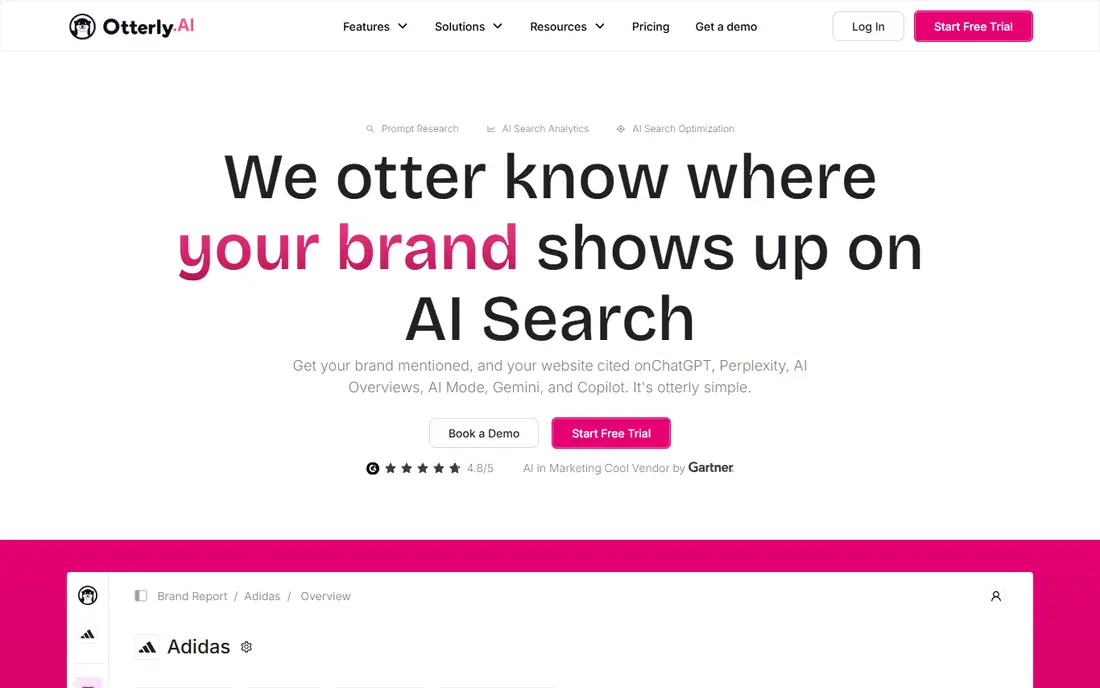
Otterly is the simplest starting point on this list. You build a library of prompts written the way prospects actually ask questions, for example asking for the best project management tool for remote teams, and Otterly runs them across the major AI search engines. It then shows which brands get cited, how often, and in what context. That prompt-first approach matters because AI answers vary by question wording, and a single brand search tells you very little.
The dashboard also covers crawlability checks, content audits and content briefs, which help explain why AI engines skip your pages. The $29 entry plan suits a single brand with a modest prompt list, and teams tracking many products or markets will need to move up. There is a free trial but no free tier, so check engine coverage before paying.
- Covers ChatGPT, Perplexity, Google AI Overviews, Google AI Mode, Gemini, Claude and Copilot
- Prompt library built around real user questions
- Share of voice against competitors
- No permanent free plan
- Higher tiers are needed for larger prompt sets and deeper reporting
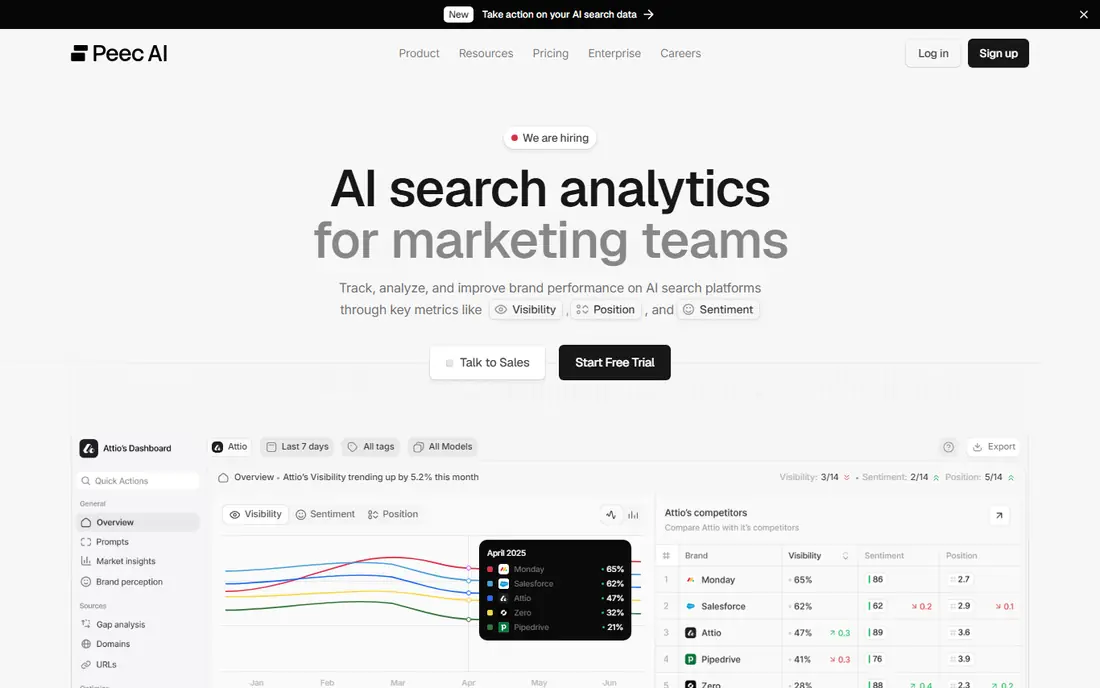
Peec AI is built for teams whose deliverable is the visibility report itself. Its Starter plan covers 50 prompts across three chosen models and one project, with Pro at $245 per month for 150 prompts and Advanced at $495 per month for 350 prompts. Every tier includes unlimited users, which is genuinely useful for agencies that want clients to see their own data without per-seat fees eating the budget.
The platform tracks visibility, position and sentiment across ChatGPT, Google AI Mode, Google AI Overviews, Microsoft Copilot, Perplexity and Gemini, with more models on Enterprise. An Actions module turns findings into a prioritized list of content and channel opportunities, and an MCP server lets AI assistants query your visibility data. The honest limit is scope. Peec reports what AI says about you and what to work on, but it does not write or publish the fix. If you wanted one tool to do the whole job, you will need a second one.
- Daily tracking on every tier
- Unlimited users on every plan
- MCP and API access for pulling data into other tools
- Clear prompt, model and project allowances
- Analytics only, so content fixes still need separate tools
- Costs rise quickly as prompts and models are added
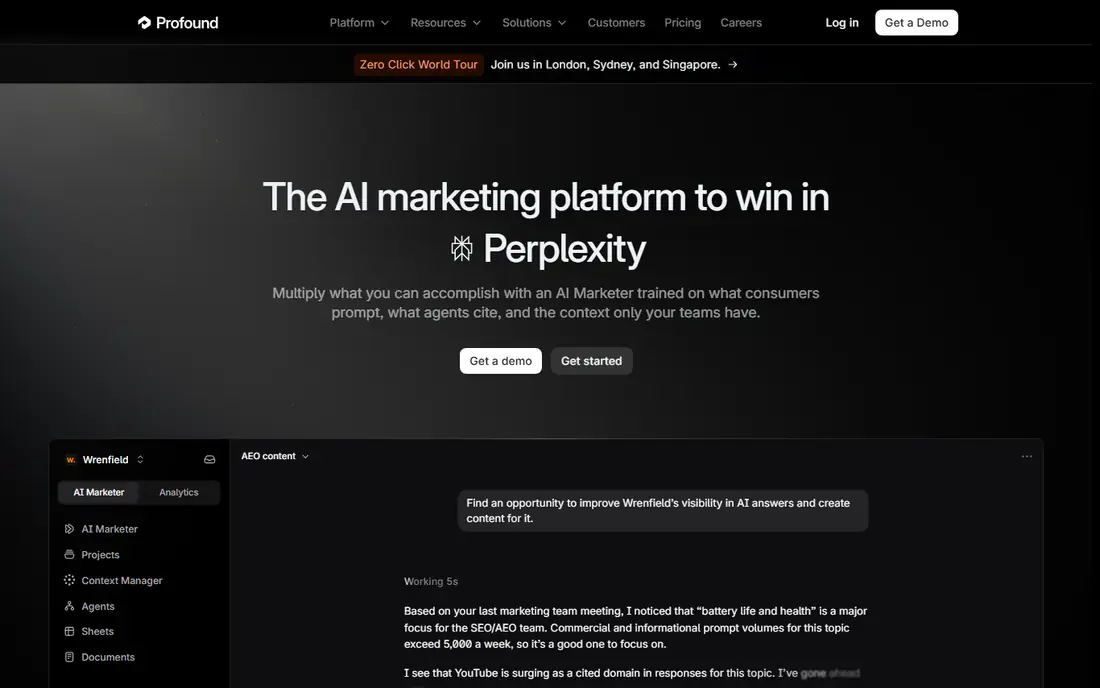
Profound sits at the enterprise end of this market. Its platform tracks brand visibility across ChatGPT, Perplexity, Claude, Gemini, Google AI Overviews and AI Mode, then goes further with agents that identify work worth doing, draft it and ask for approval. It can rewrite pages with citation decay, build pages for questions you have no answer for, and open up content that AI crawlers cannot currently read. For a large brand, that closed loop between measurement and action is the point.
There is also SKU-level tracking for ChatGPT Shopping, sentiment measurement in answer engines, and verification of claims AI makes about your brand, which matters when an answer engine describes your product wrongly. The drawback is access. Profound withdrew its self-serve Starter and Growth plans in September 2026, so smaller teams can no longer sign up at a published price. Expect an enterprise sales process.
- AI Marketer agents that draft work for approval
- ChatGPT Shopping visibility tracking
- Sentiment, benchmarking and claim verification
- Enterprise controls such as RBAC, SCIM and SOC 2
- Pricing is not published on the homepage, so budgeting requires a sales conversation
- Agent features add complexity that small teams may not need
Scrunch describes itself as an AI customer experience platform covering AI search visibility and optimization. That framing suits teams that want one vendor for both measurement and improvement, rather than a tracker plus a separate content workflow. The platform is aimed at brands that treat AI answers as a customer touchpoint, not only an SEO metric.
The main weakness for buyers is transparency. Its homepage does not publish a starting price or a free plan, so you cannot place it in a budget without talking to the vendor first. Ask for the prompt allowance, engine list and reporting limits in writing before signing, since those three details decide the real cost more than the headline figure.
- Positions itself as an AI customer experience platform, not only a tracker
- Covers visibility and optimization together
- Enterprise-friendly positioning
- Starting price is not published on its homepage, so cost comparison requires contacting the vendor
- Feature detail is thinner than rivals that publish full pricing and plan tables
Rankscale is the value pick for teams that want broad engine coverage without a large monthly bill. Its Essentials plan starts at $20 per month, with Pro at $99 per month and a Growth plan aimed at agencies. Every plan covers more than 17 AI engines, including ChatGPT, Perplexity, Claude, Gemini, Google AI Overviews, Google AI Mode, DeepSeek, Grok and Copilot, plus citation analysis, sentiment tracking, competitor comparison and page audits that score AI readiness across more than 200 factors.
The catch is the credit model. Each query draws from a shared credit pool, and some engines cost more per query than others, so a growing prompt set or a faster check cadence burns credits faster. The entry plan fits a light setup, and heavier tracking needs Pro or above. Rankscale is also measurement and diagnostics only. It tells you where visibility is missing and which pages to fix, but the writing and publishing still happen elsewhere.
- Cheapest entry price in this list
- Tracks more than 17 AI engines on every plan
- Citation, sentiment, competitor and page-audit views
- Unlimited team workspaces
- Credit-based billing means costs vary with engines and check frequency
- The entry plan suits light weekly setups rather than heavy daily tracking
ZipTie prices by what you track, not by who uses it. One prompt checked once on one engine works out at about a cent, and the vendor gives examples such as 100 prompts a week on all seven engines at $26.17 per month. Seats, projects and competitors are unlimited, which makes it a natural fit for agencies with a client roster or in-house teams with a portfolio of brands. Every project draws on one shared pool of daily, weekly and monthly prompts, so you size one plan for the whole roster rather than one per client.
The measurement itself is careful. ZipTie captures the answer each engine actually returned, measures citations, mentions and sentiment on every engine, and rolls them into one AI Success Score trend. The weakness is predictability. Because the bill follows prompts, engines and cadence, a team that keeps adding tracked questions will see the total move. Set a prompt budget per client before you start, or the flexibility becomes a cost leak.
- Unlimited seats, projects and competitors on one plan
- About a cent per engine check
- Captures full answers with citations, mentions and sentiment
- Per-project check cadence
- Usage-based billing makes the monthly total vary with prompts, engines and frequency
- No flat-rate plan for teams that want a fixed bill
SE Ranking is the only tool here that is a full SEO platform first and an AI visibility tool second. Its Core plan starts at $103.20 per month, with an AI Search add-on from $71.20 per month, and its SE Visible product tracks brand visibility across five major AI engines, including ChatGPT, Gemini, AI Overviews and AI Mode, with competitor benchmarks and analysis of the prompts and sources behind answers. If your team already tracks rankings, backlinks and keywords, adding AI visibility to the same subscription keeps reporting in one place.
That breadth is also the drawback. A buyer who only wants LLM tracking will pay more here than at Otterly or Rankscale, and the add-on structure means the true AI visibility cost is Core plus AI Search, not Core alone. The 14-day trial is the longest in this list. Choose SE Ranking when you want one platform for both worlds. Choose a pure tracker when AI answers are the only gap you need to close.
- Full SEO platform with AI visibility added
- SE Visible tracks mentions, sentiment and share of voice across five major AI engines
- API and MCP access
- 14-day trial
- Highest starting price in this list
- AI search features sit behind an add-on on top of the Core plan
- More platform than a pure AI tracker buyer may need
How we picked these
We started from tools that track how brands appear in answers from ChatGPT, Perplexity, Gemini, Copilot and Google AI features, then kept only those with a live product and a current website in October 2026. Each tool had to offer prompt-based tracking with mention or citation data, not only a one-off audit. We checked official feature pages and pricing pages, plus pages quoting vendor pricing, and we dropped tools whose homepages could not be confirmed or whose pricing could not be checked at all.
We favored a mix of prices and buyers. That is why a $20 entry plan sits next to an enterprise platform with unpublished pricing. Where a vendor did not publish a price, we wrote See website instead of repeating an old figure from a review site.
What to check before you pay for an LLM SEO tracker
A tracker is only useful if it watches the engines your customers actually use, at a prompt volume you can afford, with reports your team will read.
Engine coverage
List the engines your buyers use before you compare tools. Most buyers need ChatGPT, Perplexity and Google AI Overviews at minimum, plus Gemini or Copilot depending on audience. Some tools cover more than 17 engines, while others cover five or six. Match the list to your market rather than paying for engines your customers never open.
Prompt limits and credits
Prompt allowances decide the real price. Some tools sell a fixed number of prompts per plan, while others sell credits that drain at different rates per engine. Count your branded prompts, your main comparison prompts and your category questions before buying, then add room for the extra questions you will discover in the first month.
Reporting that gets read
The best tracker is the one whose reports reach decisions. Check whether it offers share of voice against named competitors, sentiment trends, citation sources and exports your team can send to clients or leadership. Unlimited seats, client-ready exports and API access all help here, and they are worth weighing next to price.
Trial terms
Use the trial to test your own prompts, not the vendor demo set. Enter your brand, two competitors and ten real customer questions, then check whether the answers, citations and sentiment look right. Trials here range from 7 to 14 days.
Frequently asked questions
Sources we checked (9)

Online Jobs is an independent blog about careers, online work, learning new skills and the tools that help people earn. More about us.
Keep reading
All posts
Best website audit tools
Looking for the best website audit tools? We compare 8 leading crawlers and suites on crawl depth, reporting, crawl limits, and price to help you pick well.
Best SEO Audit Tools
Looking for the best SEO audit tools in 2026? We compare 8 tools for technical crawls, site health, links, monitoring and client-ready reports for agencies.
Best Moz Alternatives
Compare the best Moz alternatives for keyword research, backlinks, rank tracking and site audits, with free options, pricing notes and honest trade-offs.