Home / SEO and AI search tools
8 Best LLM Rank Tracker Software Tools for AI Search Visibility

How we put this together: we compare official feature and pricing pages, app store listings, privacy policies and public user reviews. Prices change, so check the provider's site before you pay.
Key takeaways
- The best llm rank tracker software checks prompts across several answer engines, not just one chatbot.
- Free options exist for a first check, but regular tracking of many prompts usually sits behind a paid plan.
- Citation and source data matter as much as mention counts, because they show which pages the models quote.
- Prompt lists need care: broad prompts show brand presence, while specific prompts show buying intent.
- Prices change often in this new category, so check the vendor pricing page before you commit.
Quick comparison
| Name | Who it suits | Starting price | Free option | |
|---|---|---|---|---|
 Otterly.AI | Small teams on a budget | See website | Free trial | Visit |
 Peec AI | Agencies tracking many markets | See website | Free trial | Visit |
 Profound | Large brands with deep reporting needs | See website | No | Visit |
 Scrunch AI | Teams that also study AI crawlers | See website | Free trial | Visit |
 AthenaHQ | Teams that want a free starting point | See website | Yes | Visit |
 SE Ranking | SEO teams adding AI tracking | See website | Free trial | Visit |
 Goodie | Brands that want next steps, not just charts | See website | Free trial | Visit |
 Rankscale | Startups that want flexible checks | See website | Free trial | Visit |
The best llm rank tracker software
We compared tools that track brand mentions, citations, and prompt-level visibility across AI answer engines. The best llm rank tracker tools below cover different budgets, from a first low-cost check to a full program for a large brand.
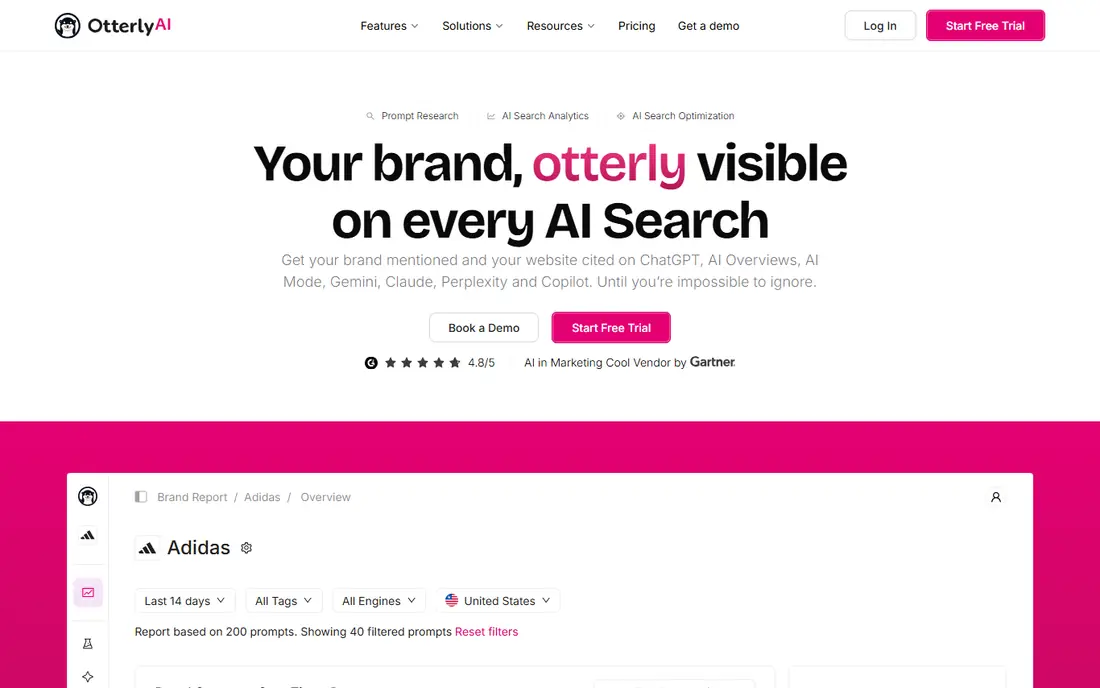
Otterly.AI fits a small team that wants a clear answer to a simple question: does an AI answer mention us, and in what context. The dashboard keeps prompt tracking, mentions, and citations in one place, so a marketer can review a week of results without learning a complex system. That focus makes it a sensible first tool for a business that is new to AI search tracking. The honest catch is scale. A small prompt list works well here, but a large brand with many products, regions, and competitors will soon want more prompts and more engines. Entry plans also give less depth on why a model cited one source over another. Use Otterly.AI to learn the pattern of your visibility, then judge whether a larger platform is worth the extra cost.
- Clear prompt-level reports
- Covers ChatGPT, Perplexity, and Google AI Overviews
- Simple setup for a first program
- Higher plans are needed for wider engine coverage
- Advanced analysis is limited at entry level
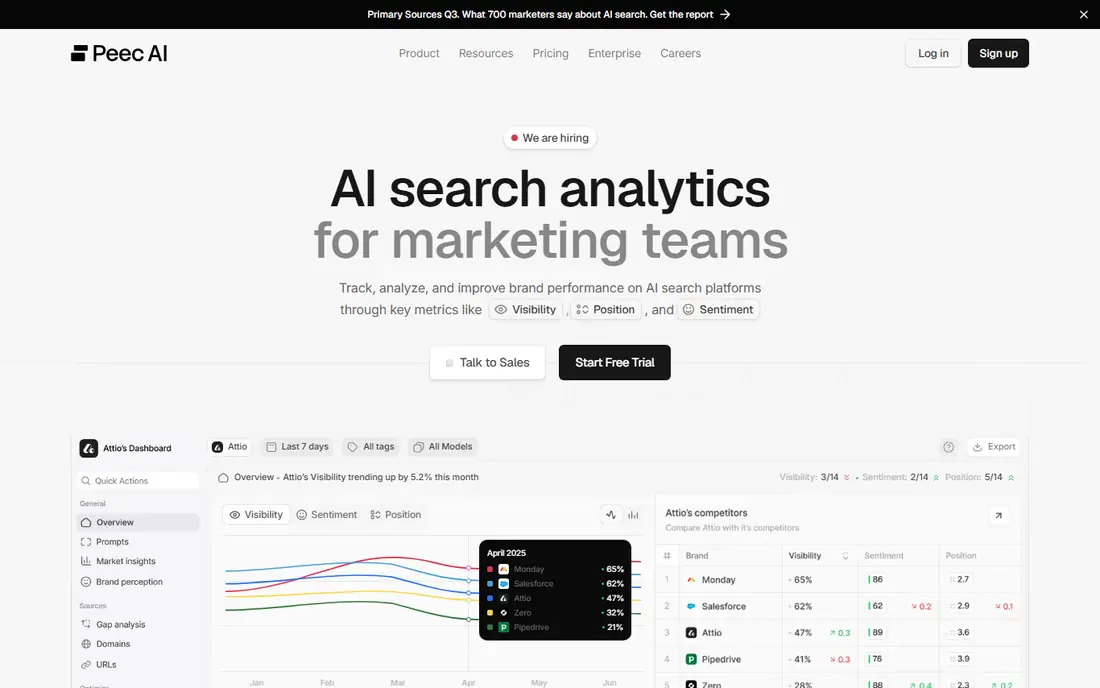
Peec AI fits agencies and mid-market teams that need to compare visibility across countries and languages. Its reports pair mention data with sentiment, which helps a team see not just that a brand appeared, but how the answer framed it. For a team managing several clients, that added context can turn a weekly report into a useful client conversation. The trade-off is cost control. Prompt counts and model coverage rise with plan level, so an agency should map clients to prompts before signing up. A team that tracks only one market may find a simpler tool does the same job for less. Peec AI earns its place when breadth across markets is the main need.
- Multi-country and multi-language tracking
- Competitor comparison
- Sentiment views alongside mentions
- Pricing is not always clear at a glance
- Entry limits can feel tight for an agency with many clients
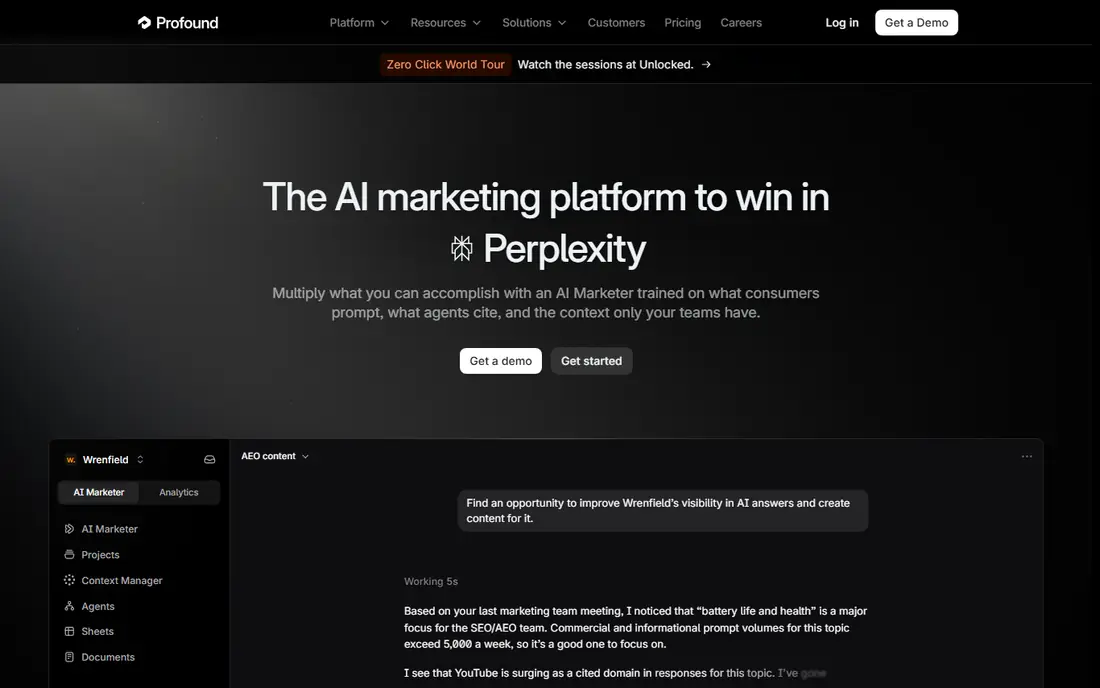
Profound fits a large brand that treats AI search as a core channel, not a side project. Its strength is depth: prompt volume, answer analysis, and citation detail that support a full content and search program. Larger teams can also connect crawler and traffic data on higher plans, which helps link AI mentions to real visits. The catch is that the public entry offer is much narrower than the enterprise product. A small team may pay for a brand name and get only part of the engine list. Profound is best judged on a demo tied to your own prompts, competitors, and markets, with a clear list of which engines and features sit in the quoted plan.
- Wide engine coverage on higher plans
- Detailed answer and citation analysis
- Built for large teams
- No free plan
- Entry coverage is narrower than the full enterprise offer
- Best value needs a larger budget
Scrunch AI fits teams that want to know both what AI answers say and how AI crawlers reach their site. That second view matters, because a page that crawlers cannot reach well is less likely to be cited. Its persona and funnel views also help a team test how different buyer types see the brand in AI answers. The honest weakness is price and effort. Scrunch AI is not a quick, cheap check. It suits a team that already has an SEO program and can act on crawler findings. A small business that only wants a monthly mention count will find simpler and cheaper options on this list.
- Prompt monitoring plus AI crawler analytics
- Persona and funnel views
- Useful for technical SEO teams
- Higher starting cost than budget tools
- Setup takes more time
- Some features sit on enterprise plans
AthenaHQ fits a team that wants to try AI visibility tracking before paying. The free plan lets you run a small set of prompts and see whether the data is useful for your brand. On paid plans, it covers a wider set of engines and adds actions based on what the tracking finds, which helps a team move from reading charts to fixing content. The catch is that the free plan is a test, not a full program. Prompt limits will bind quickly for a brand with many products. Treat AthenaHQ as a low-risk way to learn the category, then compare its paid limits with Peec AI and Otterly.AI before you scale up.
- Free plan for a first test
- Broad engine coverage on paid plans
- Action-focused reporting
- Free plan limits are tight
- Paid plans rise in cost quickly
- Smaller vendor than some rivals
SE Ranking fits an SEO team that already tracks Google ranks and wants AI visibility in the same place. That matters for day-to-day work, because the team can compare classic search results and AI answers without switching tools. Site audits, backlink checks, and keyword tracking sit alongside the AI data, which keeps reporting in one system. The weakness is focus. A dedicated tool may go deeper on AI prompts, citations, and sentiment. SE Ranking is the right pick when AI tracking is one part of a wider SEO job, not the whole job. If AI answers become your main channel, a dedicated platform may still be needed later.
- AI visibility inside a full SEO suite
- Rank tracking and site audits in one account
- Familiar workflow for SEO teams
- AI tracking is an add-on to a wider suite
- Prompt limits depend on plan
- Less focused than a dedicated AI tool
Goodie fits a brand that already knows AI search matters and now wants a work list. Instead of stopping at mention counts, it points to pages and topics that may improve how models describe the brand. That focus helps content teams, because the report links a finding to a concrete edit or a new page. The catch is resources. A list of fixes only helps if someone can make the edits. A small team with no content time may prefer a cheaper tracker and a short monthly review. Goodie earns its cost when a team can act on its suggestions each week and measure whether mentions and citations move.
- Turns visibility data into prioritised fixes
- Wide model coverage
- Clear brand description analysis
- Higher starting cost
- Best suited to brands with content resources
- Less useful as a one-off check
Rankscale fits a startup that wants to watch a focused set of prompts without an enterprise contract. Its flexible approach suits a team that tracks a product launch, a new market, or a small set of competitor prompts. The simple layout also helps a founder or a solo marketer check results quickly. The honest weakness is maturity. Rankscale does not yet match the depth of Profound or Scrunch AI on analysis and integrations. For a startup, that trade can be fine, because the main need is a reliable, affordable signal. Larger teams with complex reporting needs should shortlist a more established platform.
- Lower entry cost than enterprise tools
- Pay-per-check style flexibility
- Simple prompt tracking
- Newer vendor with a smaller feature set
- Less depth on crawler data
- Support and docs are still growing
How we picked these
We compared official feature pages, pricing pages, app and vendor descriptions, privacy and plan details, and public reviews for each tool. We looked for real prompt tracking across AI answer engines, citation or source data, competitor comparison, and a clear way to act on results. We did not claim hands-on testing. Where a price or limit could not be confirmed on the vendor site at the time of writing, we wrote See website rather than copying a third-party figure.
What to check before you buy
Start with your prompt list, because that list decides the plan you need. Write 20 to 50 prompts a real buyer might ask, split between brand prompts, product prompts, and general advice prompts. Then check how many of those prompts each tool can track each month, and which engines it covers for that plan. A cheap plan that covers only one engine can miss most of your visibility.
Match the tool to your team size
A solo marketer needs simple reports and a low monthly cost. An agency needs client workspaces and multi-country tracking. A large brand needs wide engine coverage, user roles, and data exports. Do not buy enterprise depth for a solo job, and do not expect a budget tool to run a global program.
Read citations, not just scores
AI visibility scores are directional, not exact. Two tools can give different scores for the same brand because they use different prompts and models. Citations are more useful: they show which pages models quote, and which competitor pages appear instead. Use that list to fix thin pages, add clear facts, and improve pages that should rank as sources.
Plan for change
Models, prompts, and answers change often. Re-check your prompt list each quarter, drop prompts that no longer match buyer language, and add prompts for new products. Keep a short monthly note on what changed and what you fixed, so the tool becomes part of your content work rather than a chart you glance at once.
Frequently asked questions
What is the best free llm rank tracker tool?
A free plan, such as the one from AthenaHQ, works for a small first test with a limited prompt list. For regular tracking, most teams move to a paid plan, because free limits bind quickly. List the best free llm rank tracker tools by prompt count and engine coverage, not by marketing claims, and test one with your own prompts before you judge it.
What is the best llm rank tracker tool for agencies?
Peec AI and Profound suit agencies for different reasons. Peec AI helps with multi-country tracking, while Profound suits large clients that need deep reporting. The best llm rank tracker tool for an agency is the one whose prompt limits, client workspaces, and export options match its client list.
How is LLM rank tracking different from Google rank tracking?
Google rank tracking checks a position in a list of links. LLM tracking checks whether a brand is mentioned, cited, or recommended inside a generated answer. The two can differ a lot, because a page that ranks well on Google may not be the page an AI model quotes.
How many prompts should I track?
Start with 20 to 50 prompts that cover brand, product, comparison, and advice questions. That range gives a useful signal without a large bill. Add prompts only when you can review the results and act on them each month.
Can a rank tracker improve my AI visibility on its own?
No. A tracker shows what models say and cite. Improvement comes from clearer pages, accurate facts, useful comparisons, and content that answers buyer questions directly. Use the tracker to find gaps, then fix the pages behind those gaps.
Do I need to track every AI engine?
No, at first. Start with the engines your buyers actually use, which for most teams means ChatGPT, Perplexity, and Google AI results. Add more engines when you have a reason, such as a market where another engine is common.
Sources we checked (8)

Online Jobs is an independent blog about careers, online work, learning new skills and the tools that help people earn. More about us.
Keep reading
All posts
n8n Alternatives
n8n alternatives compared for 2026, with Zapier, Make, Activepieces, and more, covering visual builders, code steps, self-hosting, and pricing models.
eBay Alternatives
Looking for ebay alternatives? We compared 9 marketplaces for sellers on fees, buyer reach, categories and ease of listing, to help you sell with confidence.

ZoomInfo Alternatives
The best ZoomInfo alternatives in 2026, compared on price, free plans, data coverage, and which tool fits small teams or large sales teams best in detail.