Best Investment Apps for Beginners in 2026: 8 Apps Compared

How we put this together: we compare official feature and pricing pages, app store listings, privacy policies and public user reviews. Prices change, so check the provider's site before you pay.
Key takeaways
- Fidelity is the best all-round beginner app, with $0 stock and ETF commissions, fractional shares from $1, and strong retirement tools.
- Charles Schwab is a close alternative, with $0 stock and ETF commissions, research, and Stock Slices from $5.
- Robinhood suits mobile-first beginners who want a simple app and fractional investing from $1.
- Acorns and Betterment suit hands-off beginners who prefer automated investing over picking stocks.
- This guide is for education only and is not financial advice, and investing carries risk, including loss of money.
Quick comparison
| Name | Who it suits | Starting price | Free option | |
|---|---|---|---|---|
 Fidelity | All-round beginners | Free | Yes | Visit |
 Charles Schwab | Research and education | Free | Yes | Visit |
 Robinhood | Mobile-first simplicity | Free | Yes | Visit |
 Vanguard | Long-term index investing | Free | Yes | Visit |
 SoFi Invest | Simple app plus automation | Free | Yes | Visit |
 Webull | Paper trading practice | Free | Yes | Visit |
 Acorns | Automated spare-change investing | See website | No | Visit |
 Betterment | Hands-off robo investing | See website | No | Visit |
The best investment apps for beginners
This guide is for education only and is not financial advice. Investing carries risk, and the value of investments can fall as well as rise, so you could get back less than you put in. The apps below differ in cost, research, account types, and automation, so the best choice depends on whether you want to pick investments yourself or have a portfolio managed for you.
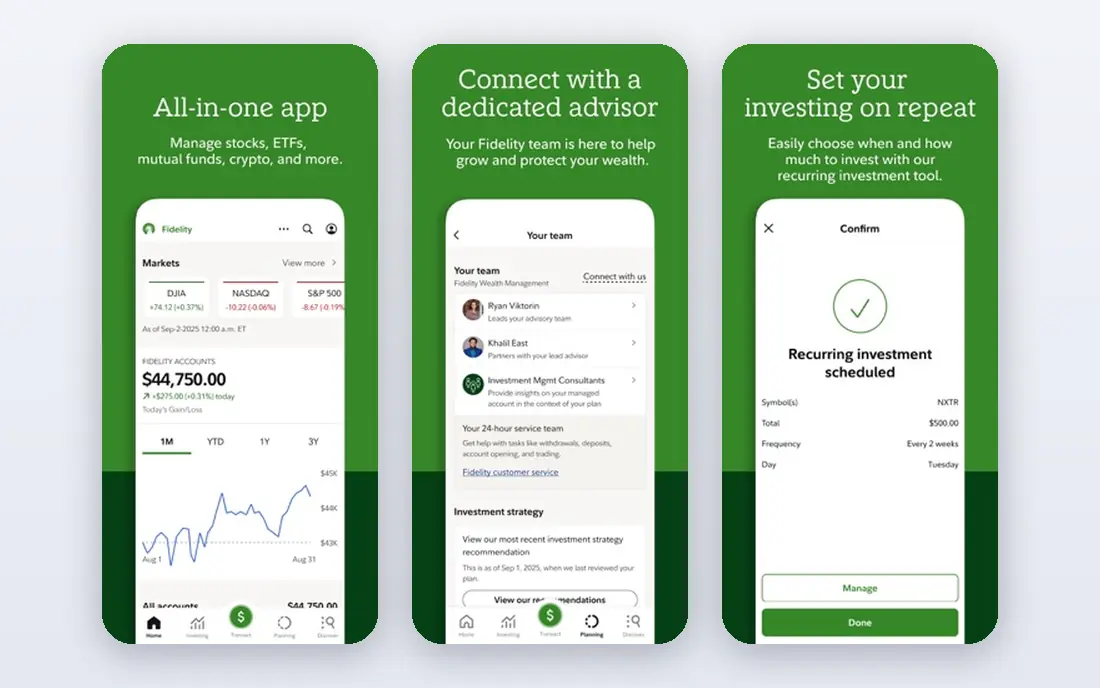
Fidelity is the safest default for a beginner who wants one account that can grow with them. You can buy fractional shares from $1, open a taxable account or an IRA, and access research and education without paying stock and ETF commissions. Zero-expense-ratio index funds are also available for eligible funds, which keeps long-term costs low for index investors. The app is broad rather than minimal, so new users may need time to find the right menus. That breadth is also the point, since the same account can later handle retirement planning, mutual funds, and more advanced orders. For most beginners, Fidelity offers the best balance of cost, choice, and support.
- $0 stock and ETF commissions
- Fractional shares from $1
- Strong IRA and research tools
- App menus can feel deep for total beginners
- Some advanced tools take time to learn
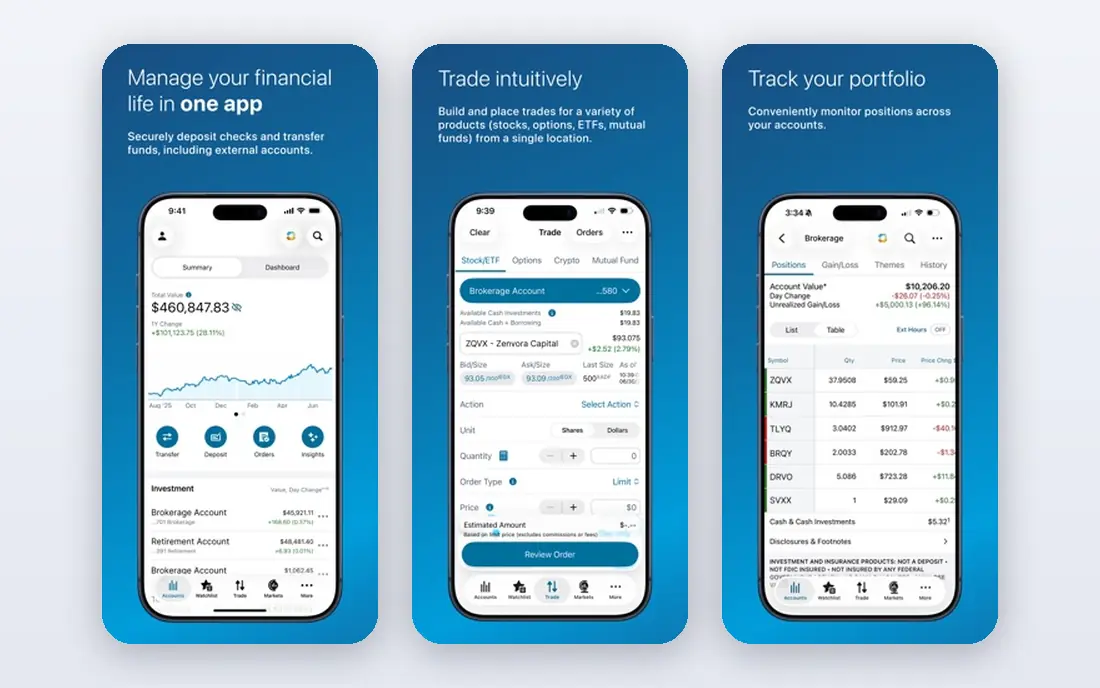
Charles Schwab pairs a clear main app with deep research, which helps beginners who want to learn as they invest. Stock Slices allow fractional buying from $5 for eligible S&P 500 stocks, and the education library covers basics through to advanced topics. Retirement accounts, taxable accounts, and planning tools are all in one place. The thinkorswim platform, now part of Schwab, is powerful but more complex than the main app, so beginners should start with the main app and move over only when they want advanced charting. Schwab suits learners who value research and want a broker that still serves them well years later.
- $0 stock and ETF commissions
- Stock Slices from $5
- Strong research and education library
- Main app plus thinkorswim can feel like two products
- Stock Slices cover eligible S&P 500 stocks

Robinhood is the easiest app to open and use, with a clean interface that takes a new investor from signup to a first fractional purchase in a few steps. Recurring investments and fractional shares from $1 make it practical for small, regular amounts, and the IRA match feature rewards consistent retirement saving for eligible users. For casual, mobile-first investing, it is hard to beat for simplicity. Research is lighter than Fidelity or Schwab, and there are no mutual funds, so investors who want deep analysis or a broad fund range may outgrow it. Robinhood suits beginners who want a simple start, provided they avoid margin, keep trading frequency low, and focus on a long-term plan.
- Very simple mobile app
- $0 stock and ETF commissions
- Fractional shares and recurring investing
- Limited research and no mutual funds
- Paid Gold tier adds features at a monthly cost
Vanguard is built for patient, long-term investors who prefer low-cost index funds over frequent trading. Its own index funds and ETFs are among the lowest-cost options in the industry, and the app covers taxable accounts, IRAs, and retirement planning in a straightforward way. For a beginner who wants to buy a diversified fund and hold it, Vanguard is a calm, low-cost choice. The app experience is less polished than Robinhood or Fidelity, and some mutual funds still carry minimums. Vanguard suits investors who care more about fund costs and a long-term plan than about a slick trading interface or advanced charting.
- $0 stock and ETF commissions
- Low-cost index funds and ETFs
- Strong long-term focus
- App feels less modern than rivals
- Some mutual funds have minimums
SoFi Invest suits beginners who want a simple app and the option to automate, without choosing between two separate services. You can buy stocks and ETFs with $0 commissions, set up recurring investing, or use automated portfolios if you prefer not to pick investments yourself. The wider SoFi app also covers banking and other financial products for users who want one login. Research and advanced tools are lighter than at Fidelity or Schwab, so active learners may want a second source for analysis. SoFi Invest fits beginners who value simplicity, automation, and a clean mobile experience over deep research.
- $0 stock and ETF commissions
- Clean app
- Automated investing option alongside self-directed trading
- Research is lighter than Fidelity or Schwab
- Product range is narrower than full brokers
Webull is a good pick for beginners who want to practise before risking real money, because its paper trading mode lets you test strategies with virtual funds. The live app also offers $0 stock and ETF commissions, fractional shares, and charting that is stronger than many free apps. For learners who enjoy charts and data, Webull gives more to explore than Robinhood. The interface can feel busy for a total beginner, and guidance is less structured than at Schwab or Fidelity. Webull suits confident learners who want to practise first, then trade small amounts, while keeping risk low and avoiding margin.
- $0 stock and ETF commissions
- Paper trading with practice money
- Strong charting for a free app
- Interface can overwhelm total beginners
- Research is less guided than Schwab or Fidelity
Acorns takes a different route by automating investing from small amounts, including round-ups from everyday purchases. That habit-building approach suits beginners who struggle to set aside a lump sum, since small, regular contributions add up over time. Portfolios are diversified and managed for you, so there is no need to pick individual stocks. The subscription fee is the catch, since a monthly charge matters more when balances are small. Acorns suits hands-off beginners who value automation over control, and who will invest regularly enough for the habit to outweigh the fee. Check the current plan price before signing up.
- Automates small, regular investing
- Spare-change round-ups
- Simple portfolios for beginners
- Subscription fee applies
- Less control for investors who want to pick stocks
Betterment is a robo-advisor, which means it builds and manages a diversified portfolio based on your goals, risk level, and time horizon. Automatic rebalancing, goal tracking, and retirement planning tools make it a strong pick for beginners who want to invest without choosing funds or timing markets. The app explains goals in plain terms, which helps new investors stay on plan. An advisory fee applies, usually as a percentage of assets, so costs rise as your balance grows. Betterment suits hands-off investors who want a managed portfolio and are happy to pay for automation, rather than investors who want to pick stocks themselves.
- Goal-based automated portfolios
- Automatic rebalancing
- Retirement and cash tools in one app
- Advisory fee applies
- Not suited to picking individual stocks
How we picked these
We compared official fee pages, account pages, app store listings, and public education notes for brokers and robo-advisors that serve beginners. We favoured apps with $0 stock and ETF commissions or a clear subscription model, fractional investing or automation, retirement accounts, and a distinct job, from self-directed trading to hands-off portfolios. We also noted where fees apply to options, advisory services, or subscriptions, because headline $0 commissions do not cover every cost. We did not rank apps by past returns or by promises about future performance. The picks reflect cost, ease of use, research, automation, and fit for different beginners. Fees and features change, so check the vendor fee page and account terms before opening an account.
Choosing the right investment app for you
Start with how involved you want to be. Self-directed apps suit investors who want to pick stocks, ETFs, or index funds themselves. Robo-advisors suit investors who want a managed portfolio based on goals. Both routes can work, but mixing them without a plan often leads to duplicate holdings and confusion.
Start small, automate, and avoid borrowed money
Begin with an amount you can afford to leave invested, use recurring contributions if your app supports them, and avoid margin and borrowed-money products as a beginner. Fractional shares let you start with small amounts, but small does not mean risk-free. Keep an emergency fund separate from investing, and review your plan once or twice a year rather than reacting to daily price moves.
Check accounts, fees, and tax notes
Confirm whether the app offers the account you need, such as a taxable account, Roth IRA, or traditional IRA, and check options fees, advisory fees, and subscription costs. Keep records of contributions and sales for tax reporting, and seek independent financial advice if you are unsure about retirement, tax, or large sums. This guide is education only, not personal financial advice.
Frequently asked questions
What is the best investment app for beginners?
Fidelity is the best all-round pick, with $0 stock and ETF commissions, fractional shares from $1, and strong retirement and research tools. Charles Schwab is a close alternative, while Robinhood suits mobile-first beginners who want the simplest app. The best choice depends on whether you want research, simplicity, or automation.
What is the best app for investing in stocks as a beginner?
Fidelity, Charles Schwab, and Robinhood all offer $0 stock and ETF commissions and fractional shares, which makes starting with small amounts practical. Fidelity and Schwab add stronger research, while Robinhood adds the simplest mobile experience. Start with diversified ETFs or index funds before buying single stocks, and keep position sizes small.
How much money do I need to start investing?
Many apps allow fractional investing from $1 or $5, and several have no account minimum for a taxable or IRA account. Acorns and robo-advisors focus on small, regular amounts, though subscription or advisory fees apply. Start with an amount you can afford to leave invested, and build the habit with regular contributions.
What is the best investment app to earn money?
No app guarantees earnings, and any claim that it does should be treated with caution. Long-term, diversified investing has historically rewarded patience, but values can fall and past performance does not predict future returns. Focus on low costs, diversification, and a time horizon of years, not days, and avoid borrowed money as a beginner.
Is Robinhood good for beginners?
Robinhood is good for beginners who want a simple mobile app, $0 commissions, and fractional investing from $1. Its research is lighter than Fidelity or Schwab, and it does not offer mutual funds. It suits a simple start, provided you avoid margin, trade infrequently, and use a long-term plan.
Should I use a robo-advisor or pick stocks myself?
A robo-advisor suits beginners who want a managed, diversified portfolio without picking investments, while self-directed apps suit investors who want control and are willing to learn. Robo-advisors charge an advisory fee, while self-directed trading can be $0 for stocks and ETFs but requires more decisions. Many beginners start with a robo-advisor or diversified ETFs, then learn self-directed investing over time.
Sources we checked (8)

Online Jobs is an independent blog about careers, online work, learning new skills and the tools that help people earn. More about us.
Keep reading
All posts
Best Trading Apps for Beginners
Compare the best trading app for beginners, with $0 stock commissions, fractional shares, education, paper trading and account types explained in 2026 now.
Best Trading App
We compared the best trading apps for beginners and active traders on fees, tools, accounts and ease of use, so you can pick a platform that fits your plan.
Best Tax Software
Compare the best tax software in 2026 for simple returns, investors, freelancers, and preparers, with free options, state fees, and honest limits for filing.