Best Investment Apps in 2026: 9 Apps Compared

How we put this together: we compare official feature and pricing pages, app store listings, privacy policies and public user reviews. Prices change, so check the provider's site before you pay.
Key takeaways
- Fidelity and Charles Schwab suit beginners who want research, education and retirement accounts alongside a taxable account.
- Robinhood and Webull suit mobile-first traders, but their simplicity can encourage frequent trading, which hurts long-term returns.
- Vanguard suits long-term index investors who want low-cost funds and are happy with a simpler app.
- Betterment and Wealthfront suit hands-off investors who want a managed portfolio and automatic rebalancing.
- This is not financial advice, and investing carries risk, including loss of capital. Check fees, account types and tax rules before investing.
Quick comparison
| Name | Who it suits | Starting price | Free option | |
|---|---|---|---|---|
 Fidelity | Overall beginners | Free | Yes | Visit |
 Charles Schwab | Education and research | Free | Yes | Visit |
 Robinhood | Mobile-first beginners | Free | Yes | Visit |
 Vanguard | Long-term index investors | Free | Yes | Visit |
 Webull | Active mobile traders | Free | Yes | Visit |
 E*TRADE | Options and active traders | Free | Yes | Visit |
 Betterment | Hands-off managed investing | See website | No | Visit |
 Wealthfront | Automated investing plus cash tools | See website | No | Visit |
 SoFi Invest | Beginners who want banking plus investing | Free | Yes | Visit |
The best investment apps
We compared official fee pages, account information and public reviews, and we focused on US brokerage and robo-advisor apps that a beginner can actually open and use. Stock and ETF commissions are $0 at most brokers here, so the real differences are research, education, account types, fractional shares and managed portfolio fees, not headline commissions.
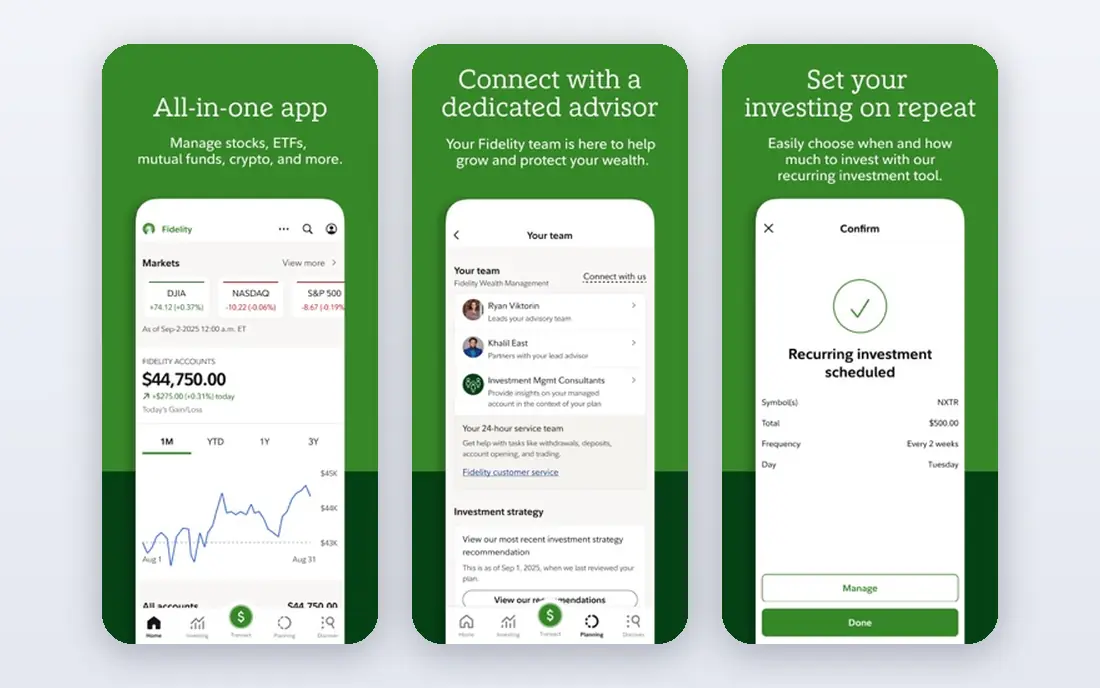
Fidelity is our pick for most beginners because it covers every stage of investing in one place. You can open a taxable account, a Roth IRA or a traditional IRA with $0 minimum in many cases, buy fractional shares from $1 in many stocks and ETFs, and use research, screeners and education guides that explain concepts without jargon. Its customer service record in public reviews is also strong, which matters when a first transfer or tax form confuses you.
The app can feel dense on first open, with many menus and tools that a beginner will not need yet. Options trading costs $0.65 per contract, which is standard but not the cheapest, and some advanced tools sit behind a separate Active Trader platform. If you want one account that can grow from a first $50 into retirement saving, Fidelity is the most complete starting point.
- $0 stock and ETF commissions
- $0 account minimum in many accounts
- Strong research, education and retirement accounts
- App can feel dense for a first-time investor
- Options cost $0.65 per contract
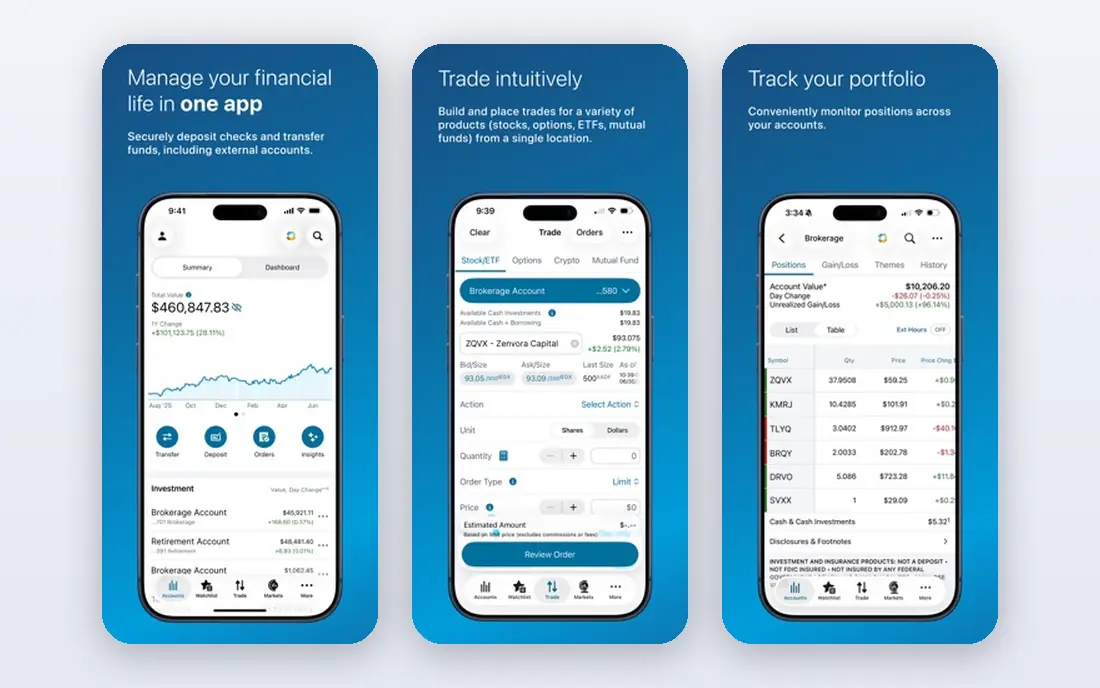
Charles Schwab suits a beginner who wants to learn while investing. Its education library, market research and paper trading practice, where available, help a new investor test ideas without risking money, and its accounts cover taxable, IRA and retirement needs with $0 minimum in many cases. The thinkorswim platform, inherited from TD Ameritrade, gives active traders charting and analysis tools that few rivals match.
The experience feels more formal than Robinhood, with a busier interface and more terminology on screen. That depth is useful once you learn it, but it can slow a first week. Options also cost $0.65 per contract, like Fidelity. If education and research matter more than a minimalist app, Schwab is a strong alternative to Fidelity.
- $0 stock and ETF commissions
- Strong education library
- Thinkorswim platform for active traders
- App feels more formal than Robinhood
- Options cost $0.65 per contract
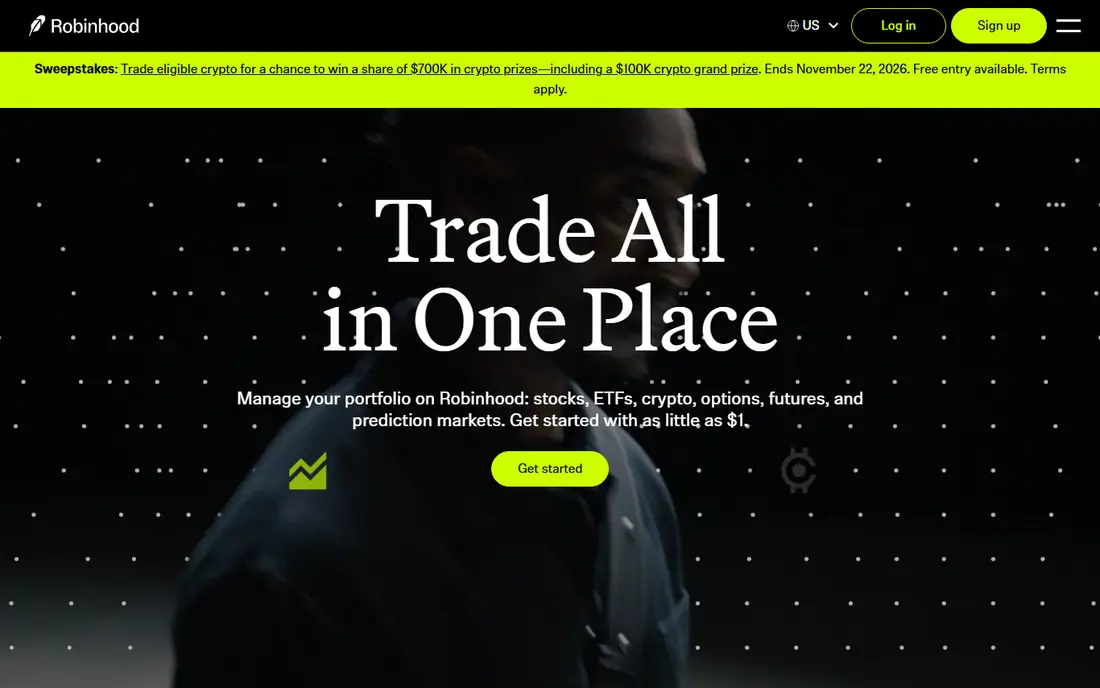
Robinhood is the easiest investing app to start with, and that simplicity is both its strength and its risk. Opening an account, buying fractional shares and tracking a portfolio takes minutes on a phone, and $0 commissions cover stocks, ETFs and options, with crypto available in the same app. Its IRA offers a contribution match in some plans, which can help a beginner start retirement saving.
Research, education and customer support are thinner than at Fidelity or Schwab, and the app design, with its focus on price moves and quick trades, can encourage frequent trading. Frequent trading usually hurts long-term returns through taxes and timing mistakes, so a Robinhood user needs a plan, like regular investing in broad funds, before opening the app daily. Use it for simplicity, not for speculation.
- Very simple mobile app
- $0 stock, ETF and options commissions
- Fractional shares and IRA with a match in some plans
- Research and education are thinner
- Simple design can encourage frequent trading
Vanguard suits investors who want to buy broad index funds and hold them for years. Its own index funds and ETFs are among the lowest cost in the industry, its accounts cover taxable and IRA needs, and its philosophy, low costs, diversification and patience, is stated plainly across its site. For a long-term investor, that focus matters more than a flashy app.
The app itself is simpler and less polished than Fidelity or Robinhood, with fewer trading tools and a more basic interface. Options cost $1 per contract in many listings, higher than Fidelity or Schwab, so active options traders should look elsewhere. If your plan is regular investing in index funds, Vanguard low costs and long-term focus are hard to fault.
- $0 stock and ETF commissions
- Low-cost index funds and ETFs
- Strong focus on long-term investing
- App is simpler and less polished
- Options cost $1 per contract in many listings
Webull is built for mobile traders who want charts, data and speed. Its app offers detailed charting, technical indicators, extended hours trading and paper trading, with $0 commissions on stocks, ETFs and options in many listings. For an intermediate trader who has outgrown Robinhood simplicity but still wants a phone-first app, Webull is a natural next step.
Retirement planning, education and human advice are thinner than at Fidelity or Schwab, and its active design, like Robinhood, can encourage more trading than is good for long-term returns. Webull also charges a transfer-out fee in some listings, so leaving later can cost money. Use Webull for active trading with a clear plan, and keep long-term retirement saving in a separate, calmer account if needed.
- $0 stock, ETF and options commissions in many listings
- Strong charting on mobile
- Paper trading available
- Less retirement and education support than Fidelity
- Active design can encourage overtrading
ETRADE, part of Morgan Stanley, suits active traders and options users who want a dedicated platform. Power ETRADE offers charting, options chains and risk tools, while the main app covers everyday investing, banking and retirement accounts. Stock and ETF commissions are $0, and options cost $0.65 per contract, with $0.50 for active traders in some listings.
Fractional shares are not offered in the same way as at Fidelity or Robinhood in many listings, so a beginner with a small amount may find it harder to buy expensive stocks. The platform also feels more complex than a beginner app, though its education library helps. If options or active trading is your focus, E*TRADE is a strong pick, but a pure beginner may prefer Fidelity first.
- $0 stock and ETF commissions
- Power E*TRADE platform
- Strong options tools and education
- No fractional shares in many listings
- Options cost $0.65 per contract, with a lower rate for active traders
Betterment suits investors who want a managed portfolio without picking stocks themselves. You set a goal, like retirement or a house deposit, choose a risk level, and Betterment builds a diversified portfolio of ETFs, rebalances it automatically and, in some plans, harvests tax losses. That hands-off approach helps beginners who know they should invest but do not want to research funds.
The cost is an annual advisory fee, listed at 0.25% in many comparisons, which is small but real, and you give up control over individual picks. Betterment also offers checking and cash accounts in some plans, which can simplify money management. If you want to set up regular investing and stop thinking about it, Betterment is a sensible choice, but compare its fee with simply holding a low-cost index fund yourself.
- Managed portfolios with automatic rebalancing
- Goal-based planning
- Tax-loss harvesting in some plans
- Annual advisory fee applies
- Less control over individual stock picks
Wealthfront is similar to Betterment, with a managed ETF portfolio, automatic rebalancing and tax-loss harvesting, plus a cash account that can hold spending money alongside investments. Its planning tools cover goals, retirement and home buying, and its app presents a clear view of net worth across accounts. For a hands-off investor who also wants cash tools in one place, that combination is appealing.
The advisory fee is also listed at 0.25% in many comparisons, and the investing account minimum is $500 in many listings, higher than Betterment $0 minimum. That minimum may delay a beginner with a small starting amount, though the cash account can be opened separately. If you have $500 to start and you want automation plus cash tools, Wealthfront is worth comparing with Betterment on fees and features.
- Managed portfolios with automatic rebalancing
- Tax-loss harvesting
- Cash account and borrowing features
- Annual advisory fee applies
- $500 minimum in many listings for investing accounts
SoFi Invest suits a beginner who already uses SoFi for banking or loans and wants investing in the same app. Stock and ETF commissions are $0, fractional shares are available, and automated investing options cover hands-off portfolios alongside self-directed trading. Its interface is friendly, and its education content covers basics without overwhelming a new investor.
Research and advanced trading tools are thinner than at Fidelity, Schwab or E*TRADE, so an active trader will outgrow SoFi quickly. Its managed portfolios are also simpler than Betterment or Wealthfront. If you want one app for banking and a first investment account, SoFi is convenient, but a dedicated brokerage may serve a growing portfolio better over time.
- $0 stock and ETF commissions
- Fractional shares
- Banking, loans and investing in one app
- Research tools are thinner than Fidelity
- Managed portfolio options are simpler
How we picked these
We compared official fee pages, account information and public reviews, and we gave weight to $0 commissions, $0 or low minimums, fractional shares, retirement accounts and education, since those decide whether a beginner can actually start and keep going. We included self-directed brokers and robo-advisors, so hands-off and hands-on investors both have options.
We did not open accounts or place trades for this guide. Our comparisons rest on vendor documentation and published reviews, not on our own trading results. This is not financial advice, and investing carries risk, including loss of capital. Prices, fees and account terms change, so check the vendor fee schedule and account documents before investing, and consider speaking to a qualified adviser for retirement or tax decisions.
How to start without overtrading
Decide your goal first, whether that is retirement, a house deposit or long-term growth, then pick an account type that fits, since an IRA and a taxable account have different tax rules. Start with broad, low-cost funds rather than single stocks, invest regularly rather than trying to time the market, and keep an emergency fund separate from investments you may need soon.
Check fees beyond commissions
Commissions may be $0, but options contract fees, transfer-out fees, advisory fees and fund expense ratios still apply. Read the fee schedule, check the expense ratio of any fund you buy, and ask about account closure or transfer costs before you commit to a platform.
Keep records for tax
Brokerages send tax forms, but you should keep your own record of contributions, especially for IRAs, and of any crypto or options trades, since tax treatment differs. If you are unsure, speak to a tax professional before filing, rather than guessing from app summaries.
Frequently asked questions
What is the best investment app for beginners?
Fidelity is best overall for beginners, thanks to $0 commissions, fractional shares, retirement accounts and strong education. Charles Schwab is a close alternative for education and research, while Robinhood is simplest on a phone.
Is there a best free investment app?
Most brokers here offer $0 stock and ETF commissions with no account fee, including Fidelity, Schwab, Robinhood, Vanguard, Webull, E*TRADE and SoFi Invest. Robo-advisors like Betterment and Wealthfront charge an advisory fee, so they are not free in the same sense.
How much money do I need to start investing?
Many brokers have $0 account minimums, and fractional shares let you start with as little as $1 in many stocks and ETFs at Fidelity and Robinhood. Wealthfront lists a $500 minimum for investing accounts in many comparisons, so check the current minimum before opening.
Are investment apps safe?
Reputable US brokers are members of SIPC, which protects accounts up to $500,000, including $250,000 in cash, if the broker fails. That protection is separate from investment risk, and it does not protect against market losses, so your investments can still fall in value.
Should I pick stocks myself or use a robo-advisor?
Picking stocks yourself suits investors who enjoy research and accept higher risk, while a robo-advisor suits hands-off investors who want a diversified portfolio and automatic rebalancing. Many beginners start with broad index funds, either self-directed or through a robo-advisor, rather than single stocks.
What is the difference between a brokerage account and an IRA?
A brokerage account is taxable, flexible and has no contribution limits, while an IRA offers tax advantages with annual contribution limits and withdrawal rules. Many investors hold both, using an IRA for retirement and a brokerage account for flexible goals.
Sources we checked (9)

Online Jobs is an independent blog about careers, online work, learning new skills and the tools that help people earn. More about us.
Keep reading
All posts
Best Trading Apps for Beginners
Compare the best trading app for beginners, with $0 stock commissions, fractional shares, education, paper trading and account types explained in 2026 now.
Best Trading App
We compared the best trading apps for beginners and active traders on fees, tools, accounts and ease of use, so you can pick a platform that fits your plan.
Best Tax Software
Compare the best tax software in 2026 for simple returns, investors, freelancers, and preparers, with free options, state fees, and honest limits for filing.