Best Inventory Management Software in 2026: 9 Tools Compared

How we put this together: we compare official feature and pricing pages, app store listings, privacy policies and public user reviews. Prices change, so check the provider's site before you pay.
Key takeaways
- Zoho Inventory is our pick for small sellers, with a genuinely free plan and paid tiers from $29 per month.
- Cin7 Core at $349 per month is the strongest choice for multichannel brands that sell on many channels at once.
- Katana is the best tool for businesses that manufacture or assemble their own products.
- inFlow suits wholesalers and B2B sellers, with private showrooms and per-customer pricing.
- Sortly is the simplest visual tracker for businesses that just need to know what is where.
Quick comparison
| Name | Who it suits | Starting price | Free option | |
|---|---|---|---|---|
 Zoho Inventory | Small sellers on a budget | Free | Yes | Visit |
 Sortly | Simple visual tracking | Free | Yes | Visit |
 inFlow | B2B and wholesale sellers | $99 per month | Free trial | Visit |
 Katana | Small manufacturers | $299 per month | Free trial | Visit |
 Cin7 | Multichannel brands | $349 per month | Free trial | Visit |
 Fishbowl | QuickBooks-based warehouses | $229 per month | Free trial | Visit |
 Ordoro | Ecommerce shipping and stock | $349 per month | Free trial | Visit |
 Square for Retail | Stores already on Square | Free | Yes | Visit |
 Odoo | Customizable open-source option | Free | Yes | Visit |
The best inventory management software
Inventory software has one core job: keep one accurate count of your stock across every channel you sell on, so you never oversell, never lose track of a warehouse shelf, and always know what to reorder. The best tool depends on how you sell. A single-channel seller needs something different from a multichannel brand, a maker needs manufacturing features a reseller does not, and a wholesaler needs customer-specific pricing. We compared nine tools on price, channel support, manufacturing depth and fit, using published pricing pages. Prices here are entry-level list prices, and your real cost depends on users, order volume, locations and add-ons.
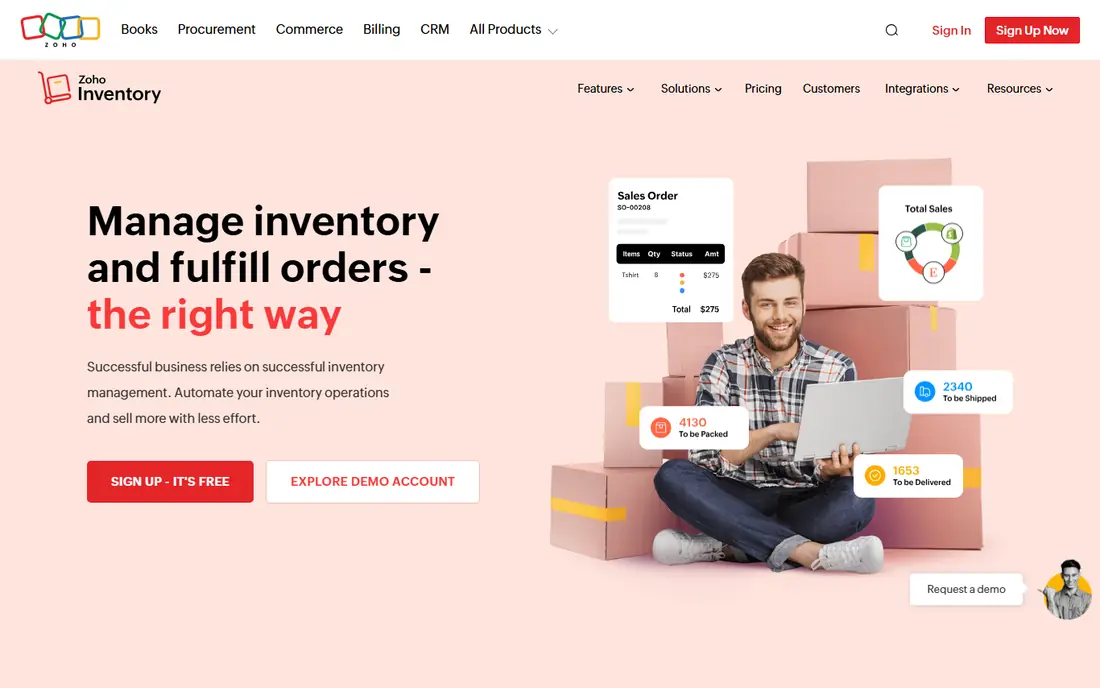
Zoho Inventory is the first tool to check for a small seller. The free plan handles 50 orders a month for one user at one location, which is enough for a side business or a new store. The Standard plan at $29 per month billed annually raises that to 500 orders, three users and two locations, and you pay per organization rather than per seat, which is rare at this price.
The catch is the tier structure. Order volume, user count and warehouse limits all rise with the plan, so a growing seller upgrades quickly, and automation and fulfillment features wait on higher tiers. If you already use Zoho Books or Zoho CRM, the shared data makes the value case even stronger. For a small seller watching every dollar, Zoho Inventory is the best starting point.
- Free plan covers 50 orders a month
- Paid Standard at $29 per month billed annually
- Per-organization pricing, not per user
- Order, user and location caps rise with plan
- Advanced automation sits on higher tiers
- Manufacturing features are limited
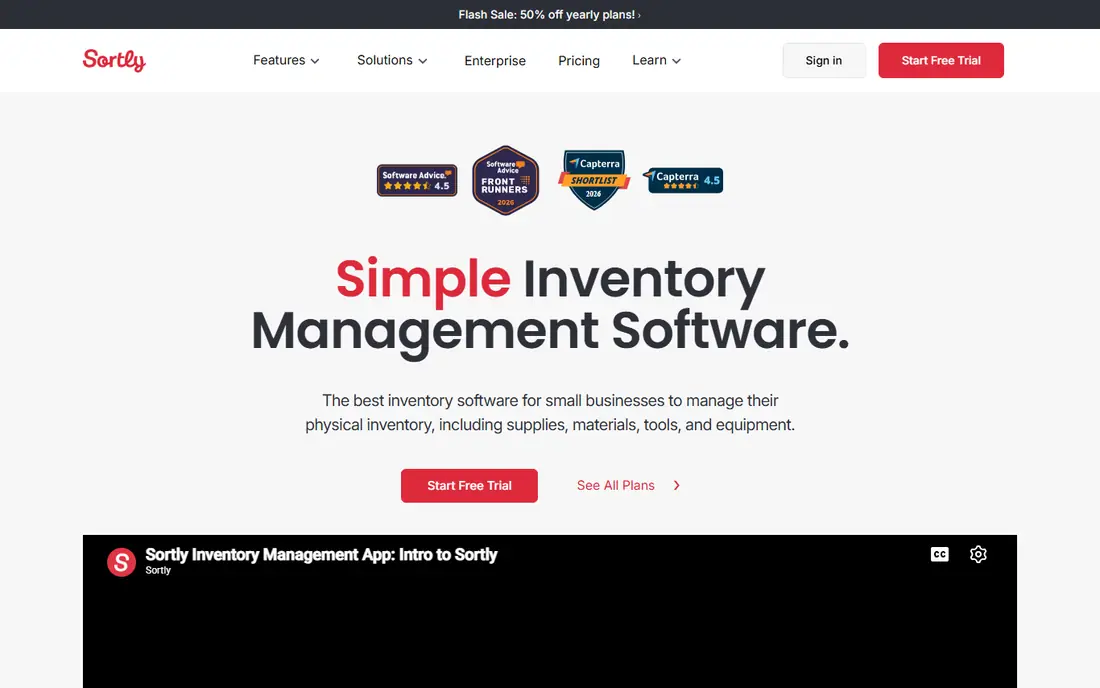
Sortly is the simplest tracker on this list, and that is its strength. You photograph items, organize them into folders, scan barcodes and QR codes from your phone, and check items in and out with a log. For a business tracking equipment, supplies, materials or a small stockroom, that visual approach is faster to learn than a full inventory system.
It is not a sales system. There is no multichannel sync, and the Advanced plan at $49 per month omits purchase orders and stock counts, which larger sellers need. For a team that just needs to know what is where, Sortly is the cheapest and clearest option.
- Photo-based visual catalog is easy to use
- Mobile-first barcode and QR scanning
- Free plan for up to 100 items
- Advanced plan at $49 per month omits purchase orders and stock counts on some tiers
- No multichannel sales sync
- Not built for high-volume sales
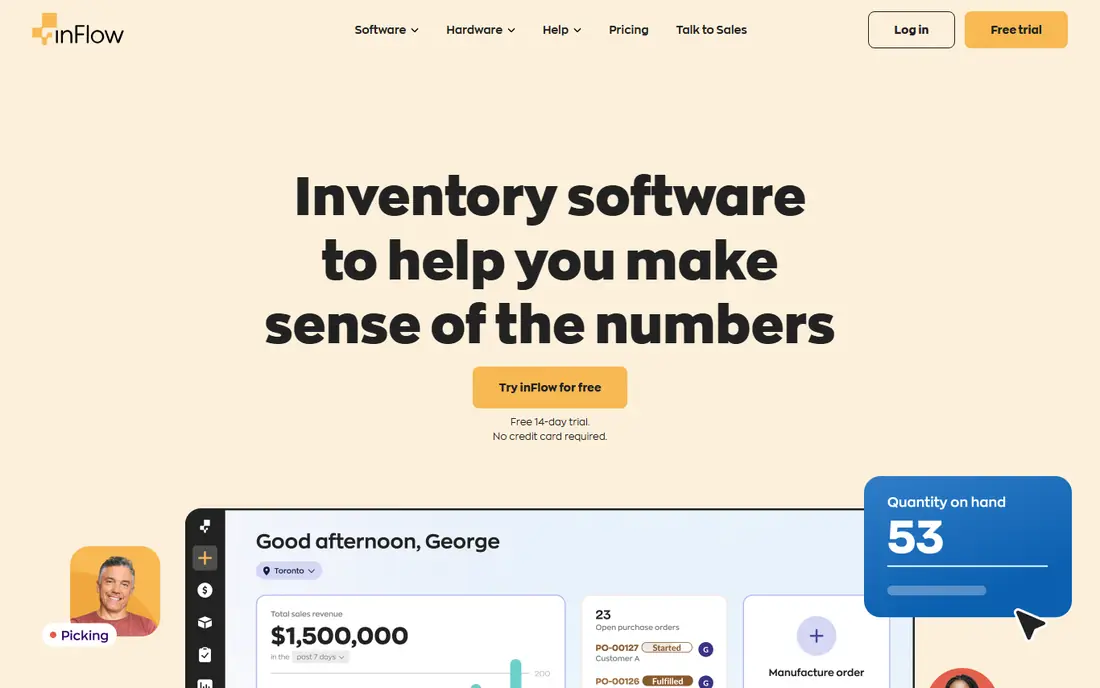
inFlow is built for wholesale and B2B sellers. Its standout feature is the B2B showroom: a private portal where each customer sees their own products and prices, places orders and tracks them, without calling your sales team. Multi-level bills of materials, invoicing and order management round out a system designed for structured B2B operations. Pricing starts at $99 per month billed annually, with a 14-day free trial.
The entry cost is a jump from the free tier crowd, and manufacturing features sit on higher plans. For a wholesaler or B2B seller who needs customer-specific pricing and a professional ordering portal, inFlow is the best fit on this list.
- Private B2B showrooms with per-customer pricing
- Multi-level bills of materials
- Strong invoicing and order management
- Entry cost is higher than Zoho or Sortly
- Manufacturing is an add-on on some plans
- Interface feels dated in places
Katana is the tool for businesses that make things. It tracks raw materials through production to finished goods, with bills of materials, production planning and shop-floor visibility, plus multichannel sales sync through Shopify and other integrations. Paid plans start at $299 per month for the Core plan, with a free tier for a small number of SKUs.
For a pure reseller, Katana is overkill and overpriced. For a maker, a small manufacturer or a brand that assembles products, it is the clearest fit, because no other tool here treats manufacturing as the core job. Unlimited users on paid plans also help growing teams.
- End-to-end manufacturing with bill-of-materials tracking
- Raw-material-to-finished-goods visibility
- Unlimited users on paid plans
- $299 per month entry is high for a small maker
- Manufacturing depth is overkill for pure resellers
- Sales-order usage billing applies
Cin7 Core at $349 per month is the strongest pick for a multichannel brand that has outgrown basic tools. It keeps one inventory pool synced across Shopify, Amazon, eBay, Walmart and hundreds of other integrations, so a sale on any channel updates stock everywhere. Demand forecasting, a warehouse management app and carrier integrations add depth for brands that self-fulfill at volume.
The price and the annual contract mean Cin7 only makes sense above a certain revenue level, and implementation takes real time. For a brand selling on many channels with real complexity, Cin7 is the most complete system on this list. For a single-channel seller, Zoho Inventory does the job for far less.
- Syncs stock across 700 plus integrations
- Demand forecasting
- Warehouse management app and carrier integrations
- $349 per month Core plan is a serious commitment
- Annual contract on most plans
- Implementation takes time
Fishbowl is built for manufacturers and distributors who run their books on QuickBooks. Its integration is the deepest on this list, syncing inventory, orders and manufacturing data with QuickBooks in real time, and its warehouse management covers barcoding, picking and assembly tracking. The Essentials plan costs $229 per month billed annually for two users.
Manufacturing depth on the Advanced plan starts at $595 per month, and setup is involved, so Fishbowl suits a warehouse-heavy operation rather than a small seller. If QuickBooks is the center of your business and you need serious warehouse control, Fishbowl is the natural choice.
- Deep QuickBooks integration
- Real-time assembly tracking
- Strong warehouse management for manufacturers and distributors
- $229 per month Essentials plan billed annually
- Manufacturing depth needs the Advanced plan from $595 per month
- Setup is involved
Ordoro suits ecommerce brands that ship and stock in one place. It combines inventory management with shipping, label printing and fulfillment, plus automated order forwarding that routes orders to suppliers or warehouses, and demand forecasting to guide reordering. The inventory app costs $349 per month, with a 15-day free trial.
There is no manufacturing support, so makers should look at Katana instead. For an ecommerce seller who self-fulfills and wants inventory and shipping in one system, Ordoro removes a whole layer of juggling between tools.
- Combines inventory management with shipping and fulfillment
- Automated order forwarding
- Demand forecasting
- $349 per month for the inventory app
- No manufacturing support
- Best for sellers who ship themselves
Square for Retail is the natural choice for a store already running on Square. The point of sale and inventory live in one system, so a sale at the counter updates stock instantly, and paid plans from $49 per month per location add real-time multi-location counts and advanced reporting. The free tier covers basic point-of-sale and inventory use.
Advanced warehouse tools are limited, so a distributor or multichannel brand will outgrow it. For a brick-and-mortar store, or a small chain, that wants one system for selling and stock, Square for Retail is the simplest path.
- Point of sale and inventory in one system
- Free tier for basic use
- Real-time multi-location counts on paid plans
- Paid plans from $49 per month per location
- Advanced warehouse tools are limited
- Best for single-location or small-chain retail
Odoo is the flexible option. Its inventory app is free when used as a single app, and it covers forecasting, automatic purchase orders and multi-warehouse management. Add other Odoo modules for accounting, sales, CRM and manufacturing, and you build a full ERP around the same data. The full suite costs $24.90 per user per month in the first year billed yearly.
The trade is complexity. Odoo's learning curve is steeper than Zoho's or Sortly's, and a full implementation takes time. For a business that wants to customize its system and grow into an ERP without switching platforms, Odoo is the best long-term bet.
- Inventory app is free as a single app
- Highly customizable with other Odoo modules
- Forecasting and automatic purchase orders
- Steeper learning curve
- Full suite costs $24.90 per user per month in the first year
- Implementation can take time
How we picked these
We compared entry-level pricing, channel support, manufacturing depth and fit for three kinds of business: resellers, makers and wholesalers. We included free options, mid-market workhorses and one open-source route, and we noted where pricing is per organization, per user, per location or per computer, since the model often matters more than the headline price as you grow.
Which tool fits your business
If you sell on one channel and want the cheapest capable tool, start with Zoho Inventory. If you make products, try Katana. If you sell wholesale, try inFlow. If you sell on many channels, try Cin7. If you just need to track what is where, Sortly is enough. And if you run a store on Square, Square for Retail is the obvious choice. Test the trial with a real product on two channels before committing.
Frequently asked questions
What is the best inventory management software for small business?
Zoho Inventory is best for most small businesses, thanks to its free plan and $29 per month Standard tier. Sortly is best for simple visual tracking, and Square for Retail is best for stores already on Square.
How much does inventory management software cost?
Entry points range from free at Zoho, Sortly and Odoo's single app to $29 to $99 per month for small-business tools, and $229 to $349 per month for mid-market systems like Fishbowl, Cin7 and Ordoro. Expect $100 to $500 per month for a serious mid-market tool.
Can inventory software stop overselling on marketplaces?
Yes, that is its core job. Tools like Cin7 and Ordoro keep one inventory pool synced across Amazon, Shopify, eBay and Walmart, so a sale on any channel updates stock everywhere. Test this in every trial by listing one product on two channels and selling it on one.
Do I need inventory software if I use a third-party warehouse?
Yes, but a different kind. You still need stock visibility, purchase ordering and channel sync, and tools like Cin7 route orders to third-party warehouses and keep counts right. You just need less warehouse functionality than a brand that self-fulfills.
What is the difference between inventory software and an ERP?
Inventory software manages stock, orders, purchasing and fulfillment. An ERP adds finance, human resources, CRM and more. Tools like Fishbowl and Cin7 blur the line with manufacturing and accounting depth, but they stay cheaper and faster to implement than a full ERP.
Is there free inventory management software?
Yes. Zoho Inventory has a free plan for 50 orders a month, Sortly has a free plan for up to 100 items, and Odoo's inventory app is free as a single app. Free plans have limits on orders, items or users, so check the caps before relying on them.
Sources we checked (9)

Online Jobs is an independent blog about careers, online work, learning new skills and the tools that help people earn. More about us.
Keep reading
All posts
Best Web Scraping Tools
Compare the best web scraping tools in 2026, from no-code Octoparse and Browse AI to Apify, Firecrawl, Bright Data, Zyte, ScraperAPI and free Scrapy, with prices.

Best Web Hosting Services
Find the best web hosting services for your site in 2026. We compare prices, speed, support and ease of use across eight leading hosting providers today.

Best Video Conferencing Software
Looking for the best video conferencing software? We compare 8 meeting apps on price, meeting limits, features, security and ease of use. Read the guide.