Best International Payroll Platforms in 2026: 9 Platforms Compared


mixed workforces across many countries · Starting price: $29 per employee per month
How we put this together: we compare official feature and pricing pages, app store listings, privacy policies and public user reviews. Prices change, so check the provider's site before you pay.
Key takeaways
- Global payroll and EOR are different products: payroll processes pay for your own employees, while EOR means the vendor employs the worker, at a far higher monthly fee.
- Deel and Remote lead on breadth and owned-entity depth, while Multiplier and Remofirst offer lower EOR entry prices.
- Published payroll prices often start near $25 to $35 per employee per month, while EOR prices start near $199 to $699 per employee per month.
- Employer social contributions and statutory benefits add a large amount on top of the platform fee, so budget the loaded cost, not just the subscription.
Quick comparison
| Name | Who it suits | Starting price | Free option | |
|---|---|---|---|---|
| Deel | mixed workforces across many countries | $29 per employee per month | No | Visit |
 Remote | compliance-first owned-entity hiring | $29 per employee per month | Free trial | Visit |
 Papaya Global | enterprise payroll and treasury visibility | $25 per employee per month | No | Visit |
 Rippling | HR, IT, and payroll in one system | $35 per month | Free trial | Visit |
 Multiplier | lower-cost owned-entity EOR | $400 per employee per month | No | Visit |
 Oyster | distributed-first lean HR teams | $29 per employee per month | Free trial | Visit |
 CloudPay | enterprises with treasury integration | See website | No | Visit |
 G-P | enterprise-scale global hiring | See website | No | Visit |
 Remofirst | low-cost EOR for startups | $199 per employee per month | Free trial | Visit |
The best international payroll platforms
Hiring abroad creates two separate jobs: paying people correctly in each country, and employing them legally where you have no local entity. International payroll platforms handle the first job, employer of record services handle the second, and many vendors sell both at very different prices. The list below compares platforms that cover multiple countries, with attention to the payroll versus EOR distinction, country reach, and total cost.
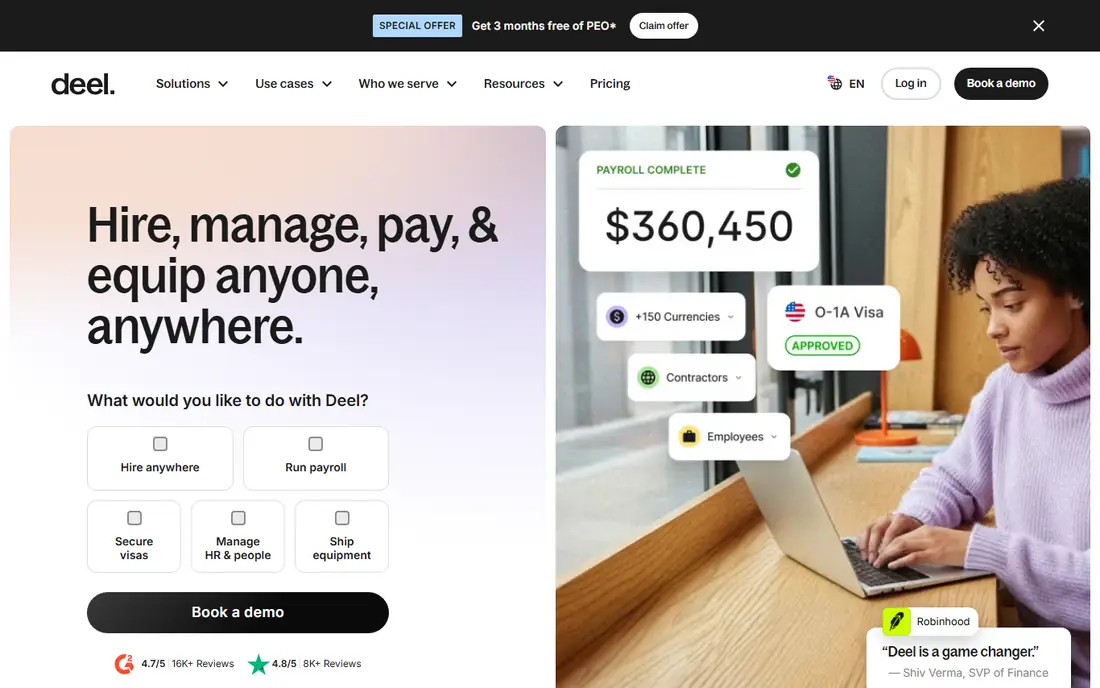
Deel suits companies running contractors, EOR employees, and direct payroll across many countries on one platform. Its dashboard consolidates payroll, contracts, taxes, and compliance, which reduces the spreadsheet work that grows with each new country. We would pair it with a clear weekly routine rather than relying on the tool alone to carry progress.
The catch is price layers: global payroll starts low, but EOR starts at a much higher per-employee rate, so budget by worker type, not by a single headline figure. Pricing also deserves a careful check before you commit, because the headline price and the price for the features you actually need can differ. We suggest starting on the free option or the shortest paid term where one exists, testing it with real work for two weeks, and only then deciding whether a longer plan makes sense.
- Global payroll in 150 plus countries
- EOR and contractor management
- Wide HR and finance integrations
- EOR price is far higher than payroll price
- Implementation fee per entity
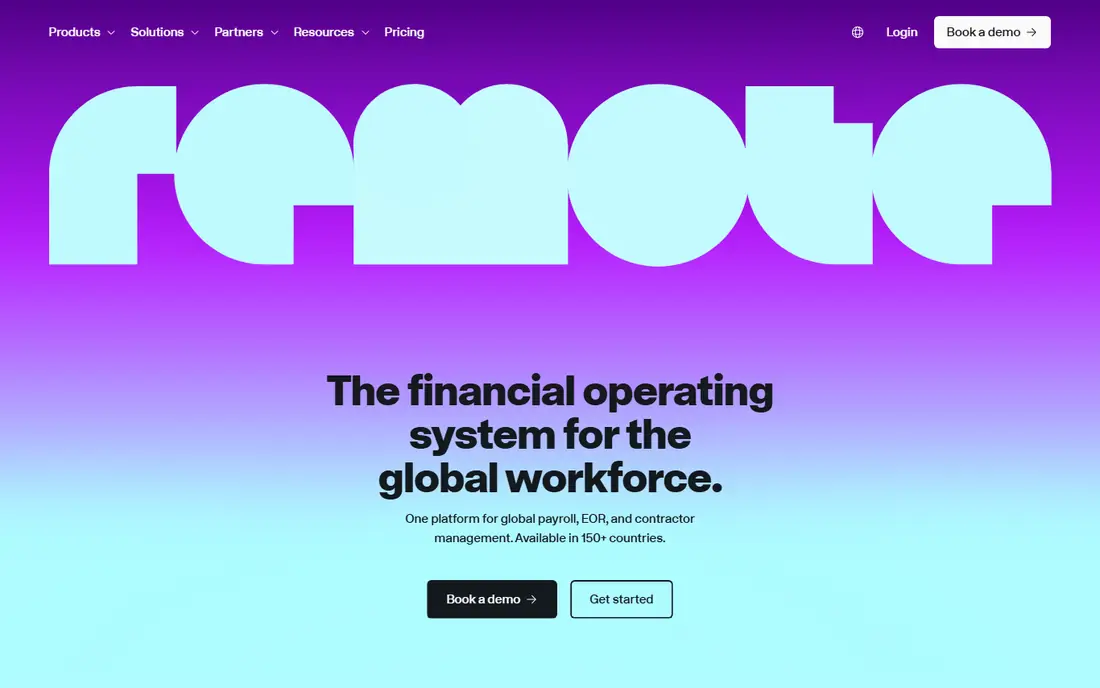
If your main goal is compliance-first owned-entity hiring, Remote deserves a close look. Remote suits companies that prize compliance depth and data ownership, with owned entities rather than partner-only coverage in many markets. Its transparent pricing and local expertise help finance and legal teams plan hiring costs without a long sales negotiation for basic figures. We would pair it with a clear weekly routine rather than relying on the tool alone to carry progress.
The catch is EOR cost: at enterprise scale the per-employee EOR fee dominates the budget, so compare payroll-only and EOR costs separately. Pricing also deserves a careful check before you commit, because the headline price and the price for the features you actually need can differ. We suggest starting on the free option or the shortest paid term where one exists, testing it with real work for two weeks, and only then deciding whether a longer plan makes sense.
- Owned entities in many markets
- Transparent EOR pricing
- Contractor and payroll options
- EOR starts at $599 per employee per month on annual terms
- Delivery fees may apply

Papaya Global stands out for learners and teams who want enterprise payroll and treasury visibility. Papaya Global suits finance-led enterprises that need centralized payments, audit visibility, and analytics across many payroll countries. Its platform aggregates payroll data and payments, which helps finance teams close the books and track costs by country and entity. We would pair it with a clear weekly routine rather than relying on the tool alone to carry progress.
The catch is fit: smaller teams may find the enterprise workflow and quote process heavier than a simpler payroll tool, so test onboarding time first. Pricing also deserves a careful check before you commit, because the headline price and the price for the features you actually need can differ. We suggest starting on the free option or the shortest paid term where one exists, testing it with real work for two weeks, and only then deciding whether a longer plan makes sense.
- Payroll across 160 plus countries
- Centralized payments
- Workforce analytics for finance teams
- EOR pricing is quote-based at higher tiers
- Enterprise focus can be heavy for small teams
For many people, Rippling is the practical choice for hr, it, and payroll in one system. Rippling suits US-strong companies that want HR, IT, device management, and payroll in one system instead of several vendors. Its automation handles onboarding, access, and payroll changes together, which saves admin time as headcount grows. We would pair it with a clear weekly routine rather than relying on the tool alone to carry progress.
The catch is modular pricing: the base price plus payroll and other modules can lift the total well above the entry figure, so get a full quote. Pricing also deserves a careful check before you commit, because the headline price and the price for the features you actually need can differ. We suggest starting on the free option or the shortest paid term where one exists, testing it with real work for two weeks, and only then deciding whether a longer plan makes sense.
- Unified HR, IT, and finance
- Global payroll add-on
- Strong automation for onboarding
- Modular pricing makes totals hard to predict
- Global payroll depth varies by country
Start with what Multiplier does well. Multiplier suits budget-conscious teams that still want owned-entity EOR coverage, with a lower EOR entry price than many rivals. Its platform covers hiring, payroll, and compliance across a wide country range, with pricing that helps mid-market teams plan expansion. We would pair it with a clear weekly routine rather than relying on the tool alone to carry progress.
The catch is transparency: payroll-only pricing is less clear than EOR pricing, so request a written payroll quote for your exact countries. Pricing also deserves a careful check before you commit, because the headline price and the price for the features you actually need can differ. We suggest starting on the free option or the shortest paid term where one exists, testing it with real work for two weeks, and only then deciding whether a longer plan makes sense.
- EOR across 150 plus countries
- Owned entities in many markets
- No setup fees on some plans
- Global payroll pricing is less transparent
- Support depth varies by market
Oyster suits remote-first teams hiring internationally for the first time, with a clear interface and guided local hiring steps. Its EOR coverage spans a wide country list, and its hiring guides help small HR teams handle local contracts and benefits with less guesswork. We would pair it with a clear weekly routine rather than relying on the tool alone to carry progress.
The catch is coverage type: EOR reach is wider than native payroll reach, so confirm which model applies in each country you plan to hire in. Pricing also deserves a careful check before you commit, because the headline price and the price for the features you actually need can differ. We suggest starting on the free option or the shortest paid term where one exists, testing it with real work for two weeks, and only then deciding whether a longer plan makes sense.
- EOR in 180 plus countries
- Clear flat-rate EOR options
- Guided hiring for first-time global teams
- EOR starts higher than payroll
- Native payroll coverage is narrower than EOR coverage
There is a clear reason CloudPay keeps appearing on shortlists for enterprises with treasury integration. CloudPay suits enterprises running payroll through their own entities, with finance and treasury integration as a core strength. Its reporting and payment controls help large finance teams manage multi-country payroll as part of wider treasury operations. We would pair it with a clear weekly routine rather than relying on the tool alone to carry progress.
The catch is scale: pricing is quote-based and implementation is a project, so it suits larger operations rather than a first international hire. Pricing also deserves a careful check before you commit, because the headline price and the price for the features you actually need can differ. We suggest starting on the free option or the shortest paid term where one exists, testing it with real work for two weeks, and only then deciding whether a longer plan makes sense.
- Payroll across 130 plus countries
- Treasury and finance integration
- Enterprise reporting
- Quote-only pricing
- Implementation is an enterprise project
Consider G-P first if enterprise-scale global hiring matters most to you. G-P, formerly Globalization Partners, suits growing companies eyeing large-scale international hiring with enterprise support. Its platform and services cover hiring, payroll, and compliance across a wide footprint, with analytics for workforce planning. We would pair it with a clear weekly routine rather than relying on the tool alone to carry progress.
The catch is price: as a premium enterprise provider, it is quote-based and typically costs more than budget EOR options, so compare total cost per hire. Pricing also deserves a careful check before you commit, because the headline price and the price for the features you actually need can differ. We suggest starting on the free option or the shortest paid term where one exists, testing it with real work for two weeks, and only then deciding whether a longer plan makes sense.
- EOR and payroll reach across many countries
- Analytics and compliance support
- Enterprise onboarding
- Quote-only pricing
- Premium positioning raises cost
Remofirst takes a different angle on low-cost eor for startups. Remofirst suits startups that need EOR coverage at a lower entry price than the major enterprise providers. Its simple onboarding and lower per-employee EOR rate help small teams hire abroad without a large upfront commitment. We would pair it with a clear weekly routine rather than relying on the tool alone to carry progress.
The catch is depth: coverage and enterprise features vary by country, so confirm support, benefits handling, and payroll timing for each target market. Pricing also deserves a careful check before you commit, because the headline price and the price for the features you actually need can differ. We suggest starting on the free option or the shortest paid term where one exists, testing it with real work for two weeks, and only then deciding whether a longer plan makes sense.
- Low EOR entry price
- Contractor and payroll options
- Straightforward onboarding
- Country depth varies
- Enterprise features are lighter
How we picked these
We compared official feature pages, pricing pages, and product documentation for each platform, and we checked public reviews and third-party benchmarks where they clarified EOR versus payroll pricing. We gave weight to country coverage, payroll accuracy, payment handling, compliance support, and honest pricing, and we used See website where a vendor prices by quote. Employer taxes, benefits, and FX costs sit outside the platform fee, so treat headline prices as a starting point, not a full hiring cost.
How to choose an international payroll platform
Start by sorting your workers into three groups: direct employees in countries where you have an entity, EOR employees where you do not, and contractors. That split decides which price applies to each person, and it prevents the common error of budgeting everyone at the payroll rate. Next, list your countries and check coverage model for each one: owned entity, partner, or payroll-only, since support depth and data handling differ. Ask about payroll calendars, payment timing, FX handling, statutory filings, and who owns compliance if a filing is late. Get a written quote that separates platform fees, implementation fees per entity, and pass-through employer costs, and run a pilot in one or two countries before rolling out globally. This is not legal or tax advice; get local advice for employment and tax decisions in each country.
Frequently asked questions
What is the best international payroll software for startups?
Deel and Remote suit startups scaling across markets, with payroll from about $29 per employee per month and wide coverage. Remofirst and Multiplier suit startups that need EOR at a lower entry price. Startups should separate payroll and EOR headcount when budgeting.
What are the best global payroll companies for enterprises?
Papaya Global, CloudPay, and G-P suit enterprises with many countries, treasury needs, and complex reporting. Deel and Remote also serve enterprises, but the right choice depends on entity model and ERP integration. Enterprises should run a pilot and check audit trails before a full rollout.
What are the best international payroll services for contractors?
Deel, Remote, Oyster, and Remofirst all offer contractor management alongside payroll and EOR, with contractor prices far below EOR prices. Contractor services suit teams with freelance or project workers abroad. Check misclassification risk, since contractor status rules vary by country.
How much does international payroll cost per employee?
Global payroll platform fees often start near $25 to $35 per employee per month, while EOR fees start near $199 to $699 per employee per month. Employer social contributions and benefits add roughly 15 to 40 percent on top of gross salary, depending on country. Always budget the loaded cost.
Do I need EOR or just global payroll?
You need EOR if you want to employ someone in a country where you have no local entity and do not want to set one up. You need global payroll only if you already employ people through a local entity and need pay processed compliantly. Many companies use both models in different countries.
Sources we checked (9)

Online Jobs is an independent blog about careers, online work, learning new skills and the tools that help people earn. More about us.
Keep reading
All posts
n8n Alternatives
n8n alternatives compared for 2026, with Zapier, Make, Activepieces, and more, covering visual builders, code steps, self-hosting, and pricing models.

ZoomInfo Alternatives
The best ZoomInfo alternatives in 2026, compared on price, free plans, data coverage, and which tool fits small teams or large sales teams best in detail.

Yotpo Alternatives
Find cheaper alternatives to Yotpo for reviews and loyalty, with Judge.me, Loox, Stamped, and more compared for Shopify stores in 2026, all in one guide.