Best Identity and Access Management Tools in 2026: 9 Tools Compared

How we put this together: we compare official feature and pricing pages, app store listings, privacy policies and public user reviews. Prices change, so check the provider's site before you pay.
Key takeaways
- Okta is our pick for most mid-market and large teams that need vendor-neutral SSO and lifecycle management at scale.
- Microsoft Entra ID is the obvious choice for organisations already running Microsoft 365 and Azure.
- Cisco Duo is the fastest way to roll out MFA across a workforce, with a free tier for up to 10 users.
- JumpCloud suits small teams that want a cloud directory plus device management in one console.
- Auth0 is the pick for customer-facing login, while SailPoint and CyberArk cover governance and privileged access at enterprise scale.
Quick comparison
| Name | Who it suits | Starting price | Free option | |
|---|---|---|---|---|
 Okta | Vendor-neutral workforce IAM | $6 per month | Free trial | Visit |
 Microsoft Entra ID | Microsoft 365 organisations | Free | Yes | Visit |
 Cisco Duo | Fast MFA rollout | $3 per month | Yes | Visit |
 Ping Identity | Large hybrid enterprises | $3 per month | Free trial | Visit |
 Auth0 | Customer login | $35 per month | Yes | Visit |
 OneLogin | Mid-market SSO | $4 per month | Free trial | Visit |
 JumpCloud | Small teams and devices | $9 per month | Yes | Visit |
 SailPoint | Access governance | See website | No | Visit |
 CyberArk | Privileged access | See website | Free trial | Visit |
The best identity and access management tools
Identity and access management, often shortened to IAM, covers who can sign in, what they can access, and how that access changes when people join, move, or leave. Some tools in this list are full identity providers, some focus on MFA or customer login, and some govern access at enterprise scale. Pick by your main job first, then by price and integration depth.

Okta is the best-of-breed workforce identity platform for teams that do not want to be tied to one vendor stack. It offers single sign-on, multi-factor authentication, and lifecycle management across thousands of apps, and it works well in mixed environments with Google, Microsoft, and many SaaS tools side by side. For mid-market and large teams, that neutrality is a real advantage over a platform tied to one ecosystem.
The drawback is complexity and cost. Setup and ongoing management benefit from a dedicated owner, and pricing, reported from $6 per user per month for a Starter suite with an annual minimum, rises on higher tiers. Small teams with simple needs may find Duo or JumpCloud easier to run. For scale and breadth, however, Okta remains the benchmark in this list.
- Broad app integration network
- Strong SSO, MFA, and lifecycle tools
- Works across many vendors and clouds
- Complexity grows with scale
- Annual minimum and higher tiers add cost
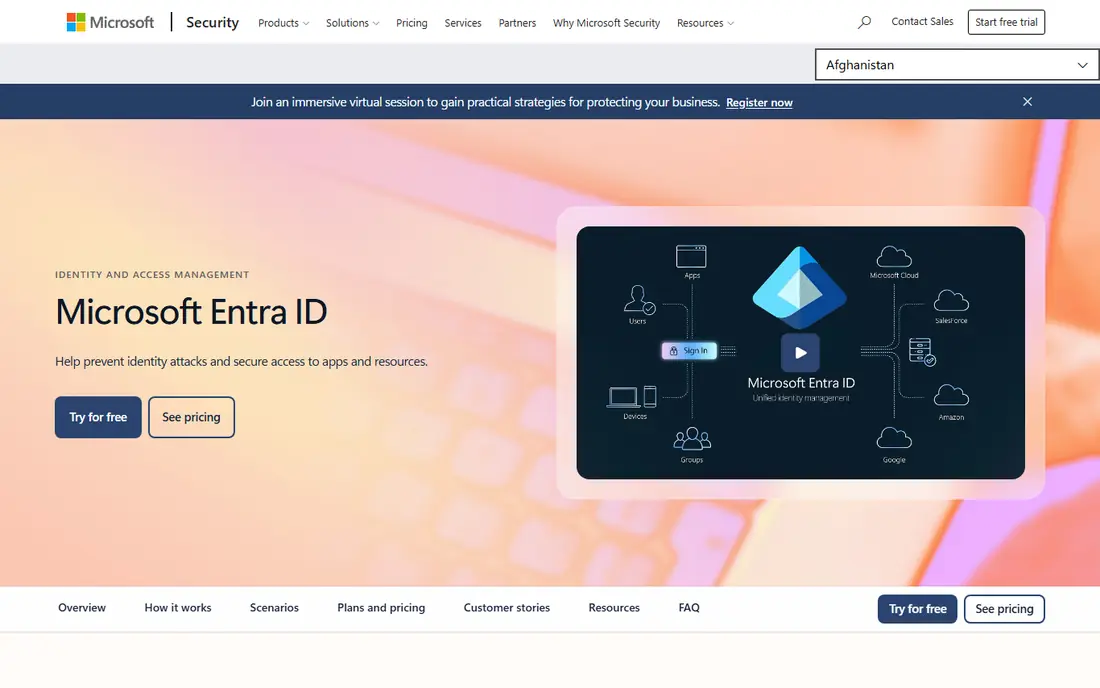
Microsoft Entra ID, formerly Azure Active Directory, is the default identity layer for organisations already on Microsoft 365. It provides SSO, MFA, and Conditional Access, which lets you set rules based on user, device, location, and risk. Paid tiers, reported at $7 per user per month for P1 and $10 for P2 on annual terms, add deeper Conditional Access, governance, and risk tools.
The main limit is ecosystem fit. If your organisation runs mainly on Microsoft products, Entra ID is efficient and often already included in existing licences. If you run a mixed stack with many non-Microsoft tools, Okta may offer broader neutrality, though Entra ID still connects to many third-party apps. Check what is already included in your Microsoft licences before buying a separate IAM tool.
- Built into Microsoft 365 and Azure
- Conditional Access and MFA included on paid tiers
- Free tier for basic SSO
- Best value depends on Microsoft licensing
- Less neutral than Okta for mixed stacks
Cisco Duo is the fastest way to add strong MFA to a workforce. Push approvals, device trust checks, and a simple admin console make it easy to roll out, and the free tier for up to 10 users lets small teams start at no cost. Paid tiers, reported from $3 per user per month for Essentials billed annually, add more device and access controls.
Duo is best seen as an MFA and access layer, not a full replacement for Okta or Entra ID if you also need lifecycle management and a broad directory. Many organisations pair Duo with an existing directory for that reason. If your main gap is MFA, rather than full identity management, Duo is the simplest and most reliable pick here.
- Very easy MFA deployment
- Free tier for up to 10 users
- Device trust checks
- Not a full identity provider on its own
- Higher tiers needed for deeper access controls
Ping Identity, which now includes ForgeRock, suits large enterprises with hybrid estates that span cloud, on-premises, and partner systems. Its federation depth, covering SAML, OIDC, and OAuth, helps connect systems that simpler tools struggle with, and it covers both workforce and customer identity. For complex, regulated environments, that depth matters.
Workforce plans are reported from $3 per user per month, with a 5,000-user minimum on some plans, so Ping is not a small-team tool. Setup also benefits from experienced identity staff or a partner. If your estate is large and hybrid, Ping is a strong enterprise pick. If you are a small or mid-market team, Okta, Entra ID, or JumpCloud will be easier to run.
- Deep federation and hybrid deployment options
- Workforce and customer identity in one vendor
- Strong for complex estates
- Minimum user counts on some workforce plans
- Enterprise pricing and setup need planning
Auth0, owned by Okta, is built for customer-facing login in your own apps and websites. Developers can add social login, passwordless options, MFA, and custom login flows without building authentication from scratch. The free tier, up to 25,000 monthly active users, makes it easy to test and to run a small product at no cost, with paid plans reported from $35 per month.
The distinction matters: Auth0 is for your customers, not mainly for your employees, though it can handle both in some setups. If you need workforce SSO and lifecycle for staff, Okta or Entra ID is the better starting point. If you are building an app and need secure, flexible customer login, Auth0 is the developer pick in this list.
- Developer-friendly customer login
- Free tier up to 25,000 monthly active users
- Social and passwordless options
- Owned by Okta, so workforce and customer roadmaps overlap
- Paid tiers rise with active users
OneLogin, from One Identity, targets mid-market companies that want straightforward SSO, MFA, and lifecycle tools without enterprise complexity. HR-driven provisioning helps automate joiner and leaver access, and the entry price, reported at $4 per user per month for an Advanced bundle in several comparisons, is competitive for the feature set.
Its integration range is smaller than Okta, and some recent pricing listings are quote-based, so confirm the current price and the apps you need before committing. For a mid-market team that wants a simple, affordable identity provider and does not need the deepest enterprise federation, OneLogin is a solid, low-friction choice.
- Simple SSO and MFA for mid-market teams
- HR-driven provisioning
- Competitive entry price
- Smaller integration range than Okta
- Some pricing details are quote-based in recent listings
JumpCloud suits small teams that want to replace an on-premises Active Directory with a cloud directory, and manage devices at the same time. It handles users, groups, SSO, MFA, and device policies for Windows, macOS, and Linux from one console, which is useful for teams without a large IT department. A free tier for up to 10 users and 10 devices lets very small teams start at no cost.
Device management pricing, reported from $9 per user per month billed annually, differs from SSO-only pricing, so check which bundle matches your needs. For governance-heavy enterprises, SailPoint or Okta will offer more depth. For a small team that needs identity and devices together, JumpCloud is the most practical pick here.
- Cloud directory plus device management in one console
- Good for mixed Windows, macOS, and Linux fleets
- Free tier for small teams
- Less enterprise governance depth than SailPoint
- SSO pricing differs from device pricing
SailPoint Identity Security Cloud focuses on governance: who has access to what, whether they should still have it, and how to prove it for audit and compliance. Access reviews, lifecycle workflows, and reporting help large, regulated organisations manage risk across many systems. Its connector library is broad, which matters when access spans SaaS, on-premises, and cloud tools.
Pricing is quote-based and enterprise-level, and the platform needs a dedicated owner to manage reviews, policies, and integrations. It is not a first IAM tool for a small team. For a large organisation that already has an identity provider and needs governance on top, SailPoint is the leading specialist pick in this list.
- Strong access reviews and governance for regulated enterprises
- Broad connector library
- Lifecycle and compliance reporting
- Quote-based enterprise pricing
- Needs a dedicated identity team to run well
CyberArk, now part of Palo Alto Networks in recent identity listings, is best known for privileged access management: protecting admin, service, and other high-risk accounts, plus secrets used by applications. Its workforce identity options extend that protection to everyday sign-in, which suits organisations that want privileged and workforce identity from one vendor family.
Pricing is by quote, and the full value comes from planning privileged access properly, including vaulting, rotation, and session controls, not just from turning on SSO. For most small and mid-market teams, Okta, Entra ID, or Duo will cover everyday needs at lower cost. For enterprises where privileged risk is the main concern, CyberArk is the specialist to shortlist.
- Strong privileged access and secrets management heritage
- Workforce identity options
- Good for high-risk accounts
- Enterprise pricing by quote
- Full value needs privileged access planning, not just SSO
How we picked these
We compared official feature pages, pricing pages, and public reviews, and we favoured tools that are still maintained, that cover SSO, MFA, or lifecycle as a core job, and that serve a clear segment, from small teams to large enterprises. We checked for integration breadth, Conditional Access or equivalent controls, governance features, and published pricing, and we kept a mix of workforce, customer, MFA, governance, and privileged tools. We did not deploy these tools in a live environment for this guide, and where pricing is by quote we say so rather than repeating a third-party estimate as a vendor price.
What to check before you buy
Start with your main gap. If you lack MFA, Duo may be enough. If you lack a directory, you need Okta, Entra ID, or JumpCloud. If you lack governance, SailPoint adds a layer on top of an existing provider. Next, check app coverage: list the apps your staff actually use, and confirm SSO and provisioning support for each, since a provider that misses a key app will leave manual work in place. Check joiner, mover, and leaver workflows, because lifecycle automation is where IAM saves time and reduces risk. Finally, plan for MFA enrolment, helpdesk load, and recovery options, since a strong IAM rollout that locks users out will lose trust quickly.
Frequently asked questions
Which identity access management tool is best overall?
Okta is our pick for most mid-market and large teams because it offers vendor-neutral SSO, MFA, and lifecycle at scale. Microsoft Entra ID is best for Microsoft 365 organisations, while JumpCloud and Duo suit smaller teams with simpler needs.
What is the difference between workforce IAM and customer IAM?
Workforce IAM manages employee and contractor access to internal apps, with joiner and leaver workflows. Customer IAM manages login for users of your own app or website, with social login, registration, and passwordless options. Okta and Entra ID lead for workforce use, while Auth0 leads for customer login.
Is there a free identity management tool?
Yes, for small use. Duo offers a free tier for up to 10 users, JumpCloud offers a free tier for up to 10 users and devices, Entra ID has a free tier, and Auth0 is free up to 25,000 monthly active users for customer login. Larger workforces normally need a paid plan for full SSO, lifecycle, and support.
Do I need both an identity provider and a governance tool?
Not always. Many teams start with an identity provider such as Okta or Entra ID, which covers SSO, MFA, and basic lifecycle. A governance tool such as SailPoint becomes useful at larger scale, or in regulated industries, where access reviews, audit evidence, and compliance reporting need dedicated depth.
How long does IAM implementation take?
A small MFA rollout can take days to weeks, while a full workforce identity migration with lifecycle, app integrations, and Conditional Access policies often takes one to three months. Allow time for app testing, MFA enrolment, and a phased rollout by team, rather than switching everyone at once.
What is the best IAM tool for small businesses?
JumpCloud is a strong pick for small teams that need a cloud directory and device management together, while Duo is best if MFA is the main gap. Microsoft Entra ID is also worth checking if you already pay for Microsoft 365, since a basic tier may already be included.
Sources we checked (11)
- https://rankite.com/blog/best-identity-and-access-management-tools
- https://supertokens.com/blog/okta-alternatives
- https://www.okta.com
- https://www.microsoft.com/security/business/identity-access/microsoft-entra-id
- https://duo.com
- https://www.pingidentity.com
- https://auth0.com
- https://www.onelogin.com
- https://jumpcloud.com
- https://www.sailpoint.com
- https://www.cyberark.com

Online Jobs is an independent blog about careers, online work, learning new skills and the tools that help people earn. More about us.
Keep reading
All posts
n8n Alternatives
n8n alternatives compared for 2026, with Zapier, Make, Activepieces, and more, covering visual builders, code steps, self-hosting, and pricing models.

eBay Alternatives
Looking for ebay alternatives? We compared 9 marketplaces for sellers on fees, buyer reach, categories and ease of listing, to help you sell with confidence.

ZoomInfo Alternatives
The best ZoomInfo alternatives in 2026, compared on price, free plans, data coverage, and which tool fits small teams or large sales teams best in detail.