Best Hotel Management Software in 2026: 8 Systems Compared

How we put this together: we compare official feature and pricing pages, app store listings, privacy policies and public user reviews. Prices change, so check the provider's site before you pay.
Key takeaways
- Cloudbeds is our pick for most independent hotels because it combines reservations, channel management, and a booking engine in one system.
- Mews suits hotels and groups that want automation, an open marketplace, and a modern guest journey.
- SiteMinder is strongest for distribution, with wide channel reach for hotels that sell through many booking sites.
- RoomRaccoon and Little Hotelier are better starting points for small properties with fewer rooms and tighter budgets.
- Price alone is a poor guide here: implementation, payment fees, and channel costs can change the total quickly, so ask for a full quote.
Quick comparison
| Name | Who it suits | Starting price | Free option | |
|---|---|---|---|---|
 Cloudbeds | Most independent hotels | See website | Free trial | Visit |
 Mews | Hotels and groups wanting automation | See website | No | Visit |
 SiteMinder | Wide distribution | See website | No | Visit |
 RoomRaccoon | Small hotels | See website | Free trial | Visit |
 Little Hotelier | Small properties up to 30 rooms | See website | Free trial | Visit |
 Hotelogix | Budget and midscale hotels | See website | Free trial | Visit |
 eZee Absolute | Hotels needing a full PMS suite | See website | No | Visit |
 Apaleo | Tech-led hotels and groups | See website | Free trial | Visit |
The best hotel management software
Hotel software is not one tool. A property management system handles reservations, housekeeping, and billing, while a channel manager keeps rates and availability in step across booking sites, and a booking engine takes direct bookings on your own site. The systems below cover those jobs in different combinations, so match the system to your size, channels, and staff, not just to a headline feature list.
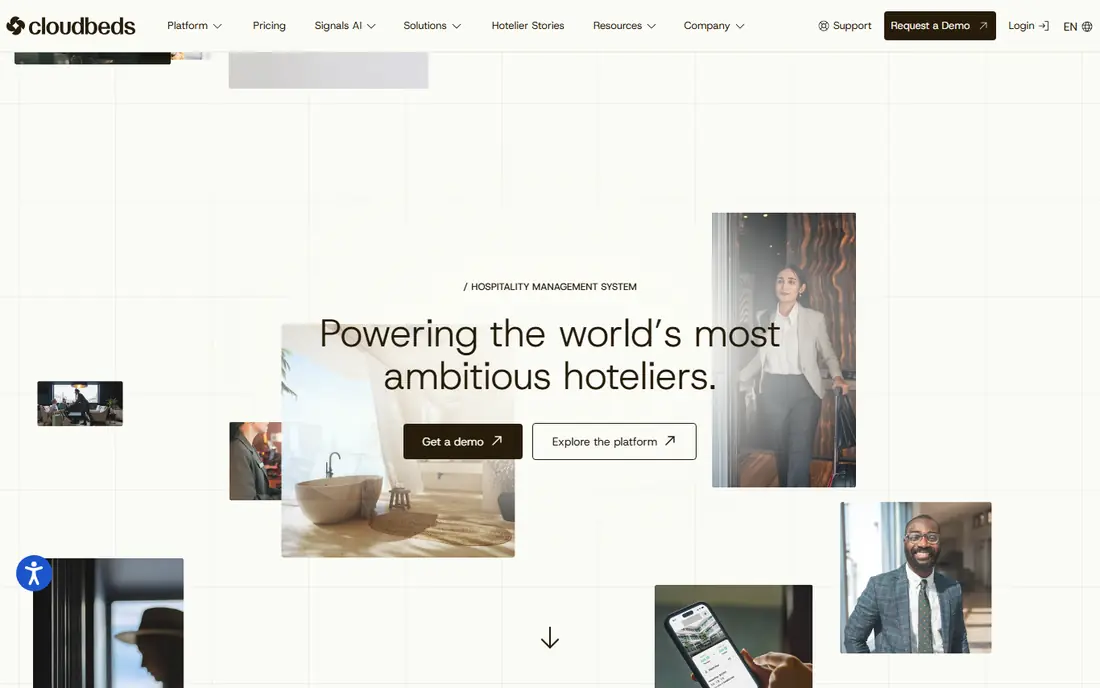
Cloudbeds is our first pick for independent hotels because it covers the core jobs in one place. Reservations, availability, rates, and guest details sit in a single system, and the channel manager and booking engine reduce the manual work of keeping booking sites in step. That matters for a small team, where one person may handle reservations, check-in, and billing in the same shift.
The main drawback is pricing transparency. Cloudbeds prices by quote, so you will need a demo and a tailored price to compare it fairly with published-price rivals. Ask for the full picture, including payment processing, channel fees, and any add-on modules, before you judge whether it is good value for your room count and booking mix.
- Combined PMS, channel manager, and booking engine
- Broad integration marketplace
- Suited to independents, hostels, and small groups
- Pricing is by quote, so comparison takes a sales call
- Larger chains may need deeper customisation
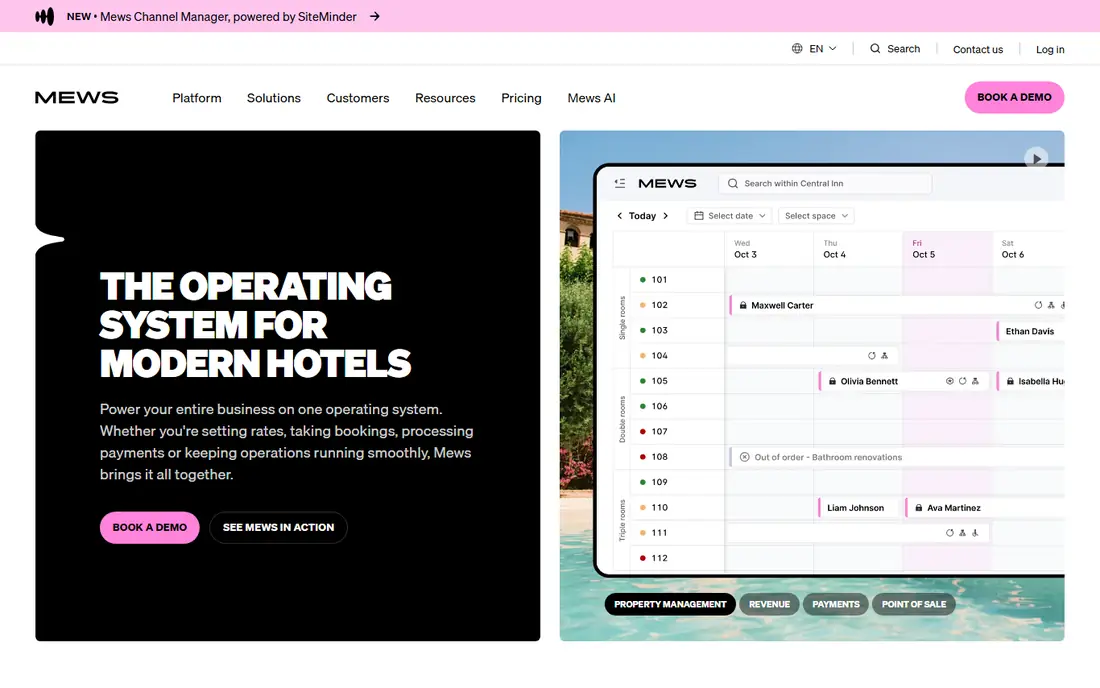
Mews appeals to hotels that want to automate routine work and build a guest journey that feels modern, from online check-in to payments and messaging. Its open API and marketplace make it easier to add tools for revenue, housekeeping, or guest communication without replacing the core system. Groups benefit most, because settings, rates, and reports can be managed across properties.
That flexibility comes with a learning period. Staff used to a simpler PMS may need training, and pricing is by quote, so small properties should check the total cost early. For hotels with enough volume to use automation well, Mews is a strong long-term choice. For a very small property with simple needs, a lighter system may be faster to run.
- Modern cloud PMS with strong automation
- Open API and marketplace
- Good for multi-property groups
- Quote-based pricing
- Setup and staff training need planning for larger properties
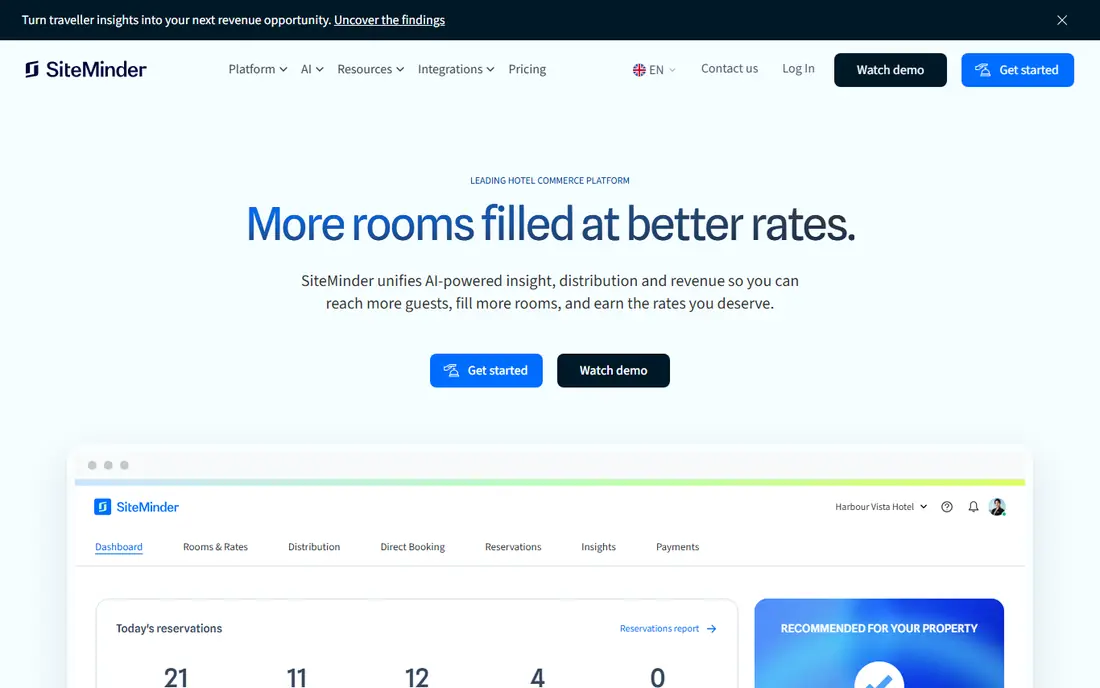
SiteMinder started in distribution, and that strength still defines it. If your hotel sells through many online travel agents and needs rates and availability to stay in step, its channel reach is a real advantage. Overbooking and rate errors fall when the channel manager updates quickly, and that protects both revenue and guest trust.
SiteMinder is less of a single-box answer than Cloudbeds or Mews. Some properties pair its channel tools with a separate PMS, including its own small-property product, Little Hotelier, covered below. Check which combination you are actually buying, and whether support covers the full setup or only one part of it.
- Wide channel connections
- Channel manager heritage
- Useful for hotels selling through many sites
- Full PMS features may require partner products
- Pricing varies by product and property size
RoomRaccoon is a good fit for small hotels that want a clear starting price and a system they can learn quickly. It combines reservations, channel management, and a booking engine, and its published plans for smaller room counts make early comparison easier than with quote-only rivals. The trial after a demo lets you test the daily workflow before committing.
Larger hotels with complex rate structures, multiple outlets, or group operations may outgrow it sooner than they would Mews or Cloudbeds. For a boutique hotel, guesthouse, or small inn, however, RoomRaccoon hits a practical balance of price, features, and ease of use.
- Published pricing for smaller properties
- All-in-one PMS, channel manager, and booking engine
- 14-day trial after a demo
- Less suited to very large hotels
- Some advanced features are on higher tiers
Little Hotelier, from SiteMinder, targets the smallest end of the market: bed and breakfasts, guesthouses, and small hotels that need reservations, a booking engine, and channel links without a complex system. The daily workflow is simple, staff can learn it quickly, and the 30-day trial gives a proper test period rather than a rushed demo.
The limits show up as a property grows. API access is restricted compared with larger systems, and some exports are manual, which can slow reporting or accounting work. If you plan to add many integrations, or you expect to grow well beyond 30 rooms soon, check those limits before you settle. For a small property that wants to get running fast, it is a solid pick.
- Built for properties with 1 to 30 rooms
- Simple daily workflow
- 30-day free trial
- Limited API access for custom integrations
- Manual exports in some workflows
Hotelogix serves budget and midscale hotels that need a full front-desk system without enterprise cost. It covers reservations, housekeeping, billing, and point-of-sale options, and it supports multiple properties, which helps small groups that are growing. For hotels in markets where price matters, including India, where many buyers search for this category, it is a practical option to shortlist.
The interface is less modern than Mews, and some features sit in add-ons, so the entry price may not reflect the full system you need. Ask for a demo based on your actual daily tasks, from group check-in to night audit, rather than judging it on a feature list alone.
- Cloud PMS with front desk, housekeeping, and POS options
- Multi-property support
- Competitive for budget hotels
- Interface feels less modern than Mews
- Add-ons and pricing need careful checking
eZee Absolute, from eZee Technosys, offers a broad suite that covers the PMS, channel manager, booking engine, and restaurant tools. Independent hotels that want one vendor for most operations will find that breadth useful, and the system is established enough that support and training material are widely available. Food and beverage outlets are a particular plus, since not every small-hotel PMS handles restaurant billing well.
As with other quote-based systems, you will need a tailored price and a clear list of included modules. The breadth that makes it attractive can also lengthen setup, so allow time for data migration, rate setup, and staff training, and test the full guest journey before go-live.
- Broad PMS, channel, and booking engine suite
- Widely used by independent hotels
- Restaurant and POS modules
- Pricing by quote
- Suite breadth can mean a longer setup
Apaleo takes a different approach: it is built API-first, so hotels and technology partners can build custom booking, check-in, and guest experiences on top of a cloud PMS core. That suits tech-led hotels, serviced apartment operators, and groups that want to shape their own stack rather than accept a fixed workflow. A self-serve trial makes early testing easier than with many enterprise systems.
The trade-off is support style. Apaleo expects more technical confidence than a turnkey small-hotel system, and a property without in-house or partner help may not get full value quickly. If your team is comfortable with integrations, it offers flexibility that fixed systems cannot match. If not, a more guided system will be easier to run day to day.
- API-first cloud PMS
- Self-serve trial
- Good for hotels building custom guest journeys
- Less hand-holding than some rivals
- May need technical help to get full value
How we picked these
We compared official feature pages, pricing pages, and public reviews, and we favoured systems that are still maintained, that handle reservations and availability as a core job, and that serve hotels rather than only vacation rentals. We checked for channel management, booking engines, payments, housekeeping, and reporting, and we kept a mix of sizes, from small properties to groups. We did not test these systems in a live hotel for this guide, and where pricing is by quote we say so rather than repeating a third-party figure as fact.
What to check before you choose
Start with your booking mix. A hotel that gets most bookings direct needs a strong booking engine and payment flow, while a hotel that relies on online travel agents needs channel speed and reliability above all. Next, map the daily workflow: check-in, housekeeping status, billing, and night audit should feel natural in a demo, not just possible in theory. Check data migration, too, including past guest records, future reservations, and rate plans, because a messy migration causes problems for months. Finally, get the total cost in writing: subscription, payment fees, channel fees, support tiers, and implementation. A low subscription with high payment or channel costs can be the most expensive option in practice.
Frequently asked questions
What is the best software for hotel management for a small hotel?
RoomRaccoon and Little Hotelier are strong starting points for small hotels because they combine reservations, channels, and a booking engine at a scale that fits fewer rooms. Cloudbeds is also worth a quote if you want more integrations and expect to grow into a small group.
Is there a free hotel management software option?
Truly free, full hotel systems are rare. Most systems in this list offer a trial or a demo, and some offer a limited free tier for very small setups, but a working PMS with channel links and payments is normally a paid product. Be wary of a free tool that lacks support, backups, or channel reliability, since those gaps cost more than the subscription you save.
What is the difference between a PMS and a channel manager?
A PMS runs the hotel: reservations, guest profiles, housekeeping, and billing. A channel manager keeps rates and availability in step across booking sites so you do not overbook. Many modern systems combine both, but check whether you are buying a full PMS, a channel tool, or a bundle, because the price and support differ.
Which hotel software is best in India for small hotels?
Hotelogix, eZee Absolute, and Cloudbeds all serve small and midscale hotels in India, and Little Hotelier suits very small properties. Local payment options, tax handling, and support hours matter as much as features, so test those in a demo with your actual booking and billing workflow.
Do I need a booking engine as well as a PMS?
Yes, if you want direct bookings on your own website. A booking engine takes reservations without commission to a third party, while the PMS stores and manages them. Many systems in this list bundle the two, which is simpler than buying them separately and keeping them in step.
How long does it take to switch hotel software?
A small property can often switch in a few weeks, while a larger hotel or group may need one to three months for migration, rate setup, channel testing, and staff training. Allow extra time for future reservations, channel connections, and payment testing, and avoid switching at peak season if you can.
Sources we checked (10)
- https://hoteltechreport.com/compare/cloudbeds-myfrontdesk-vs-mews
- https://chatlyn.com/en/blog/top-10-pms-software/
- https://www.cloudbeds.com
- https://www.mews.com
- https://www.siteminder.com
- https://roomraccoon.com
- https://www.littlehotelier.com
- https://www.hotelogix.com
- https://www.ezeetechnosys.com
- https://apaleo.com

Online Jobs is an independent blog about careers, online work, learning new skills and the tools that help people earn. More about us.
Keep reading
All posts
n8n Alternatives
n8n alternatives compared for 2026, with Zapier, Make, Activepieces, and more, covering visual builders, code steps, self-hosting, and pricing models.
eBay Alternatives
Looking for ebay alternatives? We compared 9 marketplaces for sellers on fees, buyer reach, categories and ease of listing, to help you sell with confidence.

ZoomInfo Alternatives
The best ZoomInfo alternatives in 2026, compared on price, free plans, data coverage, and which tool fits small teams or large sales teams best in detail.