Best Gold Trading Platform in 2026: 8 Platforms Compared

How we put this together: we compare official feature and pricing pages, app store listings, privacy policies and public user reviews. Prices change, so check the provider's site before you pay.
Key takeaways
- IG and OANDA suit active CFD traders who want tight spot gold spreads, but spreads widen in volatile markets and overnight charges apply.
- BullionVault suits buyers who want allocated physical gold in a vault, with custody charges that are low for larger holdings.
- eToro suits beginners who want gold alongside stocks and crypto in one account, though its gold CFD spreads are higher than specialist brokers.
- Physical gold, gold ETFs and gold CFDs are different products, and the right choice depends on whether you want ownership, income or short-term price exposure.
- This is not financial advice, and borrowed-money gold trading carries risk, including losses larger than your deposit on some accounts.
Quick comparison
| Name | Who it suits | Starting price | Free option | |
|---|---|---|---|---|
 IG | Active gold CFD trading | See website | No | Visit |
 OANDA | Gold CFDs with strong research | See website | No | Visit |
 eToro | Beginner multi-asset accounts | See website | No | Visit |
 BullionVault | Allocated physical gold | See website | No | Visit |
 FOREX.com | US gold CFD and futures access | See website | No | Visit |
 Plus500 | Simple gold CFD trading | See website | No | Visit |
 Saxo | Professional multi-asset trading | See website | No | Visit |
 Interactive Brokers | Low-cost professional access | See website | No | Visit |
The best gold trading platforms
We compared official fee pages, spread tables and product pages for the best gold trading platforms, and we separated price trading from physical ownership, since those are very different jobs. A CFD lets you trade the gold price with borrowed funds, without owning metal. An ETF gives you exposure through a fund. A vault service gives you allocated bars you own. The eight platforms below cover that range, and the right one depends on how long you plan to hold, how much borrowed margin you want, and whether you want metal you can withdraw.
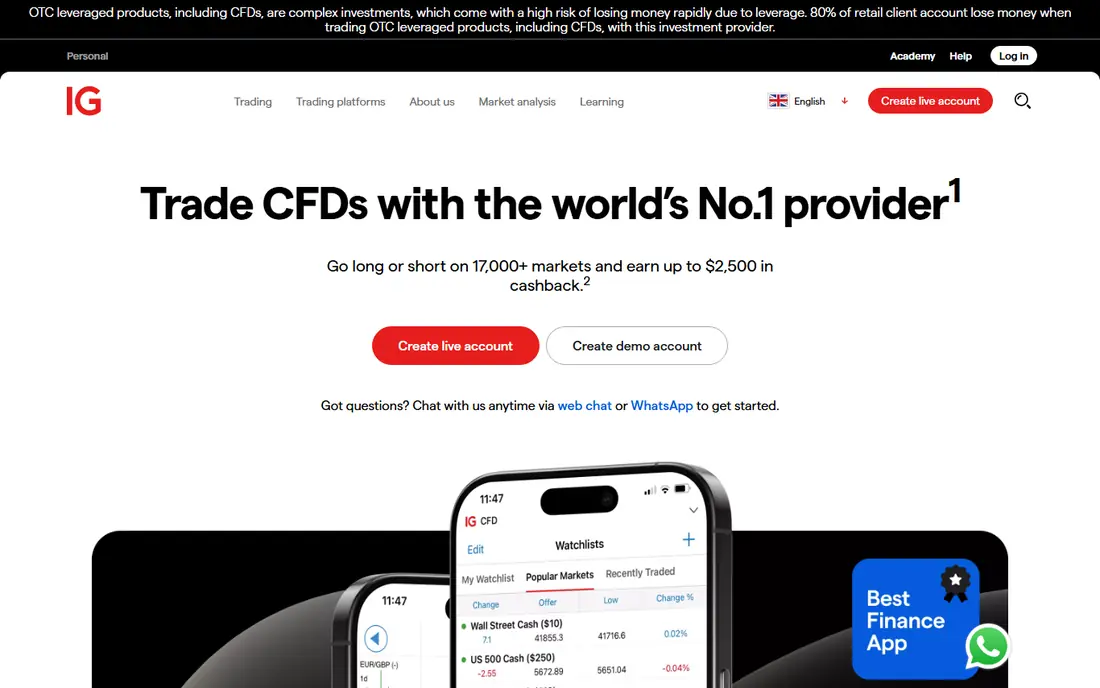
IG is our pick for active gold traders who want a mature platform, deep charting and a clear spread table. Its published commodity pages list spot gold spreads from 0.3 points on undated markets, with futures spreads wider and no overnight funding on futures, so the cheapest route depends on how long you hold. The platform also offers gold stocks, ETFs and options alongside spot gold, which helps traders who want to compare several gold routes in one account.
The catch is that a minimum spread is not a guaranteed spread. Spreads widen around news, market opens and thin liquidity, and borrowed-funds CFD positions carry overnight funding charges that add up over weeks. Use the demo account to learn the order types, set stops, and check the full cost on a small position before you scale up. IG also publishes risk warnings for CFD accounts, and those warnings deserve a careful read.
- Tight spot gold spreads in the pages we checked
- Wide market range
- Demo account for practice
- Spreads vary with market conditions
- Overnight funding applies to borrowed-funds positions
OANDA suits traders who want a clean platform, good research and flexible position sizing, including smaller trades than many brokers allow. Its metals pages state that spreads for gold trading start from 19 cents per troy ounce, and independent spread checks put the average XAU/USD spread near 0.36 to 0.38, which is a useful reminder that minimum and average are different numbers. The platform supports its own app plus MetaTrader and TradingView routes, so charting and order handling can match the tools you already use.
The limits are the usual CFD costs. Overnight financing applies to borrowed-funds positions held past the daily cutoff, currency conversion can add a markup when balances settle in another currency, and inactivity terms vary by region. OANDA is a strong choice for a trader who checks total cost, not just the headline spread, and who values research and platform choice.
- Gold spreads from 19 cents per troy ounce in its own pages
- TradingView and MetaTrader access
- Strong research tools
- Average gold spreads are higher than the minimum
- Currency conversion and overnight charges can add up
eToro is the easiest entry point in this list for a beginner who wants gold exposure alongside stocks, ETFs and crypto in one app. Its fee pages list gold CFD spreads from 0.025% in some summaries, while independent spread tests put the live XAU/USD spread much higher, near 1.03, which shows why you should check the live quote before you trade rather than trusting a single summary. The platform also offers a demo-style practice account in many regions, which helps new traders learn order handling without risking real funds.
The trade-off is cost for active gold trading. eToro is not built as a low-spread specialist broker, and conversion fees can add up if your account currency differs from USD. It is a fair pick for a long-term investor who wants gold as one part of a wider portfolio, and a weaker pick for a frequent gold CFD trader who will pay the spread many times a month.
- Simple account for gold, stocks and crypto
- Social and copy features
- Clear fee pages
- Gold CFD spreads are higher than specialist brokers
- Currency conversion applies to non-USD accounts
BullionVault is the pick in this list for buyers who want to own physical gold, not just trade its price. You buy grams of LBMA Good Delivery bars held in professional vaults in cities including London, Zurich, Toronto, Singapore and New York, with ownership held under a bailment structure. Its tariff page lists dealing commission from 0.5% down to 0.05% depending on annual volume, and gold custody at 0.12% per year with a $4 monthly minimum, including insurance.
The limits matter for small buyers. That $4 monthly custody minimum means a tiny holding pays a high percentage in storage, and physical withdrawal carries fees and minimum quantities, so BullionVault is not a coin shop for home delivery. For a buyer building a holding over time and happy to leave metal in a vault, the transparent tariff and daily audit reporting are strong points. For a short-term trader, a CFD or ETF will usually be cheaper and faster.
- Direct ownership of vaulted bars
- Low custody rate for larger holdings
- Live order board with limit orders
- Custody minimums hurt very small holdings
- Physical withdrawal carries extra fees
FOREX.com suits US-based traders who want gold CFDs or futures access through a regulated broker with familiar platforms. It offers MetaTrader alongside its own web and mobile platforms, with gold as part of a wider forex, index and commodity range, and education material that helps new traders learn margin, borrowing and risk controls. That structure makes it a practical choice for a trader who already uses MetaTrader for other markets.
The catch is regional variation. Available products, margin limits and charges differ by entity and account type, so a review from another country may not match your account. Check the live fee schedule, margin rules and overnight charges for your region before you fund the account, and start with a demo or small position. As with all CFD brokers, losses can exceed deposits on some account types, so position sizing matters more than any single spread figure.
- Regulated US broker with gold CFDs and futures
- MetaTrader access
- Education and research tools
- Product range and charges vary by region
- Borrowed-funds trading carries high risk
Plus500 is built for traders who want a simple CFD platform without a steep learning curve. Gold CFDs sit alongside forex, indices, shares and crypto CFDs, with a clean web and mobile interface, a demo account and risk tools that help new traders set stops and limits. That simplicity can be a real advantage for a trader who only wants gold price exposure and does not need a large research suite.
The trade-off is depth. Research, charting and market coverage are thinner than on IG, Saxo or Interactive Brokers, and the total cost still depends on spreads and overnight financing, which vary with market conditions. Plus500 is a fair pick for straightforward gold CFD trades, and a weaker pick for a trader who wants deep gold market research, futures access or physical ownership in the same account.
- Very simple CFD platform
- Demo account
- Clear risk tools including guaranteed stops on some markets
- Narrower research depth than IG or Saxo
- Spreads and overnight fees vary
Saxo suits experienced investors who want gold in a wider professional portfolio, with spot gold, futures, gold mining shares and gold ETFs available from one account. Its platforms offer deep charting, order types and research, and the account structure supports multi-currency funding and a broad market range that goes well beyond gold. For a trader who also follows rates, currencies and equities, that breadth can justify the extra complexity.
Beginners should expect a steeper setup and a fee schedule that depends on account tier, market and instrument, so the headline price for one gold product may not match another. Saxo is not the simplest first broker, and its minimums and platform depth can overwhelm a casual buyer. For a serious multi-asset trader, it is one of the strongest platforms in this list. For a first gold trade, eToro or BullionVault may be easier to understand.
- Wide gold routes including spot, futures and ETFs
- Strong platforms
- Deep research
- Higher minimums and complexity for beginners
- Fee tiers vary by account
Interactive Brokers is the professional pick for traders who want low-cost access to gold futures, gold ETFs, mining shares and related markets from a single account. Its commission structure and market depth suit active traders and larger accounts, and the platform supports advanced order types, margin controls and global market access that smaller brokers cannot match. For a trader who already uses it for stocks or futures, adding gold exposure is straightforward.
The catch is complexity. The platform, fee schedule and margin rules take time to learn, and beginners can easily misread margin or contract sizes. Interactive Brokers is not a simple first step for a casual gold buyer, and it offers no hand-holding for physical ownership. For a cost-conscious professional, it is hard to beat. For a first-time buyer, start with a simpler platform and a demo account.
- Very wide market access
- Competitive commissions for active traders
- Gold futures, ETFs and spot routes
- Complex platform for beginners
- Fee and margin rules need careful reading
How we picked these
We compared official fee pages, spread tables and product pages, and we kept only platforms that offer a clear gold route for US or international retail traders in October 2026. We separated CFD brokers from vault ownership and multi-asset brokers, since their costs and risks differ, and we noted where a minimum spread differs from an average spread. We did not claim hands-on trading results, and we treated third-party spread tests as a check on vendor minimums, not as a guaranteed price. Prices, margin limits and product availability vary by region, so check your local entity page before you open an account.
What to check before you trade gold
Decide first whether you want price exposure or physical ownership. A CFD gives you borrowed-funds price exposure with overnight charges and no metal to withdraw. An ETF gives you fund exposure with an annual fund charge and easy selling. Vault gold gives you allocated bars with custody charges and withdrawal fees. Those are different products, and comparing only the spread will mislead you.
Margin, spreads and overnight costs
A tight spread helps on a single trade, but overnight financing, conversion fees and widening spreads during news can dominate the cost over weeks. Check the live spread at the time you plan to trade, read the overnight funding page, and test the full cost on a small position. Use stops, size positions to your risk tolerance, and never trade with funds you need for essential bills. This is not financial advice, and trading carries risk, including the risk of losing money rapidly with borrowed funds.
Physical gold, ETFs and CFDs in brief
Physical vault gold suits long-term holders who value direct ownership and are happy to pay custody. Gold ETFs suit investors who want easy buying and selling inside a brokerage account without vault logistics. Gold CFDs suit short-term traders who want borrowed funds and the ability to go short, with higher risk and ongoing charges. Match the product to your holding period, not just to the lowest headline fee.
Frequently asked questions
What is the best trading platform for gold for beginners?
eToro is the easiest starting point for most beginners because it combines gold with stocks and crypto in one simple account, while BullionVault is easier to understand if you want physical gold. Start with a demo account where available, learn how spreads and overnight charges work, and keep early positions small. This is not financial advice, and gold prices can fall as well as rise.
What is the best gold trading app for active traders?
IG and OANDA are strong choices for active gold CFD traders, with IG listing spot gold spreads from 0.3 points and OANDA listing spreads from 19 cents per troy ounce. Both offer demo accounts, charting and risk tools, but live spreads vary, so compare the live quote and overnight charges, not just the minimum spread.
Can I buy physical gold through a trading platform?
Yes, through a vault service like BullionVault, which sells allocated bars held in professional vaults with custody charges. That is different from a CFD, where you trade the price without owning metal. Physical withdrawal carries extra fees and minimums, so check the tariff page before you buy if delivery matters to you.
What is the best platform for gold trading with low spreads?
IG and OANDA publish the tightest gold spread minimums in this list, but the cheapest platform for you depends on how often you trade and how long you hold. Frequent traders should weigh average spreads and overnight charges, while long-term holders should weigh custody or fund charges instead. Check the live spread for your account region before you decide.
Is gold trading safe?
Gold trading carries risk, and borrowed-funds CFD trading carries a high risk of losing money rapidly. Prices move with rates, the dollar, inflation data and market sentiment, and borrowing magnifies both gains and losses. Use risk controls, keep positions small, and only trade with funds you can afford to lose. This is not financial advice.
How much money do I need to start trading gold?
It depends on the product. Vault services let you buy by the gram, so the entry cost follows the live gold price, while CFD brokers set minimum position sizes and margin rules that vary by account. Check the minimum deposit, margin and contract size on the broker page for your region, and start small until you understand the full cost.
Sources we checked (8)

Online Jobs is an independent blog about careers, online work, learning new skills and the tools that help people earn. More about us.
Keep reading
All posts
Top AI Financial Software
Searching for top AI financial software? We compared 9 AI finance tools for AP, spend, close, forecasting and bookkeeping to help teams choose wisely.
Quicken Alternatives
Compare the best quicken alternatives for Mac, Windows, and small business owners, from Monarch Money and YNAB to Copilot, Tiller, and Banktivity in 2026.
QuickBooks Online Alternatives
Looking for quickbooks online alternatives? We compared 8 accounting tools on invoicing, bank feeds, payroll, pricing and fit for small businesses today.