Best Futures Trading Platforms in 2026: 8 Platforms Compared

How we put this together: we compare official feature and pricing pages, app store listings, privacy policies and public user reviews. Prices change, so check the provider's site before you pay.
Key takeaways
- NinjaTrader is our pick for dedicated futures traders, with a free platform tier and per-side commissions from $0.39 on micros.
- Tradovate and AMP Futures offer the lowest all-in costs on micro contracts for high-volume day traders.
- Interactive Brokers is the best choice when you want futures alongside stocks, options and global markets in one account.
- Day-trading margins vary enormously, from $40 on a micro contract at AMP to exchange-level margins at Interactive Brokers, so compare margins, not just commissions.
- Futures use borrowed capital and can lose more than your deposit, so practice on a simulated account before trading live.
Quick comparison
| Name | Who it suits | Starting price | Free option | |
|---|---|---|---|---|
 NinjaTrader | Dedicated futures traders | Free | Yes | Visit |
 Tradovate | Low-cost cloud futures trading | Free | Yes | Visit |
 AMP Futures | Platform choice and low margins | See website | Yes | Visit |
 Optimus Futures | Broker support and low fees | See website | Yes | Visit |
 TradeStation | Multi-asset systematic trading | Free | Yes | Visit |
 Interactive Brokers | Global multi-asset futures | Free | Yes | Visit |
 tastytrade | Futures plus futures options | See website | Yes | Visit |
 E*TRADE | Futures inside a full brokerage | Free | Yes | Visit |
The best futures trading platforms
Futures trading is a different world from stock investing. Contracts control a large value for a small deposit, margins are small relative to the notional value, and the platform you trade on matters as much as the broker behind it. Commissions are quoted per side, per contract, before exchange, clearing and regulatory fees, which is why two brokers can look similar and cost quite differently all-in. We compared published rate cards, margin schedules and platform features for the brokers futures traders actually use in 2026. This is not financial advice, and futures trading carries substantial risk, including losses that can exceed your deposit.
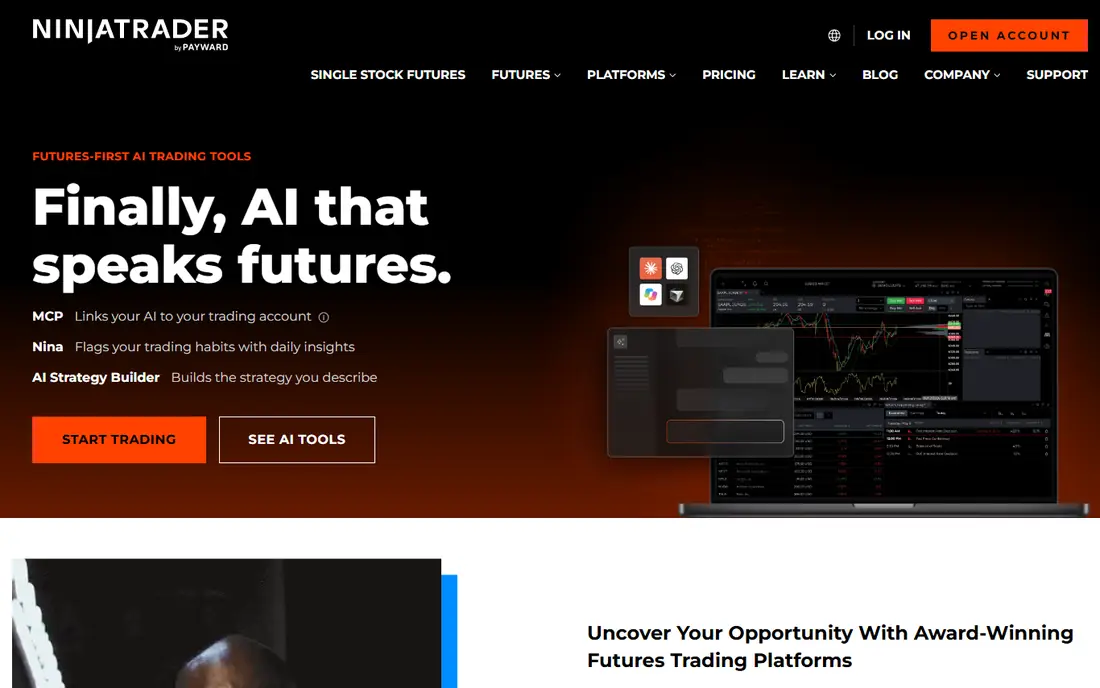
NinjaTrader is the platform most dedicated futures traders end up on. The free plan charges $0.39 per side on micro contracts and $1.29 on standard contracts before exchange, clearing and NFA fees, with monthly and lifetime plans cutting those rates further, down to $0.09 on micros for lifetime members. The desktop platform offers order-flow tools, automated strategies through NinjaScript, market replay and simulated trading.
The limits are scope and data. NinjaTrader does not offer stock trading, and market data subscriptions cost extra on top of commissions. Day margins are low, at $50 on a micro E-mini S&P contract on the free plan. For a trader whose whole business is futures, NinjaTrader is the most complete package in this list.
- Futures-specific desktop, web and mobile platforms
- Free platform tier
- Order-flow tools and automation
- No stock or options trading
- Market data costs extra
- Best pricing sits inside its own brokerage
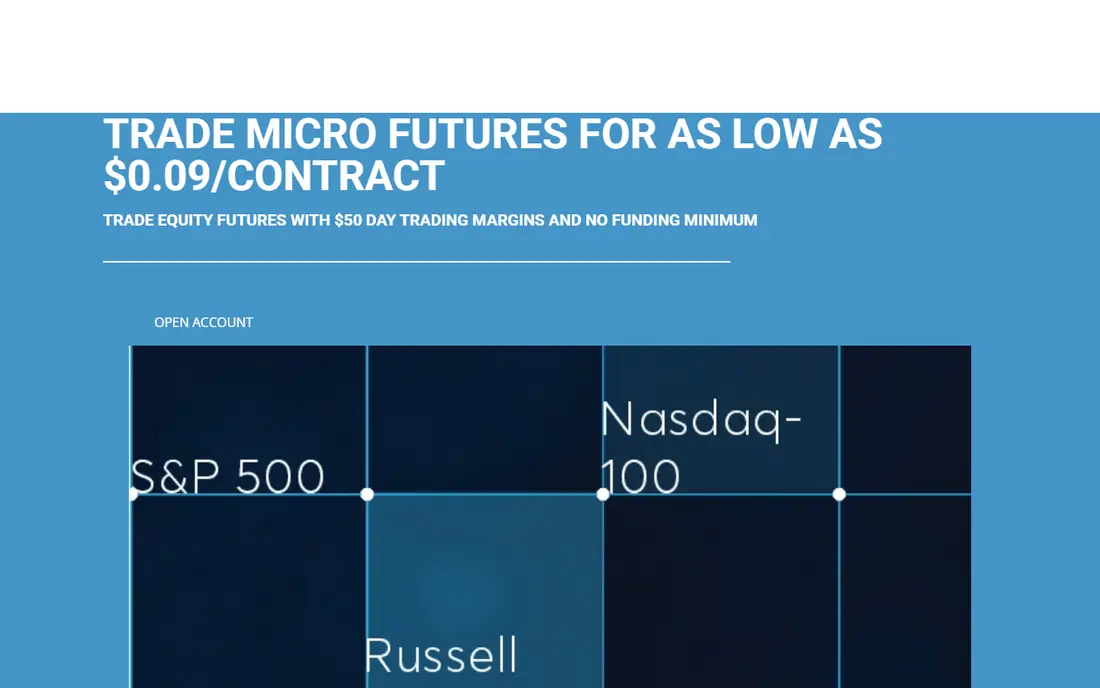
Tradovate runs entirely in the cloud, so your charts, orders and settings follow you to any computer without installing software. Pricing mirrors NinjaTrader's structure, since both sit in the same group: the free tier charges $1.29 per side on standard contracts, with monthly and lifetime plans cutting that to $0.79 and $0.29. All-in round-turn costs on micros run about $1.02 to $1.29, and day margins start at $50 on a micro contract.
Tradovate is also the execution platform behind most funded-account programs, so traders who pass an evaluation elsewhere often end up trading here anyway. The downsides are futures-only coverage, no built-in backtesting, and no TradingView integration. For a low-cost, anywhere-access futures broker, Tradovate is hard to beat.
- Cloud platform that runs anywhere
- Low micro commissions
- Free simulated account
- Popular with funded-account programs
- Futures only, with no equities
- No native backtesting
- No TradingView broker integration
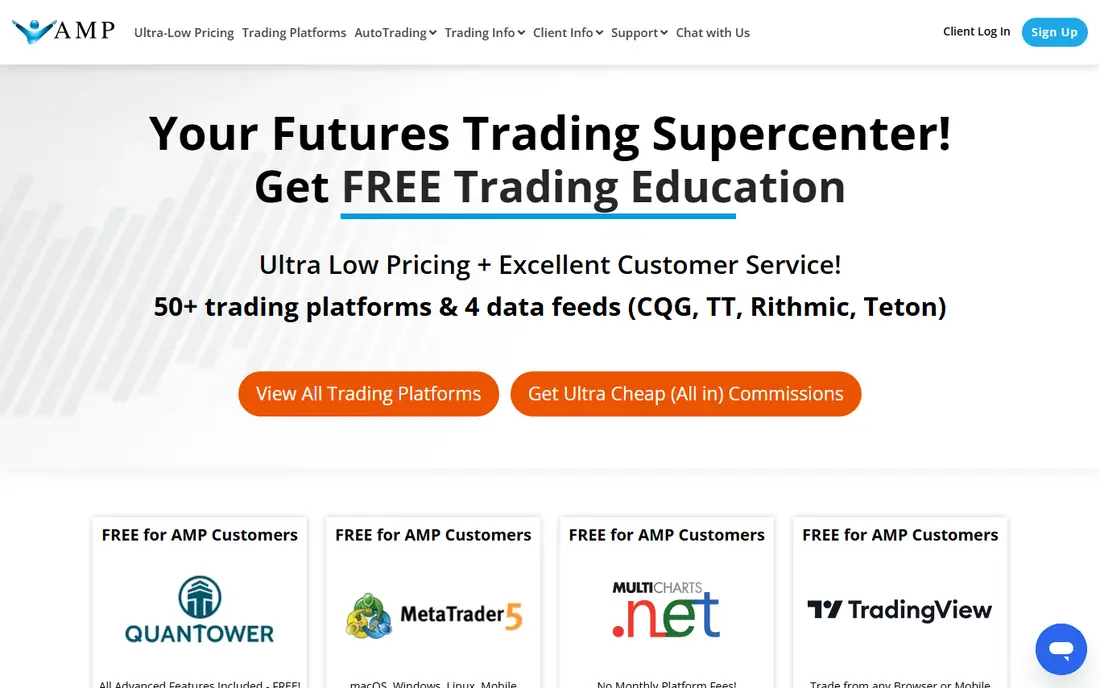
AMP Futures is the broker for traders who already know which platform they love. It supports more than 50 platforms, including Sierra Chart, Quantower, CQG, Rithmic, TradingView and MetaTrader 5, with several free for eligible clients. All-in costs on micros run about $1.02 to $1.42 per round turn, and day margins start at $40 on a micro E-mini contract, among the lowest in this list.
That choice is also the challenge. With dozens of platforms and four data feeds, a beginner can spend weeks deciding, and final pricing depends on the platform and feed you pick. One note: since April 2026, NinjaTrader has restricted new AMP setups on its platform, so traders who want NinjaTrader specifically should check current availability. For experienced traders who want their preferred tools at low cost, AMP is a top pick.
- More than 50 platforms to choose from
- Low day margins from $40 on micros
- $100 minimum deposit on volume-tiered pricing
- Platform and data choices can confuse beginners
- Commissions are quote-based and vary by setup
Optimus Futures pairs low headline commissions with unusually hands-on broker support. Commissions start at $0.25 per side on micro contracts and $0.75 on standard contracts before pass-through fees, with volume discounts available, and day margins start around $100 on a micro contract. Its free Optimus Flow platform covers charting and order entry, and the team helps new clients get set up with their chosen platform and feed.
The caveat is that final pricing can depend on which clearing firm and data feed you use, so the quote you receive is the number to trust. For traders who want low costs plus a broker who answers the phone, Optimus is a strong alternative to the bigger names.
- Low per-side commissions from $0.25 on micros
- Free Optimus Flow platform
- Broker-assisted setup
- Low day margins
- Exact pricing can depend on clearing firm and data feed
- Smaller brand than NinjaTrader or TradeStation
TradeStation is the platform for traders who build and test strategies. Its EasyLanguage scripting lets you code, backtest and automate ideas from the chart, and one account covers stocks, options, futures and crypto. Futures commissions start at $1.75 per side on standard contracts and $0.50 on micros in the lowest volume tier, plus clearing and exchange fees, with lower rates at higher volume.
Those starting commissions are higher than the futures specialists, and day margins run higher too, at about $100 on a micro contract and $650 on a standard E-mini in some schedules. TradeStation also integrates directly with TradingView, letting you route orders from TradingView charts. If you trade several asset classes and value strategy tools, TradeStation is the best all-rounder here.
- Strong strategy development in EasyLanguage
- Stocks, options and futures in one account
- TradingView integration
- Higher starting futures commissions than specialists
- Day margins are higher than AMP or NinjaTrader
Interactive Brokers is the institutional-grade option. US futures start at $0.85 per contract for the first volume tier, plus exchange and regulatory costs, and one account gives access to futures exchanges around the world alongside stocks, options, bonds and forex. For a diversified investor who also trades futures, that breadth is unmatched.
The catch is margin. IBKR's intraday margins are set far closer to exchange levels, running into thousands of dollars on a standard E-mini contract, versus a few hundred at the day-trading specialists. That makes it a poor fit for small-account day traders, but a strong fit for hedgers and larger traders who value safety and global reach over maximum position size.
- Futures on major exchanges worldwide
- One account for stocks, options, futures and forex
- Low margin loan rates
- Margins are far more conservative than day-trading brokers
- Platform complexity overwhelms beginners
tastytrade brings its options-trader sensibility to futures. Standard futures cost $1 per side, micros $0.75 and futures options $1.25, before additional fees, and the interface is built around derivatives, with clear visualizations of risk and probability. That makes it a natural home for traders who already trade options and want to add futures to the same account.
Order-flow tooling is less specialized than at NinjaTrader or on Sierra Chart through AMP, so pure scalpers may miss depth-of-market features. For options traders expanding into futures, though, tastytrade's workflow is the most approachable in this list.
- Simple derivatives-focused interface
- $1 per side on standard futures
- Strong futures options workflow
- Less specialized order-flow tooling than NinjaTrader or Sierra Chart
- Pricing confirmed in the platform
E*TRADE offers futures inside a full-service brokerage, which suits investors who trade futures occasionally rather than daily. Futures cost $1.50 per side per contract, plus exchange and NFA fees, with crypto futures at $2.50 per side and E-nano equity index futures at $0.75. Coverage spans CME Group, ICE US and CFE, plus Bitcoin futures.
That coverage is narrower than the specialists, and active futures traders will pay more per contract than at NinjaTrader, Tradovate or AMP. But if futures are one part of a broader portfolio held at E*TRADE, the convenience of a single account, and a single tax document, can outweigh the per-contract difference.
- Futures alongside stocks, options and banking
- $1.50 per side on futures
- Straightforward platform
- Futures coverage limited to three exchanges plus crypto futures
- Higher cost than specialists for active traders
How we picked these
We compared published commission schedules, day margin schedules and platform features from broker rate cards and margin pages checked in October 2026, and we favored brokers that are live in the United States, regulated by the NFA and CFTC, and used by active futures traders. Where pricing is quote-based or depends on volume, platform or feed, we say so and give the published starting figure.
Commissions are only part of the cost. Exchange, clearing and NFA fees apply at every broker, and day margins determine how much capital each trade ties up. Run your own expected volume through a broker's calculator before funding an account, and confirm margin requirements in writing, since brokers can change them without notice.
Start on simulated trading first
Every broker in this list offers a simulated account, and new futures traders should use one for weeks, not hours. Futures move fast, borrowed capital magnifies both gains and losses, and the mechanics of margin calls, contract rollover and tick values take time to learn. A simulated account teaches those mechanics with no money at risk.
When you go live, start with micro contracts. A micro E-mini contract is one tenth the size of a standard E-mini, so mistakes cost one tenth as much while you learn. Set a daily loss limit, use stop orders, and never trade with money you cannot afford to lose.
Frequently asked questions
What is the best futures trading platform for beginners?
NinjaTrader is the best starting point for dedicated futures traders, thanks to its free platform tier, simulated trading and low micro commissions. Tradovate is a close second for traders who prefer a cloud platform.
How much does it cost to trade futures?
Per-side commissions range from $0.25 on micros at Optimus to $1.75 on standard contracts at TradeStation, before exchange, clearing and NFA fees. All-in round-turn costs on a micro E-mini contract typically run about $1 to $1.60 at the specialists.
What is the minimum deposit for futures trading?
Minimums vary: NinjaTrader accounts can be opened with $0, though margin is required to trade, and AMP's volume-tiered pricing needs a $100 minimum deposit. Day margins start at $40 to $50 on a micro contract at the low-cost brokers.
Can I trade futures on Robinhood or Fidelity?
Fidelity and Schwab offer futures through separate platforms, and Robinhood does not currently offer futures trading. Dedicated futures brokers like NinjaTrader, Tradovate and AMP generally offer lower costs and better tools for futures specifically.
Are futures riskier than stocks?
Yes, because futures use borrowed capital: a small deposit controls a large notional value, so a small price move can mean a large gain or loss relative to your deposit. Losses can exceed your initial deposit, which is why risk management and simulated practice matter.
What are micro futures?
Micro futures are smaller versions of standard contracts, typically one tenth the size. Micro E-mini S&P 500 contracts let traders take index exposure with far less capital and risk, making them the standard starting point for new futures traders.
Sources we checked (8)

Online Jobs is an independent blog about careers, online work, learning new skills and the tools that help people earn. More about us.
Keep reading
All posts
Best Trading Apps for Beginners
Compare the best trading app for beginners, with $0 stock commissions, fractional shares, education, paper trading and account types explained in 2026 now.

Best Trading App
We compared the best trading apps for beginners and active traders on fees, tools, accounts and ease of use, so you can pick a platform that fits your plan.
Best Tax Software
Compare the best tax software in 2026 for simple returns, investors, freelancers, and preparers, with free options, state fees, and honest limits for filing.