Best Employee Experience Platforms in 2026: 9 Platforms Compared


Enterprise experience measurement · Starting price: See website
How we put this together: we compare official feature and pricing pages, app store listings, privacy policies and public user reviews. Prices change, so check the provider's site before you pay.
Key takeaways
- Employee experience platforms cover different needs, from surveys to recognition to internal communication, so define your goal first.
- Survey tools help you listen, but they only help if managers act on results and share what changed.
- Recognition and communication tools suit daily use, while survey platforms suit quarterly or annual measurement.
- Privacy and anonymity rules matter, because staff will not give honest feedback if they fear identification.
- Start with one use case, such as onboarding feedback or recognition, and expand only after adoption is steady.
Quick comparison
| Name | Who it suits | Starting price | Free option | |
|---|---|---|---|---|
| Qualtrics EmployeeXM | Enterprise experience measurement | See website | No | Visit |
 Culture Amp | Surveys and people analytics | See website | Free trial | Visit |
 Lattice | Performance and engagement together | See website | No | Visit |
 Workday Peakon | Continuous listening at scale | See website | No | Visit |
 Glint | Engagement surveys and action planning | See website | No | Visit |
 Microsoft Viva | Employee experience in Microsoft 365 | See website | Free trial | Visit |
 Leapsome | Feedback, goals, and engagement | See website | Free trial | Visit |
 Workvivo | Internal communication and community | See website | No | Visit |
 Bonusly | Peer recognition and rewards | See website | Free trial | Visit |
The best employee experience platforms
We compared these platforms by survey design, analytics, action planning, integrations, and fit for small, mid-size, and large companies. Pricing is usually per employee per month and varies by modules, so field lines use See website where a single figure would mislead. Confirm current pricing, minimums, and trial terms on the vendor site.
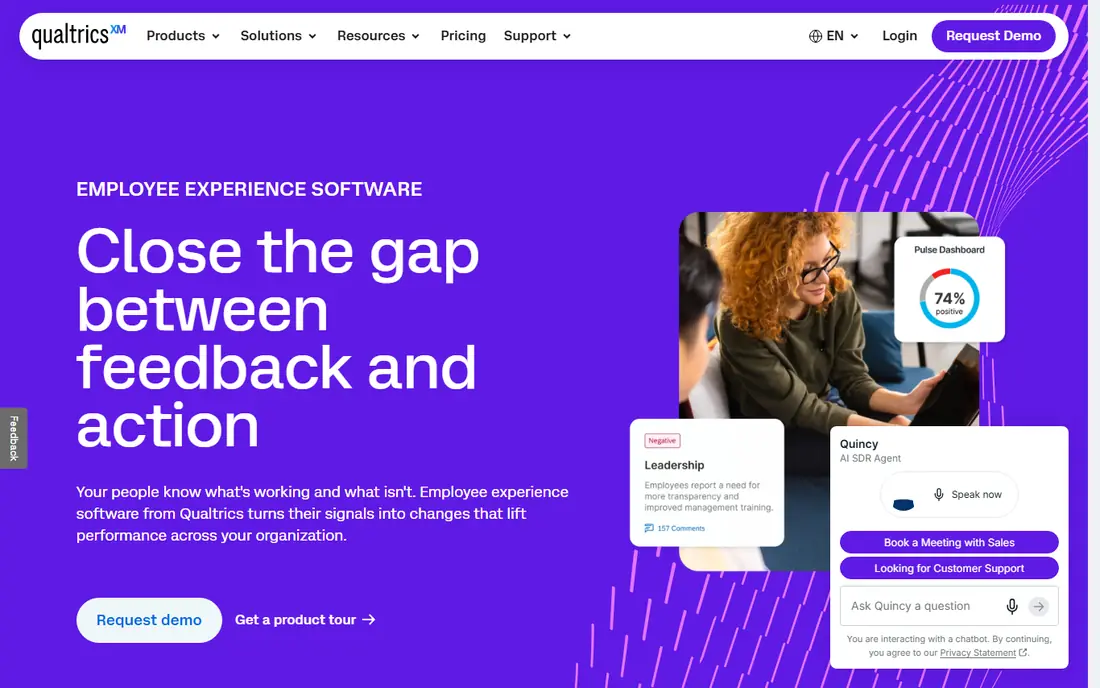
Qualtrics EmployeeXM suits large organisations that want to measure experience across the full employee lifecycle, from candidate and onboarding surveys to engagement and exit surveys. Its analytics can cut results by team, location, and tenure, which helps large firms find where action is needed. That depth is its main strength. The trade-off is complexity and cost. Smaller firms may find Culture Amp or Leapsome faster and cheaper, while Qualtrics rewards companies with a people analytics team and a clear measurement plan. Buy it for scale, not for a single annual survey.
- Deep survey and analytics tools
- Lifecycle surveys from hiring to exit
- Strong enterprise integrations
- Enterprise pricing and setup
- Needs a dedicated owner to get full value
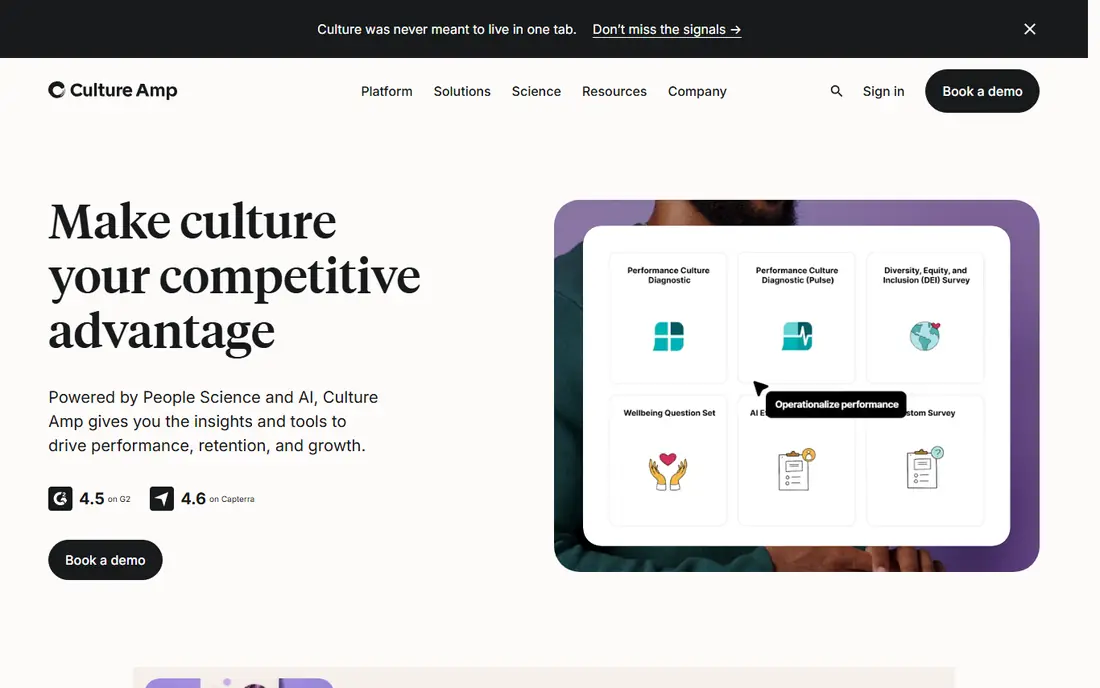
Culture Amp is our pick for mid-size companies that want credible engagement surveys without building them from scratch. Its templates are based on people research, and its reports give managers clear next steps rather than raw scores alone. That manager focus matters, because engagement improves when managers act, not when HR alone reads a report. The catch is cost at scale. Pricing rises with headcount, and advanced analytics may need a higher plan, so confirm which modules your quote includes. For a first serious engagement program, Culture Amp is a strong, focused choice.
- Research-backed survey templates
- Clear reporting for managers
- Action planning tools
- Pricing scales with headcount
- Some features need higher plans
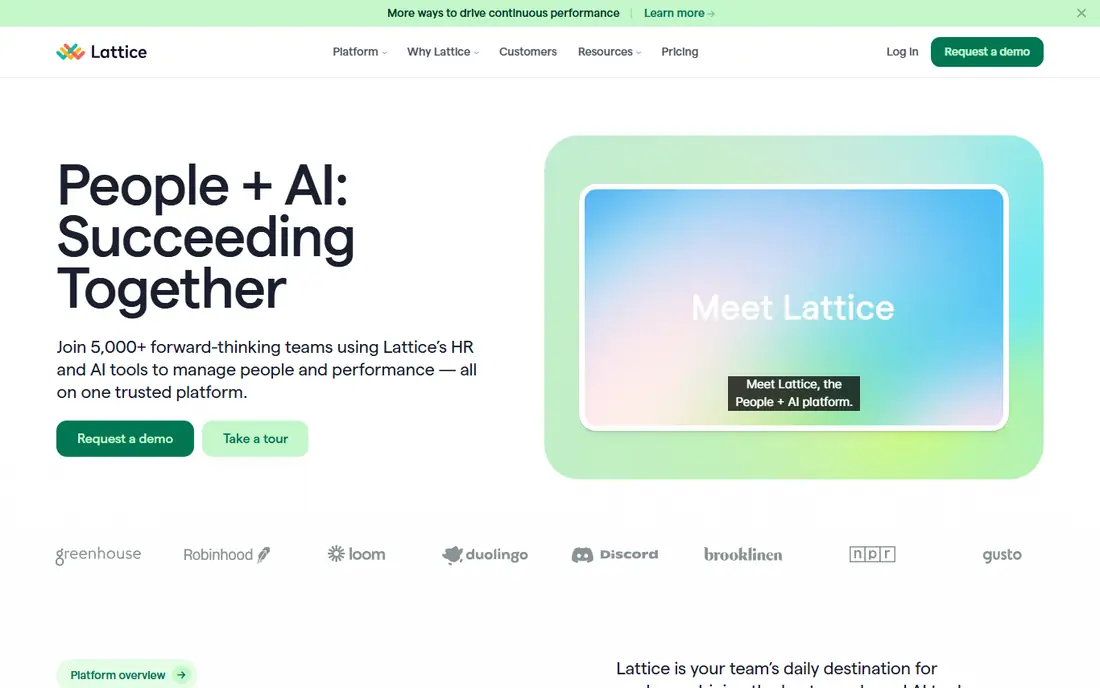
Lattice suits companies that want performance, goals, and engagement in one place, rather than buying separate tools. Managers can run reviews, track goals, and see engagement results in the same system, which helps link feedback to development plans. That combination is useful for growing firms formalising performance for the first time. The weakness is scope. If you only need surveys, Lattice may be more than you need, and module pricing can add up. Choose it when performance and engagement should live together, not when surveys alone are the goal.
- Combines performance reviews, goals, and engagement
- Clear manager tools
- Good for growing companies
- Broader platform can feel heavy if you only need surveys
- Pricing depends on modules
Workday Peakon, formerly Peakon, is built for continuous listening: short, frequent surveys that track engagement over time rather than once a year. That frequency helps large firms spot changes after a reorganisation, a return-to-office change, or a benefits update. Integration with Workday HR data makes reporting by team and location easier for Workday customers. The catch is ecosystem fit. Companies already on Workday will get the most value, while others should compare Culture Amp and Glint for a standalone listening tool. Ask for a demo with your own reporting needs before you commit.
- Frequent short surveys with trend tracking
- Strong Workday integration
- Action recommendations
- Best value inside Workday
- Standalone value is harder to judge without a demo
Glint, part of Microsoft, focuses on engagement surveys, people analytics, and manager action planning. Its survey design draws on people science, and its action tools help managers pick a small number of changes and track them, which is where many survey programs fail. That action focus is its strength. The limitation is scale. Glint is enterprise leaning, with pricing and implementation to match, so small firms will find Leapsome or Culture Amp more accessible. Larger firms already using Microsoft tools should check Glint alongside Viva for how the two fit together.
- People science backed surveys
- Manager action plans
- LinkedIn and Microsoft ecosystem links
- Enterprise leaning
- Pricing and minimums suit larger firms
Microsoft Viva suits companies already running Microsoft 365 and Teams, because it brings connections, insights, learning, and goals into tools staff already open daily. Viva Connections can serve as an intranet hub, Viva Engage supports communities, and Viva Goals tracks objectives, all without a separate login. That daily presence is a real advantage over a survey tool staff open once a quarter. The catch is module complexity. Viva is a suite, not a single product, and pricing varies by module and licence, so map the modules you need to your current Microsoft licences before you budget.
- Works inside Teams and Microsoft 365
- Connections, learning, and goals modules
- Familiar for Microsoft shops
- Module pricing is complex
- Value depends on Teams adoption
Leapsome fits mid-size companies that want feedback, goals, engagement surveys, and learning in one platform without enterprise complexity. Its interface is clear for managers and staff, and its module structure lets firms start with reviews or surveys and add goals later. That flexibility helps growing companies that are not ready for a full enterprise suite. The trade-off is ecosystem size. Integrations and advanced analytics are narrower than Lattice or Microsoft, so check your HR system and reporting needs first. For a combined people platform at mid-size scale, Leapsome is a strong value pick.
- Combines reviews, goals, surveys, and learning
- Good for mid-size firms
- Clear pricing pages by module
- Smaller ecosystem than Lattice or Microsoft
- Advanced analytics may need higher plans
Workvivo is different from the survey tools in this list, because its focus is internal communication and community. It gives staff a social feed, company news, groups, and recognition in a mobile-friendly app, which suits frontline, retail, and field staff who do not sit at a desk. That reach is its main strength, because deskless workers are often missed by email-based tools. The limit is scope. Workvivo does not replace engagement surveys or performance reviews, so pair it with Culture Amp, Glint, or Lattice if you need measurement as well as communication. It also needs regular content, or staff will stop opening it.
- Social intranet and community features
- Strong for frontline and deskless staff
- Mobile app
- Not a survey or performance tool
- Needs content ownership to stay active
Bonusly suits teams that want daily peer recognition without a heavy platform. Staff give small bonuses with a public note, recipients redeem points for rewards, and managers can see who is recognised and who is overlooked. That visibility helps build a habit of thanks, which surveys alone cannot create. Integrations with Slack and Teams keep recognition where work already happens. The catch is scope. Bonusly will not measure engagement, run reviews, or fix management problems, so use it alongside a survey or performance tool, and set a rewards budget so costs stay predictable as headcount grows.
- Simple peer-to-peer recognition
- Points and rewards catalogue
- Integrations with Slack and Teams
- Recognition alone does not fix survey or performance gaps
- Rewards budget needs management
How we picked these
We compared official vendor pages for survey design, analytics, action planning, communication, recognition, and integrations, and we grouped tools by their primary job rather than treating them as interchangeable. We favoured platforms with current documentation, clear privacy and anonymity guidance, and real use at their target company size, and we left out single-feature survey forms that do not support action planning or reporting. Pricing is per employee and module based, so we did not invent a single monthly figure.
How to choose and roll out a platform
Start with the problem you need to solve in the next six months. If managers do not know why staff leave, a survey tool such as Culture Amp or Glint is the priority. If staff feel unseen, Bonusly or Workvivo may matter more. If performance reviews are inconsistent, Lattice or Leapsome will help more than another survey. Picking the problem first prevents buying a suite for a single need, and it gives you a clear success measure for the first year.
Next, protect anonymity and set expectations before the first survey. Tell staff who sees results, what group size is needed for reporting, and what will happen with the findings. If staff believe comments can be traced to them, response quality will fall, and no analytics tool can fix that. Run a pilot with one department, share the results and the actions taken, and only then expand. A platform that staff trust and managers actually use will beat a more powerful tool that sits unused after launch.
Frequently asked questions
What are the best employee experience software options for a small company?
Leapsome and Bonusly are strong small and mid-size picks, with Leapsome covering feedback and goals and Bonusly covering recognition. Small firms should start with one use case rather than buying a full enterprise suite.
What are the best employee experience tools for surveys?
Culture Amp, Glint, Qualtrics EmployeeXM, and Workday Peakon lead for surveys, with Culture Amp best for mid-size firms and Qualtrics and Peakon best at enterprise scale. Choose by company size, HR system, and whether you want annual or continuous listening.
What is the best employee experience platform for Microsoft 365 users?
Microsoft Viva is the natural fit, because it works inside Teams and Microsoft 365. Pair it with Glint for deeper survey analytics if needed, and check which Viva modules your current licences already include.
What are the top rated employee experience software reviews telling buyers?
Reviews commonly praise clear manager reporting, easy survey setup, and strong integrations, while warning about module pricing and adoption effort. Treat reviews as a shortlist tool, and run a pilot with your own managers before you commit.
What is the best employee experience platform solution for frontline staff?
Workvivo suits frontline and deskless staff, because its mobile community and news features reach workers who do not use email daily. Pair it with a survey tool for measurement, because communication alone does not show engagement trends.
How do employee experience platforms handle anonymity?
Most survey platforms report only for groups above a minimum size and hide individual responses from managers, but rules vary by tool and setting. Confirm the minimum group size, comment visibility, and admin access on the vendor page before your first survey.
Sources we checked (9)

Online Jobs is an independent blog about careers, online work, learning new skills and the tools that help people earn. More about us.
Keep reading
All posts
n8n Alternatives
n8n alternatives compared for 2026, with Zapier, Make, Activepieces, and more, covering visual builders, code steps, self-hosting, and pricing models.

ZoomInfo Alternatives
The best ZoomInfo alternatives in 2026, compared on price, free plans, data coverage, and which tool fits small teams or large sales teams best in detail.

Yotpo Alternatives
Find cheaper alternatives to Yotpo for reviews and loyalty, with Judge.me, Loox, Stamped, and more compared for Shopify stores in 2026, all in one guide.