Best Electronic Data Interchange Software in 2026: 8 Products Compared

How we put this together: we compare official feature and pricing pages, app store listings, privacy policies and public user reviews. Prices change, so check the provider's site before you pay.
Key takeaways
- SPS Commerce suits retail suppliers that want a full-service network and hands-off partner onboarding.
- TrueCommerce suits small and mid-size suppliers that want managed EDI plus invoicing and related tools.
- Orderful suits growing brands that want API-first EDI and published pricing.
- Cleo, Celigo, and Boomi suit teams that want EDI inside a wider integration platform.
- Most EDI pricing is by quote, based on trading partners, document volume, and service level.
Quick comparison
| Name | Who it suits | Starting price | Free option | |
|---|---|---|---|---|
 Orderful | API-first EDI for growing brands | See website | Free trial | Visit |
 SPS Commerce | Full-service retail EDI | See website | No | Visit |
 TrueCommerce | Managed EDI for SMB suppliers | See website | Free trial | Visit |
 Cleo | EDI, API, and file transfer in one platform | See website | Free trial | Visit |
 Celigo | Self-service EDI inside an automation platform | See website | Free trial | Visit |
 Boomi | EDI inside an existing Boomi estate | See website | Free trial | Visit |
 eZCom Software | Affordable supplier compliance | See website | Free trial | Visit |
 OpenText Trading Grid | Global enterprise B2B network | See website | No | Visit |
The best electronic data interchange software
Electronic data interchange, or EDI, lets trading partners exchange purchase orders, invoices, shipping notices, and other business documents in a standard electronic format. The right tool depends on whether you sell to retailers, how many partners you have, and whether you want to run EDI yourself or hand it to a managed service.
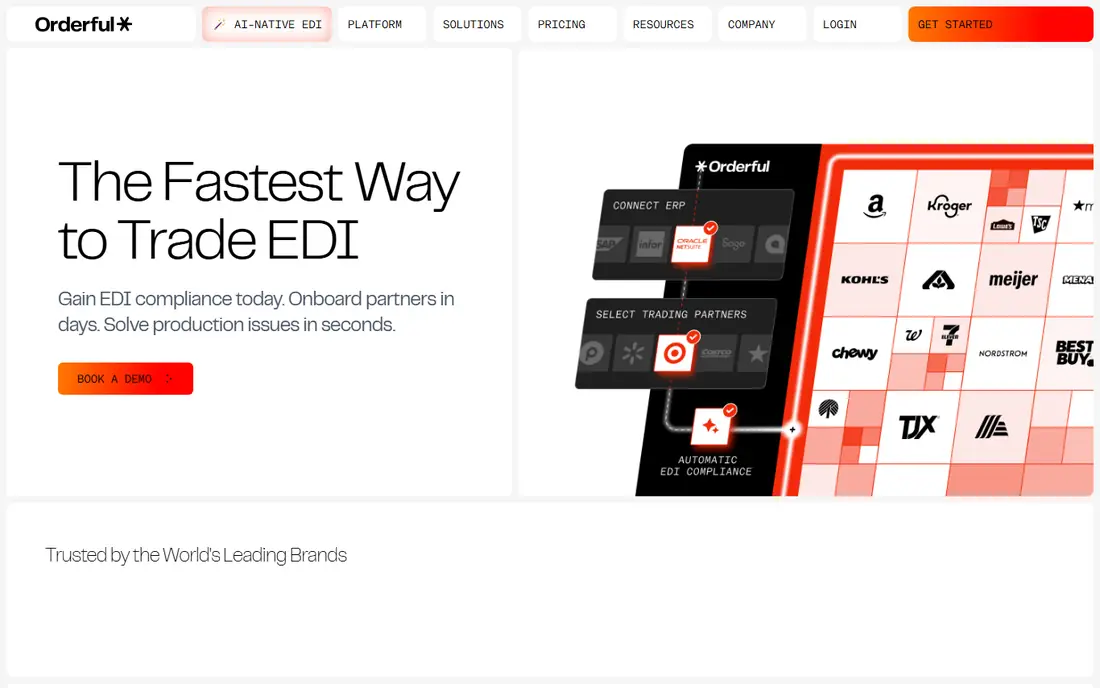
Orderful is built for brands that are moving from direct sales into wholesale and retail, and that want EDI without a long, opaque implementation. It offers web EDI for low-volume suppliers, integrated EDI for system-to-system exchange, and managed services for teams that want help with onboarding and mapping. The API-first approach suits teams that want to connect EDI to an ERP, warehouse, or order system with modern tools.
Orderful also publishes pricing tiers, which is rare in EDI and helps smaller brands budget. Buyers should still confirm which trading partners, document types, and support levels are included in each tier. A trial or demo using a real retailer requirement will show how fast a partner can be set up.
- API-first design
- Published pricing tiers on its site
- Web EDI, integrated, and managed options
- Best fit is brands moving into wholesale
- Very large enterprise networks may need a larger platform
SPS Commerce is a full-service EDI provider with one of the largest retail networks. It handles partner onboarding, mapping, testing, and ongoing support, so a supplier does not need in-house EDI expertise. That model suits suppliers that sell to many large retailers and want one provider to manage compliance across partners.
The trade-off is control and price transparency. Full-service EDI is priced by quote, based on partners, volume, and services, and suppliers rely on SPS for changes and testing. For a supplier with many big-box partners, that support is often worth the cost. Ask for a total cost by partner, the onboarding timeline for your first retailers, and how chargeback risks are handled.
- Very large retail network
- Full-service onboarding and support
- Strong fulfilment tools
- Pricing is by quote
- Self-service control is limited compared with API-first tools
TrueCommerce combines EDI with e-invoicing, vendor-managed inventory, and B2B ecommerce tools, which suits small and mid-size suppliers that want more than EDI alone. Managed service options mean TrueCommerce can run partner onboarding and mapping, while web EDI gives low-volume suppliers a browser-based way to process documents. ERP integrations help move orders and invoices into accounting and order systems without manual re-keying.
TrueCommerce is a practical choice for a supplier that wants a managed service but does not need the largest retail network. Buyers should confirm which ERP version is supported, which document types are included, and how partner testing is scheduled. A clear onboarding plan tied to a first retailer launch date will reduce delays.
- Managed and web EDI options
- E-invoicing and related supply chain tools
- ERP integrations
- Pricing is by quote
- Advanced integration work may need partner help
Cleo Integration Cloud covers EDI, API integration, and managed file transfer in one platform, with options for self-service, managed service, or a blend. That breadth suits teams that need to consolidate several integration types, such as EDI with retailers, API links to logistics partners, and secure file transfer with suppliers. Real-time visibility helps teams spot failed documents and fix them before a retailer does.
Cleo is more platform than a simple web EDI portal, so small suppliers with one retailer may find it larger than needed. It fits best when integration work spans EDI and other data flows, and when a team wants one place to monitor them. Ask how EDI errors are categorised and resolved, and what is included in managed service versus self-service.
- EDI, API, and managed file transfer in one platform
- Real-time visibility
- Managed and self-service options
- Pricing is by quote
- The platform is broader than a pure EDI tool
Celigo offers B2B EDI management inside a wider intelligent automation platform, so teams can pair EDI with integrations between business apps. It suits teams that want to own their trading partner maps and manage changes themselves, rather than waiting on a fully managed provider. That control helps when partner requirements change often or when EDI must feed several internal systems.
Celigo needs a clear internal owner. A team without EDI or integration skills may prefer a managed service, while a team with those skills will value the control. Buyers should check which ERP and app connectors are included, how partner onboarding is tested, and how document errors are surfaced to operations staff.
- Self-service EDI management
- Pairs EDI with app integration
- Useful for teams that want to own their maps
- Pricing is by quote and based on partners and document types
- Needs internal ownership
Boomi provides B2B and EDI management inside its integration platform, with low-code mapping tools and a partner portal. It suits organisations that already use Boomi for application integration and want EDI in the same environment, with shared governance and monitoring. That consolidation can reduce the number of integration tools a team must maintain.
For a company that does not already use Boomi, a dedicated EDI provider may be simpler and faster to launch. Boomi fits best when integration is already centralised on the platform and EDI is one more flow to manage. Confirm which EDI standards, partner types, and document volumes are covered on the plan you are quoted.
- B2B and EDI management inside a broad integration platform
- Low-code mapping
- Partner portal
- Pricing is by quote
- Best value comes when Boomi is already in use
eZCom Software focuses on helping suppliers meet retailer EDI requirements without a large enterprise platform. It offers web EDI for low-volume suppliers and integrated EDI for teams that want documents to flow into their ERP or accounting system. The supplier focus helps with compliance checklists, testing, and support for common retail partners.
eZCom suits a small or mid-size supplier that needs to become compliant for one or a few retailers and wants a clear, affordable path. Buyers should confirm which retailers are already supported, how testing is handled, and what happens when a retailer changes a requirement. A short pilot with a first retailer will show whether the support model fits your team.
- Supplier-focused EDI compliance
- Web EDI and integrated options
- Strong support reputation
- Smaller scale than the largest networks
- Pricing is by quote
OpenText Trading Grid is a global B2B network and value-added network for enterprises with many international trading partners. It supports high-volume, complex B2B flows across regions, standards, and partner types, with managed service options for teams that want OpenText to run part of the network. That scale suits global manufacturers, distributors, and retailers with a large partner base.
Small suppliers will usually find a web EDI or managed retail provider simpler and cheaper. OpenText fits when partner count, volume, and global reach are all large, and when a single network must serve many countries. Ask about regional coverage, onboarding capacity, and how partner changes are managed across time zones.
- Global B2B network and VAN services
- Suitable for very high volumes
- Managed options available
- Pricing is by quote
- Complexity suits large enterprises more than small suppliers
How we picked these
We reviewed official feature pages, pricing pages, and product documentation for EDI providers, plus public comparisons of EDI platforms in 2026. We kept providers that are actively sold, that cover retail or B2B EDI, and that offer a clear service model, whether web EDI, integrated EDI, or managed service. Where pricing is by quote, we wrote See website rather than repeating a third-party estimate. That keeps the price column honest for a category where almost every vendor quotes by partner count and volume.
Choosing between web EDI, integrated EDI, and managed EDI
Web EDI is a browser portal for processing documents manually, which suits low volumes and a small partner count. Integrated EDI connects to your ERP or order system so documents flow automatically, which suits higher volumes and reduces manual errors. Managed EDI hands onboarding, mapping, and monitoring to the provider, which suits teams without EDI expertise. Many suppliers start with web EDI and move to integrated or managed EDI as partner count grows.
Check retailer requirements first
Your retailer will specify document types, formats, testing steps, and deadlines. Common documents include purchase orders, invoices, and advance shipping notices, but each retailer has its own rules. Get the requirement document before choosing a provider, and ask the provider to confirm it can meet each item. That check prevents a costly switch after testing has started.
Budget by partner and volume, not just by plan
EDI costs usually scale with trading partners, document types, and monthly volume, plus service level. Ask for a quote that lists each partner, each document type, and any onboarding or testing fees. Track cost per partner against revenue from that retailer, since a low-volume partner with high EDI costs may need a different approach.
Plan for errors and partner changes
Documents will fail, partners will change requirements, and systems will update. Check how each provider alerts you to failures, how quickly errors can be fixed, and who owns the fix. A provider with clear error alerts and a fast support path will save more money than a cheaper provider with slow error handling, especially when chargebacks are at stake.
Frequently asked questions
What is the best EDI software for wholesale business?
Orderful, SPS Commerce, and TrueCommerce are all strong for wholesale, but the best choice depends on scale. Orderful suits growing brands moving into wholesale with API-first needs, SPS suits suppliers with many large retail partners, and TrueCommerce suits mid-size suppliers that want managed service. Check your retailer list and volume first, then compare service models.
What is the top-rated EDI software for small business?
For small suppliers, TrueCommerce and eZCom are common choices, because both offer managed or web EDI paths that do not require in-house EDI staff. Orderful is also worth checking for growing brands that want published pricing. The best option is the one that already supports your first retailers and can onboard them quickly.
What are the alternatives to EDI?
Alternatives include API-based integration, supplier portals, and file transfer through secure channels, but most large retailers still require EDI for purchase orders, invoices, and shipping notices. API integration can complement EDI, especially for real-time data, but it does not replace a retailer EDI requirement. Check what each trading partner accepts before choosing an alternative.
What is web EDI versus integrated EDI?
Web EDI processes documents through a browser portal, which is fine for low volumes. Integrated EDI connects to your ERP or accounting system so documents move automatically, which is better for higher volumes and reduces manual entry. Many providers offer both, so a supplier can start with web EDI and move to integrated EDI later.
How long does EDI implementation take?
Web EDI can go live in days for a single partner. Integrated or managed EDI usually takes weeks, including mapping, testing, and partner approval. Plan around your first retailer's launch date, and allow extra time for testing if the retailer has strict requirements or a busy onboarding queue.
Can EDI integrate with QuickBooks and other accounting systems?
Yes, several providers integrate with QuickBooks and other small-business accounting and ERP systems, translating EDI documents into orders and invoices automatically. Confirm your exact version is supported, which document types sync, and how errors are handled when a document fails to post.
Sources we checked (8)

Online Jobs is an independent blog about careers, online work, learning new skills and the tools that help people earn. More about us.
Keep reading
All posts
n8n Alternatives
n8n alternatives compared for 2026, with Zapier, Make, Activepieces, and more, covering visual builders, code steps, self-hosting, and pricing models.

eBay Alternatives
Looking for ebay alternatives? We compared 9 marketplaces for sellers on fees, buyer reach, categories and ease of listing, to help you sell with confidence.

ZoomInfo Alternatives
The best ZoomInfo alternatives in 2026, compared on price, free plans, data coverage, and which tool fits small teams or large sales teams best in detail.